
Wholesale Planning
Wholesale Planning
4-String Tenor Banjo Strings: A Wholesale Tuning and Loop-End Guide
Specify four-string tenor banjo sets by tuning and octave, four full-length positions, plain/wound layout, usable length, loop end, sample fit, pack code and revision.
Introduction
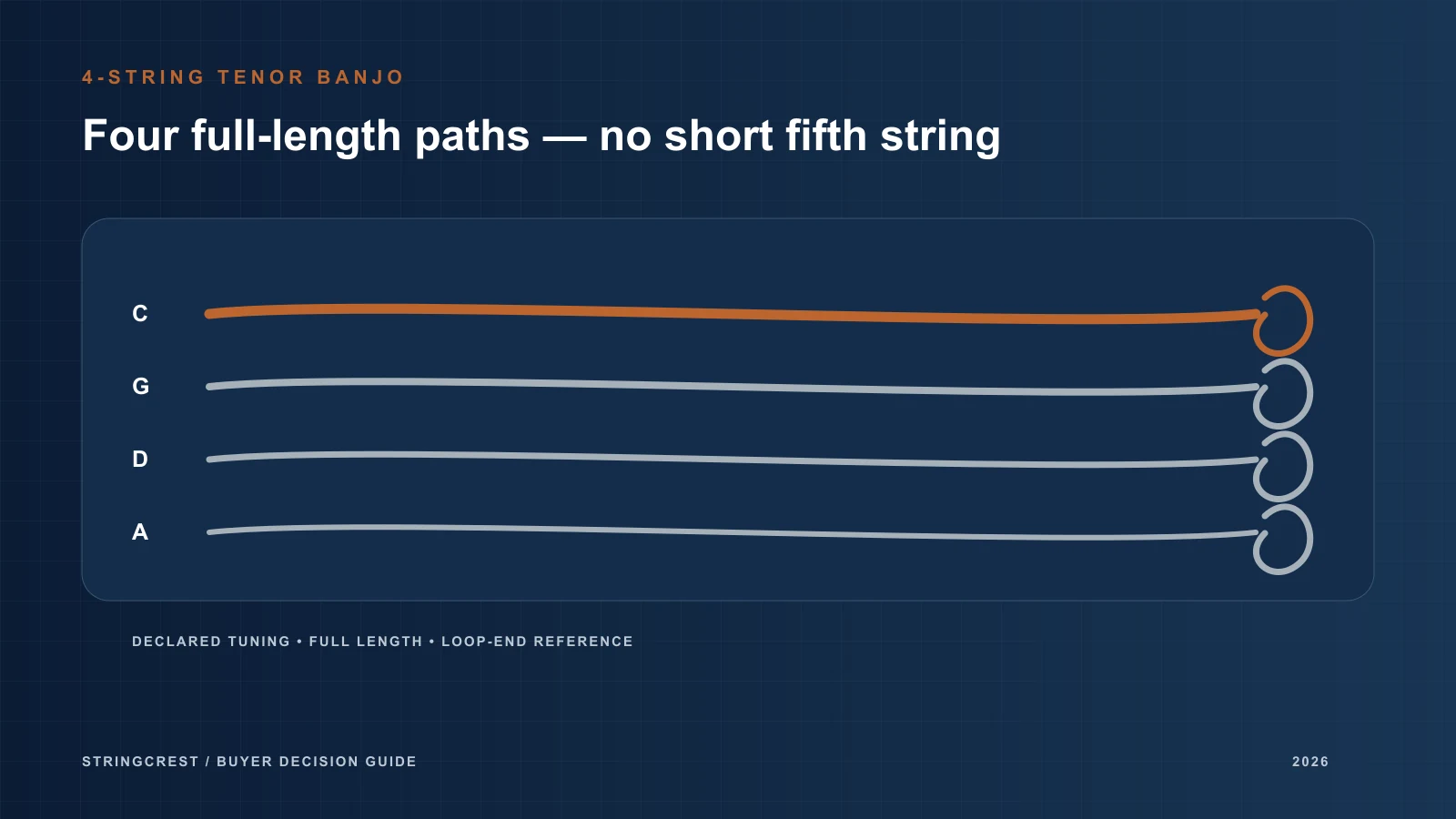
A four-string tenor banjo order needs a tuning with octaves: standard tenor is C3–G3–D4–A4, and Irish tenor is G2–D3–A3–E4, both written from lowest to highest pitch. Here, full length means that all four positions run from the ordinary nut to the bridge. It does not mean their overall supplied lengths or cutting lengths are identical. A conventional five-string banjo has a separate short fifth-string path, while a plectrum banjo is another four-string instrument with its own tuning and fit requirements.
For a U.S. brand, importer, distributor or music store, the useful buying question is whether each proposed set matches the customer's instrument and tuning. Four strings and four loop ends do not answer that question. The purchase file also needs a position map, construction, usable length and a checked tailpiece interface.
The tables below provide a tuning reference and a blank specification worksheet. StringCrest's available tenor-banjo constructions, lengths, loop options and pack formats need confirmation for the proposed project.
Standard and Irish tenor: compare all four positions
Use position 1 for the highest-pitched string and position 4 for the lowest. A pack marked CGDA normally presents the sequence from low to high, so its printed letter order runs opposite to this position table.
| Physical position | Standard tenor | Irish tenor | String path |
|---|---|---|---|
| 1 — highest pitch | A4 | E4 | Full length |
| 2 | D4 | A3 | Full length |
| 3 | G3 | D3 | Full length |
| 4 — lowest pitch | C3 | G2 | Full length |
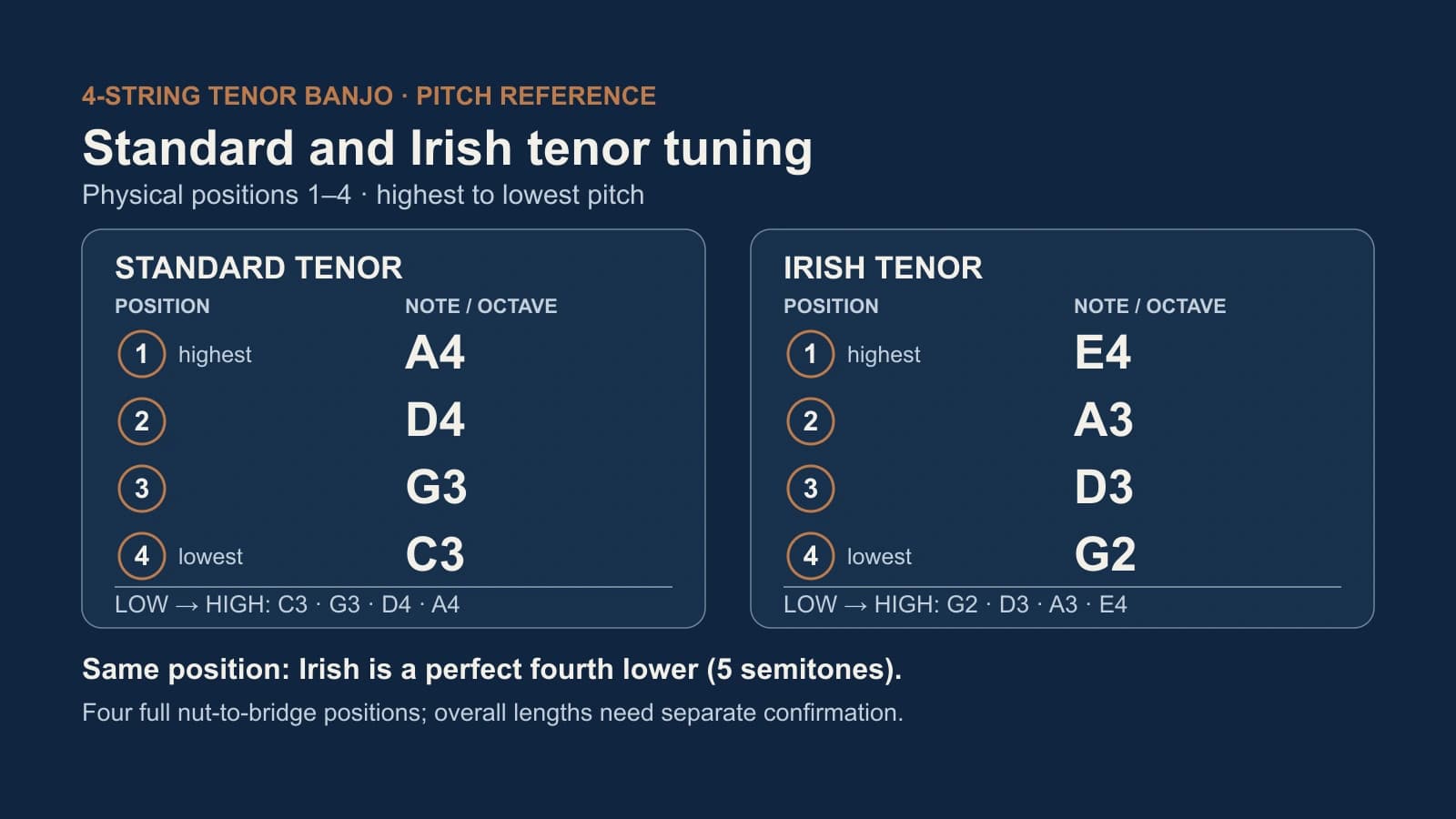
D’Addario's official EJ63 tenor set identifies four strings, CGDA tuning and loop ends; its note chart lists A4, D4, G3 and C3. The corresponding EJ63I Irish tenor set lists E4, A3, D3 and G2. These are named manufacturer examples that establish the pitch distinction. Their gauges, materials and tension figures are specific to those products.
Deering's tuning guide independently distinguishes standard CGDA from Irish GDAE. Both configurations rise in fifths from the lowest string. Irish GDAE is one octave below violin or mandolin GDAE; it is not one octave below standard tenor CGDA.
Every physical position changes pitch between these two tenor configurations. A standard set and an Irish set therefore need separate proposed specifications, even when their packages both say “4-string tenor banjo.” Do not assume that one approved construction can serve both by retuning it. Obtain the string supplier's recommendation for the actual instrument and intended pitches before a conversion trial.
Confirm tenor, five-string or plectrum before choosing a set
Record the instrument maker and model, tuning, fret count, nut-to-bridge vibrating length, tailpiece and tuner arrangement. A photograph of the whole neck and peghead can resolve an instrument description that only says “banjo.”
The short fifth string described in Deering's explanation of banjo types is a different route from the four full-length tenor positions. If the customer's instrument has that arrangement, use the five-string banjo specification guide to identify the extra position and its installation path. Removing a fifth string does not establish that the remaining four match a tenor set.
A plectrum banjo also has four strings. Deering lists its usual tuning as C–G–B–D, which differs from both tenor configurations above. Keep plectrum requests on a separate instrument and tuning sheet, with the intended octaves confirmed. A four-string count or a similar-looking loop tailpiece is insufficient to approve substitution.
Fret count is useful identification, but it does not select the tuning by itself. Deering lists both standard CGDA and Irish GDAE options for its Artisan Goodtime 17-Fret Tenor. Use the customer's declared tuning and actual instrument measurements; do not assign every 17-fret instrument to Irish tuning or every 19-fret instrument to standard tuning.
Complete a four-position construction sheet
Copy this worksheet separately for each proposed configuration. Put the standard or Irish configuration, four octave pitches, instrument ID and specification revision at the top of the sheet. Enter the intended pitches below, then ask the supplier to complete the remaining fields. The blank cells mean not yet confirmed. They do not mean zero, no winding or an available StringCrest option.
| Position | Intended pitch | Finished gauge and unit | Plain/wound; wire or core/wrap materials | Length record ID | Loop drawing or code |
|---|---|---|---|---|---|
| 1 | |||||
| 2 | |||||
| 3 | |||||
| 4 |
“Nickel wound” on a set description does not identify the construction of every position. Request plain or wound status separately for all four strings. For a plain string, identify the wire material and any treatment. For a wound string, identify core material, wrap material and winding form, plus any coating or other treatment. A nickel-plated wrap and a coated finished string are different declarations.
Use finished outside diameter for the gauge field, with the unit stated. Core diameter, when supplied for a wound string, belongs in a separate construction field. A first-to-fourth gauge range alone leaves the two middle positions and their builds unidentified. Do not fill those gaps with values copied from a competitor's set.
The length record should distinguish:
- Vibrating length: the nut-to-bridge speaking length on the documented instrument.
- Installed path: the route from the loop seating point through the tailpiece, bridge and nut to the relevant tuner post.
- Overall string length: the supplier's stated end-to-end measurement, with its reference points defined.
- Construction transitions: where winding, exposed core, loop twist or any other transition begins and ends on the proposed string.
Record the path for each position. The four speaking lengths do not describe every difference in the routes to the tuner posts. Check whether the proposed string provides the necessary working length and reaches the intended contacts in the intended construction. Do not impose a universal rule that all wound material must end before the bridge, nut or tuner; use the supplier's drawing, installation instructions and the actual instrument.
Check the loop-end interface on the actual tailpiece
A loop is an attachment format, not a complete compatibility specification. Its shape and seating must work with the particular tailpiece, including any cover, hook, pin, slot or edge along the string route.
Ask for a tailpiece overview and a close-up of each attachment point with the strings removed where practical. Identify the hardware model or mark it as unknown. A photo with a measurement reference helps a supplier interpret the interface, but perspective can distort dimensions; use a drawing or direct measurement for an agreed fit dimension.
Use this blank fit record alongside the four-position construction sheet:
| Fit-record field | Project entry |
|---|---|
| Instrument model, tuning and measured vibrating length | |
| Tailpiece model or identifying photographs | |
| Loop specification/drawing and sample revision | |
| Defined loop seating point and measurement units | |
| Attachment dimensions and access under any cover | |
| Installed path and contact/transition locations, by position | |
| Installation instructions and any required setup work | |
| Fit observation, date, installer and result |
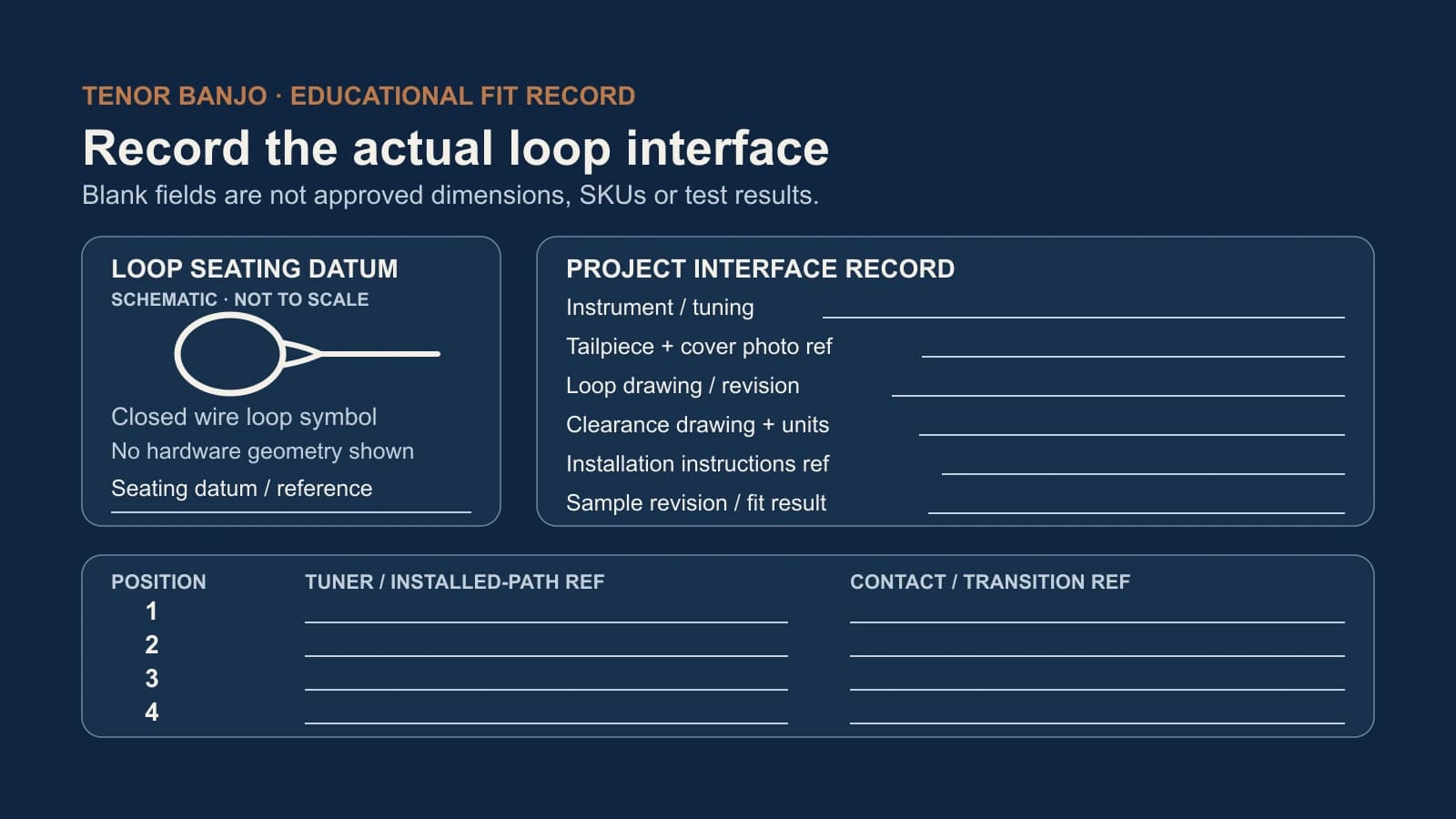
During installation, check that the loop seats as intended and stays retained along the specified route. Inspect for sharp edges, interference, unintended contact at a construction transition, and enough usable length at the tuner. Note any nut or bridge work performed before evaluating the string. If seating is uncertain, stop and resolve it with the supplier or an instrument technician before changing the loop or hardware.
An approval should identify the tested combination of sample revision, instrument, tuning and tailpiece. It does not establish fit on every banjo sold under the same broad instrument name.
For a proposed project, send StringCrest the four octave pitches, instrument measurements and tailpiece photos. Include the completed fields and the points that still need a supplier recommendation so the discussion can address a specific configuration.
Keep the sample and pack identity tied to the tuning
Give standard and Irish proposals distinct sample references. Before installation, verify four contents against the position sheet and identify which string belongs at positions 1 through 4. If a pack prints low-to-high CGDA or GDAE, also show the direction or a numbered diagram so receiving staff do not reverse the contents map.
Install each proposal at its declared tuning on a documented instrument. Record the sample revision, installer, date, instrument setup and any fitting work. Check loop seating, tuner retention, tuning behavior and obvious buzzes or contact problems before comparing playing feel and sound. Define the observation period and acceptance criteria for the project; this guide does not establish a performance guarantee or a test result.
When comparing two constructions, retain the same instrument and setup where practical. If the instrument, tuning or setup changes, record it with the observations. A useful note names the position and condition—for example, where a contact problem occurred—so the supplier can investigate it without relying on a general “poor fit” label.
The sample evaluation and approval guide provides a broader documentation workflow for guitar strings. Adapt its sample identity, installation log and approval record to the four tenor-banjo positions and the loop interface here. The linked workflow is not evidence of tenor-banjo testing or an approved banjo specification.
For a distributor or music store carrying both tunings, the package and receiving record should state the tuning, octave map, position order and approved sample reference. A proposed set means four specified strings, one for each position; proposed replacement singles need their own position identity. Record the intended order unit explicitly, and confirm any set or single-string supply options with the supplier. This planning distinction does not imply that either format is currently offered.
FAQ
Is Irish tenor tuning an octave below standard CGDA?
No. At the same physical positions, Irish E4–A3–D3–G2 is five semitones below standard A4–D4–G3–C3, a perfect fourth. The octave comparison applies to Irish GDAE and violin or mandolin GDAE. The four octave pitches in the reference table remove that ambiguity from an order.
Can I choose a tenor set from “17 fret” or “19 fret” alone?
No. Fret count helps identify the instrument, but the tuning, vibrating length, installed string paths and end fit still need confirmation. The Deering 17-fret example above has both standard and Irish tuning options. Specify the customer's configuration instead of inferring it from fret count.
Conclusion
A usable tenor-banjo buying file connects four declared octave pitches to four physical positions, then records each string's construction, usable length and loop fit on the intended instrument. Keep standard and Irish proposals separately identifiable through sampling, artwork and receiving.
Browse the folk and orchestral string category for the wider instrument family. To discuss a tenor-banjo project, send your tuning, four-position sheet, instrument details and proposed order units so available options and unresolved fit questions can be reviewed.
FROM GUIDE TO PRODUCT
Connect this guide to Folk & Orchestral Strings.
Review the relevant range, then bring the instrument, complete specification and open questions into one project brief.
YOUR PRODUCT · YOUR BRAND
Discuss your next string project with Frank.
Share your instrument category, target market, gauge or material direction and private-label packaging requirements.

ABOUT THE AUTHOR
Frank Zou
Frank works directly with musical-instrument brands, importers and distributors on string specifications, product selection and private-label project requirements.
Meet Frank