
Wholesale Planning
Wholesale Planning
5-String Banjo Strings: A Wholesale Guide to Loop Ends, Gauges and the Fifth String
Specify 5-string banjo sets by position, tuning, gauge, wound fourth string, short fifth-string path, loop end, usable length, samples, packaging and SKU.
Introduction
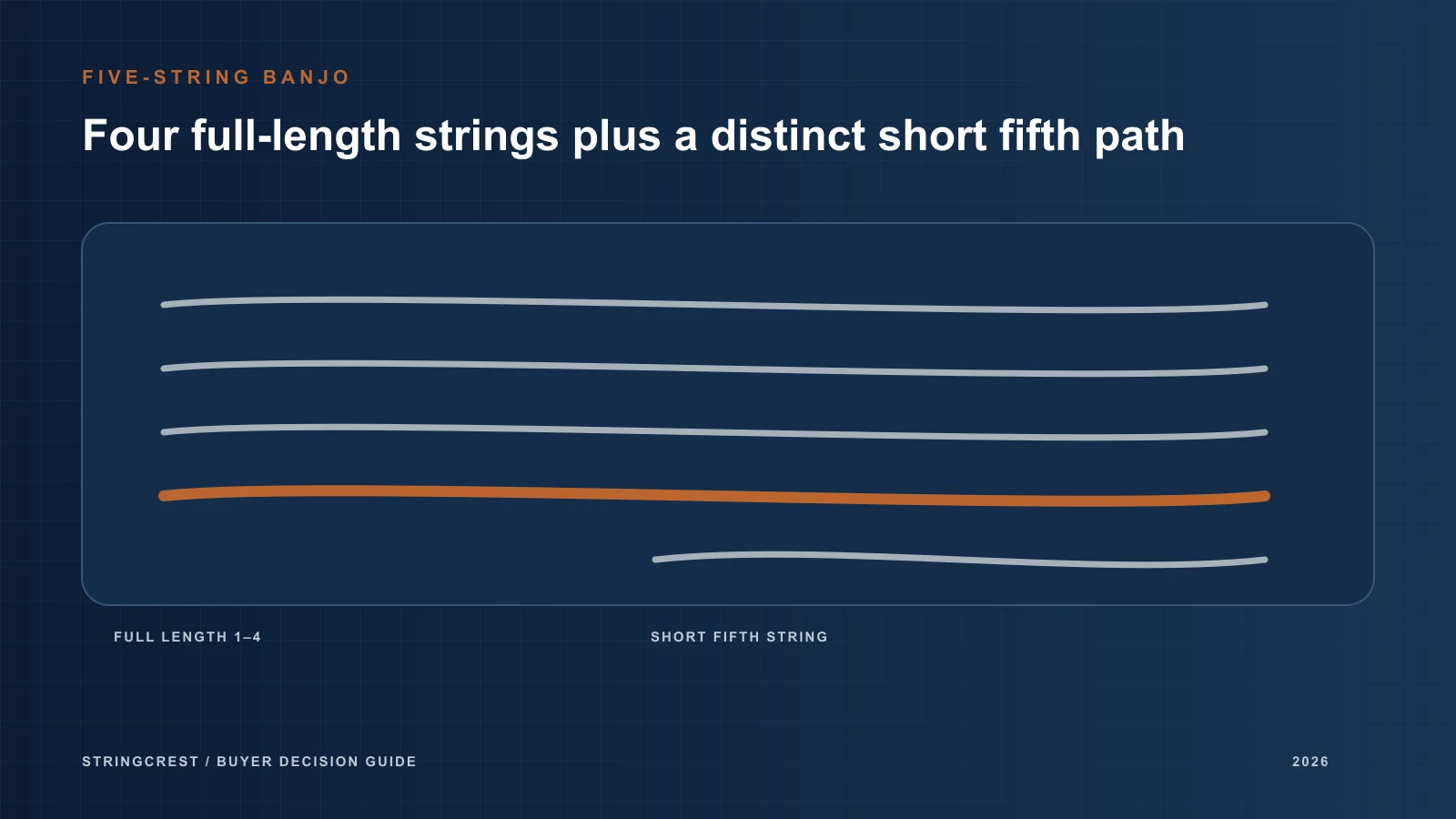
For a conventional five-string banjo in uncapoed open G, specify position 1 D4, 2 B3, 3 G3, 4 D3 and 5 G4. The fifth string is a short, high-pitched drone. It is not an added bass string. Its speaking length and route to the tuner need their own record, alongside the four strings that run to the main nut.
For a brand, importer, distributor or music store, a useful sample request connects those five positions to the actual banjo, construction and loop-end interface. A gauge range or a “5-string” label leaves too much unspecified. The reference map and blank records below describe how to prepare that request; StringCrest's proposed banjo constructions, dimensions and supply options still need confirmation.
Map open G by physical position
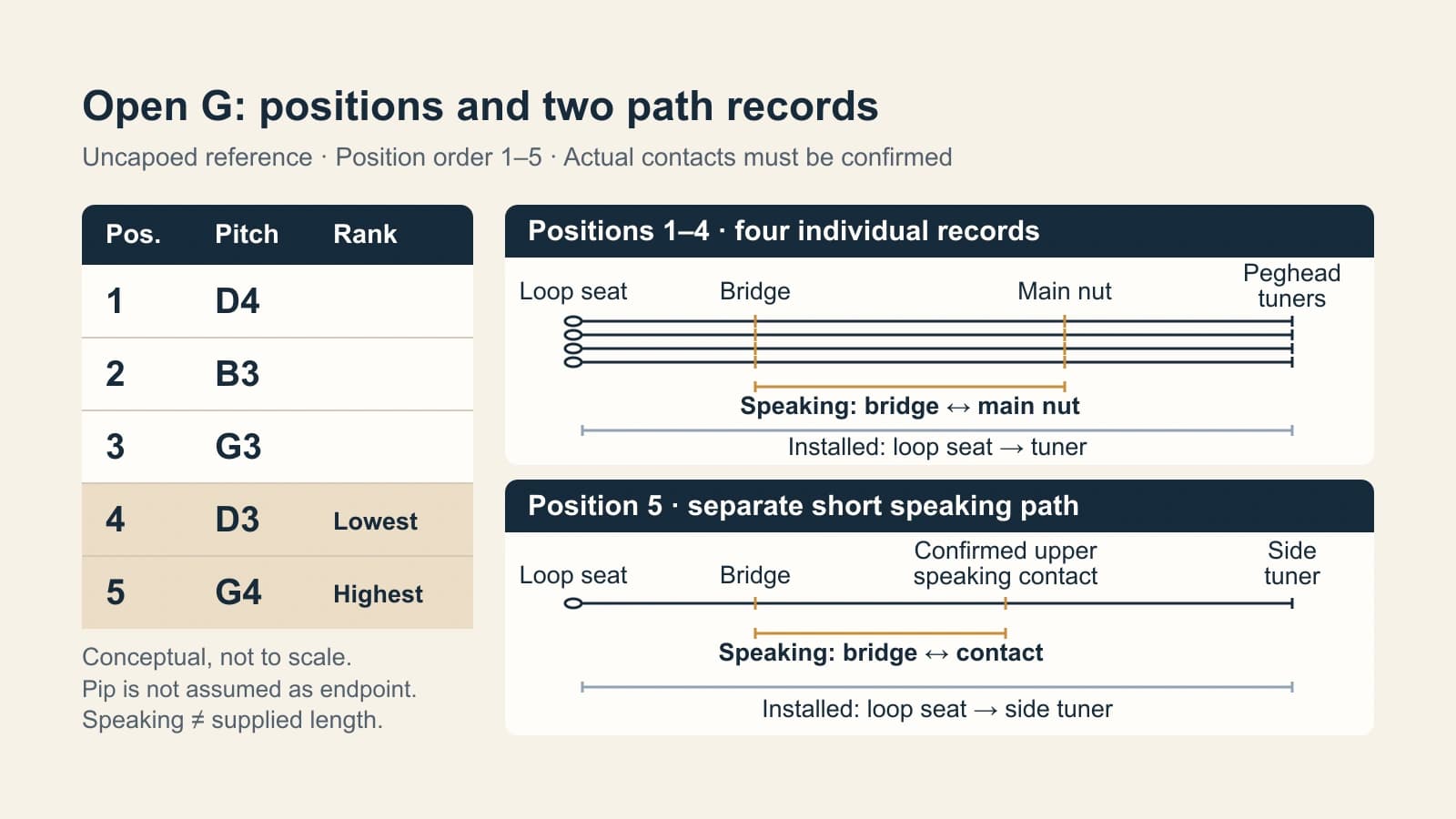
Read this table in physical position order, 1 through 5, not from lowest to highest pitch. Among these open notes, position 4 is the lowest and position 5 is the highest. The repeated D and G letters describe different octaves, so retain the octave numbers on the project sheet.
| Physical position | Uncapoed open-G reference | Conventional string path |
|---|---|---|
| 1 | D4 | Bridge to main nut; onward to its peghead tuner |
| 2 | B3 | Bridge to main nut; onward to its peghead tuner |
| 3 | G3 | Bridge to main nut; onward to its peghead tuner |
| 4 | D3 | Bridge to main nut; onward to its peghead tuner |
| 5 | G4 | Bridge to its separate upper speaking contact; onward to the side tuner |
D’Addario's official EJ60 and EJ69 charts list D4, B3, G3, D3 and G4. Deering's tuning guide identifies conventional open G as G–D–G–B–D when written from the fifth string to the first. These descriptions agree; their reading directions differ.
Deering's explanation of banjo types describes the short fifth as a drone or thumb string and shows the conventional side-mounted tuner near the fifth-fret area. That is the arrangement used in this guide's reference map. On a project drawing or photograph, mark the viewing direction, instrument handedness and position numbers rather than guessing them from which side of an image a tuner appears on.
Here, the four main-nut paths describe the instrument layout. They do not mean that positions 1–4 have identical supplied lengths or cutting lengths. They also do not identify a tenor set. Use the four-string tenor guide for its separate standard and Irish tuning maps; removing the drone does not establish a tenor specification.
Record the fifth string's actual speaking and installation paths
The short fifth string still attaches at the tailpiece and crosses the bridge. Its upper end follows a different route from positions 1–4. Before choosing a supplied length, distinguish four measurements or records:
- Speaking length: the distance between the bridge speaking contact and the upper contact that actually defines the vibrating segment in the stated playing configuration.
- Installed path: the complete route from the defined loop seating point, through the relevant contacts, to the intended tuner attachment point.
- Overall supplied length: the supplier's end-to-end dimension, with both reference points stated.
- Construction transitions: the locations of the loop twist, winding starts and ends, or any other construction change that could meet a contact along the route.
For positions 1–4, document the ordinary nut and the separate routes onward to their tuners. For position 5, identify the actual upper speaking contact and any separate fifth-string nut or pip, guide and tuner passage. Do not assume that a visible pip is always the speaking boundary, or measure to the side tuner and call that the vibrating length. Ask the instrument maker or technician to identify the relevant contacts when the design is unclear.
Measure along the actual installed route, using an agreed seating datum and units. Retain a drawing or reference photograph that identifies those points. Perspective in a photograph is not a reliable substitute for a direct dimension. The supplier should then confirm the working length and tuner allowance required by its installation method. This guide sets no universal extra length or cutting rule.
Side-mounted fifth tuners are not the only configuration. The Walnut Phantom feature block in Nechville's official Phantom collection lists a tunneled fifth string. Treat that as a separate route to document, rather than applying a side-tuner length assumption. Obtain the actual model's route and installation guidance; the collection description does not establish a tunnel's internal dimensions or a compatible StringCrest string.
Keep spikes and capo settings in the configuration
A capo across the four main-nut strings does not by itself define what happens to the short fifth. Deering's fifth-string capo explanation discusses separate fifth-string devices and spikes. Record any device present, whether it is engaged, its location/reference, the intended fifth-string pitch and the resulting speaking-length basis. Where an engaged spike holds the string against a fret, record that confirmed bearing fret separately from the spike's location. Other devices still require their actual effective contact to be identified.
Keep the uncapoed reference separate from observations made under a spike or capo. A buzz or tuning change in one state should not silently become a finding about every setup. Obtain the instrument maker's instructions for the actual hardware. Installing or altering spikes, a pip or a tuner is a separate job for an appropriately experienced technician, not a way to make an unspecified sample fit.
Start the fit record at the loop seat
“Loop end” identifies an attachment format, not a complete tailpiece fit. Record the tailpiece model or identifying details, the loop drawing or supplier code, the defined seating point and access around any cover. Check each position's attachment and route; a similar-looking hook or slot does not establish the same usable clearance.
Before and after fitting, document seating, retention, sharp edges, interference and the locations of construction transitions. Check the fifth string's separate upper contacts and tuner as well as the bridge. If a loop will not seat, the route is uncertain or a transition meets hardware in an unintended way, stop and resolve it with the supplier or instrument technician before bending the loop or modifying the hardware.
Describe your banjo model, five octave pitches, fifth-string route and tailpiece reference for a StringCrest project discussion. Identify any drawing or photograph references and the fit questions still open so the proposed sample has a defined purpose.
Declare all five gauges and constructions
D’Addario's EJ60 feature list identifies plain steel at positions 1, 2, 3 and 5, with a nickel-plated-steel-wound fourth. Its EJ69 page describes a phosphor-bronze wound string, mapped to D3 in the chart. These are named manufacturer examples, not a rule that every five-string banjo set must have that construction. Their gauges and tension figures do not supply missing StringCrest values.
For a proposed set, declare each position separately. A plain string needs its wire material, plating or treatment and end construction. A wound string needs core and wrap declarations, winding form and any coating or treatment. Keep finished outside diameter separate from a disclosed core diameter. Do not infer a core shape from the set name or import a guitar-family description into the banjo record.
Copy the following blank construction sheet for the actual tuning and instrument. Put the configuration ID, five octave pitches and specification revision in its header. Empty cells mean unconfirmed; they do not mean zero, no winding or an available option.
| Position | Intended pitch | Finished gauge and unit | Plain/wound; wire or core/wrap declaration | Supplied length and route-record ID | Loop drawing/code |
|---|---|---|---|---|---|
| 1 | |||||
| 2 | |||||
| 3 | |||||
| 4 | |||||
| 5 |
Use a sample to resolve the fifth-string fit question
Check the labelled contents against all five positions before installation. Give the fifth string a position identity even if it resembles another plain string. A pack should make the tuning and contents map understandable without relying on “short” to mean a particular pre-cut length.
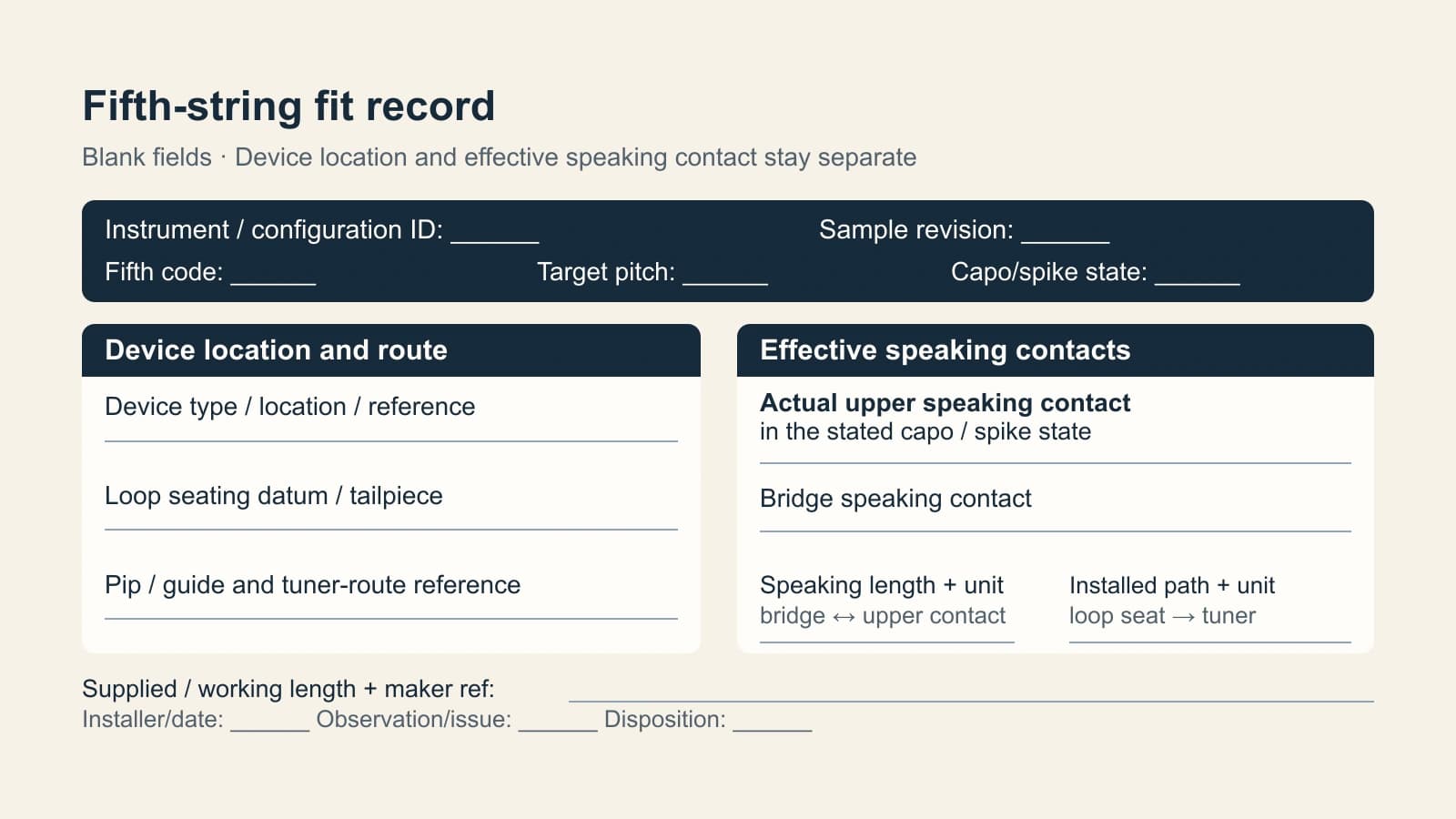
Use this original blank record with the construction sheet. It contains no completed inspection or approved sample.
| Fifth-string fit and observation field | Project entry |
|---|---|
| Instrument ID, configuration ID and sample revision | |
| Five intended octave pitches; capo/spike state | |
| Fifth-string device location/reference, separately from effective contact | |
| Fifth-string code and declared construction | |
| Tailpiece model, loop code and seating datum reference | |
| Bridge and effective upper speaking-contact references in the stated state | |
| Pip/guide and side-tuner route, or separate model-specific route drawing | |
| Measured speaking length and installed path, with units | |
| Supplier-confirmed supplied/working length and installation instruction | |
| Loop, bridge, upper-contact and tuner observations | |
| Installer, date, setup changes, unresolved point and disposition |
Record installation observations before evaluating sound or playing feel. If there is slipping, buzzing, binding or breakage, identify the position, location, pitch and setup state. Describe any fitting work. Those details help distinguish a contact or installation problem from a question about the proposed string; they do not establish the cause by themselves.
For a playing comparison, use the same documented instrument, tuning and capo state where practical. Record the task, string condition and observation period. A successful trial on that combination does not prove fit on every five-string banjo or establish a lifespan, corrosion or break-strength advantage.
Other tunings need their own five-position record with octaves, instrument details and supplier recommendation. Deering's tuning guide lists alternatives to open G; this reference table does not approve retuning an unspecified construction to all of them. Keep a changed pitch, instrument route or capo condition visible rather than overwriting the open-G record.
The sample evaluation and approval guide explains the broader identity, observation and approval workflow for guitar strings. Adapt that documentation to the banjo's five positions and loop interface. It is not evidence of banjo testing or an approved banjo build. A project decision should name the actual sample revision, instrument, tuning and installation configuration it covers.
FAQ
Can a first string replace the fifth if both show the same gauge?
Gauge alone does not establish interchangeability. Compare the actual wire or construction, end, supplied length and installation requirements against the fifth-string route. Use the supplier's confirmed component identity or recommendation. Matching printed diameters do not approve a substitute.
Does “short fifth string” mean it should be cut to a standard short length?
No. It describes the conventional short playing path, not a universal supplied or cutting dimension. The tailpiece-to-tuner route and the product's installation method still determine the working length. Confirm those details before trimming; do not choose a cut length from the position number or a schematic.
Conclusion
A useful five-string banjo proposal links each octave pitch to its physical position, then treats the fifth string's speaking contacts, installed route and tuner fit as a separate part of the record. Declare the construction and loop interface for every position, and keep sample observations tied to the actual configuration.
Browse the folk and orchestral string category for the wider instrument family. To discuss a project, send the five-position proposal, banjo model, route references and unresolved sample questions. Available constructions and commercial terms require confirmation for that project.
FROM GUIDE TO PRODUCT
Connect this guide to Folk & Orchestral Strings.
Review the relevant range, then bring the instrument, complete specification and open questions into one project brief.
YOUR PRODUCT · YOUR BRAND
Discuss your next string project with Frank.
Share your instrument category, target market, gauge or material direction and private-label packaging requirements.

ABOUT THE AUTHOR
Frank Zou
Frank works directly with musical-instrument brands, importers and distributors on string specifications, product selection and private-label project requirements.
Meet Frank