
Wholesale Planning
Buying Guides
Nylon Banjo Strings: Materials, Fifth String and Setup Checks
Keep nylon, Nylgut and gut identities separate, map all five positions and resolve the actual instrument’s setup questions before changing from steel.
Introduction
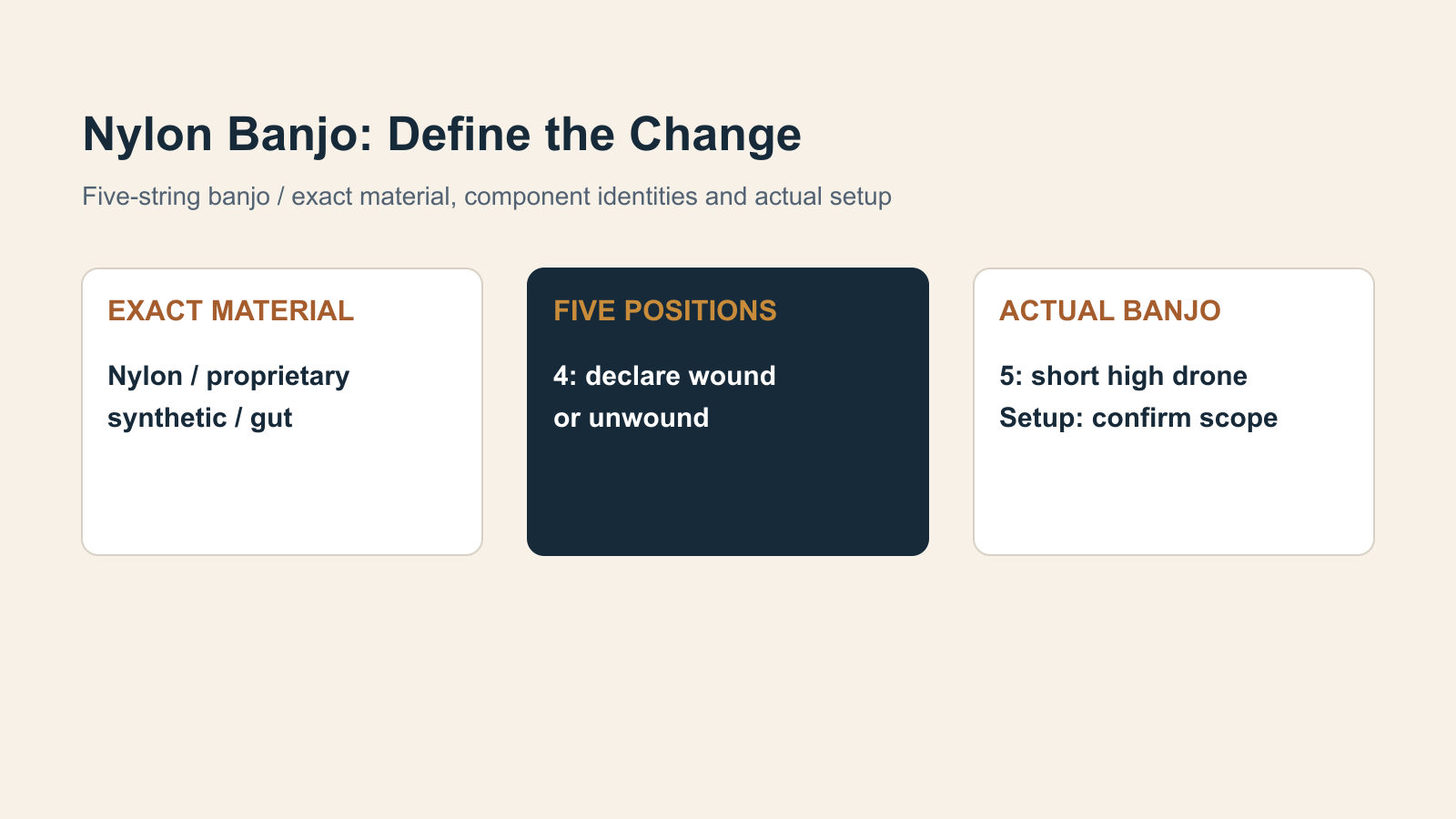
Choose nylon banjo strings by the actual five-string banjo, the named replacement set and its intended tuning—not by the word “nylon” alone. A proposal needs five component identities, including the short fifth string, plus confirmation that the instrument's contacts and attachment method suit the proposed construction. Replacing a steel set is a setup question as well as a material choice; matching five note names does not establish fit.
For a dealer, the useful first distinction is between a documented replacement for an existing synthetic-string setup and a proposed change from steel. The first needs the correct set and revision. The second also needs the instrument maker's guidance and a technician's assessment where fit or setup is uncertain. This guide concerns five-string banjos. Four-string banjo ukulele strings have a different position map and replacement question.
Keep nylon, Nylgut and gut names distinct
“Nylon banjo strings” is a useful search term, but it should not become the material declaration for every product a customer finds. Preserve the manufacturer's exact set name, component description and intended instrument. A proprietary synthetic offered as an alternative to gut is not evidence that the string is chemically nylon, and “gut-like” does not identify a natural-gut component.
Three official examples make that distinction practical:
| Named manufacturer reference | What the published description establishes | What still needs its own confirmation |
|---|---|---|
| La Bella Classic Banjo, SKU 17 | A five-string, plain-end set combining clear nylon components with a silver-plated wound component | The actual packet's position labels, wound-string core, required lengths and suitability for the customer's banjo |
| Aquila Nylgut banjo sets 1B and 2B | A proprietary synthetic family; the maker specifically identifies their fourth string as unwound | The exact selected set, current component specification and actual instrument fit |
| Aquila Historical Banjo Set and its synthetic alternative | Separate gut/silk and Nylgut/synthetic-core constructions | Which version the customer means, its intended tuning and the instrument maker's requirements |
These are attributed examples from La Bella's Classic Banjo page, Aquila's Nylgut banjo page and its Historical Banjo Set description. They are not StringCrest specifications or interchangeable recommendations.
The fourth string deserves attention before a dealer describes a set as “all plain” or “all nylon.” La Bella lists its five-component sequence as clear nylon, clear nylon, clear nylon, silver-plated wound and clear nylon. Aquila explicitly describes an unwound fourth for 1B/2B, using a powder-loaded material. An unwound construction is not the same thing as a separate metal wrap. Neither example supplies missing core or wrap details for another set.
Number all five positions before discussing replacements
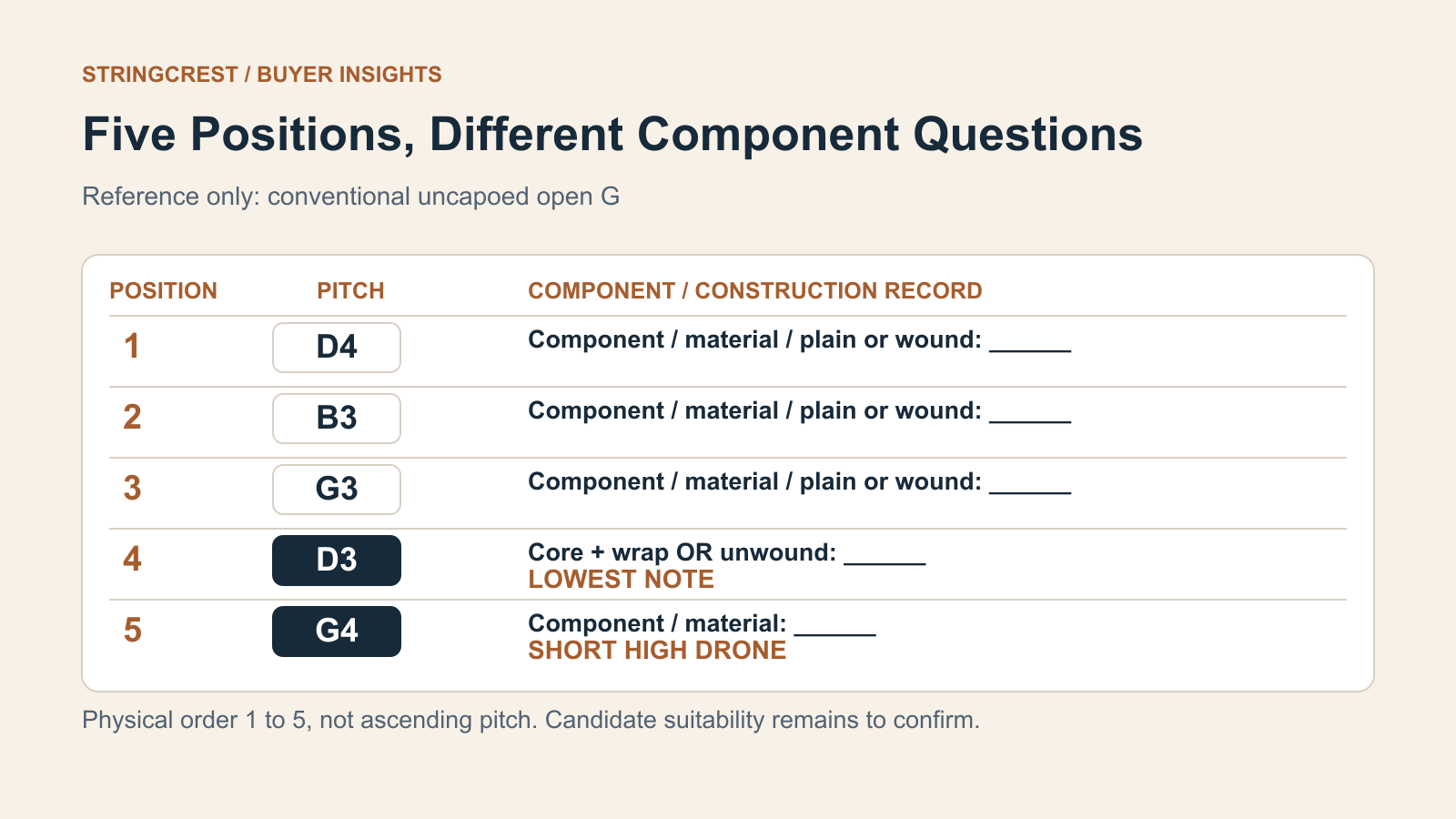
For the conventional uncapoed open-G reference, physical positions 1 through 5 are D4, B3, G3, D3 and G4. Position 4 is the lowest note; position 5 is a high, short drone. This table is in physical string-number order, not ascending pitch order.
Deering's tuning guide writes conventional open G from fifth to first as G–D–G–B–D. The octave values agree with the note chart on D'Addario's EJ60 page. That steel-string chart is used here only to make the reference notation explicit; its gauges, construction and tension are not a synthetic-string specification.
| Physical position | Open-G reference pitch | Role in this reference | Candidate component identity to enter |
|---|---|---|---|
| 1 | D4 | Main-nut string | Material/product reference: ____; plain or wound: ____ |
| 2 | B3 | Main-nut string | Material/product reference: ____; plain or wound: ____ |
| 3 | G3 | Main-nut string | Material/product reference: ____; plain or wound: ____ |
| 4 | D3 | Lowest note | Material/product reference: ____; core/wrap or unwound declaration: ____ |
| 5 | G4 | Short, high drone | Material/product reference: ____; plain or wound: ____ |
Use the table only when open G is the intended configuration. Drop C, double C, lower-pitched historical setups and other tunings require their own five pitches with octaves and a set intended for that use. A string packet marked “banjo” or a lower-case “g” on a handwritten request is not enough to settle the full configuration.
Do not fill a missing nylon diameter from a familiar steel gauge or assume that two makers' “medium” labels describe the same components. Obtain each proposed position's actual specification. If it is unavailable, keep that field unresolved rather than substituting a value from one of these examples.
Give the short fifth its own fit question
Changing material does not turn the fifth string into a bass. Deering identifies it as the short drone or thumb string in its five-string banjo explanation. In the open-G reference above, it remains G4 even though its speaking section is shorter than those of positions 1–4.
For a proposed replacement, identify the fifth string's actual upper speaking contact, route to the tuner and any engaged fifth-string device. Record enough supplied length for that actual installation, using the applicable maker method. “Short fifth” describes the instrument arrangement; it is not a universal instruction to pre-cut a string to a particular length.
The separate five-string banjo guide explains why speaking length, installed route and capo/spike state are different records. For this material change, the additional question is whether those contacts and passages suit the candidate component. A former steel string's route does not by itself answer that question for nylon or another synthetic.
Matching first- and fifth-string diameters is also insufficient evidence for substituting one for the other. Ask whether the maker identifies the same component for both positions, including its construction, end and usable length. Preserve the answer with the replacement reference.
Resolve the steel-to-synthetic setup questions first
Read permission at the actual model and set level
An instrument maker may specify a combination that a broad material label would hide. Magic Fluke's Firefly setup and care instructions, dated June 14, 2023, give a position-specific replacement list for its five-string Firefly in G. That list includes nylon at positions 1, 2 and 5 and named NYXL components at positions 3 and 4. It is a model-specific mixed list, not permission to install any five-piece nylon set on any banjo. Confirm that the instructions apply to the instrument/version being serviced.
For another model, obtain that maker's answer rather than borrowing the Firefly list. A useful question identifies the existing set, proposed exact set, tuning and instrument version. Ask whether the maker permits that change and which setup checks or work it requires. A string manufacturer's product page establishes what it sells; it cannot approve every customer's instrument.
Check contact condition without turning the article into a repair procedure
Aquila's Nylgut banjo page specifically warns about cutting edges and calls for suitable nut and bridge surfaces before stringing. Treat this as a requirement attached to that maker's product family. It is not evidence that a particular customer's bridge, nut or tailpiece has already been inspected.
Have the actual contacts assessed under the applicable instructions. That includes the fifth string's separate contacts and the proposed securing method, as relevant to the instrument. If a component binds, shows cutting damage or cannot be retained as instructed, stop and resolve the cause with the maker or technician. Do not force it through a slot, add improvised metal balls to a plain polymer string or assume that fitting a steel loop proves synthetic-string suitability.
This guide supplies no sanding, slot-widening or knot recipe. Work that changes the instrument should follow the actual maker's guidance and be recorded separately from the string choice.
Keep setup changes visible in the comparison
Before removal, record the existing set and tuning and the instrument's relevant setup condition. For the candidate, use the maker's fitting and stabilization guidance; do not impose a universal number of pulls, tuner turns or waiting days. Record when pitch was checked, what was retuned and whether attachment or contact behavior changed.
If a technician changes the nut, bridge, action or another setup feature, identify that work. A listening comparison after such work describes the resulting instrument-and-string configuration. It cannot isolate a material's effect. Keep the same playing task and recording conditions where practical, and separate observations about fit or tuning from a player's preference for the sound.
Use a change record that answers the unresolved question
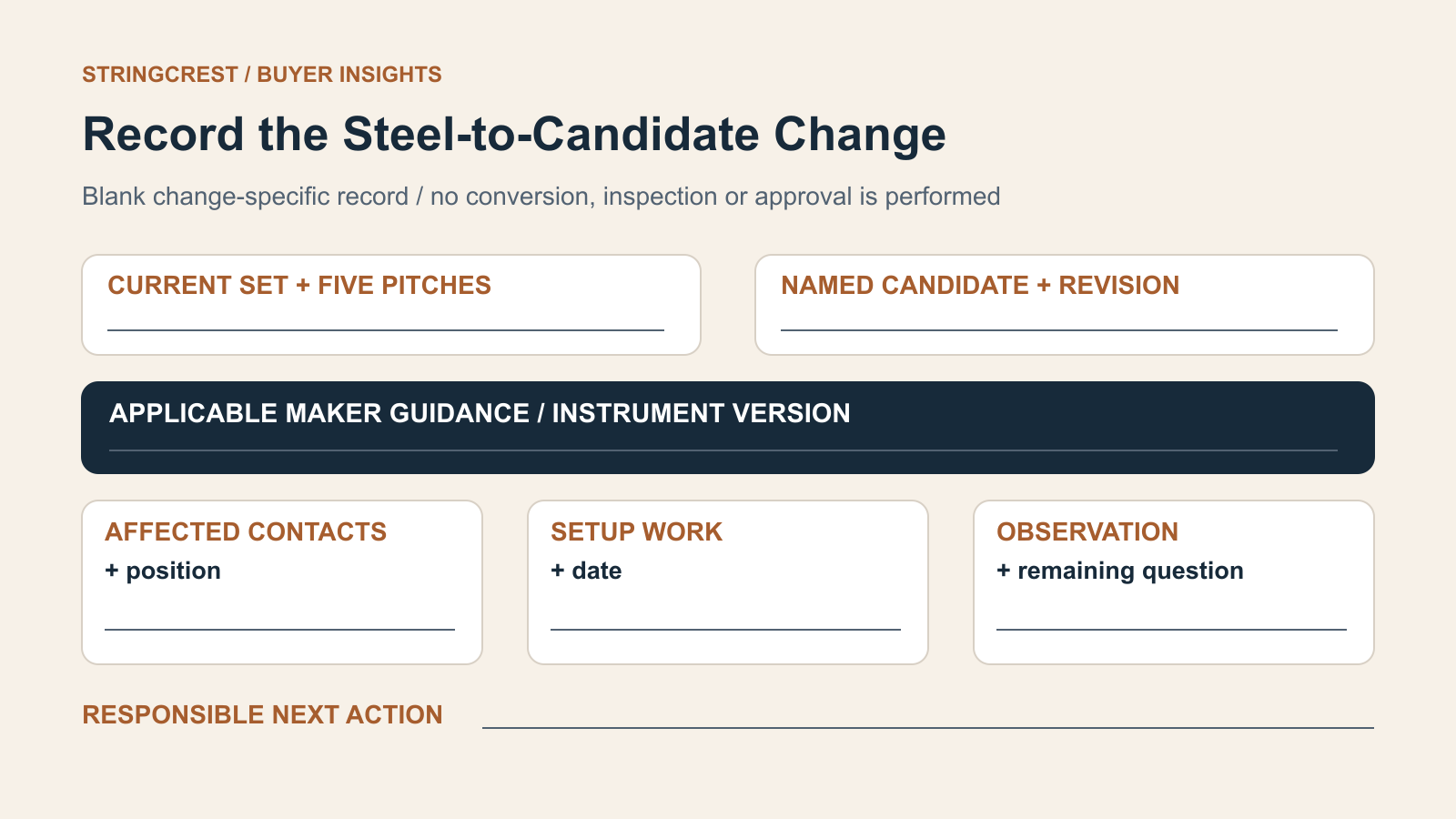
The five-position map identifies the contents. The following short addendum records why this particular change can proceed, needs more information or should stop. It is a blank educational tool, not a completed inspection or a claim that StringCrest has approved a conversion.
| Change question | Entry for this banjo and candidate |
|---|---|
| What is changing? | Instrument/version: ____; existing set: ____; proposed set/revision: ____; five target pitches: ____ |
| What guidance covers the change? | Instrument-maker response/manual and date: ____; string-maker instructions: ____; scope or remaining question: ____ |
| Which contacts need attention? | Positions affected: ____; nut/bridge/fifth-string/attachment reference: ____; technician assessment or required work: ____ |
| What length/construction issue remains? | Position: ____; speaking and installation references: ____; supplied usable-length or winding-transition requirement: ____; units: ____ |
| What was actually observed? | Configuration and date: ____; fitting/tuning observation: ____; setup work: ____; unresolved item: ____ |
| Who decides the next action? | Responsible person: ____; proceed within stated scope / obtain answer / stop: ____; reason: ____ |
Blank means unrecorded, not zero or “no issue.” Enter “not applicable” only with a reason. A supplier specification can answer a component question; a technician's observation can answer a fit question on the inspected instrument. Keep those evidence types distinct.
FAQ
Does a plain end mean a manufactured metal loop or ball?
No. For the plain-end polymer configuration discussed here, the supplied string has no added metal ball or manufactured steel loop. The instrument maker's securing method is a separate matter. La Bella 17's plain-end listing does not establish a universal knot or tailpiece method for every banjo.
Can a guitar nylon set supply the missing banjo positions?
A shared material word does not establish the required five components. The banjo's pitches, speaking lengths, fifth-string route and attachment requirements still need a matching set or a maker-confirmed selection. Do not turn a six-string guitar package into a banjo recommendation by omitting one string.
Conclusion
A useful nylon-banjo proposal names the actual material and construction at each position, retains the high short fifth where the intended tuning requires it and resolves the instrument-specific questions before replacing steel. Keep the current set reference, candidate specification and any setup work together so a later replacement does not repeat the uncertainty.
StringCrest's folk and orchestral category provides an instrument-specific discussion route. It does not confirm a nylon-banjo SKU, a proprietary material equivalent or a conversion service.
FROM GUIDE TO PRODUCT
Connect this guide to Folk & Orchestral Strings.
Review the relevant range, then bring the instrument, complete specification and open questions into one project brief.
YOUR PRODUCT · YOUR BRAND
Discuss your next string project with Frank.
Share your instrument category, target market, gauge or material direction and private-label packaging requirements.

ABOUT THE AUTHOR
Frank Zou
Frank works directly with musical-instrument brands, importers and distributors on string specifications, product selection and private-label project requirements.
Meet Frank