
Buying Guides
Buying Guides
Banjo Ukulele Strings: A Material and Attachment Guide
Identify a banjolele by its maker documentation, then keep material declarations, supplied ends, tailpiece requirements and four octave pitches together before selecting replacement strings.
Introduction
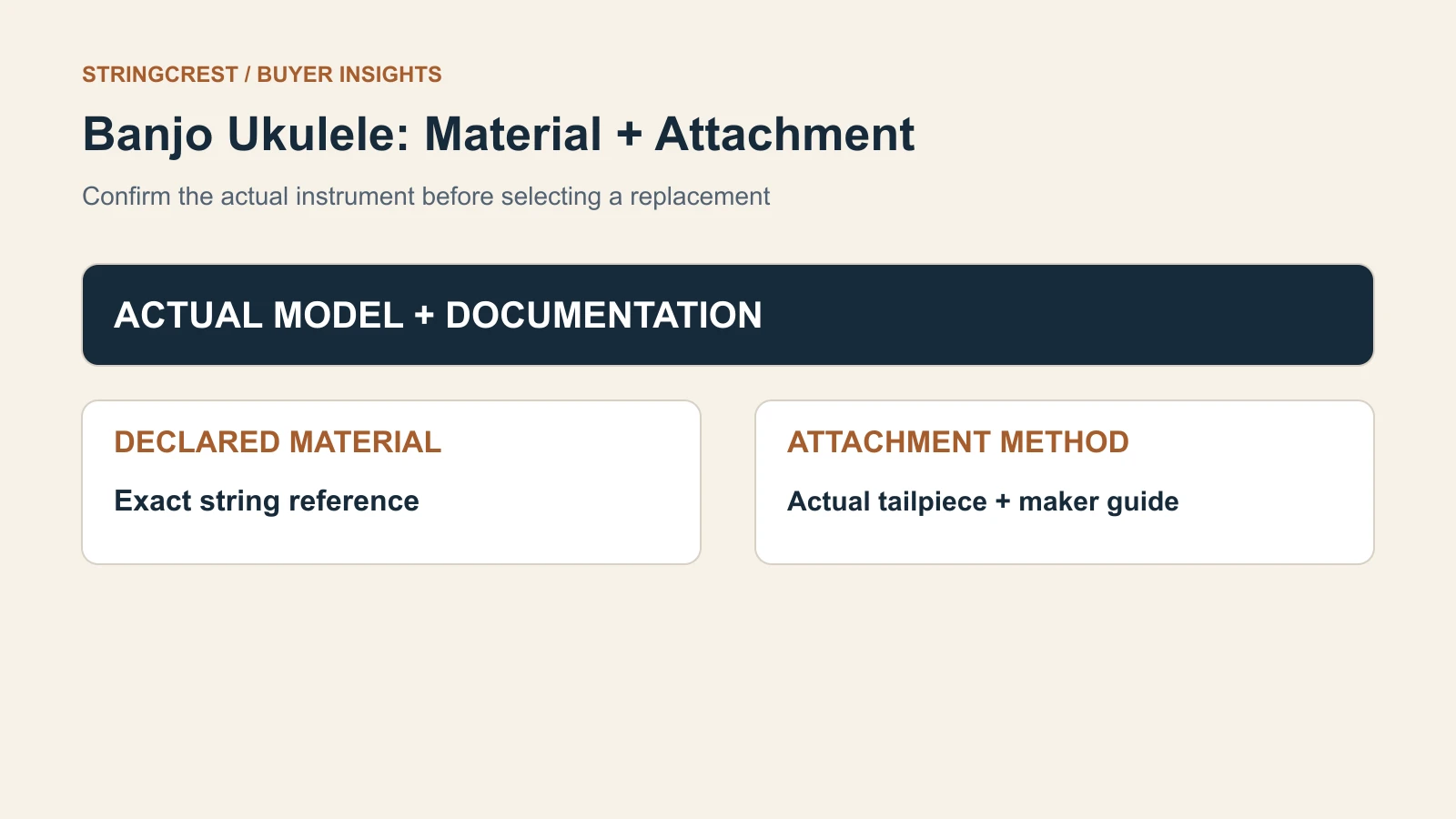
Choose banjo ukulele strings from the actual instrument's material, tuning and attachment requirements, rather than from its banjo-shaped body. A documented polymer-string banjolele does not become a steel-string loop-end instrument because it has a round head and a metal tailpiece. Identify the maker and model, then confirm the proposed four strings and how their supplied ends are secured on that instrument.
For a dealer, the useful distinction is between replacing a documented set and changing the material or tuning. A replacement can start with the maker's existing specification. A change needs a recommendation for the new combination; neither a familiar ukulele packet nor a standard banjo packet establishes compatibility by itself.
The record below helps separate those decisions. StringCrest's general ukulele category is a discussion starting point, not evidence of an available banjo-ukulele SKU or an approved replacement for a named instrument.
Identify the instrument before choosing the material
Start with the maker, model, size and current setup. Record four physical string positions, the existing string reference if known, and whether the instrument has been modified. Ask for an overview plus tailpiece, bridge and tuner references. An old packet helps identify what was installed, but it does not establish that the previous installation was correct.
Manufacturer examples show why the compound name matters. Deering's published Goodtime Banjo Ukulele Concert Scale documentation names Aquila Super Nylgut strings. Its page also uses the broader term nylon. Preserve the specific product name when identifying a replacement instead of treating that wording as a chemical specification for every synthetic string.
Gold Tone's Banjolele model page identifies a concert-scale instrument, GCEA tuning and a “Banjo Uke Style” tailpiece. That is a named model reference. It does not supply every string's octave, a universal attachment method or a compatibility statement for another maker's set.
Keep ordinary four- and five-string banjo requests separate. The five-string banjo guide concerns a different position map, a short fifth-string route and named steel-string loop-end examples. None of those features should be added to a four-string banjo-ukulele order merely because the instruments share part of a name.
Retain the material declaration for each position
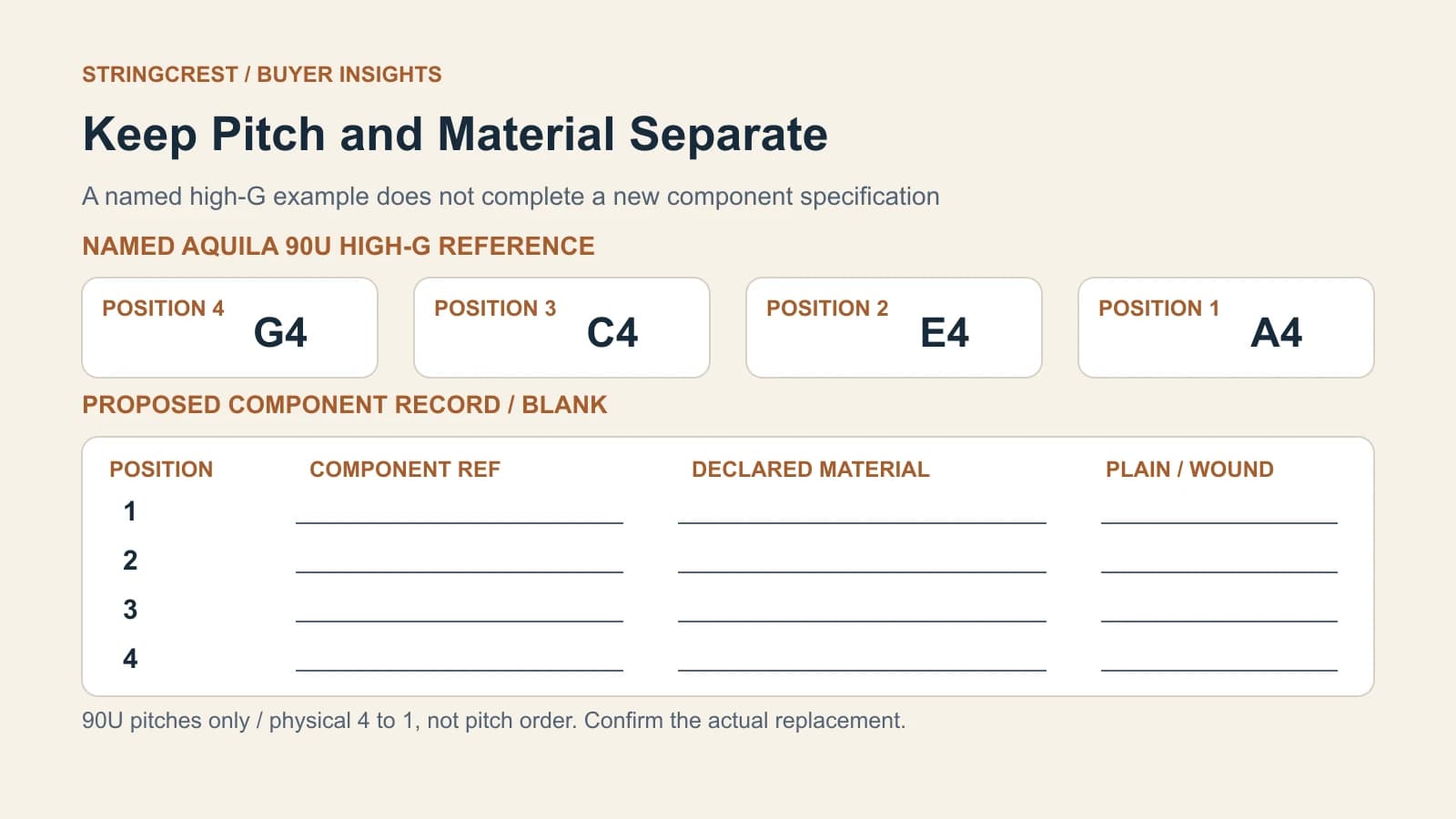
“Nylon,” “Nylgut” and a manufacturer's series name should not be silently substituted for one another on an order. Record the declared material or product code, its source, and whether each component is plain or wound. Where a wound component is proposed, distinguish its core from its wrap; where it is plain polymer, do not add a fictitious metal wrap or ball end to the specification or artwork.
A supplied plain-cut polymer end has no added metal ball-end hardware. That describes the end under discussion, not every banjo-ukulele product sold in the market. If the customer's instrument or current packet has a different end treatment, identify it separately and obtain the maker's guidance. Do not illustrate an unmodified plain nylon string with a ball-end steel-guitar photograph.
Appearance alone is weak material evidence. Aquila's Red Series Banjo Ukulele 90U variant is described as synthetic; the series explanation also discusses metal powder in its material. A colored synthetic string should not therefore be identified as plain steel or metal-wound from its appearance. Use the manufacturer's component declaration rather than assigning construction from color.
These examples do not establish a preferred material for every banjolele. They establish which information belongs in a replacement request. Keep an unidentified material marked as unconfirmed until a maker or supplier can identify the proposed component.
Confirm the attachment separately from the string family
A suitable material still needs an appropriate connection to the actual tailpiece and tuner. Deering's Goodtime tailpiece listing distinguishes a ukulele version from its tenor/five-string and six-string versions. The family resemblance does not eliminate model-specific hardware identification.
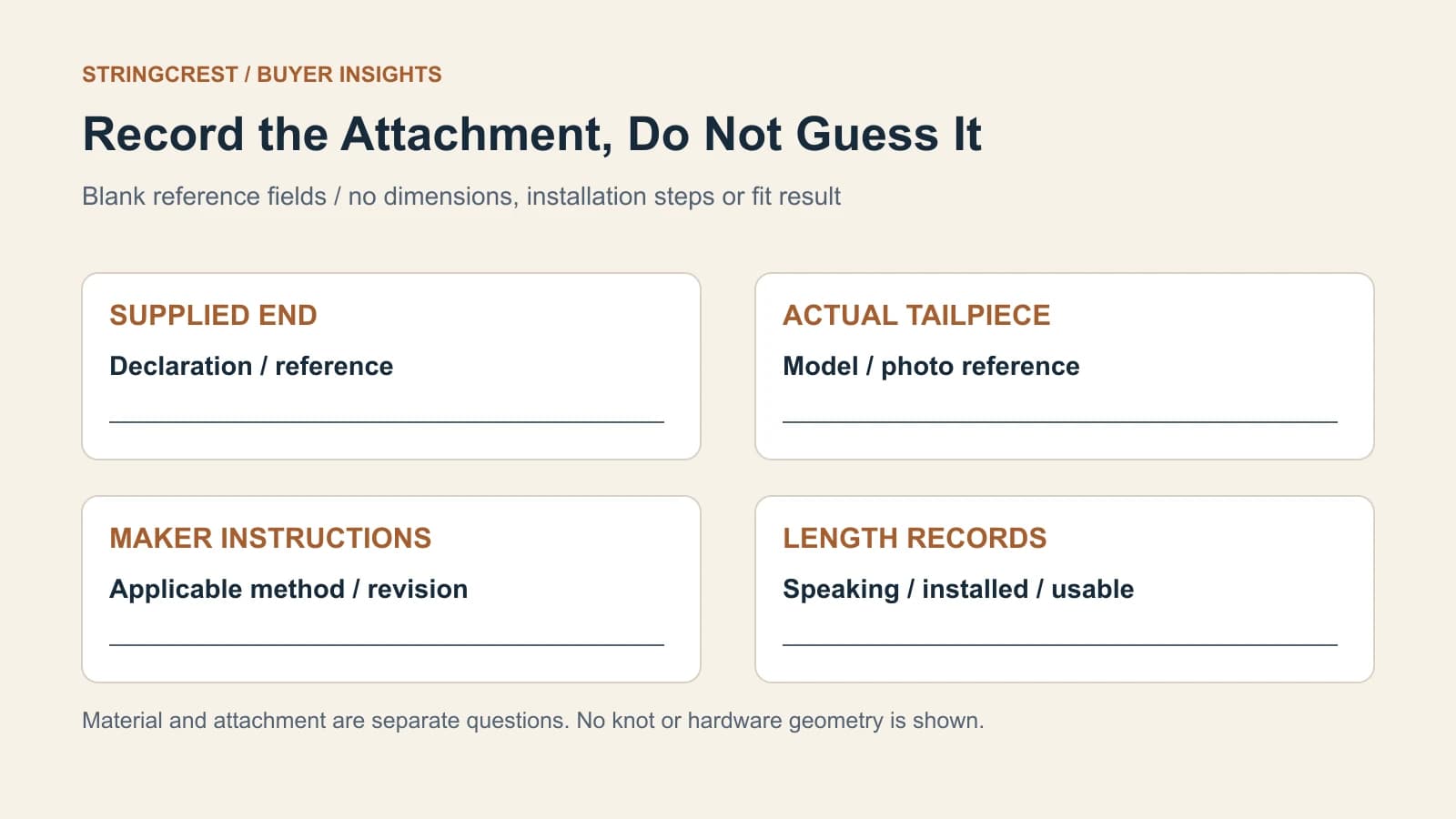
Ask for two separate descriptions: what end is supplied on the string, and what installation method the instrument maker requires. A plain end supplied without a preformed fitting is not the same product description as an installer-created tie. Nor is a tied polymer loop evidence that a manufactured steel loop-end banjo string is an equivalent replacement.
A photograph can identify the hardware and an uncertain contact, but it cannot validate an improvised knot or a dimension taken from perspective. Use the actual maker's installation instructions or obtain clarification for that model. This guide does not prescribe a knot, number of turns, tail allowance or alteration to a tailpiece.
Check the relevant route from the documented attachment point across the bridge and nut to the intended tuner. Keep speaking length separate from the full installed path and the supplier's usable or overall string length. Record the measurement references and units rather than applying a fixed extra length to every banjo uke.
Aquila's installation guidance includes separate instructions for its Red Series and unwound low-G products and identifies sharp nut edges as a damage concern. Follow the instructions applicable to the actual string and instrument. If a string slips, binds or shows damage at a contact, stop and resolve the location and method with the maker or an appropriate technician; do not add hardware or reshape an attachment to make an unspecified set fit.
Resolve GCEA before assigning the fourth string
GCEA written as four letters does not settle whether the fourth string is high G or low G. Keep the intended octave attached to each physical position, and state the direction used in the record.
For one explicit manufacturer example, Aquila identifies its 90U banjo-ukulele set as high G, G4–C4–E4–A4. The table follows physical positions 4 to 1, not ascending pitch:
| Physical position | Pitch in the named 90U high-G example | What this establishes |
|---|---|---|
| 4 | G4 | A high fourth string, not the lowest note |
| 3 | C4 | The lowest open pitch in this example |
| 2 | E4 | Its own identified string position |
| 1 | A4 | The highest open pitch in this example |
This reference does not approve 90U for the Deering or Gold Tone instruments above. Those model and string references answer different questions. For a customer's instrument, obtain the actual intended register and an appropriate set recommendation together.
The high-G versus low-G ukulele guide explains the wider register distinction. A proposed low-G banjolele configuration still needs its own fourth-string construction, attachment and length record. Do not label a high-G replacement as suitable for low G simply because both packets can be abbreviated GCEA.
Use a material-and-attachment selection record
Keep one instrument-level header: maker/model and size, current set or source reference, intended four octave pitches, tailpiece identification, and the applicable maker instructions. Then fill the four rows below for the proposed replacement. Blank means unconfirmed, not zero, no treatment or an available option.
| Position | Intended pitch + octave | Material/product reference; plain or wound | Supplied end declaration | Attachment/path reference |
|---|---|---|---|---|
| 1 | ||||
| 2 | ||||
| 3 | ||||
| 4 |
Use the last column to identify a separate route or fitting record when needed, rather than squeezing an installation drawing into a product name. Retain the supplier's length specification, its measurement endpoints and any relevant construction transitions with that reference. Do not copy another brand's diameters into empty cells and relabel them as a StringCrest proposal.
Before treating the request as ready for selection, resolve three questions: Is the material identified? Is the supplied end compatible with the documented attachment method? Are the intended pitches and usable lengths defined for the actual instrument? A missing answer calls for a specific follow-up, not an assumed match based on “ukulele” or “banjo.”
The ukulele length and plain-end guide provides broader length-record guidance. Its ordinary ukulele bridge examples do not describe every banjo-ukulele tailpiece. Keep this instrument's attachment reference with the four-position record.
Separate an installation observation from a material preference
If a proposed set is evaluated, document the actual instrument, tuning, set revision and installation method first. Note slipping, damage or an uncertain contact by position and location. Those observations do not identify a cause by themselves, and a favorable playing impression does not resolve an unclear attachment.
When comparing materials, use the same documented instrument and register where practical, and record any setup changes. Keep fit observations separate from the player's preference for feel or sound. No trial result, settling period or lifespan claim is supplied by this guide.
For the shop record, distinguish a full four-string set from a replacement single and identify the relevant position. Keep a changed material or high-/low-G configuration separate from the earlier reference so staff can explain which replacement was discussed.
Conclusion
Start the discussion with the actual banjo ukulele and its documented setup. Confirm the four components, material declarations, supplied ends and maker's attachment method before choosing a packet. A round head, a metal tailpiece or the letters GCEA cannot fill in those details.
Browse the ukulele string category for the broader discussion scope. Banjo-ukulele constructions, fit and supply options require project-specific confirmation; the category does not identify an approved special-instrument set.
FROM GUIDE TO PRODUCT
Connect this guide to Ukulele Strings.
Review the relevant range, then bring the instrument, complete specification and open questions into one project brief.
YOUR PRODUCT · YOUR BRAND
Discuss your next string project with Frank.
Share your instrument category, target market, gauge or material direction and private-label packaging requirements.

ABOUT THE AUTHOR
Frank Zou
Frank works directly with musical-instrument brands, importers and distributors on string specifications, product selection and private-label project requirements.
Meet Frank