
Product Selection
Product Selection
Ukulele String Order: A G–C–E–A Wholesale Set and Packaging Guide
A four-position B2B guide to GCEA orientation, high- and low-G identity, size, material, samples, inner labels, artwork and shipment inspection.
Introduction
Ukulele string order is easy to recite and easy to misapply. Soprano, concert and many tenor ukuleles commonly use G–C–E–A tuning, but those four letters do not state the physical package order, the octave of G, the instrument size, the material, the diameters or the required length. A private-label pack can display the correct letters while still containing an unclear or unsuitable set.
This B2B guide turns G–C–E–A into a four-position product record. It explains numbering, high-G and low-G identity, size and scale, material, plain/tie ends, inner labels, artwork, sample approval and receiving checks. It does not assume that every StringCrest size, material or low-G construction is currently available. Each proposed combination needs confirmation before quotation and publication.
Official references support the basic system. Fender’s ukulele tuning guide gives standard G–C–E–A and explains the reentrant high G. A D’Addario concert set page identifies four strings, concert application, tie ends and standard GCEA tuning. These pages describe those brands’ products and guidance; they do not define a StringCrest set.
Establish a single orientation
Use player-view position numbers
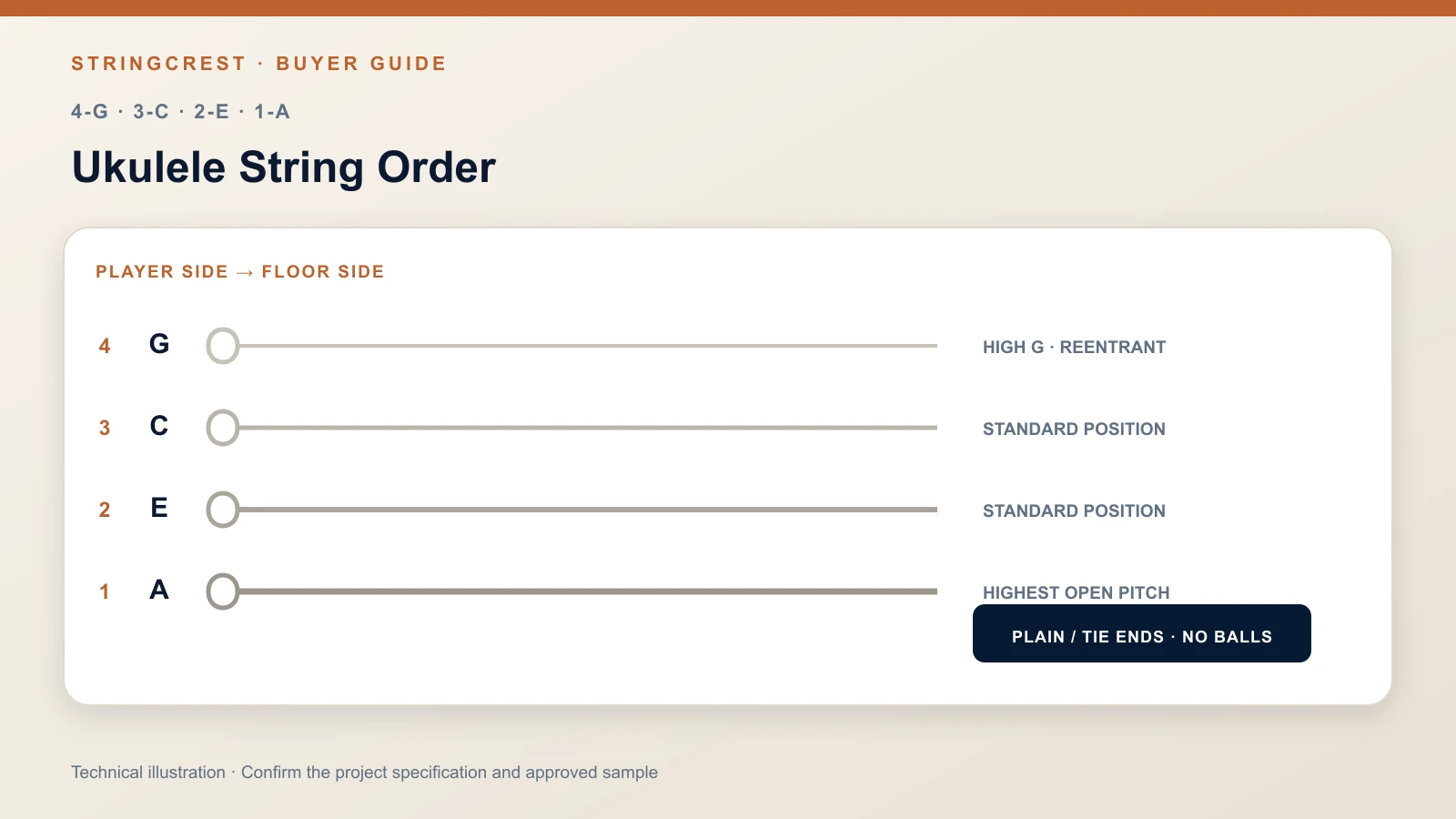
When a right-handed ukulele is held in playing position, the string closest to the player’s face is commonly called string 4 and tuned G. Moving toward the floor gives string 3 C, string 2 E and string 1 A. Written from string 4 to string 1, the order is G–C–E–A.
Packaging teams sometimes list strings from 1 to 4 instead, producing A–E–C–G. Both sequences describe the same instrument when labeled, but an unlabeled list creates mistakes. Choose one convention for the master and show both string number and pitch everywhere: 4-G, 3-C, 2-E, 1-A.
Do not describe standard high-G tuning as low-to-high pitch
In reentrant high-G tuning, the fourth-string G is raised an octave. Fender notes that this G is the second-highest open-string pitch; only A is higher. Therefore, G–C–E–A is a physical order across the instrument, not a continuously ascending pitch sequence.
Use “string 4 to string 1” or “player side to floor side” instead of “low to high” when high G is intended. Reserve pitch-order explanations for a diagram that includes octaves. This wording matters because a technician, catalog editor and buyer may interpret “low” differently.
Define high G or low G explicitly
High G is reentrant; low G is linear
High-G standard tuning typically uses G4–C4–E4–A4. A low-G tenor or other compatible setup uses a lower fourth string, commonly G3, producing a more linear pitch sequence. The same letters appear on both packs, so “GCEA” alone cannot distinguish them.
The product master should include an octave or the explicit words High G / Low G. The inner label for string 4 also needs this distinction. A warehouse cannot identify the intended octave reliably from a clear string’s appearance, and a retailer should not have to open the pack to discover it.
Treat the fourth-string construction as a product decision
High G is often a plain monofilament in the same material family as the other positions. Low G may be wound or use another construction depending on the product. That change can affect diameter, feel, nut fit, length and packaging. Do not replace high G with an arbitrary wound string or market one fourth string as universal.
StringCrest’s public ukulele direction should not be expanded into a low-G claim until the exact construction and installed fit are approved. The existing high-G versus low-G guide covers that assortment decision in more detail.
Create the four-position master
Record more than four letters
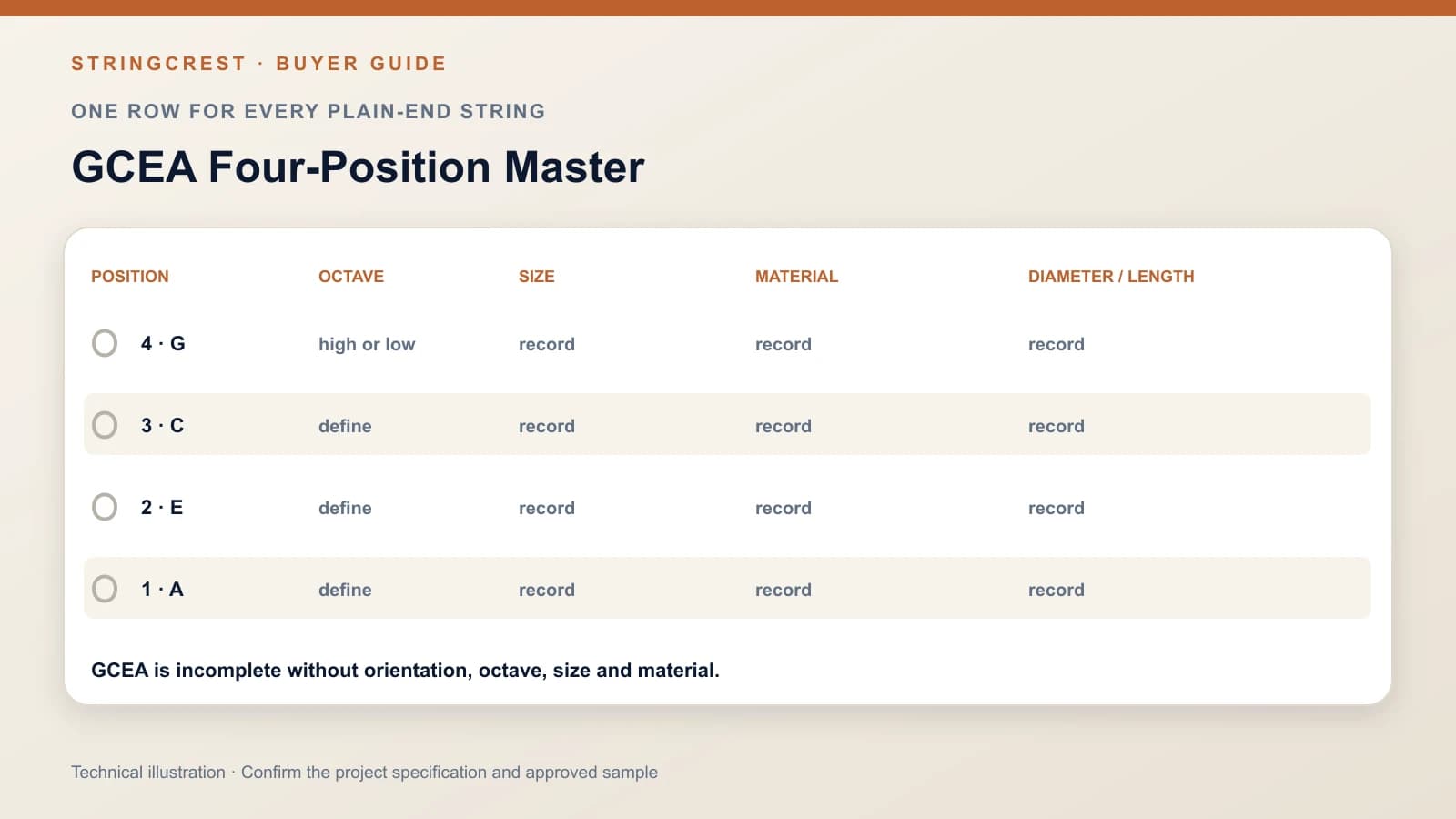
For every proposed set, list:
- string number and pitch, including octave where relevant;
- high-G or low-G configuration;
- instrument size and scale basis;
- material and construction for each position;
- nominal diameter or gauge and unit;
- color, transparency or surface only if controlled;
- usable length and end condition;
- approved sample and artwork revision.
Do not copy a competitor’s gauges into the brief. The D’Addario concert page publishes its own four-position construction, and the D’Addario Nyltech example publishes another. The useful lesson is the completeness of the data, not the numeric values.
Keep physical order and package order synchronized
The master should define how loose strings are arranged inside the pack. Options include envelopes numbered 1–4, individual labels with pitch and gauge, or a fixed card layout. Whatever method is chosen must agree with the outer sequence. If the outer pack lists 4-G first and the inner envelopes start with 1-A, show the numbering prominently.
Color coding can help, but color is not enough. Printing, lighting and material batches can change perception, and buyers with color-vision differences need text. Always retain number, pitch and material identity.
Match the set to size and scale
Do not assume one length fits every ukulele
Soprano, concert and tenor instruments use different scale and overall dimensions. A string can reach more than one size, but compatibility should be demonstrated through usable length, tuner wraps, bridge attachment and installed behavior. A marketing statement such as “soprano/concert” needs evidence on representative instruments.
Record the bridge-to-saddle, saddle-to-nut and nut-to-tuner path for each reference size. For a plain monofilament set, confirm there is enough clean string for secure bridge and tuner attachment without relying on a damaged or irregular section.
Separate baritone from G–C–E–A products
Baritone ukulele commonly uses D–G–B–E rather than G–C–E–A and may use different materials or wound positions. It should have its own position master, packaging and product route. Do not add “baritone” to a GCEA pack simply to broaden the audience.
Other special tunings and multi-string ukuleles also require separate records. A six- or eight-string instrument is not a four-string extension that can be explained with the same artwork.
Define material without relying on transparency
Plain strings can use different polymers
Nylon, rectified nylon, fluorocarbon and other synthetic formulations are established in the market. Clear appearance does not identify the polymer. Two visually similar strings can use different diameters for the same pitch because material density and construction differ.
Record the supplier’s material description for each position and keep it connected to the sample code. Do not call fluorocarbon “carbon fiber”; it is commonly a monofilament, not a woven fiber. Avoid promises such as “perfect intonation” or “never stretches” unless the specific product has substantiation.
Keep the end construction accurate
The StringCrest ukulele direction should be illustrated with plain/tie ends and no metal ball ends. At the bridge, the string is secured according to the intended ukulele design. Product images should not add guitar-style ball ends, hooks or invented hardware.
For receiving inspection, a clean plain end is normal. Check length, surface, identity and the approved preparation. If a project uses a specialty end, assign a separate construction code and verify it on the intended bridge.
Design an installed sample review
Use the intended ukulele size
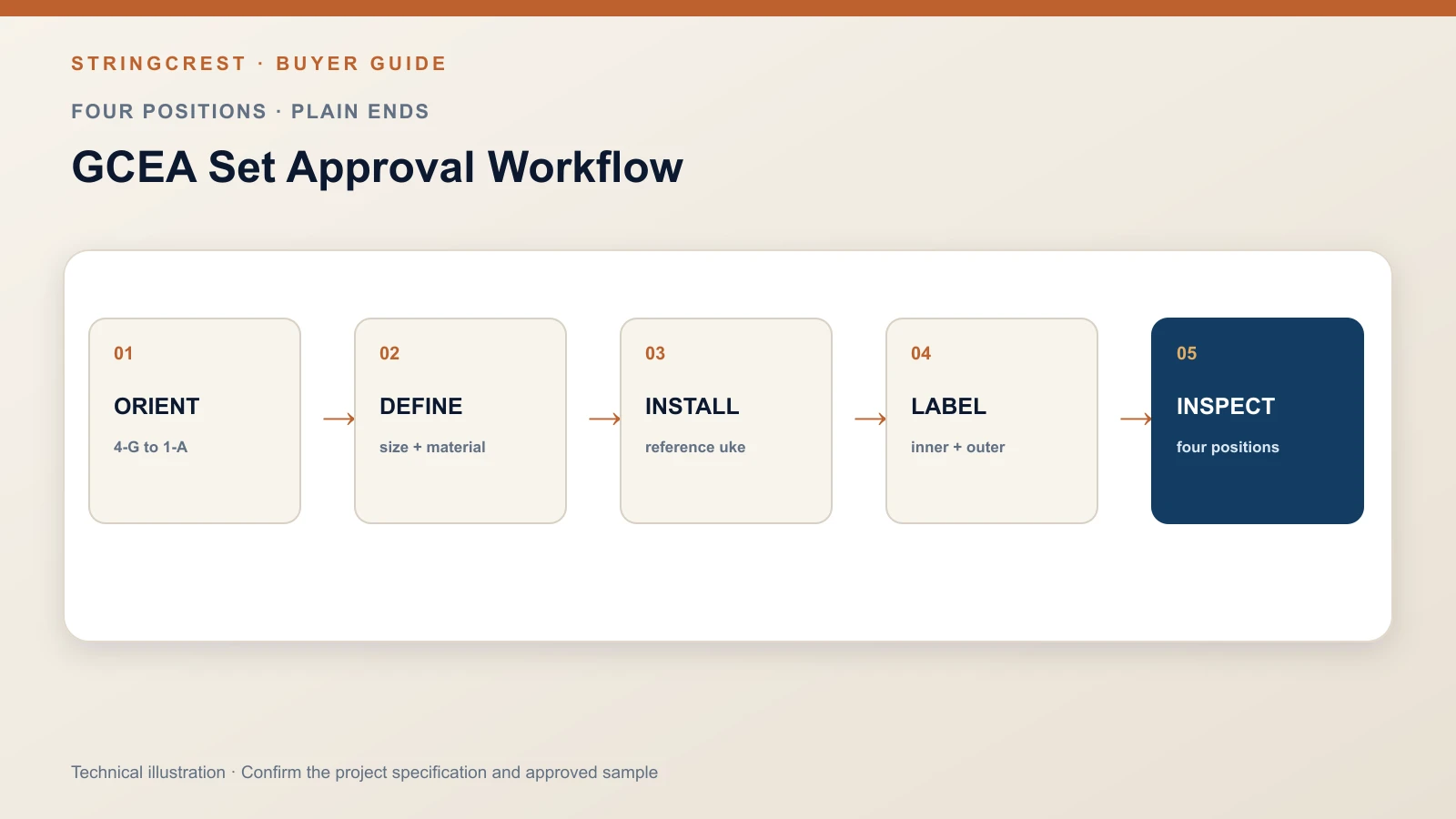
Install the sample on a reference instrument for each claimed size. Record scale, bridge type, tuner path, setup, tuning, sample code, date and evaluator. Photograph all four strings at the bridge, nut and tuners after installation. Confirm the plain ends and correct position sequence.
If the pack claims both soprano and concert fit, review both. A successful concert installation does not automatically prove soprano or tenor compatibility. If high G and low G are offered, treat them as separate installed revisions.
Stabilize and tune through a documented routine
Fresh monofilament strings can require repeated tuning as they settle. Define a consistent installation and stabilization routine for comparison, while recognizing that exact time varies with material, tying method, instrument, environment and handling. Record when observations were made rather than advertising a universal settling time.
Check that bridge ties or attachments remain secure, tuner wraps do not slip and the string path is clean. If a position continues to move unusually, inspect installation and string identity before judging material quality.
Compare repeatable musical tasks
Use open strings, first-position chords, single-note movement across all four positions, repeated melody notes and a short strumming pattern. For high-G sets, include a passage that makes the reentrant fourth string easy to hear. For a low-G proposal, include bass movement and inspect the wound fourth string where applicable.
Record balance, feel, surface noise and tuning behavior relative to the named baseline. Do not convert one player’s preference into an objective ranking. A darker or brighter observation belongs to the tested instrument, room, setup and sample.
Build packaging that survives handoffs
Put size and G configuration near the product name
The front panel should identify Ukulele Strings, the intended size, four-string set and High G or Low G. The back can show 4-G, 3-C, 2-E, 1-A with material and diameters. If the set fits more than one size, list only the sizes approved through the chosen evidence process.
The item code and barcode must identify the exact combination. High-G concert nylon and low-G tenor fluorocarbon cannot share an SKU merely because both use the letters GCEA.
Make inner labels usable without the outer pack
Each inner label should include at least item family, string number, pitch, gauge or diameter and material code. The fourth string needs the G octave or High/Low designation. If multiple loose strings share an envelope, use a diagram that prevents order mistakes.
Avoid arranging four unmarked loops in a photo and assuming their thickness is obvious. Clear monofilaments can be hard to distinguish, especially after a pack is opened. A service team needs textual identity for replacements and complaints.
Link artwork to the approved revision
Store the final four-position table, sample code, artwork, barcode and case label under one revision. The web page should repeat the same orientation and size language. When a diameter or material changes, decide whether the product code, sample approval and copy also need revision.
Artwork proofing should check hyphens, octave notation, units and the order of numbers. A typographic error can turn a correct sample into a misleading product.
Inspect production and shipment evidence
Define what incoming and in-process checks should show
Ask how raw material, extrusion or finished monofilament, position, diameter and set revision are identified. The supplier may propose material certificates, work orders, diameter records or other controls. Confirm which records are applicable and available instead of claiming a process that has not been documented.
Selected diameter checks require an agreed instrument and method. Soft polymer can deform under excessive measurement force, so a number without method may not be comparable. Visual checks can find contamination, kinks or surface damage but cannot prove polymer identity.
Make pack-out checks position-specific
Final inspection can verify outer SKU, high/low G statement, size, print revision, barcode, four inner identities, visible condition, count and case label. An agreed sample can be opened to compare the contents with the master. Periodic installation can confirm fit against the retained reference plan.
Do not rely on total string count alone. A pack with four pieces can still contain two of one position and omit another. The inspection sheet should tick 4-G, 3-C, 2-E and 1-A individually.
Use change control for material and size claims
Require notice before changing polymer, diameter, fourth-string construction, color, usable length, end preparation, inner labels or package components. A material or diameter change normally deserves new samples; a text correction may need only artwork review. Any added size claim should trigger fit confirmation on that size.
Retain the approved sample and specification so a later reorder can be compared against a known revision. Search keywords or competitor listings are not substitutes for product evidence.
Plan a focused wholesale assortment
Avoid too many near-identical sets
A clear starting range may contain one high-G set for a defined size group and one distinctly different material or size option. A low-G extension should launch only after its fourth-string construction and fit are settled. Each SKU needs a sales explanation based on verifiable fields.
Use inquiries to learn whether buyers need soprano, concert, tenor, high G, low G, a different polymer or replacement singles. Do not equate broad search interest with guaranteed order volume.
Prepare replacement singles by position
If singles are offered, link each one to string number, pitch, octave, material, diameter, length and compatible set revision. A generic “G string” is not enough because it may be high or low G. Confirm availability before promising dealer support.
Keep singles labeled after the outer set is opened. A replacement program is useful only when the delivered position matches the original product.
Prepare a quote-ready RFQ
Include:
- soprano, concert, tenor or confirmed size group;
- reference scale and full string path;
- 4-G, 3-C, 2-E, 1-A orientation;
- high-G or low-G configuration with octaves;
- material and construction for every position;
- all diameters or gauges with units;
- plain/tie-end and usable-length requirements;
- reference instruments and baseline set;
- sample codes, evaluation tasks and approval method;
- inner position labels, artwork, barcode and carton details;
- requested current MOQ, sample terms, price, lead time and quotation validity.
Ask the supplier to flag any size or material claim that still needs confirmation. A quote based on “standard ukulele strings” is not sufficiently precise for final packaging.
FAQ
What is the standard ukulele string order?
From string 4, nearest the player’s face in normal playing position, to string 1, the common order is G–C–E–A. Label the orientation because some lists run from string 1 to 4.
Is G–C–E–A arranged from lowest pitch to highest?
Not in reentrant high-G tuning. The fourth-string G is raised an octave and is the second-highest open pitch. GCEA describes physical order across the instrument.
How does a buyer distinguish high G from low G?
Specify the octave and write High G or Low G on the product master, inner fourth-string label and outer pack. The four letters alone are insufficient.
Can one set fit soprano, concert and tenor ukuleles?
Only claim multiple sizes after usable length, attachment, tuning and installed behavior are confirmed on representative instruments. Size names alone do not prove fit.
Should StringCrest ukulele images show ball ends?
No. The approved StringCrest ukulele direction should use plain/tie ends without metal ball ends. Visuals and inspection records must show the correct construction.
What should shipment inspection count?
Verify 4-G, 3-C, 2-E and 1-A individually, plus size, high/low G identity, material or code, visible condition and packaging revision.
Conclusion
G–C–E–A becomes useful for procurement only when every letter is attached to a position, octave direction, size, material, diameter, length and approved sample. Clear orientation prevents the package, warehouse and product page from describing the same set in different ways.
A four-position master also makes future extensions safer. High G, low G, different polymers and additional sizes can be evaluated as controlled products instead of vague variations. That discipline supports accurate quotes, cleaner artwork and more reliable reorders.
Explore StringCrest ukulele strings · Request a four-position ukulele set review
Sources and interpretation limits
- Fender: How to Tune a Ukulele
- Fender Play Support: Ukulele requirements and G–C–E–A tuning
- D’Addario: EJ65C Concert Ukulele Set
- D’Addario: EJ88C Nyltech Concert Ukulele Set
These sources support common GCEA order, high-G pitch logic and the need to state size, material, string count and end type. Their gauges, materials, tension figures, manufacturing statements and product claims belong only to those products. They do not establish StringCrest availability, dimensions, low-G construction, test results, MOQ, capacity, price or delivery time.
FROM GUIDE TO PRODUCT
Connect this guide to Ukulele Strings.
Review the relevant range, then bring the instrument, complete specification and open questions into one project brief.
YOUR PRODUCT · YOUR BRAND
Discuss your next string project with Frank.
Share your instrument category, target market, gauge or material direction and private-label packaging requirements.

ABOUT THE AUTHOR
Frank Zou
Frank works directly with musical-instrument brands, importers and distributors on string specifications, product selection and private-label project requirements.
Meet Frank