
Product Selection
Product Selection
Ukulele String Length and Plain Ends: A Wholesale Fit Checklist
A fit-focused RFQ for four-string nylon ukulele sets with plain ends and size-specific samples.
Introduction
For a buyer sourcing ukulele strings, “four nylon strings” is not a complete product description. Instrument size, tuning, usable length and bridge attachment must be specified together. A set can contain the correct material and still be too short for the tuner route, poorly identified by position, or confusingly labelled for the wrong size. The problem is often discovered only when a retailer or customer opens the package.
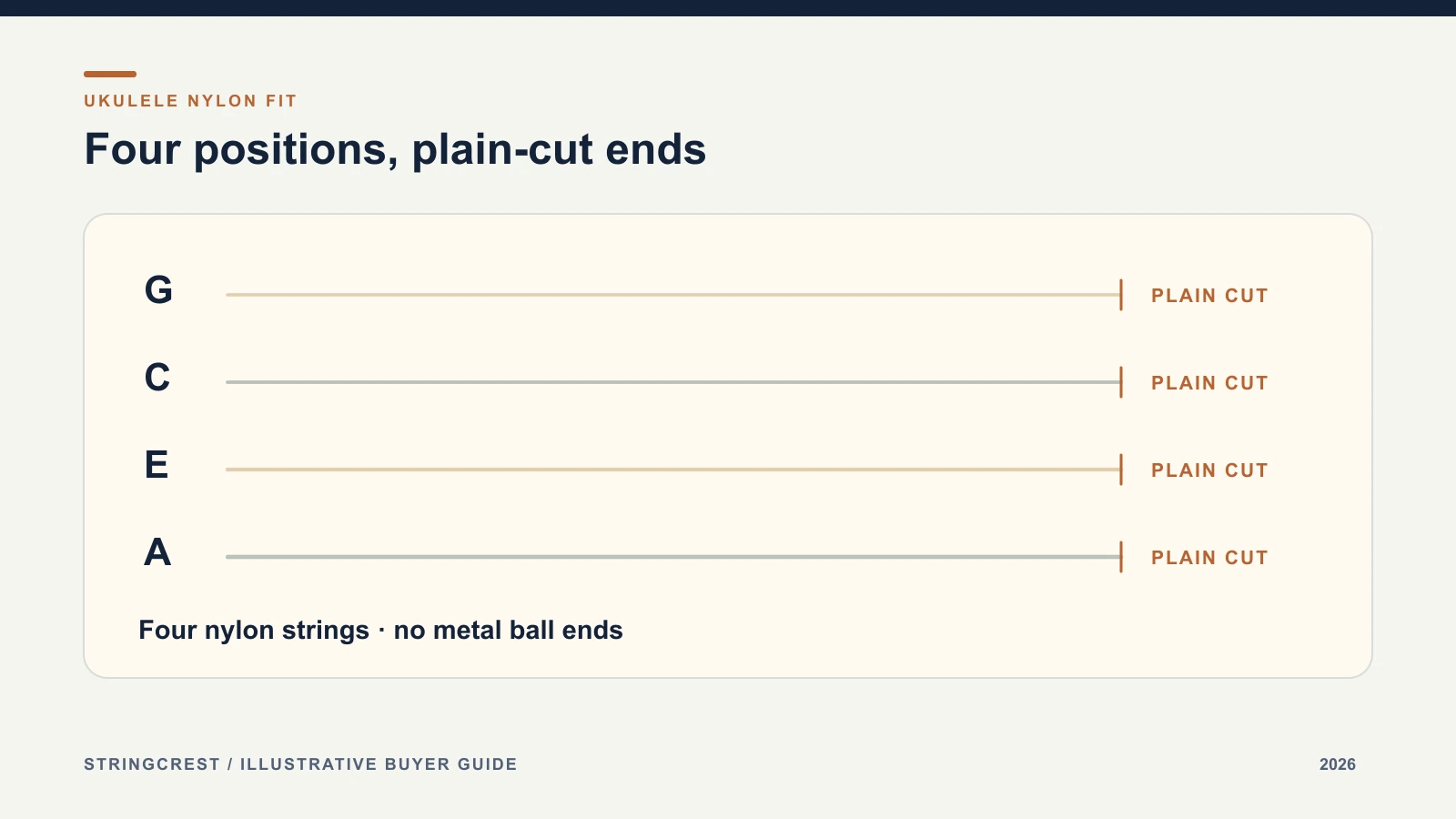
StringCrest’s current ukulele range presents soprano, concert and tenor as selection categories, with a four-string nylon set and plain-cut ends. Exact set availability and dimensions still require confirmation. This guide shows how to prepare a fit-focused request for quotation without inventing a StringCrest baritone SKU or a universal length. The examples from Kala and D’Addario are evidence about common instrument arrangements and another maker’s labelled products, not a substitute for a StringCrest specification.
Start with size and tuning, not a generic “ukulele” label
Soprano, concert and tenor ukuleles share a family resemblance but are not one interchangeable measurement. Their scale lengths and the distance from bridge to tuner can differ by model. The four-position count also does not tell a supplier which note sequence the buyer intends. Kala describes G–C–E–A as common on soprano, concert and tenor instruments, and its explanation of high and low G shows why a set’s fourth-position construction cannot be guessed from “GCEA” alone. Some players or instruments use alternatives; if so, write the actual intended pitch and octave for each position.
A useful assortment begins with the instrument sizes the dealer actually sells. If the shop stocks mainly soprano and concert instruments, a tenor-only length and label should not be presented as a universal set merely to simplify inventory. Conversely, a set long enough for a tenor does not automatically have the intended tension or feel on a soprano. Length, diameter, material and tuning interact. Sample installation on each claimed size is the safe way to approve the pack claim.
| Field | Example information to request | Why it matters |
|---|---|---|
| Instrument size | Soprano, concert or tenor; model when possible | Defines the intended fit review. |
| Scale reference | Nut-to-saddle measurement or maker specification | Helps assess usable length and pitch. |
| Position and pitch | G, C, E, A with octave or an alternative sequence | Prevents high-G/low-G confusion. |
| Material by position | Nylon and any distinct fourth-position construction | Avoids assuming all four are identical. |
| End attachment | Plain-cut/tie method at the actual bridge | Avoids an inappropriate metal ball end. |
| Pack claim | Exact sizes and tuning actually sampled | Limits an overbroad compatibility promise. |
The terms “soprano,” “concert” and “tenor” are useful purchase categories, not a guarantee that every instrument within them has identical hardware. A buyer can choose a narrow claim and expand it after testing more instruments. That is more credible than printing “fits all ukuleles” on the first artwork proof.
Describe the end honestly
A plain-cut nylon end is not a ball end
The StringCrest nylon ukulele product page describes plain-cut ends. In a common tie-style bridge, a player forms a knot or loop to secure the string. Kala’s description of ukulele parts notes that the bridge often secures strings by knotting one end, and a D’Addario soprano set is explicitly listed as tie-end. Those are examples of bridge practice; individual instruments can differ. The buyer should still supply a photograph or installation diagram of the actual bridge.
Do not use a metal ball-end guitar photo to illustrate an unmodified nylon ukulele string. It can mislead the customer about what is in the pack. Artwork, product photographs and ALT text should show the real proposed end: clean plain nylon with sufficient length to tie at the bridge. If a customer has a bridge designed for another attachment method, confirm an appropriate product separately rather than implying that the plain-cut set includes hardware it does not have.
The knot or tie is an installation step, not necessarily a factory-finished feature on every plain-cut string. Specify whether strings are delivered as straight cut lengths, pre-tied loops or another confirmed finish. If the buyer requests a pre-formed end, obtain the bridge dimensions and approve a physical sample. A generic picture of a knot cannot validate an exact bridge fit.
Examine the bridge path before discussing cut length
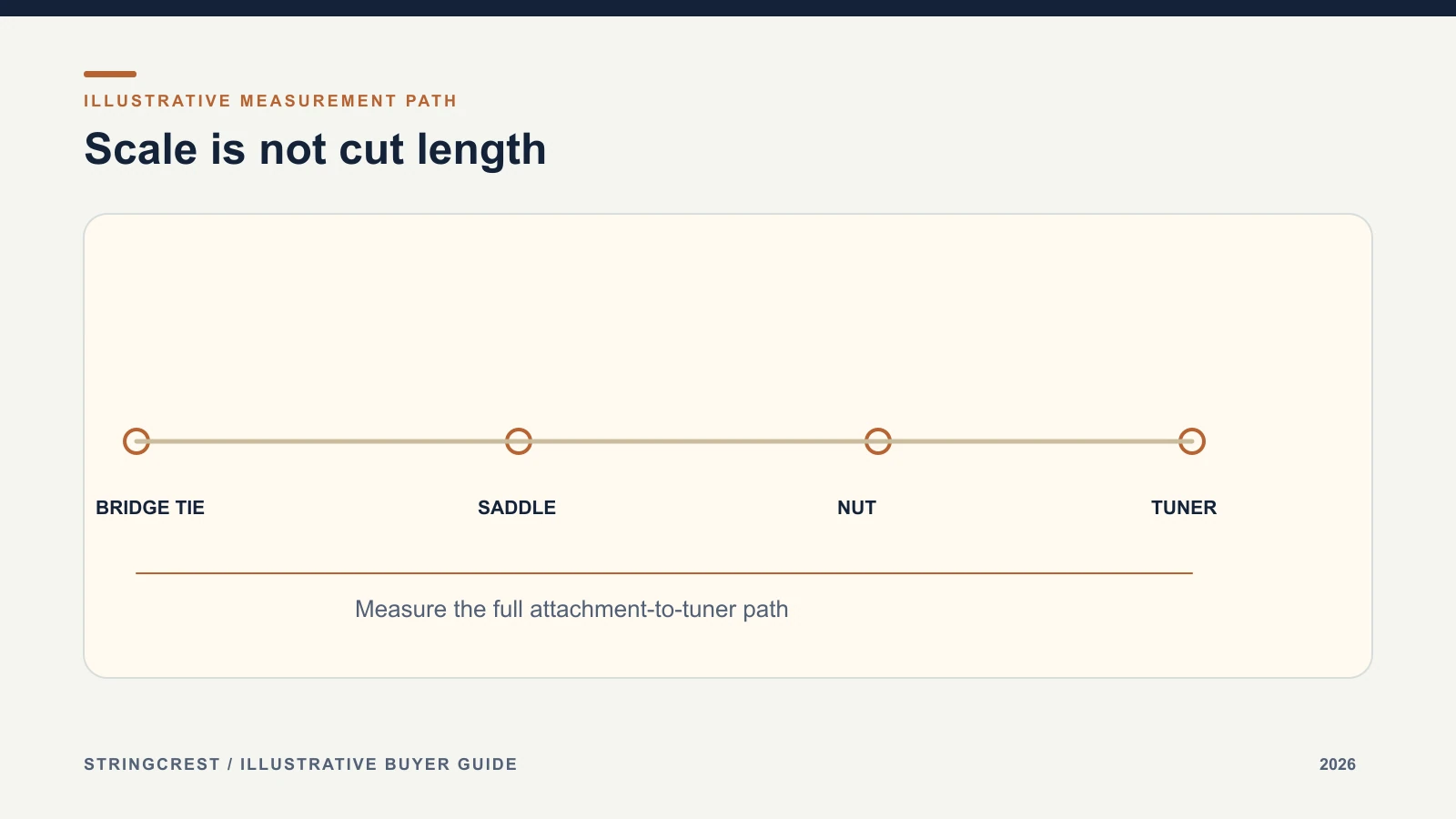
Measure from where the string is secured at the bridge, across the saddle and nut, to the tuning post, then allow for the maker’s recommended windings or tying procedure. Define both the minimum usable length and any excess-length handling. A scale length alone is shorter than the path the string travels; it should never be used as the entire cut-length specification. The buyer's measurement sheet should state the start and end points so two people can reproduce it.
Photographs help: one wide view of the complete instrument, one close view of the bridge and one of the headstock/tuners. Include a ruler or manufacturer dimensions rather than relying only on image perspective. For a model with a different bridge geometry, repeat the check. A string that barely reaches a tuner during one installation is not an acceptable universal-length proof.
Keep position identity through the whole supply chain
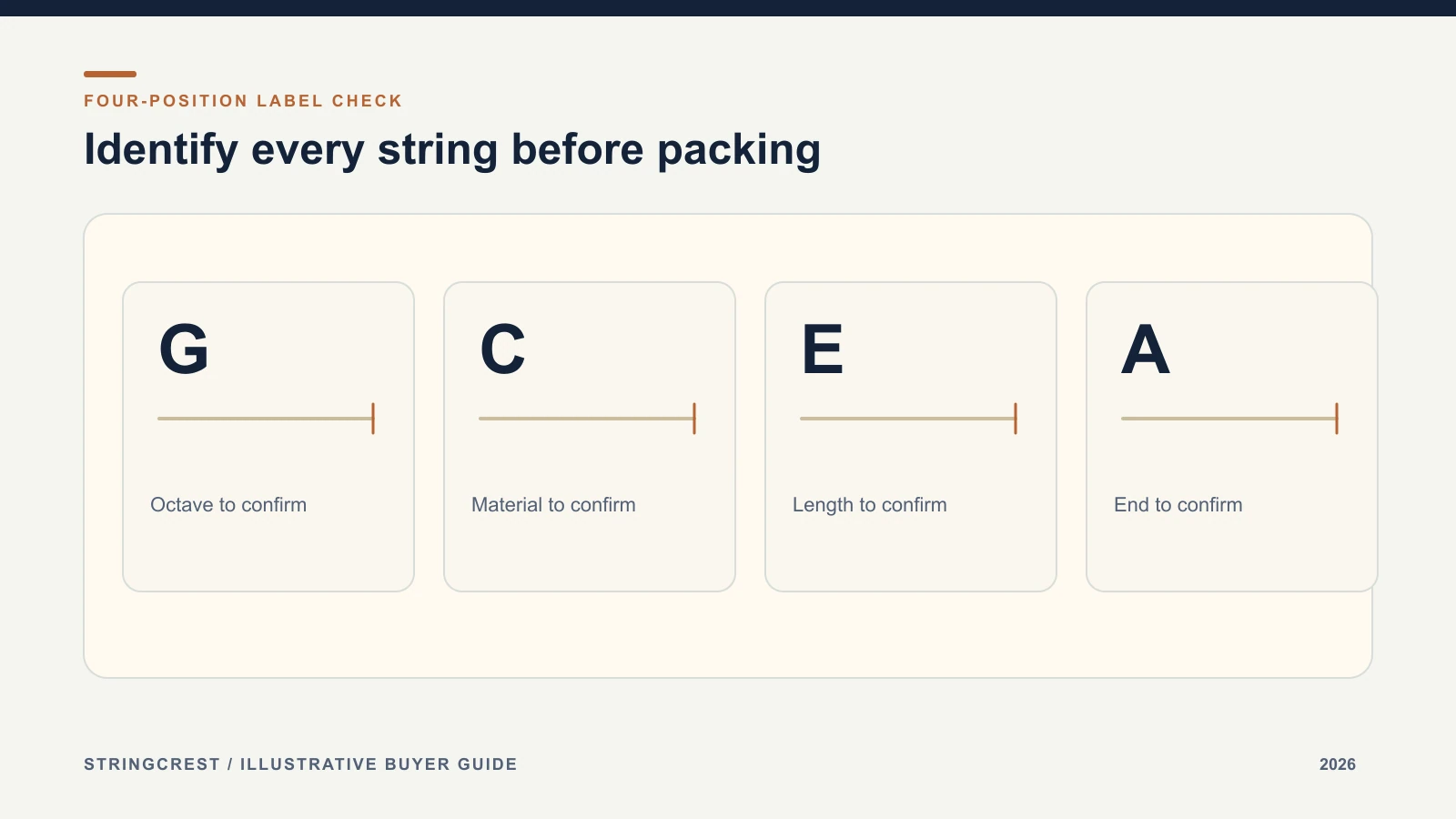
Four strings can look similar inside an unlabelled pack. The buyer should request a position-by-position record showing intended note, octave, finished diameter or other agreed specification, material, length and any distinct construction. If the fourth position is a different low-G design, do not use the high-G code or photograph for it. The pack and each inner sleeve should make the choice visible before the player begins installation.
String orientation can confuse even experienced buyers when a diagram switches between player view and front view. State the view used in every illustration. Kala's public guide describes G as the string closest to the player's face and A closest to the feet in playing position for a standard ukulele. An RFQ can use a simple table from fourth to first position and put both note and physical location on the sample card. Do not ask an illustrator to improvise the string order from an instrument photo.
For a range containing both high-G and low-G versions, give them separate product codes and clearly different front-panel language. A color accent can help but should not be the only distinction; a grayscale printout, barcode scan or text-only retailer feed still needs to distinguish the two. The same applies to size claims. A set approved for soprano and concert should not automatically be listed under tenor in an online catalogue.
Measure the set a buyer will actually receive
Create a position sheet before asking for prices
Begin with one line for G, C, E and A. Record pitch with octave, material, nominal diameter, cut length, end finish, intended size and any packing identifier. Where a value is unknown, say “supplier proposal required.” Do not copy the diameters of another maker’s set and call them a StringCrest specification. An outside example can guide questions, but its formulation, tension and performance are tied to that maker’s materials and scale assumptions.
If you are comparing two material options, hold size, tuning and bridge design constant first. A nylon-versus-fluorocarbon comparison is a separate product decision. Similarly, comparing high-G to low-G adds a tuning and construction change. This article focuses on the fit and identity questions that must be clear regardless of material. When several variables change at once, sample feedback becomes hard to interpret and a quote is hard to compare.
Provide the supplier with the intended retail use and packaging format. Ask them to state the actual strings proposed for each position, not just “nylon four-pack.” Where packaging is sealed for storage, define how the strings stay identifiable after opening. A retailer handling a warranty question needs to know whether a returned G string matches the high-G or low-G SKU; a clear position code is more valuable than decorative copy.
Distinguish tolerances from marketing claims
For production control, a buyer may specify a length tolerance, diameter tolerance, surface appearance criterion and allowed packaging variation. Those values should be negotiated against an actual sample and measurement method. “Precision strings” or “professional quality” is not a test method. If the buyer wants a tension target, state the instrument scale, tuning and the method used to calculate or measure it. Without those conditions a number can create false comparability across sizes.
It is reasonable to ask for a sample card with actual measurements, but do not present an illustrative card as evidence of completed factory testing. Production records and shipment inspection reports should be supplied only if they exist for the relevant batch. If they do not, write a proposed inspection plan and decide with the supplier what can be documented. Credibility comes from matching the claim to the evidence available.
Approve samples on representative instruments
A practical trial should include the exact ukulele sizes named on the planned package. If the label says “soprano/concert,” test at least a representative soprano and concert model; if a tenor claim is added, test a tenor as well. Record maker and model, scale, bridge style, tuner route, tuning and environmental conditions relevant to the trial. More models may be needed if the buyer wants a wide compatibility claim.
Before installation, inspect the four strings and confirm their identities against the position sheet. Check that every string has a plain-cut end if that is the approved design. Install using the instrument maker’s or qualified technician’s method. Note whether a secure tie can be formed with adequate tail length, whether the string reaches the tuning post with practical winding allowance, and whether the surface shows any obvious damage at contact points. Retune as appropriate for nylon settling, but do not invent a universal settling time.
Playing notes can cover clarity, balance, feel and response, yet they should be separated from fit results. A player who prefers one feel may still find that both samples install correctly. Conversely, a pleasing tone does not make an undersized string acceptable. Use pass, fail and unresolved for each fit criterion, attach photographs, and retain the sample revision. If a result is borderline, test another representative instrument or narrow the package claim.
The test should be repeatable by a new product manager. An approval sheet with “sounds good” and no model number does not help when the next shipment arrives. A concise record of position identity, tie method, usable length and exact instrument is more valuable than a long subjective review with no traceable sample code.
Protect the information in packaging and listings
The front panel should make instrument size and tuning visible. “Nylon Ukulele Strings · Soprano · High G” is clearer than “Universal Uke Set.” The back panel or online description can list four positions, material, end style and any size limitation. If a set has been checked on soprano and concert models but not tenor, do not let a marketplace category silently widen the claim. Retailer data sheets need the same scope as the printed pack.
Images matter here. A product photo showing four coils with metal beads would contradict a plain-cut nylon specification even if the text is correct. A lifestyle photo of a ukulele cannot establish which bridge attachment the strings use. Use a close-up of the actual end or an explicitly illustrative diagram that shows a plain cut and the correct number of strings. Captions should distinguish illustration from a photograph of shipped goods.
Artwork approvals should include the product code, barcode, language, intended size, tuning and four-position table. Any change to the string construction or cut length may require another fit trial and a copy revision. Keep an archive of the previously approved proof. Without that history, a dealer could receive an unchanged pack containing a materially different set and have no way to explain customer feedback.
Inspect the first order and manage changes
At receipt, sample sealed packs and compare product codes, size/tuning claims and quantity with the purchase order. Open a documented sample to confirm four strings, inner identifiers, plain ends, visible condition and cut lengths using the agreed measurement origin. Note the inspection quantity and any nonconformance. Keep a retained approved sample nearby so a difference in surface, length or identification can be investigated objectively.
If a pack arrives with a ball end where the approved sample used plain nylon, it is not a harmless visual variation. If a sample is too short for one of the promised sizes, pause the compatibility claim while the supplier and buyer examine the revision. If an inner sleeve labels a low-G string as high-G, quarantine the affected packs rather than relying on a retailer to correct them. These are hypothetical examples of response rules, not reported StringCrest shipment incidents.
For repeat orders, request advance notice of changes to material, diameters, cut lengths, end preparation and packaging. Record the decision: no impact, re-sample or new SKU. Changes that alter the promise on the pack deserve an approval step even when the outside carton looks the same. A disciplined product record lets the buyer extend the assortment later without losing control of earlier claims.
FAQ
Are soprano, concert and tenor strings always interchangeable?
No. A maker may design one set for more than one size, but length, tuning, tension and feel must be appropriate for the instruments named. Check the actual product specification and install a sample on representative models before claiming broad compatibility.
Do plain nylon ukulele strings have metal ball ends?
The StringCrest nylon set described here has plain-cut ends, not metal ball-end hardware. Common tie-style bridges secure a plain string by knotting or tying. Confirm the actual instrument bridge before specifying the end or choosing an image for the package.
Is scale length the same as required string cut length?
No. Scale is generally the vibrating distance between nut and saddle. The complete string must also reach its bridge attachment and tuning post with enough length for secure installation. Define the measurement origin and check a sample on the intended instrument.
What belongs in a four-position sample record?
List the intended note and octave, material, diameter, cut length and end finish for each position. Add instrument model, bridge type, installation observations, pack revision and an approval decision. Separate subjective playing notes from measurable fit checks.
Should the packaging say “fits all ukuleles”?
Only if that broad claim has been supported across the relevant sizes, tunings and bridge types; a narrow, tested size claim is usually clearer. Do not imply baritone compatibility from a soprano/concert/tenor sample review or from another maker’s catalogue.
Conclusion
A reliable ukulele-string range begins with the instrument on which it will be installed. Confirm size, tuning, four-position construction, plain-cut end treatment and the entire bridge-to-tuner path. Put those details in the RFQ, test on the sizes named on the pack, and preserve the accepted sample as the reference for inspection. That process protects a buyer from a common failure: a visually appealing four-string package whose length, end or label does not match the instrument in the customer’s hands.
If you are building a private-label ukulele range, send your soprano, concert or tenor models, bridge photos and four-position brief. StringCrest can discuss confirmed options and sample requirements without assuming an unlisted size or end format.
Sources
- Kala: Getting to Know Your Uke — ukulele parts, common tuning and bridge attachment examples.
- Kala: What Is the Difference Between High G and Low G Tuning? — maker-specific explanation for soprano, concert and tenor tuning choices.
- D’Addario EJ87S soprano set — another maker’s four-string tie-end product example; its material and gauges are not StringCrest specifications.
FROM GUIDE TO PRODUCT
Connect this guide to Ukulele Strings.
Review the relevant range, then bring the instrument, complete specification and open questions into one project brief.
YOUR PRODUCT · YOUR BRAND
Discuss your next string project with Frank.
Share your instrument category, target market, gauge or material direction and private-label packaging requirements.

ABOUT THE AUTHOR
Frank Zou
Frank works directly with musical-instrument brands, importers and distributors on string specifications, product selection and private-label project requirements.
Meet Frank