
Product Selection
Product Selection
High-G vs Low-G Ukulele Strings: A Wholesale Assortment Guide
Plan high-G and low-G assortment roles through tuning layout, fourth-string construction, size fit, labeling and sample approval.
Introduction
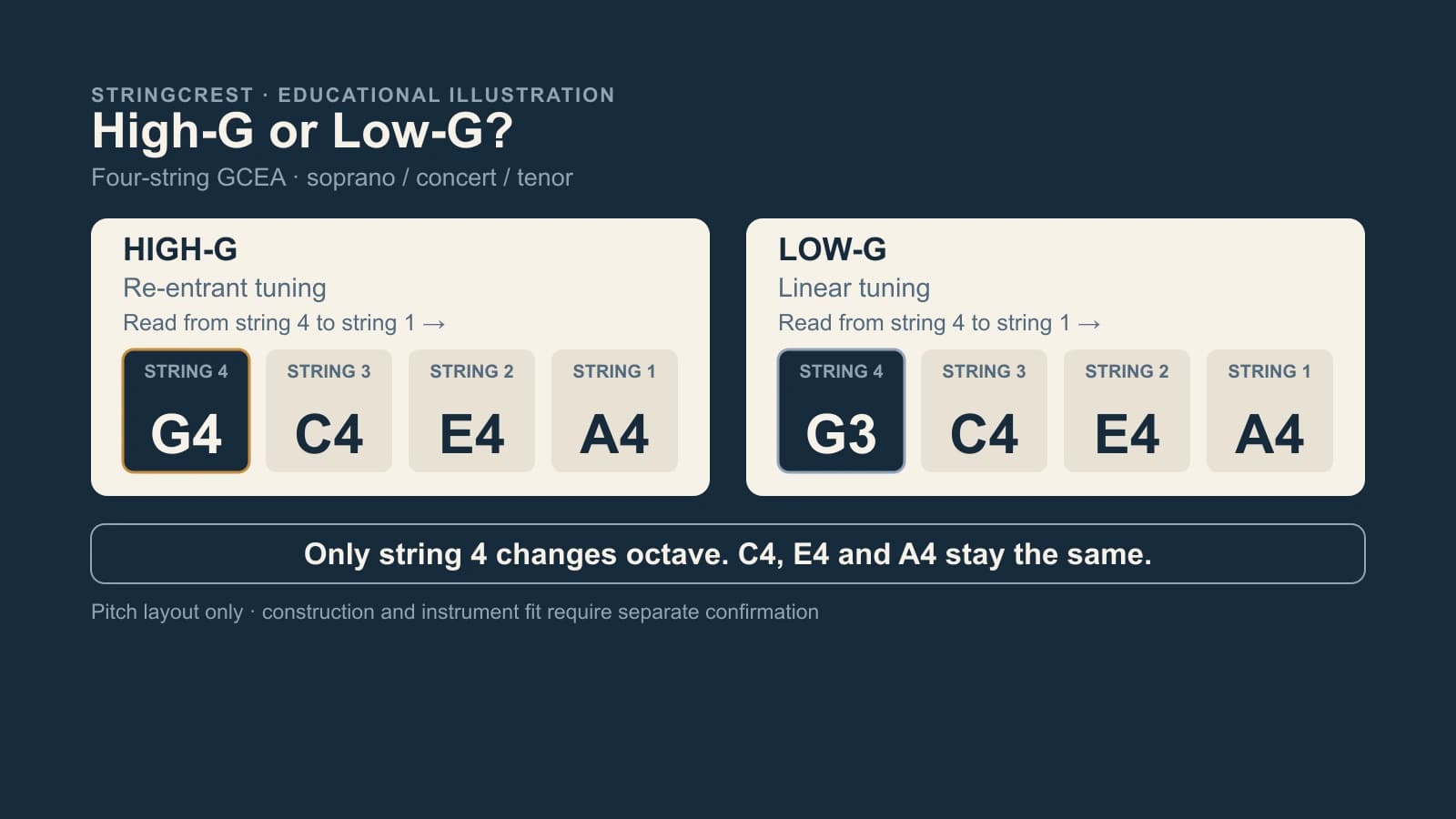
For common soprano, concert and tenor ukuleles in C tuning, high-G and low-G sets differ in the fourth string: G4 for high-G, G3 for low-G. The other three open notes remain C4, E4 and A4. High-G uses a re-entrant layout; low-G places the open strings in ascending pitch from the fourth to the first. Choose the tuning your customers need, then confirm the fourth string's construction and fit before treating it as a replacement SKU.
A low-G string can be wound or unwound. Its pitch does not establish its material, diameter, tension or compatibility with every instrument. This guide covers four-string GCEA assortments. Standard baritone DGBE belongs in a separate baritone ukulele string brief.
What changes when G4 becomes G3?
Read the familiar GCEA tuning sequence from string 4 to string 1:
- High-G: G4–C4–E4–A4.
- Low-G: G3–C4–E4–A4.
The table below uses the reverse direction—string 1 to string 4—so it can also serve as a packing or specification reference. String numbers identify positions, not a ranking from lowest to highest pitch.
| String position | High-G open note | Low-G open note | Difference |
|---|---|---|---|
| 1 | A4 | A4 | Same target pitch |
| 2 | E4 | E4 | Same target pitch |
| 3 | C4 | C4 | Same target pitch |
| 4 | G4 | G3 | Low-G is one octave below high-G |
Aquila's official ukulele guide lists these two pitch sequences for soprano, concert and tenor GCEA sets. Its other tuning options illustrate why a size name alone is not a complete tuning specification.
In a high-G set, G4 is higher than C4: the sequence drops in pitch between strings 4 and 3, then rises through E4 to A4. That return to a lower note is what “re-entrant” describes. In a low-G set, G3–C4–E4–A4 rises continuously, so the layout is called linear.
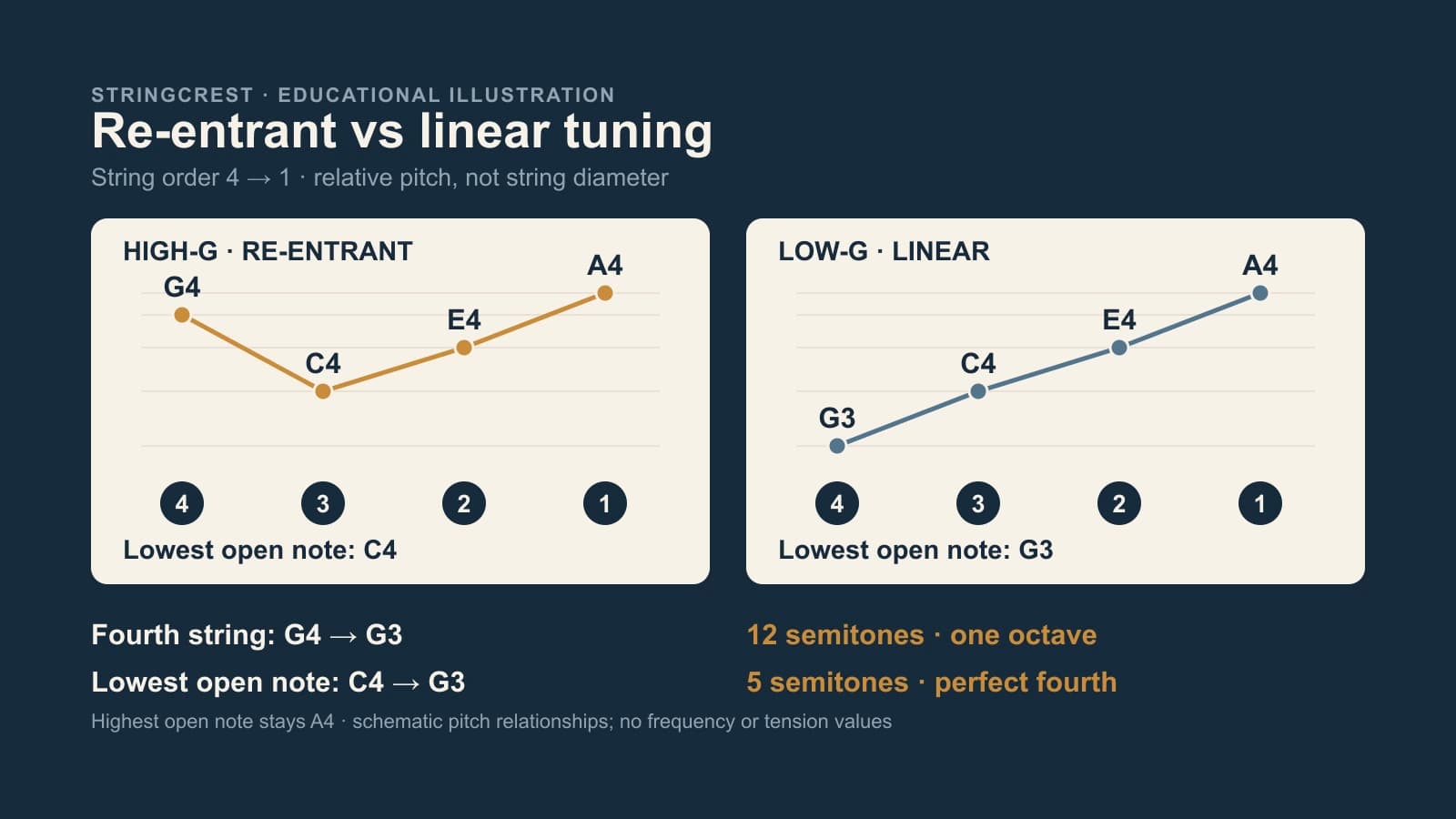
The fourth string drops an octave, but the lowest open note of the whole set moves from C4 to G3—a perfect fourth, or five semitones. A4 remains the highest open note. Low-G adds lower notes for melody and bass movement; it does not move every string down an octave or automatically extend the upper range.
Ordinary chord fingerings still produce the same note names, with the fourth-string note in a different octave. The chord's voicing changes. For range planning, ask whether customers need the re-entrant arrangement used by their lessons and repertoire, or the lower register of linear tuning. Neither layout is a universal upgrade.
Low-G construction is a separate choice
“Low-G” describes the target pitch. “Wound” and “unwound” describe construction. Official products provide useful examples of that distinction:
| Manufacturer's example | What the manufacturer identifies | What it establishes |
|---|---|---|
| D'Addario EJ65T and EJ65TLG | EJ65T is an all-nylon tenor set with G4. EJ65TLG has a G3 fourth string made with silver-plated copper wound on nylon, alongside three clear nylon strings. | A nylon-family low-G set can include a wound fourth string. |
| Aquila New Nylgut guide | Soprano 5U, concert 8U and tenor 15U are listed as low-G G3–C4–E4–A4 sets with one wound string. | Low-G choices are identified by instrument size and a specific set code. |
| D'Addario EJ99TLG | An all-fluorocarbon tenor low-G set with carbon monofilament strings. | Low-G also exists as an unwound fluorocarbon option. |
| Worth CM-LG and Worth's ukulele range | CM-LG changes the fourth string to low-G; Worth identifies its ukulele strings as 100% fluorocarbon. | Another manufacturer identifies low-G by a specific fluorocarbon set code. |
These are manufacturers' examples, not StringCrest specifications or a claim that one construction sounds better. They do not establish a universal low-G gauge or tension. Request the proposed string's finished diameter, material and construction rather than copying a competitor's numbers into your order.
An unwound fourth string has no separate wrap wire. For a wound proposal, distinguish the core from the wrap material; a description such as “nylon set” can leave the fourth string's surface unspecified. During sample comparison, listen for balance between the fourth string and the other three, and note surface feel and finger noise under the same playing conditions.
The StringCrest nylon four-string page is a high-G specification brief example, with A4, E4, C4 and G4 shown by position. It is not a confirmed low-G product data sheet. StringCrest low-G availability, construction and size coverage must be confirmed for the proposed product.
Can low-G directly replace high-G?
It may fit, but “GCEA” on both packs is not enough to approve a direct replacement. Use a fourth string designed for G3 at the intended scale; simply lowering an existing high-G string does not establish a suitable low-G specification.
Check three parts of the instrument and proposal together:
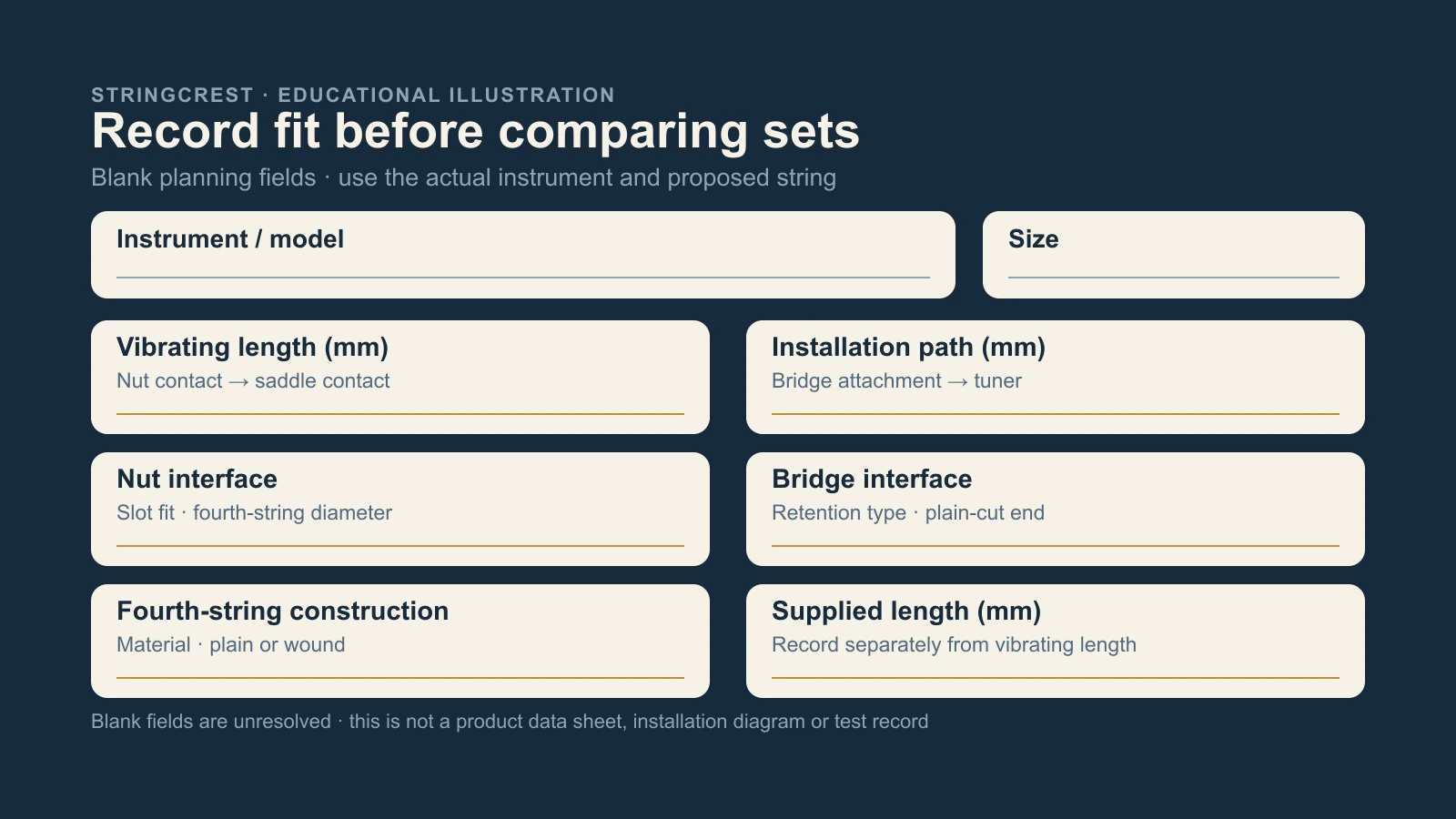
- Size and vibrating length. Record soprano, concert or tenor, the instrument model, and the actual nut-to-saddle vibrating length. Martin's size guide explains scale length as the distance between the nut and saddle. Also record the longer installation path from the bridge attachment to the tuner and the length needed for the specified fastening method. Scale length and supplied string length are different fields.
- Fourth-string nut fit. Check the proposed finished diameter, slot seating and contact edges. A larger unwound low-G candidate may need a setup change. Worth specifically warns that some instruments may require modification for its CM-LGEX version; that warning belongs to that model, not to every low-G string. Aquila's installation guidance also identifies sharp nut edges as a damage risk for its unwound Red Series low-G strings. Have a qualified technician assess a needed slot change before offering “drop-in” compatibility.
- Bridge and tuner interfaces. Identify a tie bridge, a slotted bridge or another attachment design, then confirm how the proposed string is retained and whether it passes through the required openings. Specify plain-cut ends for the nylon proposal in this guide; they have no metal ball ends. A wound surface on a low-G fourth string does not itself imply a ball end. Use the instrument and string manufacturer's installation instructions for the actual combination.
After installation, check seating, slippage, buzzing and fretted pitch as well as the open G3. If hardware has been changed to accept a candidate, record that change: the result no longer demonstrates an unmodified replacement.
Send your instrument size, vibrating length, bridge details and high-G or low-G requirement to discuss a proposal with StringCrest. Include a bridge and nut photo when the attachment or fourth-string fit is uncertain.
Build an assortment customers can identify
A high-G and a low-G pack may both say “GCEA.” Give buyers the octave distinction where they choose, order and receive the product. Put High-G / G4 or Low-G / G3 beside the size and material description, and keep the same identity on the set label and fourth-string envelope.
| Proposed assortment role | Distinction to keep visible | Approval needed before listing |
|---|---|---|
| High-G replacement set | Instrument size or approved fit range; G4–C4–E4–A4; material | Complete four-position specification and fit confirmation |
| Low-G set | Instrument size or approved fit range; G3–C4–E4–A4; fourth-string construction | Low-G availability plus approved construction and fit |
| Separate low-G fourth string | String 4, G3; material; wound or unwound; compatible set reference | Whether single-string supply and that set pairing are available |
These are planning roles, not announced StringCrest SKUs. A brand or distributor can begin with the configurations its dealers actually need and add alternatives when it can explain their compatibility. Do not assign one shared inventory item to a wound low-G and an unwound low-G merely because both tune to G3.
For an existing range, confirm whether strings 1–3 are identical between the two approved sets before promising that customers can change only the fourth string. Matching pitch names do not prove matching materials or diameters. The StringCrest ukulele category is the starting point for discussing the product family. For envelope order and position labeling, use the separate GCEA packaging guide.
Compare samples under the same conditions
Decide what the comparison can answer. A high-G versus low-G review compares pitch layouts. A wound versus unwound low-G review compares constructions at the same G3 target. Hold strings 1–3 constant where the approved candidates allow that comparison. If the other three strings also change, record it as a complete-set comparison rather than isolating the fourth-string construction. Combining pitch and construction changes in one trial makes it harder to attribute a preference.
Use a documented instrument and an installer who follows the relevant instructions. Keep the instrument setup, tuning reference, playing passages and listening or recording arrangement consistent. If different instruments are necessary, record their differences instead of treating the comparison as a controlled test.
| Comparison question | Practical observation to record |
|---|---|
| Does the candidate fit? | Fourth-string seating at the nut, bridge retention, tuner fit, available length and any setup change |
| Is the pitch layout suitable? | A repeated chord passage and a melody that uses the lower register; whether the required arrangement works |
| Is the fourth string balanced? | Its level and feel relative to C4, E4 and A4; surface noise during the same passage |
| Does the installed set behave consistently? | Open and fretted pitch checks, observed retuning and elapsed time after installation |
These are proposed checks, not completed StringCrest test results. Let samples settle according to their manufacturer's guidance, then compare them at a stated elapsed time. Keep listening preference separate from an observed fit problem. Record the sample code and instrument conditions so an approval describes what was actually evaluated.
FAQ
Does low-G lower the whole ukulele set by an octave?
No. In the C-tuning layouts here, only string 4 changes from G4 to G3; C4, E4 and A4 keep their open pitches. The set's lowest open note changes from C4 to G3, a perfect fourth. That is different from the one-octave change of the fourth string itself.
Must a low-G string be wound?
No. Both wound and unwound low-G products exist. The manufacturer's examples above show different constructions; neither target pitch nor a broad material-family name identifies the proposed fourth string's core, wrap, diameter or tension.
Is a low-G fourth string always a direct replacement?
No. Confirm its intended scale, material, finished diameter, length and bridge attachment against the actual instrument and compatible set. Nut-slot or other setup work may be needed for a particular combination, so a GCEA label alone is not a drop-in approval.
Conclusion: use a four-position RFQ sheet
Start with the instrument model, size, nut-to-saddle vibrating length in millimeters, bridge type and installation path. State whether your request is for a full set, a replacement fourth string or both. Add the intended order quantities and packaging requirements separately.
Copy the following blank sheet for each proposed configuration. Enter G4 or G3 in the fourth row, then ask the supplier to complete and confirm the production fields. Blank fields are unresolved; they are not zero values or approved specifications.
| String position | Target open note | Material / plain or wound | Finished diameter, mm | Supplied length, mm / end format | Supplier item / revision |
|---|---|---|---|---|---|
| 1 | A4 | __________ | __________ | __________ | __________ |
| 2 | E4 | __________ | __________ | __________ | __________ |
| 3 | C4 | __________ | __________ | __________ | __________ |
| 4 | G4 or G3: __________ | __________ | __________ | __________ | __________ |
For a wound fourth string, add the core and wrap materials and any construction transition relevant to bridge or tuner fit. If tension is supplied, request its unit, target pitch, vibrating length and whether it is measured or calculated. A tension label alone is not a comparable numerical specification.
Keep high-G and low-G requests on separate sheets. When considering a fourth-string substitution, reference the approved set it must match. This gives the supplier a clear question and gives your sales team an identity it can carry onto the pack.
The diagrams in this guide are educational pitch layouts and blank fit records. They are not photographs of supplied strings, installation instructions, factory evidence or test results. Fit decisions rely on the written specification, the actual instrument and the relevant manufacturer's instructions.
Send your four-position sheet and proposed assortment to StringCrest to confirm which high-G or low-G construction can be proposed for your instruments.
FROM GUIDE TO PRODUCT
Connect this guide to Ukulele Strings.
Review the relevant range, then bring the instrument, complete specification and open questions into one project brief.
YOUR PRODUCT · YOUR BRAND
Discuss your next string project with Frank.
Share your instrument category, target market, gauge or material direction and private-label packaging requirements.

ABOUT THE AUTHOR
Frank Zou
Frank works directly with musical-instrument brands, importers and distributors on string specifications, product selection and private-label project requirements.
Meet Frank