
Product Selection
Product Selection
Private-Label Ukulele String Packaging: A Size and Tuning Proofing Guide
Connect sample identity, four-string data and final artwork to prevent wrong-size ukulele packs.
Introduction
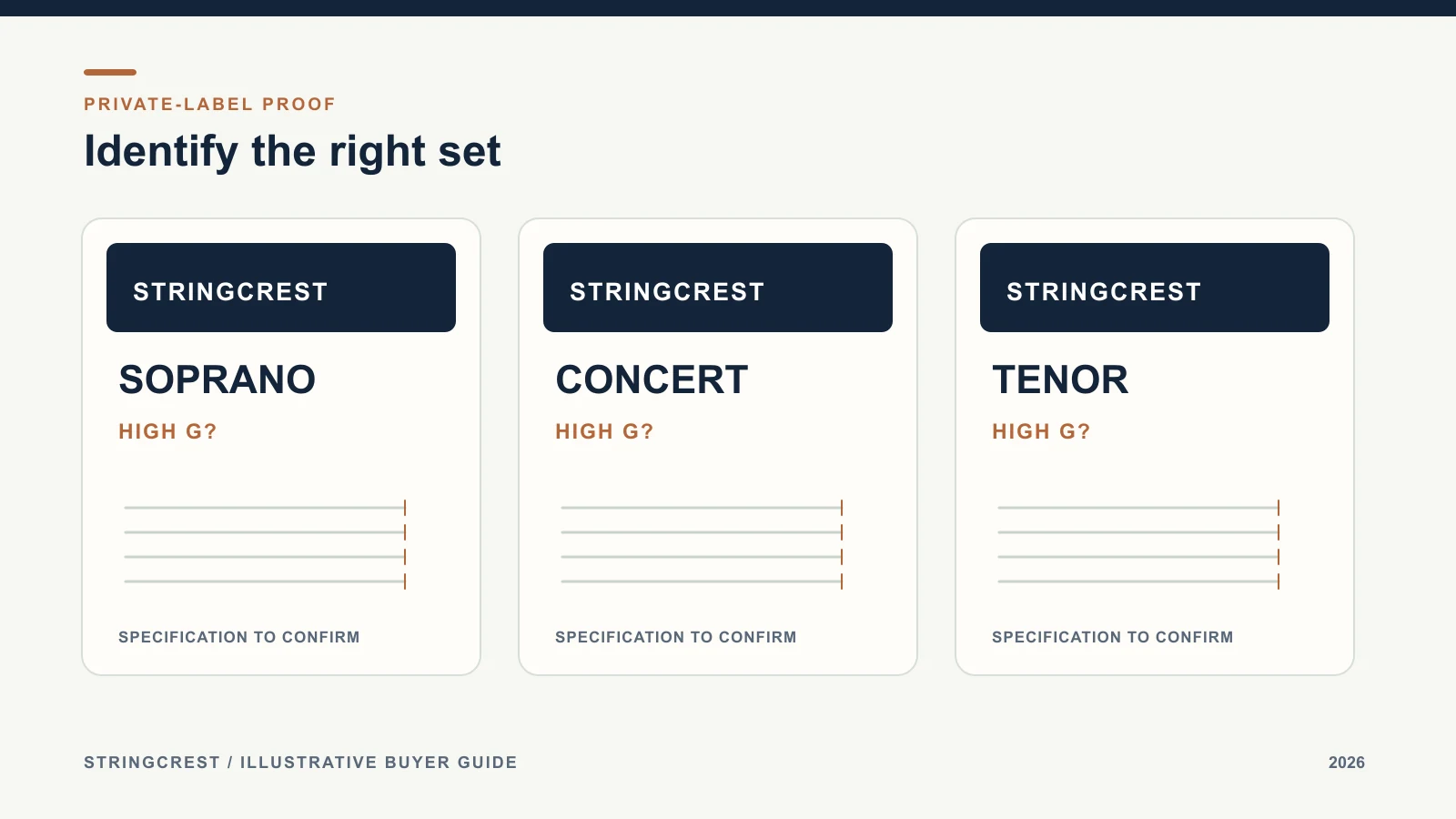
A ukulele string pack can be beautifully designed and still cause a wrong purchase. If “ukulele strings” is prominent but soprano, concert or tenor application is unclear, a dealer may order the wrong set. If the front says low G while the order line and contents describe a high-G configuration, customer support cannot resolve the issue from the artwork alone. For a private-label buyer, packaging approval is therefore a product-identity check, not only a graphic-design milestone.
This guide shows how to connect the four string positions, intended instrument size, tuning, material, end format and pack revision from the sample through the retail listing and shipment. It does not claim that StringCrest offers every size/tuning combination. The current StringCrest ukulele category presents a four-string nylon direction, plain-cut ends and soprano, concert and tenor choices for discussion. Any exact size fit, low-G construction, pack material or private-label commercial term must be confirmed for the requested product.
Define the product before artwork starts
Start with a controlled product record, not a mood board. Give the candidate a working code and state the instrument size, tuning, fourth-string direction, four individual positions, material/construction, end format, useful length and pack unit. Ask the supplier which values are available and which remain proposals. If one string differs from the other three, name that difference in both the technical specification and the artwork brief.
Kala's explanation of high G and low G distinguishes reentrant high-G tuning from a lower fourth string and describes size-specific sets in its own range. The point for a brand is not to copy Kala's products. It is to recognize that “GCEA” by itself may not tell a shopper which octave of G is inside. Kala's size-specific product examples likewise show why a retailer should identify the actual set version, rather than assume one generic pack fits every size and tuning.
The StringCrest product preview shows a high-G tuning example; low-G availability and construction are explicitly subject to confirmation. Do not design a low-G pack first and expect the manufacturing decision to follow. Baritone should not be added to this scope merely because it appears in general search results; it is not confirmed in the current product data. Keep the proposed launch to the sizes and configurations that can actually be specified and sampled.
Use a four-position master record
| Field | Buyer-approved value | Where it must stay consistent |
|---|---|---|
| Instrument size | Soprano, concert or tenor as confirmed | Front, detail panel, order line, listing |
| Tuning | Notes and G octave where relevant | Front claim, four-position panel, FAQ |
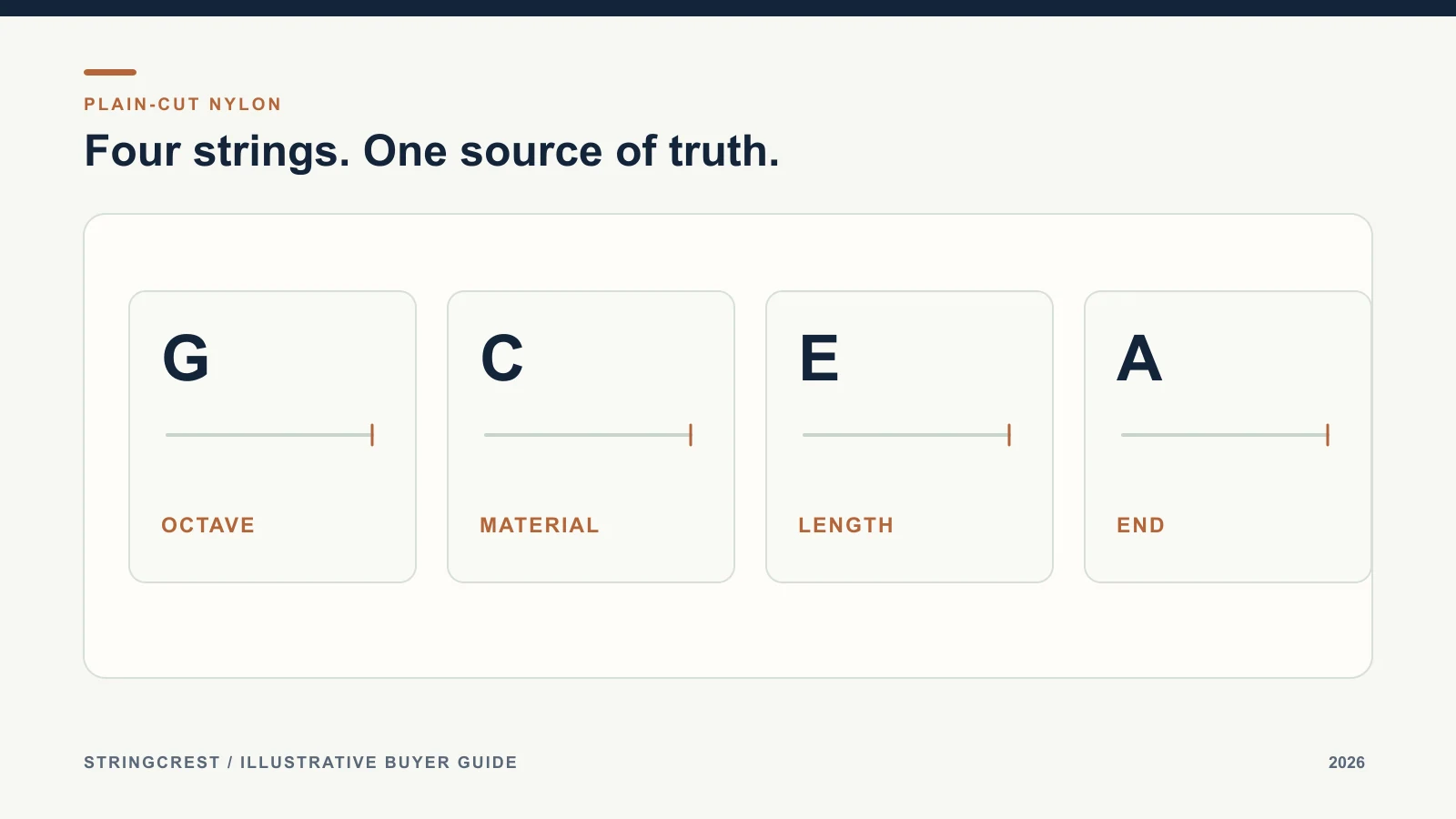
| Position 1–4 | Individual note and material/construction | Supplier brief, sample, technical panel |
| End format | Plain-cut/tie direction for confirmed sample | Supplier brief, installation copy, illustration |
| Useful length | Confirmed measurement and reference points | Technical record, compatibility claim |
| Revision and code | Unique identity for each approved variant | Artwork file, price list, carton, reorder |
Do not fill an unknown cell with an attractive generality. “Fits all ukuleles” is a claim that requires evidence across the instruments it names. If one set may be usable on more than one size, agree on the exact length, tuning and trial instruments before using a multi-size label. The related plain-end and length guide covers that physical check; this article addresses how the confirmed answer appears in customer-facing data.
Make the front panel answer three questions
Within seconds, a retailer or shopper should be able to see the instrument family, size application and tuning direction. A front panel can say “Ukulele Strings,” then the actual approved size and a clear “High G” or “Low G” where that distinction matters. If the candidate is high G, the fourth-string callout can prevent a buyer who expects low G from choosing the wrong SKU. If the product has a wound fourth string, that fact should be confirmed in the technical panel instead of implied by a stylized illustration.
The product name should not outrun the specification. Words such as “professional,” “premium” and “universal” do little to resolve a fit question. A concise identification panel helps the dealer more than several unqualified tone adjectives. If a material claim appears on the front, it must match the approved four-position construction; one wound position can make “all nylon” inaccurate even when the other strings are nylon. The copywriter needs the supplier's confirmed data before final language is approved.
Test the hierarchy at actual shelf or phone-screen size. A proof shown at 200% zoom can conceal a small size label. Print at expected scale, photograph it beside adjacent packs, and view the listing thumbnail on a narrow screen. Ask someone who did not write the artwork to identify the size and G direction without opening the technical brief. Record where they hesitate and revise the hierarchy, not merely the color.
Give the technical panel a four-string audit trail
The rear or side panel should answer what is inside, how it is used and how it is identified. List four positions in a stable order, with note, material/construction and any specific length or end information that is appropriate and verified. A general material phrase can coexist with a detailed panel, but the two must not contradict each other. Do not publish diameters, tension figures or lifespan statements before their source and conditions are approved.
Terminology matters. A standard reentrant high G can be labeled as high G and shown in the four-note sequence, while a confirmed low G needs a distinct label and product code. If the brand wants an installation note, identify the bridge attachment expected for the actual sample. The current StringCrest nylon preview uses plain-cut ends. Product artwork showing guitar-style metal ball ends would be a technical error, even if the designer intended it as decoration. Keep diagrams simple and anatomically correct.
The panel should also carry the information the distributor needs to manage the product: internal item code, approved revision where used, pack count and any buyer-supplied barcode or importer fields. Market-specific legal, recycling or warning copy requires review for the destination market. This guide cannot decide regulatory wording for every country, and a supplier should not be expected to invent the buyer's legal identity or barcode assignment.
For cross-border sales, decide which language or languages belong on the physical pack and which belong on a market-specific insert or listing. A translated size or tuning term should preserve the same product code and four-position facts; it must not become a new unapproved specification. Have a fluent market reviewer check the copy at print size. Do not treat automatic translation as a legal review, and do not add country-of-origin or environmental claims before the business can support them. When one pack serves several markets, version control becomes more important because a late text correction may affect more than one customer channel.
Sample front-to-back check
| Front statement | Technical-panel proof | Order-data proof | Failure to catch |
|---|---|---|---|
| “Concert ukulele” | Approved concert application | Concert SKU and quote | Soprano sample inside concert artwork |
| “High G” | Position 4 identified as approved high G | Matching item code | Low-G pack or listing substituted |
| “Nylon” | Materials listed for all four positions | Supplier construction record | Unconfirmed wound/alternate material omitted |
| “Plain ends” | Correct installation/end diagram | Sample end inspection | Metal ball-end illustration reused |
This table is a proofing method, not a description of a StringCrest production batch. Add rows for claims the brand wants to make, then remove any claim that cannot be supported by the approved sample and documentation.
Keep sample, artwork and listing on one revision
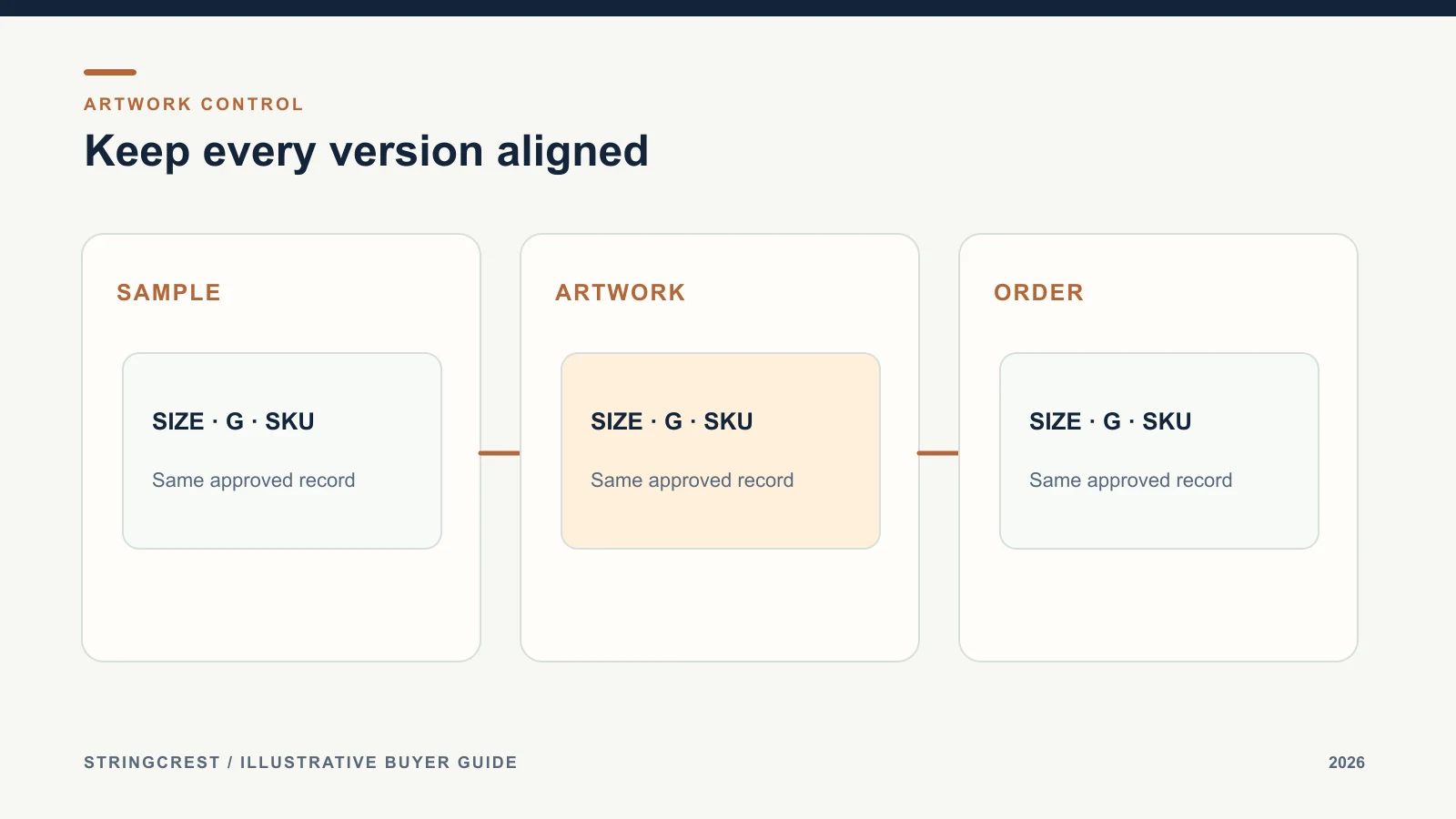
A common workflow failure is approving a sample and artwork in separate conversations. The buyer may receive Sample B after the designer has started from Sample A's notes, or a small change to the fourth string may not reach the e-commerce team. Prevent that with one revision log: product code, sample ID, date, size, tuning, four-position specification, image version, artwork filename and approving person. Each change should state whether it requires a new physical sample, a new pack proof or both.
During sample review, compare the unopened label with the contents and the four-position master record. If the strings are unmarked, agree on a method to identify each position before retail packing. Photograph the sample and its label as evidence of identity, but avoid publishing that photograph as a claim of systematic factory inspection unless such an inspection actually happened and can be documented. The purpose of this buyer-side review is to approve a proposed product, not to fabricate a production history.
For artwork proofing, give the reviewer the master record and a checklist, not merely a PDF with “looks good?” in the email. Verify the front size, tuning callout, material wording, four-position panel, end illustration, SKU, barcode data and destination-language text. Confirm that the same values appear in the website listing, catalog sheet, price list and carton description. A mismatch between online title and pack front can generate a wrong order even when the physical strings are correct.
Distinguish protection from visual design
The printed outer appearance is only one packaging decision. Ask how the strings are kept identified, contained and protected during handling and shipment. Whether a set uses individual inner sleeves, one group pouch, printed cards or another format should be confirmed against the actual product and commercial brief. Do not promise a particular moisture-barrier rating, storage life or corrosion result without applicable material and test evidence.
For nylon strings, the visual condition of the pack and the accuracy of its contents are immediately relevant. Check for mixed positions, misprinted size, an open protective pack or an unreadable code. If a wound fourth string is part of a confirmed low-G concept, it may need its own identification and handling description; do not assume it is identical to a plain monofilament string. Packaging decisions should also consider how a warehouse can select a variant without opening or damaging retail packs.
Ask for a pre-production proof at realistic size and a representative finished pack before accepting a large print run. A screen rendering can misrepresent color, folding, legibility and the location of a small size label. The approval record should state which proof and version was accepted. If the supplier later changes a material or print process, the buyer should decide whether a new proof is necessary rather than silently carrying forward an earlier approval.
Plan the first shipment's identity inspection
Before the purchase order is released, agree on checks that matter to the product's commercial identity. A practical receiving or pre-shipment checklist can verify the approved SKU, visible size and G label, number of strings per pack, readable barcode, sealed or intact pack, outer-carton count and agreement between the carton and retail variants. If material or dimensional checks are part of the order, define the method, sampling and tolerance separately; a marketing proof is not a technical measurement record.
Use a reference sample and the approved artwork revision. If multiple ukulele variants ship together, specify how cartons and inner units are separated and identified. A carton marked “ukulele strings” while containing several size and tuning variants invites picking errors. Keep a change log for any substitution, shortage or relabeling request, and require buyer approval where the final item differs from the controlled record.
Shipment inspection should answer a narrow question: does this shipment match the specified, approved product and pack? It should not be expanded into unsupported claims such as “zero defects” or “factory tested for years.” If a complaint later arises, the sample, order, pack proof and shipment identity should let the team determine which version was supplied.
FAQ
Is “GCEA” enough to identify a ukulele set?
Not always. High-G and low-G sets can both be described with the same letter names while using a different octave for the fourth string. State the G direction clearly on the approved pack and item record. Confirm the actual construction of every position before printing.
Can one package claim soprano, concert and tenor fit?
Only when the actual candidate has been checked for the named sizes, including useful length, tuning and installation. A generic category label is not proof of compatibility. If fit remains unconfirmed, use a narrower approved size claim or request further samples.
Should a nylon ukulele illustration show ball ends?
The current StringCrest nylon preview uses plain-cut ends, so a metal ball-end drawing would misrepresent that proposed product. Match artwork to the actual sample. Other manufacturers may sell different end formats; their existence does not change this specific product brief.
What if a low-G variant is proposed after the artwork is approved?
Treat it as a change to the product specification and likely a separate SKU. Confirm availability and the fourth-string construction, assess whether another sample and fit check are needed, then revise the front, technical panel, listing and order data together.
Which approval should happen first: sample or artwork?
A rough visual concept can be explored early, but final technical claims should follow a controlled sample and specification. Approve the two together under one revision record before printing or placing the bulk order. If a later change affects either, reopen the relevant proof.
Conclusion
An effective ukulele pack lets a buyer identify size, tuning direction and four-position contents without guessing. The master record, sample, artwork, online listing, order line and carton should tell the same story. Confirm the actual StringCrest configuration and packaging terms for the intended project, then use the proofing matrix to prevent a polished design from concealing a technical mismatch.
FROM GUIDE TO PRODUCT
Connect this guide to Ukulele Strings.
Review the relevant range, then bring the instrument, complete specification and open questions into one project brief.
YOUR PRODUCT · YOUR BRAND
Discuss your next string project with Frank.
Share your instrument category, target market, gauge or material direction and private-label packaging requirements.

ABOUT THE AUTHOR
Frank Zou
Frank works directly with musical-instrument brands, importers and distributors on string specifications, product selection and private-label project requirements.
Meet Frank