
Private Label
Wholesale Planning
Baritone Ukulele Strings in DGBE: A Wholesale Range and Fit Guide
Specify baritone ukulele strings by DGBE tuning, scale, four-position construction, wound-string count, tie end, sample fit, packaging and SKU identity.
Introduction
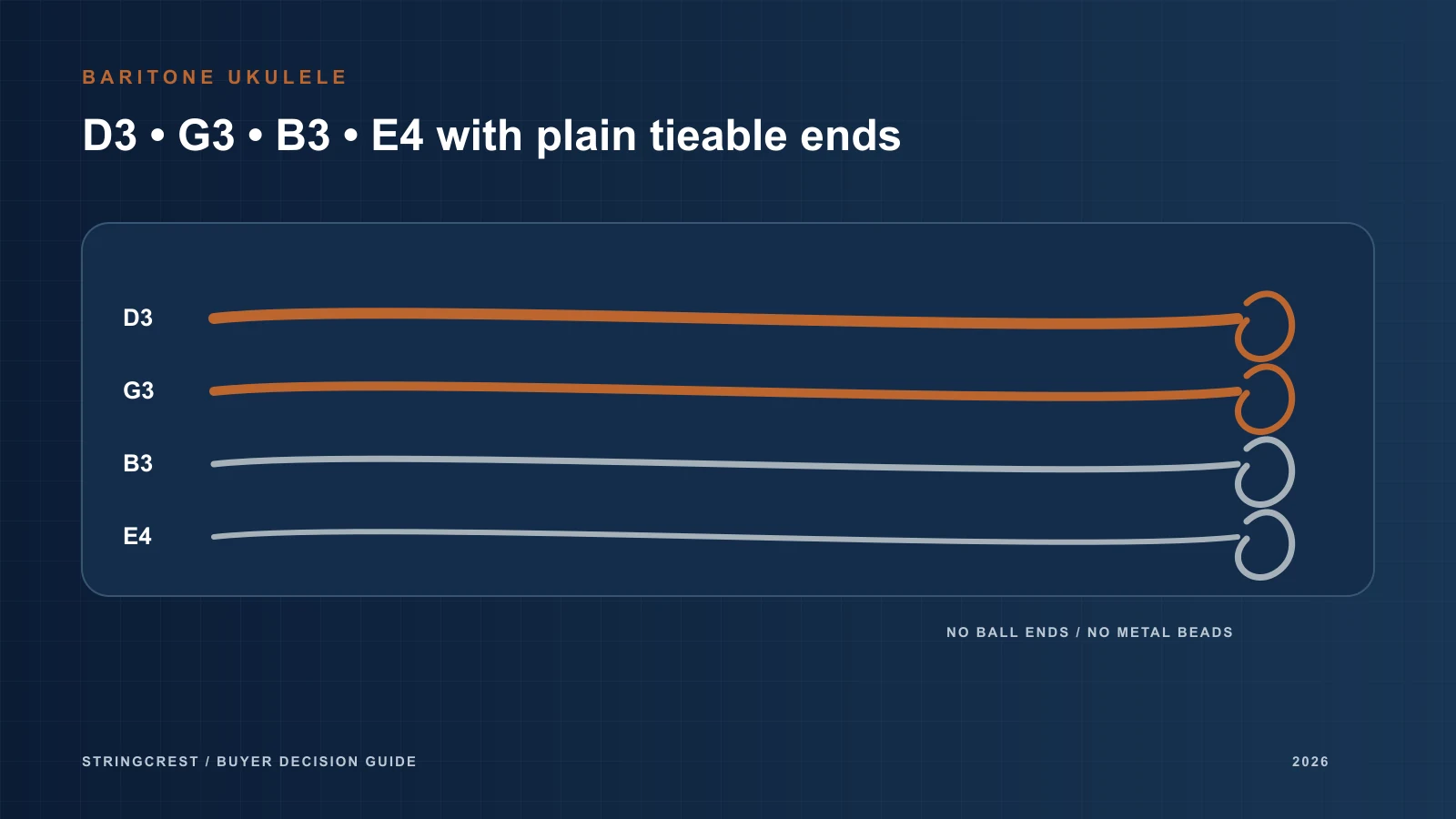
Baritone ukulele strings should not be specified as a larger version of a standard GCEA set. Current D’Addario baritone pages identify standard DGBE tuning and show that four-position construction can differ by family: two cited sets use monofilament E and B with wound G and D, while another cited carbon family uses three monofilament positions and a wound D. The same pages list tie ends. These details belong to those named products and demonstrate the variables a buyer must ask for; they are not StringCrest specifications.
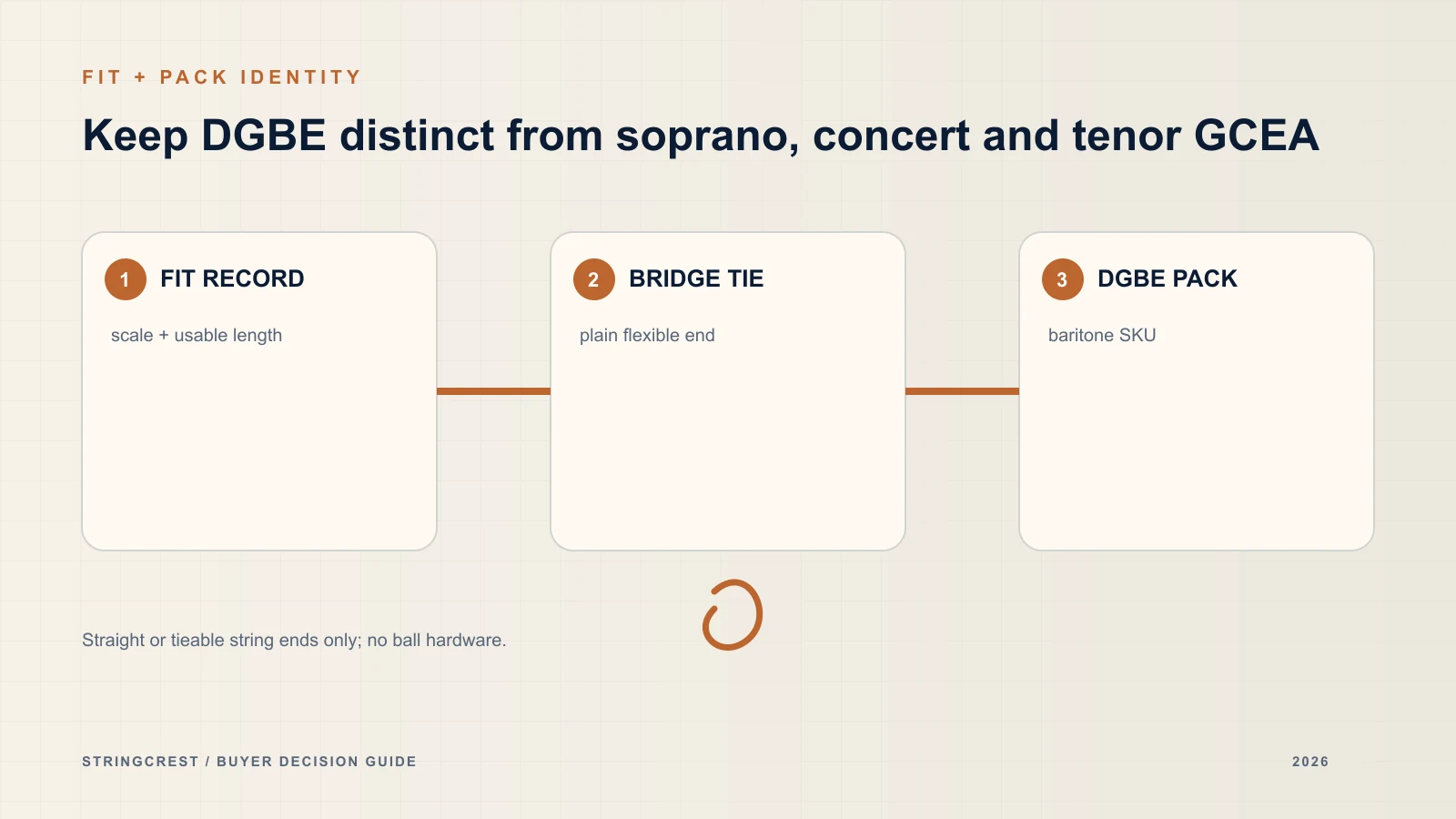
Write D3, G3, B3 and E4, the instrument scale reference, usable length, material and construction at every position, number of wound strings, and the plain tie-end requirement. Nylon-family and fluorocarbon-style ukulele strings in this project must be shown without ball ends or decorative metal beads. Install coded samples on documented baritone instruments and record nut-slot passage, bridge tying, winding clearance, tuning stability during the review and balance as qualified observations. Keep baritone SKU and artwork clearly separated from soprano, concert and tenor GCEA ranges.
For a B2B buyer, choosing among baritone ukulele DGBE string range is a range-design decision rather than a single sound preference. The purchase file has to connect four-position tuning and octave, instrument scale and usable length, instrument fit, package identity and an approved reference. For the baritone DGBE range, when these fields remain implicit, two apparently similar quotations can represent different products and the difference appears only during installation or receiving.
Write the intended customer and instrument use before choosing the SKU. Within the four-position baritone file, a dealer replacement range, an education program and a specialist performance line may need different breadth. The goal is not to predict every player's preference. For the plain tie-end approval, it is to make the proposed range understandable, orderable and repeatable for the selected channel.
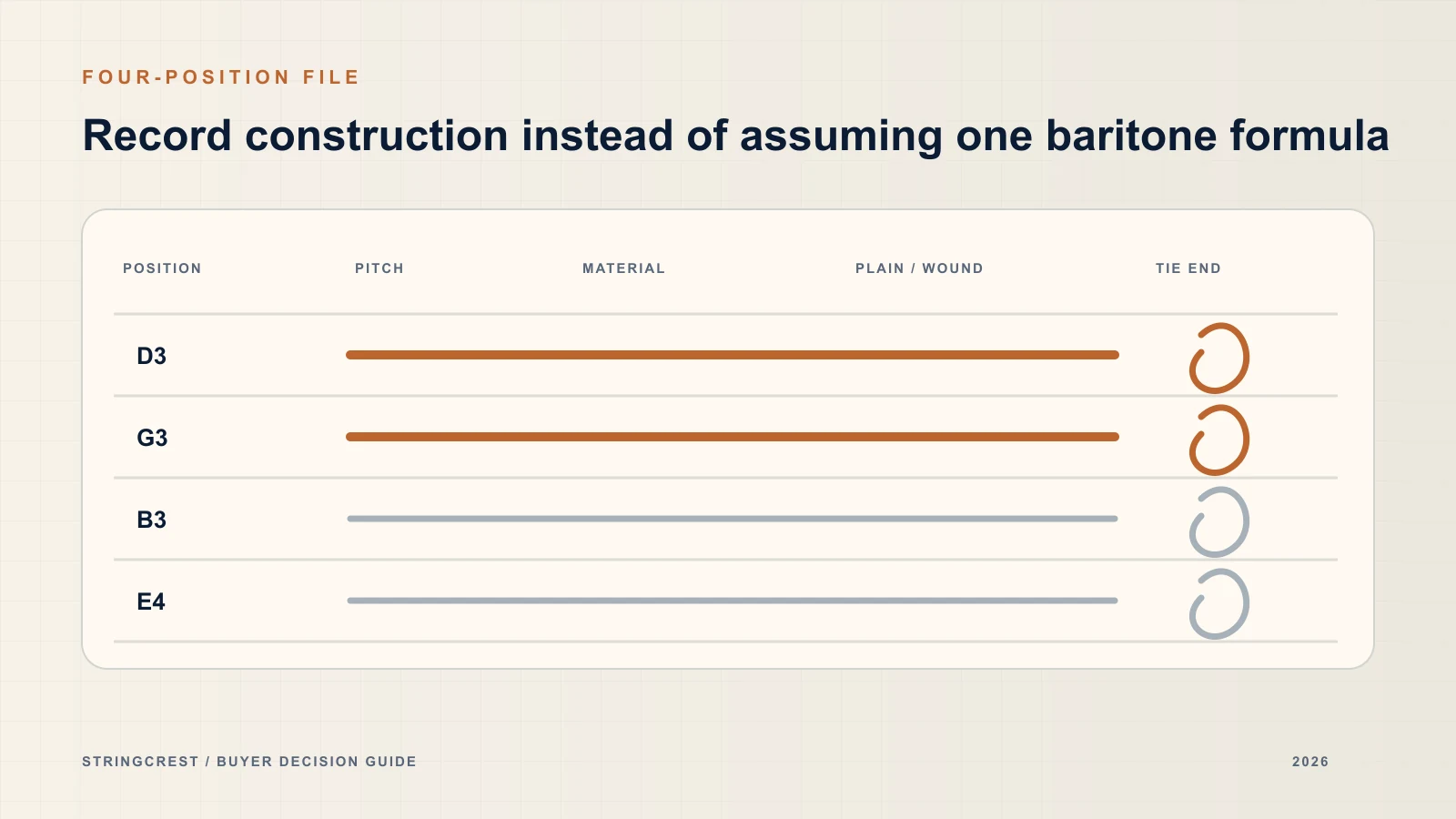
Use a position-by-position matrix. Record monofilament and wound-string layout, plain tie end without ball hardware, coded sample fit record, material or construction family, end format and any visible identifier. For the baritone DGBE range, keep measured fields separate from words such as warm, bright, flexible or powerful. Within the four-position baritone file, those words can guide listening, but they are not substitutes for a specification.
Request supplier-specific data for the proposed construction. For the plain tie-end approval, public competitor charts and product pages can clarify terminology, but they do not become StringCrest specifications. For the baritone DGBE range, state the instrument, tuning, measurement reference and units whenever a length, gauge or tension value is exchanged.
Install coded samples on documented instruments. Within the four-position baritone file, record the model or identifier, relevant scale, bridge and nut condition, tuning, installer, date and the exact sample revision. For the plain tie-end approval, inspect the contact points before blaming a string for breakage, buzzing, slippage or unstable tuning.
Start with the buyer decision
Define the commercial question
At this stage, the practical focus is the field “instrument scale and usable length.” The buyer should turn “Define the commercial question” into a dated decision with an owner, an input document and a visible result. Link that result to the field “coded sample fit record”; otherwise the next team may interpret the same commercial name differently.
Create a decision table before samples arrive. For the baritone DGBE range, for each candidate SKU, state the intended range role, required instrument fit, allowed alternatives, fields that must match exactly and observations that will be recorded. This prevents a meeting from becoming a contest of undocumented impressions. Within the four-position baritone file, it also makes a conditional approval visible: a sample may pass installation but still await package identity or another position-specific check.
Translate the choice into a specification
Fields that belong in the RFQ
At this stage, the practical focus is the field “monofilament and wound-string layout.” The buyer should turn “Fields that belong in the RFQ” into a dated decision with an owner, an input document and a visible result. Link that result to the field “baritone pack and SKU identity”; otherwise the next team may interpret the same commercial name differently.
Write the intended customer and instrument use before choosing the SKU. The goal is not to predict every player's preference.
Treat revision control as part of the product. For the plain tie-end approval, put the same project code and revision on the RFQ, sample label, approval sheet, artwork proof and purchase order. For the baritone DGBE range, if one component changes, record whether the change needs a document review, a replacement sample or full reapproval. Within the four-position baritone file, do not allow a supplier to replace material, construction, length, end format or packaging silently because the commercial name stayed the same.
Check fit before performance language
Installation preparation
At this stage, the practical focus is the field “plain tie end without ball hardware.” The buyer should turn “Installation preparation” into a dated decision with an owner, an input document and a visible result. Link that result to the field “approved DGBE range revision”; otherwise the next team may interpret the same commercial name differently.
Use a position-by-position matrix.
Build a controlled sample matrix
Compare one variable at a time
At this stage, the practical focus is the field “coded sample fit record.” The buyer should turn “Compare one variable at a time” into a dated decision with an owner, an input document and a visible result. Link that result to the field “baritone ukulele DGBE string range”; otherwise the next team may interpret the same commercial name differently.
Request supplier-specific data for the proposed construction.
Create a decision table before samples arrive. This prevents a meeting from becoming a contest of undocumented impressions.
Review packaging and product identity
Make the pack explain the choice
At this stage, the practical focus is the field “baritone pack and SKU identity.” The buyer should turn “Make the pack explain the choice” into a dated decision with an owner, an input document and a visible result. Link that result to the field “four-position tuning and octave”; otherwise the next team may interpret the same commercial name differently.
Install coded samples on documented instruments.
Treat revision control as part of the product.
Plan receiving and shipment checks
Keep inspection tied to the approved revision
At this stage, the practical focus is the field “approved DGBE range revision.” The buyer should turn “Keep inspection tied to the approved revision” into a dated decision with an owner, an input document and a visible result. Link that result to the field “instrument scale and usable length”; otherwise the next team may interpret the same commercial name differently.
For the plain tie-end approval, compare one planned variable at a time and keep the remaining scope stable. For the baritone DGBE range, use repeated musical tasks, but describe observations under the stated conditions instead of turning a small review into a universal promise. Within the four-position baritone file, retain an unused approved sample when practical and link it to the written revision.
Receiving staff need a short version of the approved matrix. For the plain tie-end approval, they should know which features can be confirmed by label and contents, which require measurement and which cannot be verified without specialist testing. For the baritone DGBE range, quarantine unexplained differences first, then compare the affected lot with the retained reference and current document. Within the four-position baritone file, a clear disposition record is more useful than changing the master specification after the fact.
Compare quotations on the same scope
Separate price from launch risk
At this stage, the practical focus is the field “baritone ukulele DGBE string range.” The buyer should turn “Separate price from launch risk” into a dated decision with an owner, an input document and a visible result. Link that result to the field “monofilament and wound-string layout”; otherwise the next team may interpret the same commercial name differently.
Packaging must tell the buyer what is inside without requiring guesswork. For the plain tie-end approval, confirm product family, configuration, material or tuning choice, position count, SKU, barcode, artwork revision and any required market text. For the baritone DGBE range, claims about life, corrosion resistance or measured performance need evidence for the actual product and pack process.
Use cost comparison at the project level. Within the four-position baritone file, include sample rounds, artwork revisions, separate inner packs, barcode control, receiving checks, replacement stock and the cost of a wrong assortment. For the plain tie-end approval, a lower set price can be offset by more variants, ambiguous labeling or extra repacking. For the baritone DGBE range, the quotation should therefore show inclusions, exclusions, validity and assumptions rather than one unexplained unit price.
Manage the range after launch
Use field feedback without overclaiming
At this stage, the practical focus is the field “four-position tuning and octave.” The buyer should turn “Use field feedback without overclaiming” into a dated decision with an owner, an input document and a visible result. Link that result to the field “plain tie end without ball hardware”; otherwise the next team may interpret the same commercial name differently.
Within the four-position baritone file, a shipment check should compare selected units with the purchase order, approved matrix and pack reference. Define the sample method and acceptance rule for the project. For the plain tie-end approval, record lot and carton identity, selection, product count, visible construction, key dimensions, artwork version, deviations and disposition.
Evidence and interpretation limits
Official product information can help define vocabulary, but it remains brand-specific. The cited sources below explain the variables used in this guide. For the baritone DGBE range, they do not establish StringCrest specifications, availability, factory practice, legal compliance or performance. Confirm the actual proposal, sample and quotation for each project.
- www.daddario.com technical reference
- www.daddario.com technical reference
- www.daddario.com technical reference
- www.daddario.com technical reference
Buyer operating worksheet
Turn the range decision into controlled records
Start the working file with baritone ukulele DGBE string range. Within the four-position baritone file, define the sale unit, intended customer and instrument reference before asking for a price. Then record four-position tuning and octave as a position-level requirement rather than a marketing phrase. For the plain tie-end approval, this lets the buyer compare offers that use the same visible name but different construction or fit assumptions.
The technical row should connect instrument scale and usable length with monofilament and wound-string layout. For the baritone DGBE range, state which values come from the supplier, which are measured during sample preparation and which remain observations from installation. Within the four-position baritone file, a missing value stays open; it must not be filled from a competitor chart or a familiar retail description.
Use plain tie end without ball hardware as an installation checkpoint. For the plain tie-end approval, photograph the relevant interface before and after fitting, identify the coded sample and record any adjustment. For the baritone DGBE range, if the sample needs a different setup, describe that condition and decide whether it belongs in the intended range. Do not turn one installation into a universal compatibility claim.
Link every accepted sample to coded sample fit record. Within the four-position baritone file, the approval sheet should name the exact position matrix, packaging revision and unresolved questions. For the plain tie-end approval, when a material, end, length or construction changes, the buyer decides whether document review, another installation or complete reapproval is required.
Receiving and replenishment should use baritone pack and SKU identity and approved DGBE range revision. For the baritone DGBE range, the short receiving aid can confirm identity, count, visible construction and agreed measurements, while specialist properties remain outside a visual check. Within the four-position baritone file, keep previous revisions available so an unexplained difference can be investigated without rewriting the approved record.
After launch, classify feedback by SKU, revision, position, instrument and observation. For the plain tie-end approval, separate preference, wrong application, installation damage, label error and possible product deviation. For the baritone DGBE range, this keeps a small number of comments from becoming an unsupported defect rate or performance promise, while still giving the buyer evidence for the next range review.
The matrix below uses international letter names and scientific pitch notation, from string 4 to string 1. Standard low-D baritone tuning is D3–G3–B3–E4. A re-entrant high-D variant uses D4 instead of D3 and needs its own approved string specification; it must not be substituted under the same tuning label. D’Addario’s baritone reference confirms the standard registers for that named product, not StringCrest gauges or tension values.
| Position | Pitch and octave | Material and construction | Wound status | End and fit record |
|---|---|---|---|---|
| 4 (D) | D3 | Supplier-specific field | Plain or wound as proposed | Plain tieable end; no ball hardware |
| 3 (G) | G3 | Supplier-specific field | Plain or wound as proposed | Plain tieable end; no ball hardware |
| 2 (B) | B3 | Supplier-specific field | Usually recorded as monofilament when proposed | Plain tieable end; no ball hardware |
| 1 (E) | E4 | Supplier-specific field | Usually recorded as monofilament when proposed | Plain tieable end; no ball hardware |
FAQ
Is one sample enough?
No. Plan installation, comparison, retained reference and packaging review separately. The number depends on the project and test purpose.
Can the supplier choose the missing fields?
Within the four-position baritone file, only when the buyer explicitly allows alternatives and records how they will be approved. Otherwise an open field creates quotation and production ambiguity.
Should we copy a competitor specification?
No. Public information can clarify terminology. The project needs supplier-specific construction, fit, measurements and approval evidence.
How should a deviation be handled?
For the plain tie-end approval, identify the affected revision and lot, quarantine when appropriate, document the difference and decide rework, concession or reapproval before release.
What belongs in the first RFQ?
For the baritone DGBE range, include the position matrix, instrument and tuning, material and construction direction, length references, end format, packaging layers, quantities, destination and sample stages.
Conclusion
A dependable buying decision joins baritone ukulele DGBE string range, instrument scale and usable length, plain tie end without ball hardware and baritone pack and SKU identity in one revision-controlled record. Within the four-position baritone file, approve fit and identity before promotional language, preserve the accepted sample, and require every later quotation and shipment check to cite the same scope.
Define the sample method and acceptance rule for the project.
FROM GUIDE TO PRODUCT
Connect this guide to Ukulele Strings.
Review the relevant range, then bring the instrument, complete specification and open questions into one project brief.
YOUR PRODUCT · YOUR BRAND
Discuss your next string project with Frank.
Share your instrument category, target market, gauge or material direction and private-label packaging requirements.

ABOUT THE AUTHOR
Frank Zou
Frank works directly with musical-instrument brands, importers and distributors on string specifications, product selection and private-label project requirements.
Meet Frank