
Buying Guides
Buying Guides
Six-String Ukulele Strings: Four Courses or Guitalele?
Six physical strings can mean four paired or single courses, or six individual guitar-style positions. Identify the actual model and every component before ordering.
Introduction
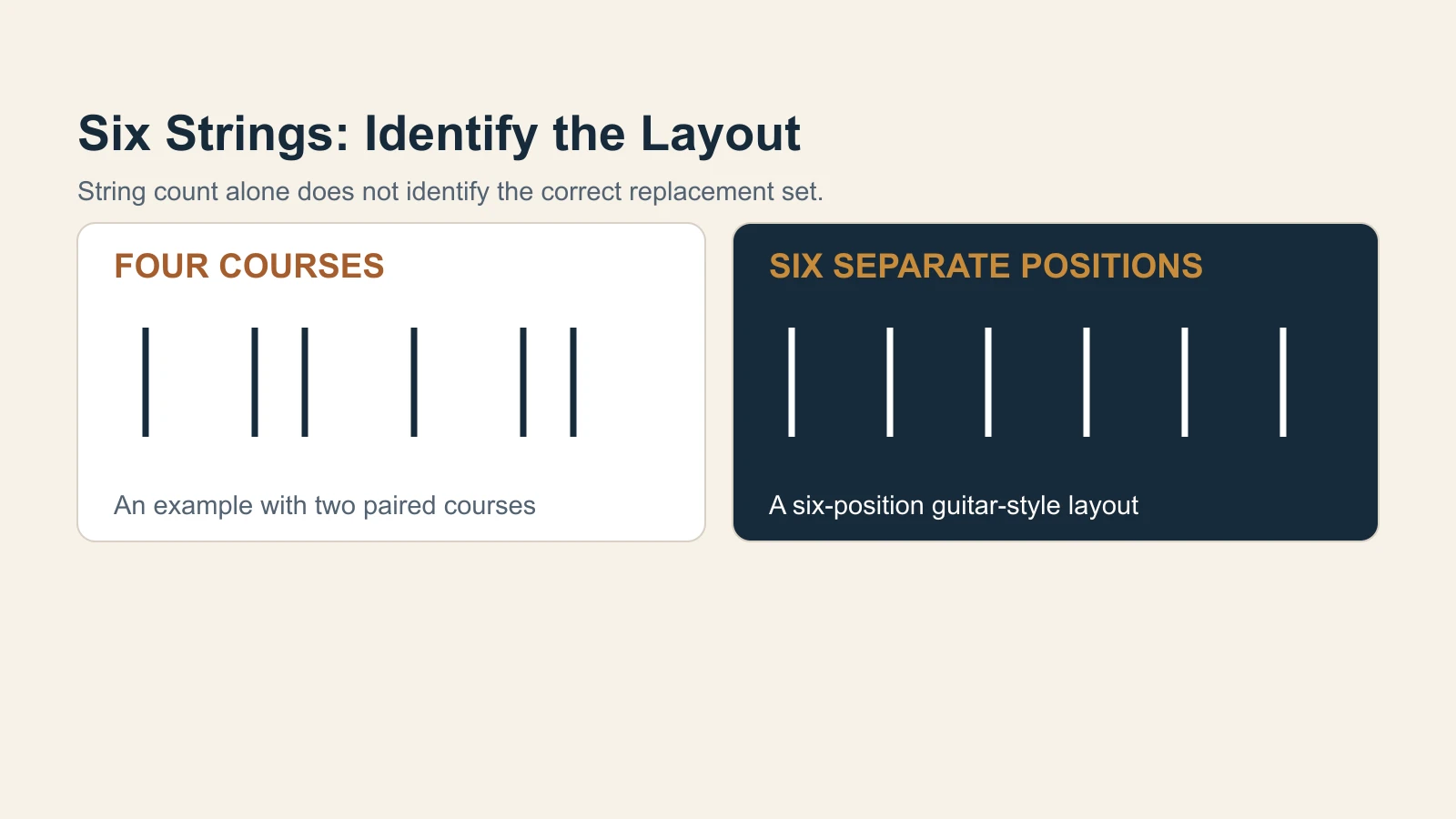
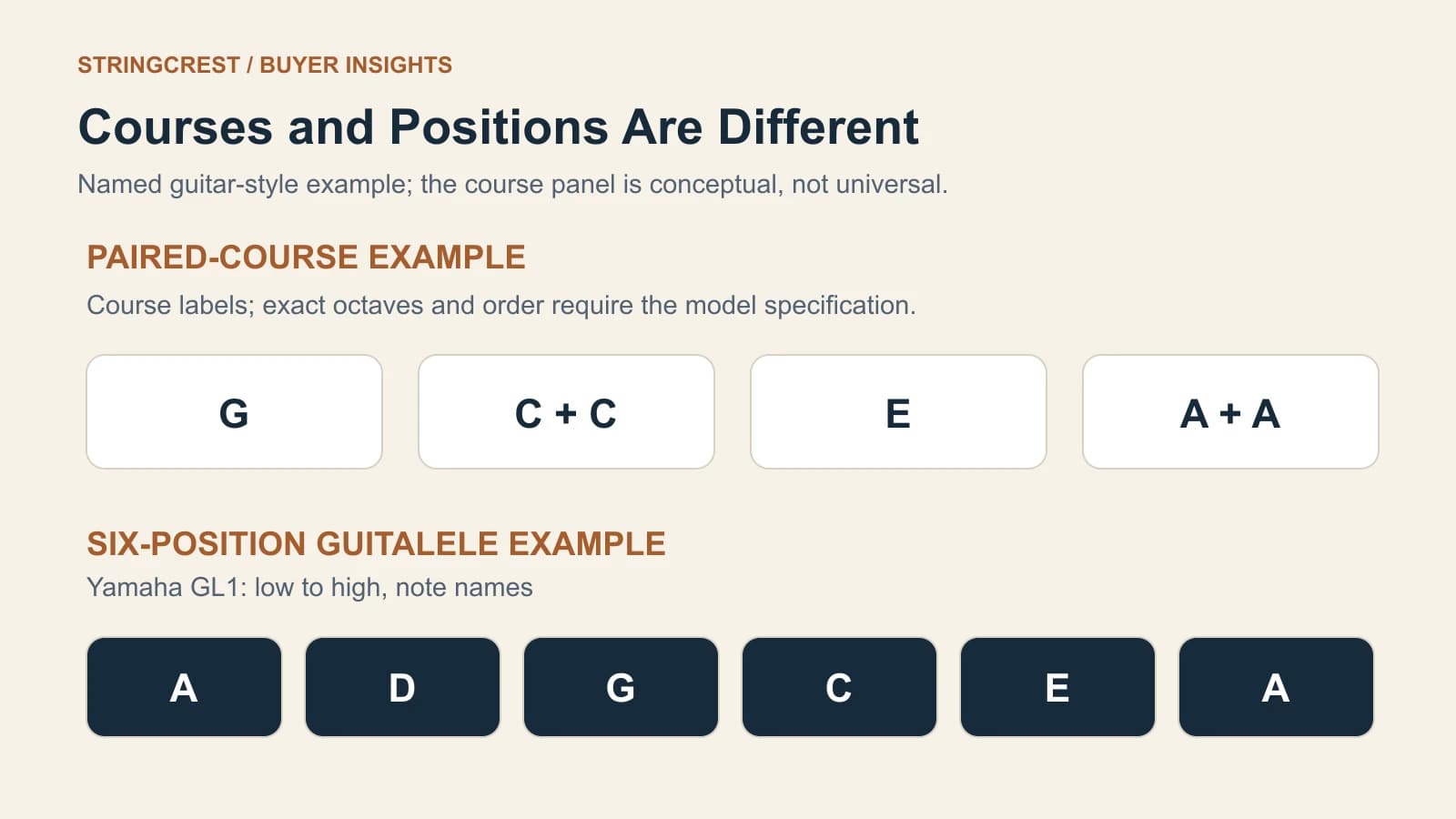
Before ordering 6 string ukulele strings, establish whether the instrument has four courses containing six strings or six separate playing positions. In the Kala six-string ukulele configuration discussed below, the C and A courses each contain an octave pair. Yamaha’s GL1 guitalele uses six individual strings with A–D–G–C–E–A tuning. A pack described only as “six-string” does not resolve that difference.
For a dealer, the useful starting point is the instrument’s exact model and its maker’s string map. Count both physical strings and courses, then identify every member of a pair. This guide separates those records so a replacement request for “the C string” or “the sixth string” becomes specific enough to discuss. It does not provide a universal six-string tuning or approve a substitute set for an unidentified instrument.
Count courses as well as strings
A course is a playing group: it may contain one string or more than one string intended to be played together. Six physical strings can therefore occupy four courses. The extra members do not necessarily create two new independent note positions.
| Question | Four-course six-string ukulele example | Yamaha GL1 guitalele |
|---|---|---|
| Physical string count | Six | Six |
| Playing groups | Four courses | Six individual positions |
| Tuning description used here | G–C–E–A course names; C and A paired in Kala’s described configuration | A–D–G–C–E–A |
| What must the replacement record distinguish? | Each course and each member within its pair | Each of the six individual positions |
Kala explicitly distinguishes its six-string ukulele from a guitarlele and describes octave pairs on C and A in its six- and eight-string explanation. That is a documented configuration, rather than a rule for every instrument sold under the six-string ukulele name.
For ordinary four-string instruments, our GCEA string-order guide explains the four-position reference. Its four-row packaging map should not be extended to a paired-course instrument by adding two unnamed strings.
Keep the named examples within their evidence
Kala’s six-string description and an actual model
Kala’s explanation identifies a lower-octave A member as part of its described arrangement. Its later tuning guide again describes octave pairs on C and A. Neither description makes the phrase “sixth string” a universal name for that additional member.
The actual Kala KA-6 product page identifies a tenor six-string instrument and lists D’Addario Nyltech Tenor 6-String strings. That family label is useful identification, but it does not supply a complete component-number map or explicitly name a replacement-set code. Keep the instrument model and replacement-set identity as separate fields until the connection is confirmed.
A string-set example with explicit octaves
D’Addario publishes the following notes for its EJ88T-6 six-string tenor set. The table below groups those notes by course name; it does not reproduce the manufacturer’s displayed sequence as an installation order. D’Addario EJ88T-6 specifications.
| Course label for this record | Members in the named EJ88T-6 example | Physical member count |
|---|---|---|
| 4 — G | G4 | 1 |
| 3 — C | C4 and C5 | 2 |
| 2 — E | E4 | 1 |
| 1 — A | A3 and A4 | 2 |
| Total | Four courses | 6 |
Here, the two C members differ by an octave, as do the two A members. The course sequence is a route across the instrument, not a rising-pitch list. No left/right order within a pair is assigned by this table. The set page also identifies a tie-end product; that information belongs to this named set, not every six-string instrument.
This is a separate string-set reference. It is not evidence that EJ88T-6 is the documented factory set for every KA-6, or that its component specifications fit a different maker’s instrument.
Yamaha GL1 follows a different map
Yamaha describes the GL1 as a small six-string nylon guitar pitched up a fourth, with A/D/G/C/E/A tuning. Treat its six individual positions as a different replacement system from the four-course uke example.
The cited US page gives tuning letters without scientific octave numbers. Retain that distinction in the order record: obtain the actual model’s per-position octave information from its documentation instead of turning this article’s letter sequence into a complete replacement specification. A similar body size, six tuners or an overlapping product name does not establish the same set.
Separate course numbers from component numbers
Use three labels when a course contains two members:
- Course identity: the playing group, such as the C course.
- Member identity: which of its two strings is being discussed, including the intended octave.
- Maker’s component identity: the packet number, single-string reference or other identifier used to supply that member.
For the GCEA example above, course labels run 4 G, 3 C, 2 E, 1 A. A supplier may identify the six components differently. Preserve the maker’s notation alongside your course labels rather than renumbering the pack to fit an assumed six-position system.
If a working record uses “member A” and “member B,” define them as neutral record labels. They should not silently mean left/right, nearest the player, lower/higher pitch or a particular tuner. Record the viewing direction and the maker’s own diagram reference when physical placement matters.
This makes a single-string replacement request clearer. “C course, C5 member, packet reference ___” conveys more than “third string.” If that member’s identity remains unknown, record the uncertainty before selecting a replacement. Do not choose the member from thickness alone.
Fill a six-member course-to-component record
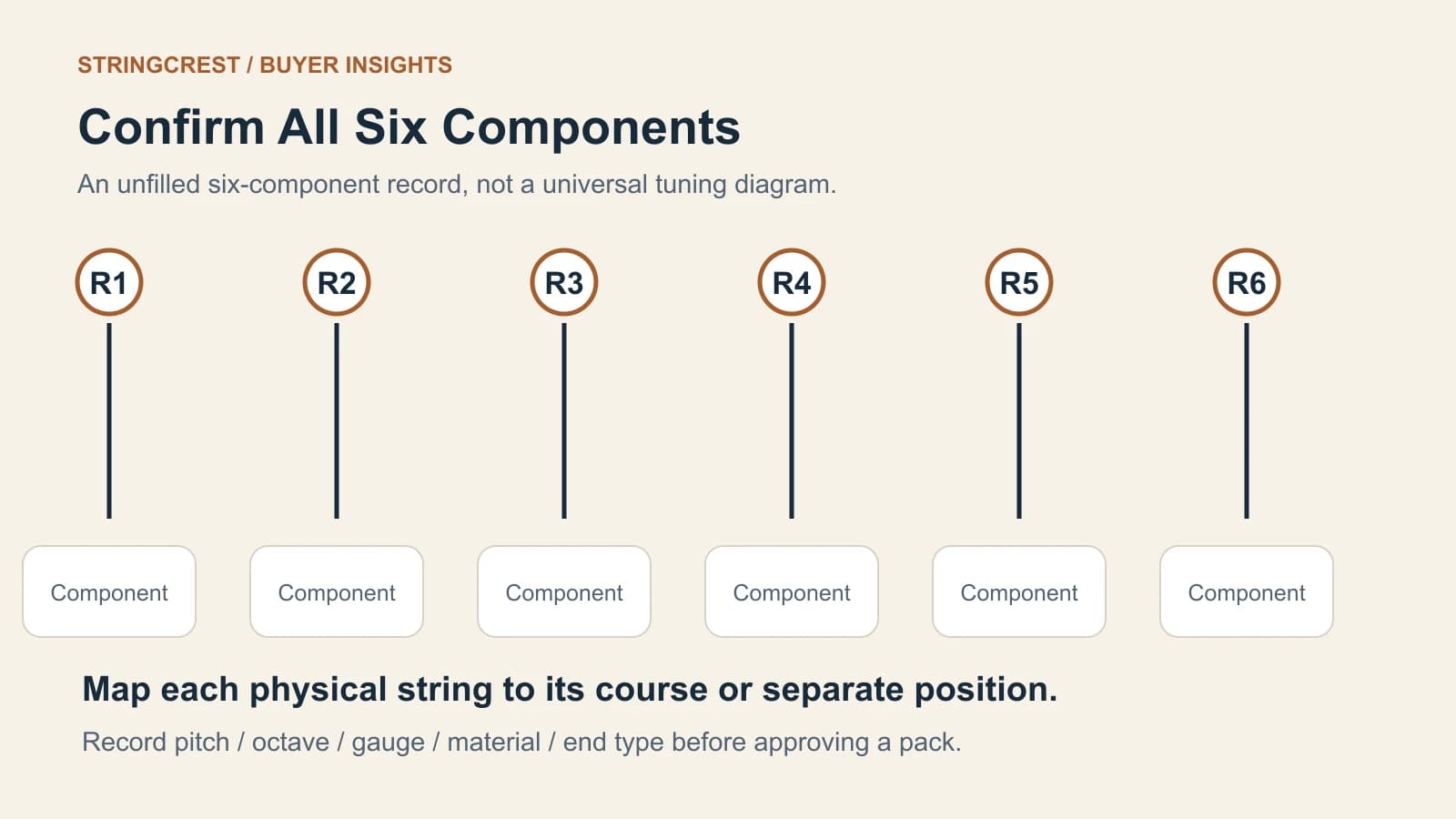
Use the blank record below after checking the actual instrument and maker’s documents. It contains six component rows, not six preassigned courses. For a four-course instrument, paired members will share a course label; for a six-position guitalele, each row will refer to its own position.
Instrument maker/model and any relevant version: _____
Maker’s tuning/string-map reference and date: _____
Confirmed structure — four courses or six individual positions: _____
Record viewing direction or placement-diagram reference: _____
| Record row only | Course or single position | Maker member / packet ID | Pitch + octave | Component reference |
|---|---|---|---|---|
| R1 | _____ | _____ | _____ | _____ |
| R2 | _____ | _____ | _____ | _____ |
| R3 | _____ | _____ | _____ | _____ |
| R4 | _____ | _____ | _____ | _____ |
| R5 | _____ | _____ | _____ | _____ |
| R6 | _____ | _____ | _____ | _____ |
R1–R6 are local record IDs. They do not prescribe physical string numbers, pitch order or placement. If a packet identifies a component differently, enter its exact label in the maker-ID column. Link a component specification to that row rather than leaving a diameter or material attached only to the set name.
Before using the record for an order, reconcile three totals: the physical instrument has six strings, the record identifies six components, and the course grouping matches the instrument. A completed six-row table with six different course numbers would still be wrong for the four-course example.
Turn the confirmed map into a replacement request
Once the map is established, resolve the remaining fit details for that specific instrument and set. Record the intended tuning, actual vibrating length or maker’s size designation, required usable string length and the specified attachment method. Follow the instrument maker’s fitting instructions; this guide does not supply a tying pattern or hardware modification.
Keep construction information at component level where the set uses different components. A broad material name should not erase a member’s plain or wound construction. Likewise, do not infer intermediate diameters from the thickest and thinnest strings or copy a named competitor’s published specifications into a proposed private-label product.
For stock descriptions, put the distinguishing structure near the product identity: “six strings / four courses” or “six individual positions,” followed by the confirmed tuning and model scope. On inner packets, retain enough member information to prevent two octave-pair components being confused during a partial replacement. These are suggested record fields, not a proposed label for an unverified StringCrest set.
After those identities are resolved, the ukulele range-planning guide can help place the item in a broader assortment. Our ukulele category is a discussion entry point; it does not confirm a six-string uke or guitalele SKU, construction or availability.
FAQ
Can a four-string ukulele set plus two single strings replace a six-string set?
The arithmetic alone is insufficient. Each added member needs a documented course, octave, component specification and fit for the actual instrument. A four-string pack does not establish those extra members, and the two original course members also need to match the intended arrangement. Use a maker-identified set or resolve the complete six-member specification before treating a combination as a replacement.
Does “sixth string” always mean the lowest string?
No. In a six-individual-position guitar system, the term follows that instrument’s numbering convention. In a four-course six-string uke, an extra physical member belongs to a course; its identity cannot be recovered from the word “sixth” alone. Ask for the course, octave member and maker’s packet or component identifier.
Conclusion
For six-string replacement requests, identify the playing structure before choosing the pack. A four-course uke and a six-position guitalele need different maps even though both contain six physical strings. Use named manufacturer references for examples, then complete a separate record for the actual instrument, its six components and any unresolved fit details.
FROM GUIDE TO PRODUCT
Connect this guide to Ukulele Strings.
Review the relevant range, then bring the instrument, complete specification and open questions into one project brief.
YOUR PRODUCT · YOUR BRAND
Discuss your next string project with Frank.
Share your instrument category, target market, gauge or material direction and private-label packaging requirements.

ABOUT THE AUTHOR
Frank Zou
Frank works directly with musical-instrument brands, importers and distributors on string specifications, product selection and private-label project requirements.
Meet Frank