
Buying Guides
Buying Guides
8-String Ukulele Strings: A Four-Course Pairing Guide
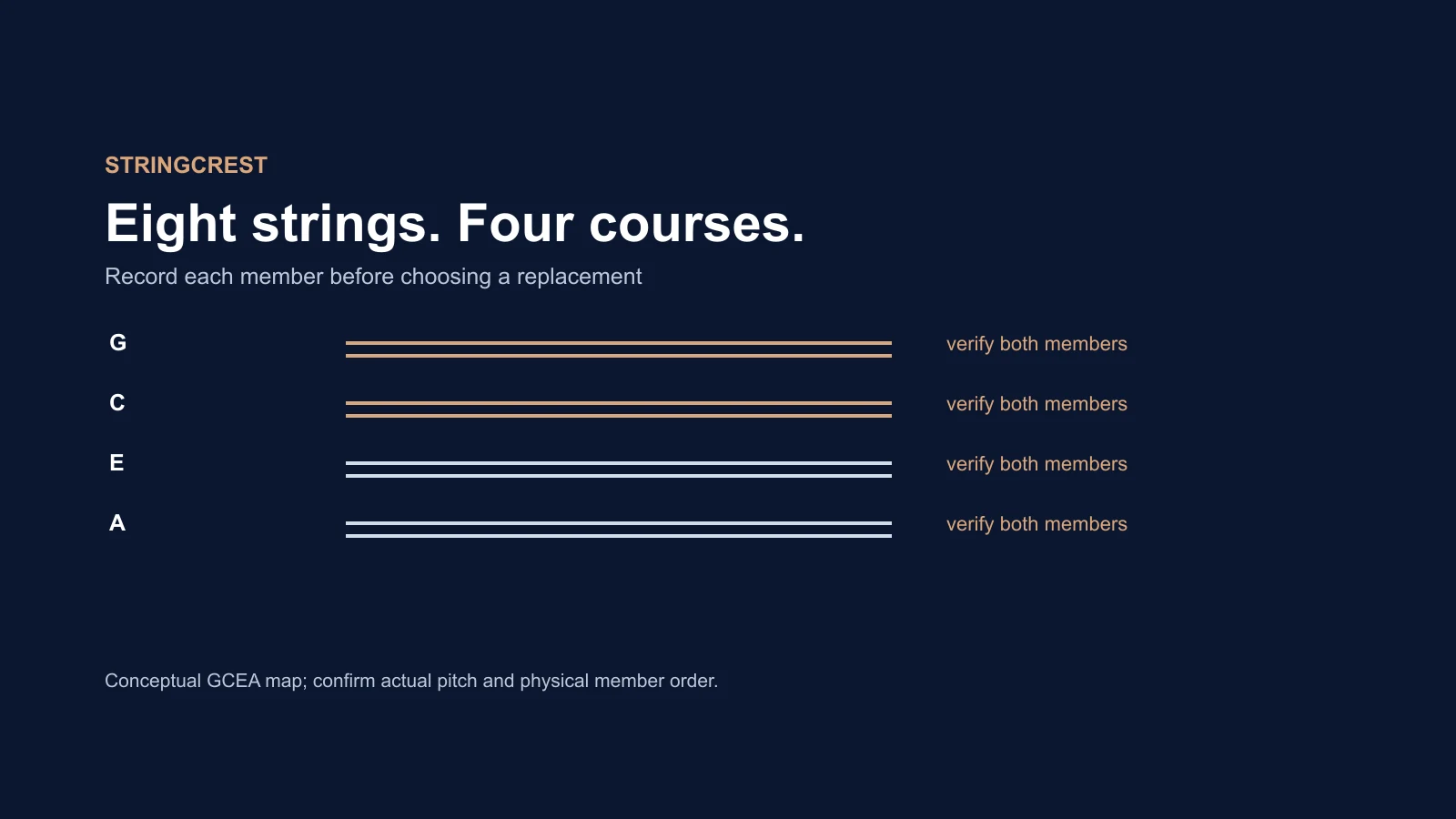
Four courses need eight identifiable members. Record the actual unison or octave pairing before preparing sample packs, single-string replacements and reorder labels.
Introduction
When sourcing strings for an 8 string ukulele, identify four courses and both members of every pair. The replacement brief must say whether each pair sounds at the same pitch or an octave apart. A four-note tuning name does not provide eight component specifications.
For dealers and importers, the recurring problem is an incomplete request such as “a spare C string” or “a tenor eight-string set.” This guide turns that request into an eight-member map with an explicit viewing direction, pitch information and replacement identity. It concerns a paired-course ukulele application, not eight independently fingered strings or an assumed extension of a standard four-string pack.
Establish the instrument and the pairing pattern
Count the physical strings and the playing courses separately. A course groups strings played as one musical position. In the eight-string arrangement discussed here, four courses each contain two members. Confirm the exact instrument model, scale, bridge arrangement and maker’s string map before assigning the pairs.
Kala’s six- and eight-string explanation describes its eight-string GCEA ukuleles with octave pairs on G and C and unison pairs on E and A. This is a useful named example of a mixed pairing pattern. It does not establish every eight-string instrument’s tuning, and the same article discusses a baritone application separately.
Use a fresh instruction or map supplied for the actual model. A picture of eight tuner buttons can establish a count, but it may not show which string follows which course or which octave each member should sound. If the identification is uncertain, obtain the instrument maker’s information before suggesting a replacement.
Make unison and octave mean something precise
A unison pair has the same intended pitch in both members. An octave pair has two intended pitches one octave apart. The two members of an octave pair therefore need separate identities even when they share a course name. Their constructions and diameters must come from the proposed specification, not from the word octave alone.
Use note names with octave numbers when the actual map is available. G3 and G4 communicate a difference that two entries labeled G cannot. However, a direction such as “left string” is only useful when the viewing position has also been declared. A photograph taken from the tuning end can reverse the apparent order seen by the player.
The high-G versus low-G guide explains the G3/G4 distinction for four-string GCEA sets. It does not supply all eight members of a paired-course set. Borrow the pitch notation, not an assumption that two standard four-string packs will make the required eight-string selection.
Build an eight-member map that a warehouse can use
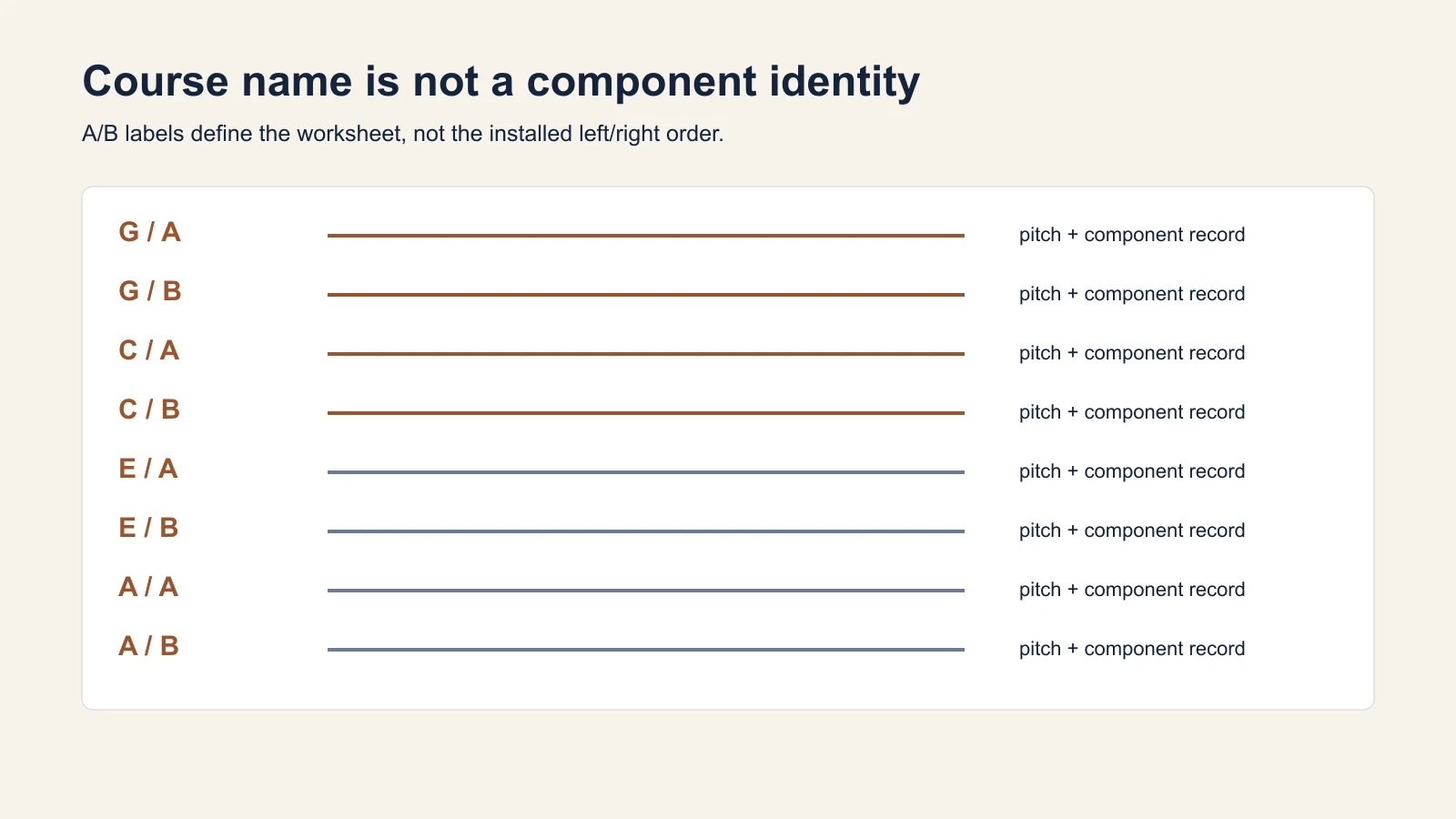
Choose a diagram direction and keep it consistent across the request, supplier drawing and packaging. The table below uses course labels G, C, E and A for a confirmed GCEA application. A and B are worksheet member identifiers only. They do not prescribe which side of a real course a member occupies.
| Course | Member | Requested note and octave | Unison or octave relationship | Supplier component and revision |
|---|---|---|---|---|
| G | A | |||
| G | B | |||
| C | A | |||
| C | B | |||
| E | A | |||
| E | B | |||
| A | A | |||
| A | B |
If the actual instrument uses a different tuning, replace the course labels before completing the record. Add the instrument model and a drawing or photograph reference that fixes the physical member order. The diagram should make it possible to identify one component without turning the instrument over and guessing which side the author meant.
For each row, obtain the proposed material, plain or wound construction, finished diameter with units, supplied and usable lengths, attachment requirements and sample identifier. The table’s empty cells are an original buying worksheet. They are not a declaration of stock, a gauge recommendation or a completed installation check.
Keep octave relationships separate from materials
An octave description answers a pitch question. It does not say whether a member is plain polymer or wound, nor whether a proposed low member fits a particular bridge or tuner. Similarly, matching visible diameters does not establish an approved unison pair. Ask the supplier to identify the construction of each proposed component.
Where both members are proposed as the same item, record that equality explicitly in the component list. Where they differ, give each a distinct reference. This avoids a common paperwork ambiguity: a course quantity of two can otherwise be read either as two identical strings or as one of each of two different components.
Keep the customer’s requested build separate from the supplier’s proposal. If a supplier changes the material of one member, the returned map should show the change at that row. Review any resulting fit, identification and playing-comparison questions before the alternative becomes the accepted pack description.
Resolve a single-string request without losing its partner
When a customer asks for a spare C, establish the course, member and intended octave. Keep the partner’s identity with the request. If the partner is unidentified or already changed, the original set’s diagram may no longer describe what is installed.
A dealer’s intake can record three kinds of information separately:
| Intake item | What it establishes | What remains to be confirmed |
|---|---|---|
| Instrument model and original string map | The maker’s intended application | Whether the installed strings still match it |
| Marked photograph and course/member label | The physical position being discussed | Exact construction and target pitch |
| Old package or supplier item reference | A possible replacement identity | Revision, condition and applicability |
| Target note and octave | The requested sounding result | An appropriate component for that scale and path |
Avoid treating a broken string’s remaining length or apparent thickness as a complete specification. The piece may have lost an end, stretched in use or been cut during installation. Use the available evidence to narrow the inquiry, then obtain an applicable replacement identity rather than presenting a visual guess as confirmation.
In a hypothetical intake, a customer requests “the thin C” from an eight-string tenor. Record the instrument model and a marked photograph, then ask for the intended octave and any known component reference. “Thin” describes an appearance; it does not identify a replacement. The existing partner’s reference helps distinguish a verified match from a proposal still needing review.
For a dealer that stocks both complete packs and singles, the item system should connect each replacement member to the relevant complete-set revision. A change to one member can affect which spare is correct even when the retail pack keeps a similar name. Preserve the old-to-new component relationship in the reorder record.
Prove the pack contains the intended eight components
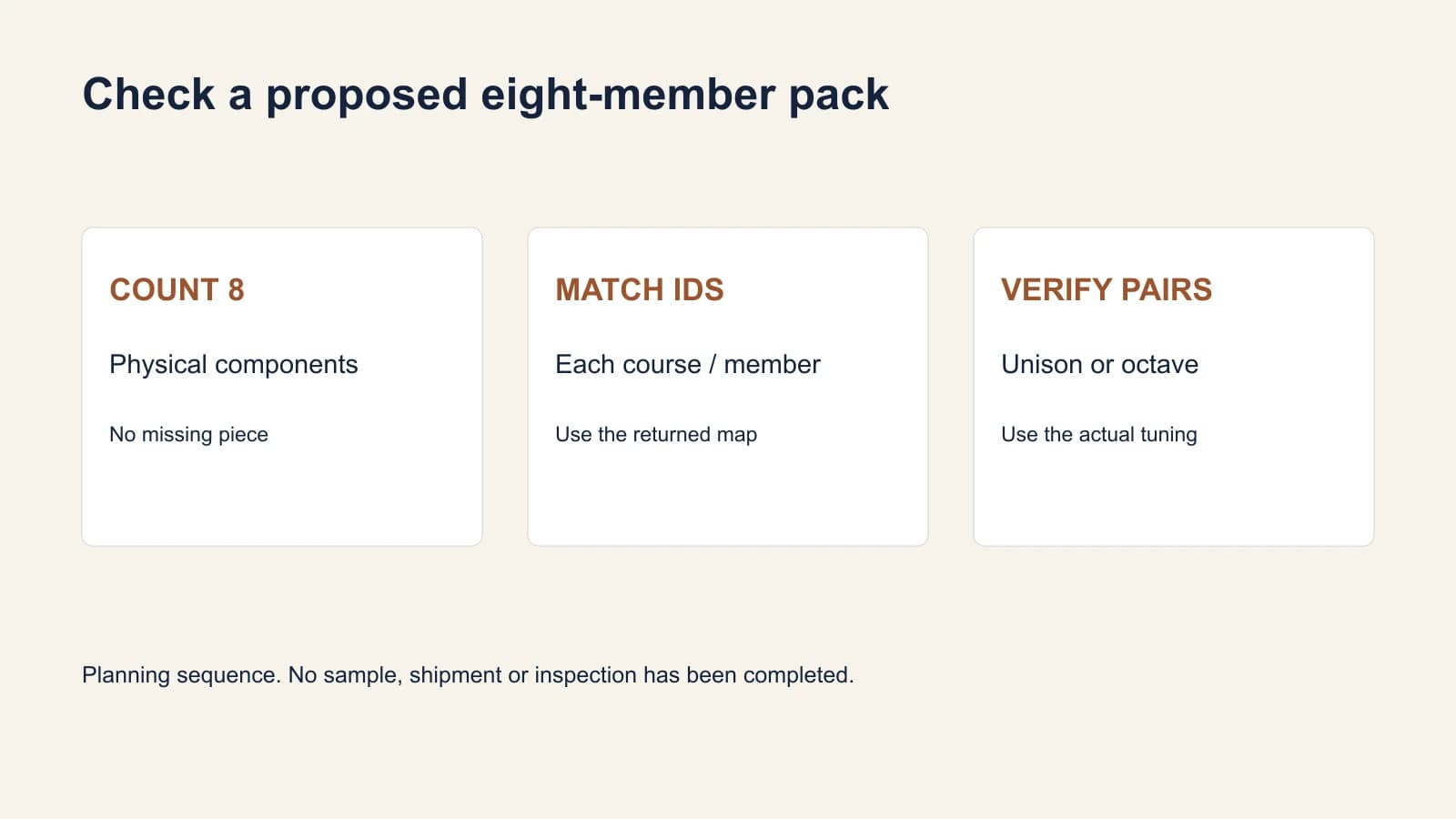
An artwork proof can show eight labels, but it cannot establish that the physical contents follow them. Review the pack map and the actual component identification together. The checking task is to account for all eight members and their pair relationships.
On receipt of a proposed sample pack, record its set identity and revision, then match each envelope or tag to the returned map. If the packaging combines a pair in one envelope, it should still make the two identities understandable. A supplier may use another sensible identification method; ask how the dealer distinguishes the members before installation.
The ukulele packaging proof guide addresses the broader artwork process. For an eight-string pack, add a specific check for course names, member distinctions, declared tuning and viewing direction. Do not let a familiar four-string illustration pass review merely because the product title says eight-string.
Separate this range from other ukulele formats
A six-string course ukulele, a six-string guitalele and an eight-string paired ukulele answer different instrument requests. The six-string format guide owns the first distinction. This page’s contribution is the full eight-member pairing record, including how a single replacement stays connected to its course partner.
For an eight-string baritone request, obtain the actual baritone tuning and paired layout. Do not reuse a GCEA drawing and change only the instrument size printed at the top. Likewise, a different physical scale or installation path requires the relevant component lengths to be checked rather than inferred from the string count.
Keep only the variants whose application the sales and warehouse teams can explain accurately. The private-label ukulele range guide covers assortment choices. Use the confirmed eight-member record as an input to that decision, without claiming demand, stock or supplier availability from this educational example.
FAQ
Can two four-string packs be used as an eight-string set?
Two packs provide eight pieces, but their pitches, constructions, lengths and pairing pattern may not match the intended instrument. Obtain the actual eight-member specification before approving that substitution.
Are all four courses doubled in octaves?
No universal pattern follows from the count. In the named Kala example, G and C are octave pairs while E and A are unison pairs. Check the map for the actual model rather than extending that example to every instrument.
Must both members of a unison course have identical specifications?
The common target pitch alone does not prove identical construction or an approved pairing. Ask the supplier to identify both members. If the proposal uses one identical component twice, state that explicitly in the component list.
Conclusion
An eight-string buying brief should identify eight members, four course relationships and one unambiguous physical map. That makes a spare-string request, sample pack and reorder record easier to compare without inventing a universal tuning or gauge sequence.
Use the ukulele string category to begin a project discussion. Send Your Course and Member Map with the instrument model, pitch requirements and proposed pack identity. Confirm any actual offer and commercial terms for that application.
FROM GUIDE TO PRODUCT
Connect this guide to Ukulele Strings.
Review the relevant range, then bring the instrument, complete specification and open questions into one project brief.
YOUR PRODUCT · YOUR BRAND
Discuss your next string project with Frank.
Share your instrument category, target market, gauge or material direction and private-label packaging requirements.

ABOUT THE AUTHOR
Frank Zou
Frank works directly with musical-instrument brands, importers and distributors on string specifications, product selection and private-label project requirements.
Meet Frank