
Specifications & Fit
Folk & Orchestral
Pedal Steel Guitar Strings Wholesale: A Tuning, Set and Quality-Control Guide
A tuning-led B2B workflow for E9, C6 and custom pedal steel string sets, from position mapping and fit to sample approval and packaging.
Introduction
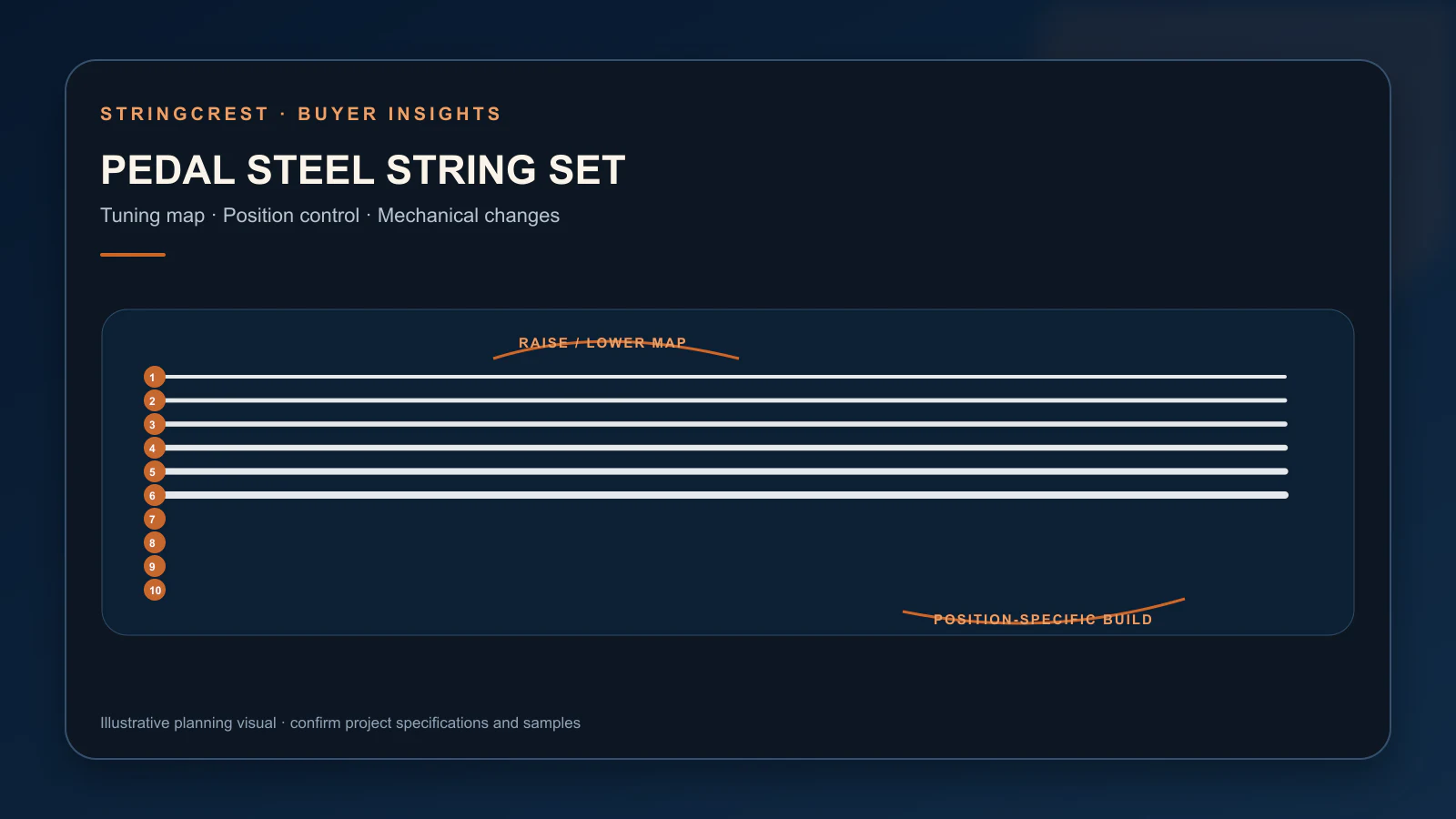
Sourcing pedal steel guitar strings wholesale begins with a tuning map, not with a generic “ten-string set.” Pedal steel instruments use changers, pedals and knee levers to raise or lower selected strings. That mechanical system makes position identity, gauge progression, plain-versus-wound construction, usable length and change control especially important. A set can contain the correct number of strings and still be unsuitable if it was designed around a different tuning or if a critical position responds poorly to repeated pitch changes.
Two tuning names appear frequently in the market: E9 and C6. Official GHS product pages, for example, publish separate ten-string sets and different position gauges for those tunings. The important lesson for a B2B buyer is not to copy those numbers. It is that the tuning name changes the function of the positions and therefore the set specification. Other instruments may use universal twelve-string layouts, custom copedents or player-specific substitutions, so the buyer must document the actual instrument and tuning.
This guide gives private-label brands, distributors, steel-guitar specialists and repair suppliers a practical method for requesting samples and quotations. It describes what belongs in a position table, how to manage the plain-to-wound transition, what to verify during installation and mechanical use, and how to prevent a packaging or warehouse mix-up. It does not claim one ideal gauge sequence or StringCrest stock specification. The final product must be defined and approved for the intended tuning and instrument.
Start with the complete tuning and copedent
Position numbers alone do not explain string function
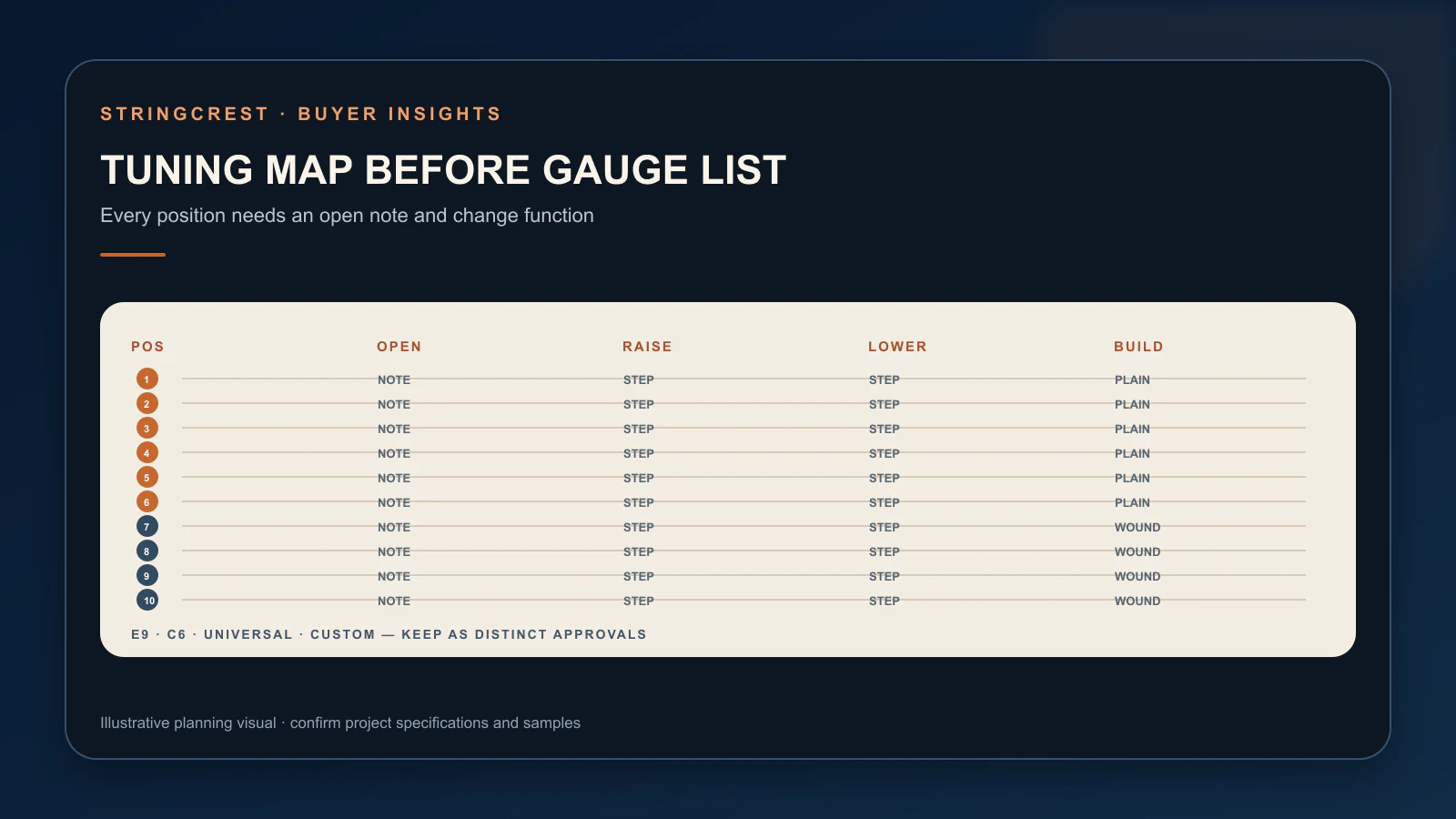
A pedal steel request should list the open pitch of every string from the player’s first position to the last. Add the number of strings, scale length, keyless or keyed design, changer type where known, and the common pedal and knee-lever changes that matter to the buyer. The term “copedent” refers to the relationship among tuning, pedals and knee levers. Even a simplified project sheet should show which positions are raised or lowered and by how much.
This information changes the discussion. A plain string that is repeatedly raised may face a different use pattern from a wound bass position that changes less. A buyer does not need to reveal a player’s private setup if the project is a general retail set, but the intended standard configuration must still be explicit. If the channel serves several common setups, decide whether one set is a documented compromise or whether separate SKUs are required.
Use note names with octave or position references where possible. Avoid a sequence of ten unlabeled gauge numbers. A packing error is harder to detect when the technical sheet, envelope labels and customer instructions do not share the same position numbering.
| Required input | Example format | Why it matters |
|---|---|---|
| Instrument | 10-string single-neck pedal steel | Defines set count and context |
| Open tuning | Position-by-position note table | Prevents E9/C6 or custom-set confusion |
| Changes | Key raises and lowers by position | Shows mechanically active strings |
| Scale length | Declared nut-to-bridge measurement | Supports tension and fit review |
| Headstock/changer | Keyed or keyless; end path notes | Affects total length and installation |
| Material direction | Declared wrap and plain-string system | Keeps samples comparable |
Build the set position by position
Separate plain and wound roles in the technical sheet
Pedal steel sets may place plain steel on several upper positions and wound strings on lower positions. The transition point can vary with tuning, gauge choice and player preference. One position may appear in the market as either plain or wound, and that choice can change feel and mechanical behavior. The buyer should therefore identify construction for every position rather than assuming all strings below a certain number are wound.
Official GHS E9 and C6 tables provide a useful market example: both are ten-string sets, yet the position sequences differ. Their pages also distinguish plain gauges from product-specific wound-string codes. Those tables belong to GHS products. They should be used only to understand the variables that a professional specification exposes, not as hidden StringCrest recipes.
For each position, record nominal gauge, plain or wound construction, declared core and wrap material, end construction, total length and any winding or taper transition. If the project includes more than one material family, create separate candidate tables. Do not label a set “stainless,” “nickel” or “pure nickel” unless the description accurately explains which parts of the set use that material and which strings are plain.
The set should also be checked as a progression. Adjacent positions need a usable relationship under the target tuning and mechanical changes. A single gauge can look acceptable in isolation while creating a sudden difference in stiffness or response from neighboring positions. Sample notes should address the transition, not only favorite individual strings.
Use tension as a calculation and test input
Gauge by itself does not predict behavior
String tension depends on unit weight, vibrating length and frequency. D’Addario’s published tension reference includes pedal steel string entries and illustrates how the same string produces different calculated tension at different pitches. This is a physical relationship, not a complete recommendation. A buyer still needs the instrument scale and the actual open and changed pitches.
For a mechanically active position, document the highest and lowest target pitches used in the approval setup. Ask the supplier whether the proposed construction is intended for that range, then confirm through sample installation. Do not convert a calculation into a durability guarantee. Repeated pedal changes, installation technique, burrs, changer geometry, player attack and maintenance can all affect real-world results.
If two candidate sets are being compared, keep the instrument, tuning, setup and evaluation period consistent. Record the number and type of changes used during the review rather than saying only that the sample was “played.” A defined procedure makes feedback more useful without pretending to be a universal laboratory test.
Confirm length, end fit and changer installation
The non-speaking string path still matters
Scale length is only the vibrating portion. Pedal steel strings also travel through or around the changer, across the nut or roller, and toward keys or a keyless clamping system. The longest required path should be measured on the target instrument. A keyed instrument may need more total length than a compact keyless design, while a custom changer or headstock can alter where a wound section or transition sits.
The end construction must seat cleanly in the changer. Ball-end geometry and attachment should be specified and visually checked. Do not assume that every guitar-style ball end is equivalent. During installation, confirm that the ball seats without interference, that the string follows the intended path, and that no thick transition contacts a roller, nut or clamping point inappropriately.
For wound positions, record the usable wound length and any taper. Thick winding should not end inside the speaking length unless that is the deliberate design, and it should not create an unsuitable wrap or clamp condition at the keying end. The buyer should provide reference measurements rather than asking the supplier to infer them from “standard pedal steel.”
Photograph the installed path for each candidate revision. Include the changer end, nut or roller region and key or clamp. If a string needs unusual trimming or modification, treat that as a fit issue to discuss, not as an invisible step in approval.
Test the strings with the instrument’s mechanical changes
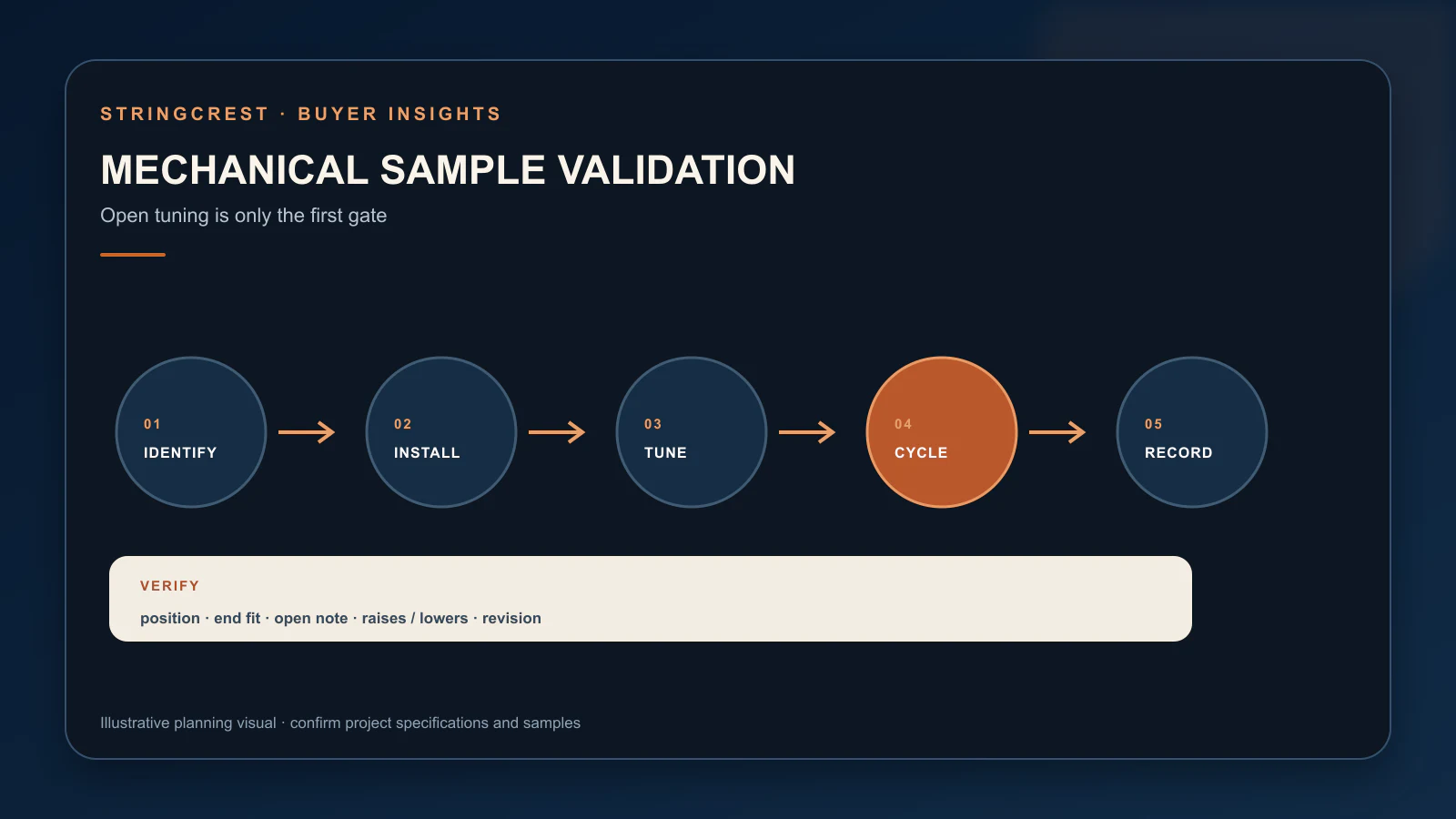
Open tuning is only the first installation gate
After installation, bring the set to open tuning using the normal procedure for the reference instrument. Confirm that each position is identified correctly and that pedals and knee levers still reach their intended changes. If a candidate gauge or construction affects the setup, record the adjustment rather than comparing before and after states as if nothing changed.
A useful review includes open-pitch stability after settling, return to pitch after repeated changes, feel across adjacent strings, changer-end seating, visible winding movement and any unusual noise at contact points. These observations should be linked to the sample code and instrument. If a string breaks, preserve the position, break location, installation notes and photographs. One failure does not prove a product-wide rate, but an unexplained failure should not be erased from the record.
Pedal action and tuning adjustment can be affected by string changes. Buyers should involve a qualified technician when the instrument requires setup work. The wholesale article or package should not instruct customers to modify a changer beyond their competence. The role of the B2B approval is to show that the proposed set was tested on declared reference equipment and that its limitations are understood.
| Sample gate | What to check | Evidence |
|---|---|---|
| Identification | Correct position, note, gauge and construction | Coded envelope and worksheet |
| Installation | Ball seating, length, winding location and key/clamp fit | Installed photographs |
| Open tuning | All positions reach the declared notes | Tuning log |
| Mechanical use | Required raises/lowers operate and return acceptably | Structured change-cycle notes |
| Revision | Sample, artwork and order use one specification | Approval record |
Choose materials without turning adjectives into evidence
Material names should describe construction first
Market pedal steel ranges include nickel-plated, stainless, pure-nickel and other product-specific systems. These choices can support different feel and tonal directions, but broad adjectives are not enough for a private-label brief. State the plain-string material, wound-string core and wrap, and any surface treatment. If a supplier proposes a proprietary treatment, ask what can be accurately declared in the technical sheet and packaging.
Do not promise extended life, improved break resistance or a specific tonal outcome without a defined comparison and evidence. A safer sample brief asks evaluators to describe attack, sustain direction, surface feel and response on the reference instrument. Results can guide range positioning, but the public wording should remain narrower than the internal feedback.
When comparing materials, hold gauge sequence and tuning constant where practical. If a construction change requires a gauge change, document both. Otherwise, the buyer may attribute a result to the wrap material when the real difference came from mass or tension.
Design packaging to prevent position errors
A ten-string set needs clear internal identification
Pedal steel packaging should show the tuning, number of strings, complete gauge sequence, plain-versus-wound information where relevant, material description and compatibility limits. “Pedal steel set” is insufficient. E9 and C6 packs can look similar while containing materially different sequences.
Inside the pack, each string should be identified by position or note and gauge. If several strings are close in diameter, visual judgment is not a reliable warehouse or customer control. Use printed envelopes, stable codes or another verified system that survives normal handling. The outer barcode and SKU should map to the same revision as the inner identifiers.
For distributors carrying singles, distinguish set-replacement positions from generic guitar singles. A technically compatible diameter does not automatically mean the same construction, length or use case. If a generic single is offered as an alternative, the catalog should say so accurately.
Packaging claims about tuning compatibility should be based on approved samples. If a set was evaluated only on an E9 reference instrument, do not add C6 or universal twelve-string language to broaden the market. A narrower accurate label protects the buyer and reduces support questions.
Control singles, sets and revisions
Inventory design should reflect service needs
Steel-guitar specialists may need complete sets plus individual high-use positions. General music retailers may be better served by a smaller set-focused range. Decide using the channel’s replacement patterns, not by assuming every gauge deserves a SKU.
For each single, define note or position use, gauge, construction, length, end and compatible set revision. Keep in mind that players use custom copedents; a gauge may have more than one valid role. Catalog language should describe the product, not guarantee every custom setup.
Revision control is particularly important when one position changes. A substitute string can alter pedal travel or feel even when the nominal gauge remains the same. If a core, wrap or gauge is revised, update the technical record, sample approval, inner identifiers, outer artwork and warehouse transition plan together. Old and new revisions should not share an indistinguishable code during overlap.
Prepare a complete RFQ
Make every supplier quote the same product definition
The RFQ should contain the tuning table, position count, open and changed pitches, scale and total-path measurements, gauge and construction candidates, materials, ball-end requirement, package format, inner identification, target market and sample quantity. Mark which fields are fixed and which are open to recommendation.
Ask the supplier to state deviations explicitly. A proposed plain-to-wound transition, alternate gauge or different usable length should be visible in the quotation. Commercial terms such as MOQ, sample charges, price and lead time depend on the accepted specification and should be confirmed for the current project rather than copied from an article.
Before production, reconcile the approved physical set, technical revision, packaging proof and purchase order. Use a final position-by-position check because a single swapped envelope can change the product. Shipment inspection can then verify codes, pack counts, carton identity and visible condition without claiming to prove every performance characteristic from a small sample.
Common pedal steel sourcing mistakes
The first mistake is ordering by string count without naming the tuning. The second is publishing a gauge list without position notes or plain-versus-wound identity. The third is approving open tuning while ignoring pedal and knee-lever changes. The fourth is measuring only the scale and overlooking changer and keying paths.
Other mistakes include treating a material word as a performance guarantee, mixing revisions inside one pack, and offering singles without a clear relationship to the approved set. Finally, do not copy a competitor’s E9 or C6 table and present it as your own product. It is evidence that tuning-specific specifications matter, not authorization to reproduce the recipe.
FAQ
Are E9 and C6 pedal steel string sets interchangeable?
They should not be assumed interchangeable. Market examples use different position gauges and constructions for the two tunings. A buyer should specify the complete open tuning and mechanical changes, then approve a set for that use.
Why must plain and wound positions be identified?
Two strings with similar nominal diameters can behave differently when one is plain and the other is wound. Construction affects mass, feel and mechanical response. The position table and inner envelopes should state the difference.
How should a custom twelve-string setup be sourced?
Provide the full copedent, scale, keying system, changer path, gauges under consideration and required changes. Treat it as a defined custom project rather than extending a ten-string set with two unidentified singles.
What should be tested beyond open tuning?
Check installation fit, the required pedal and knee-lever raises or lowers, return to pitch, adjacent-string feel, visible end and winding stability, and any setup adjustments. Record conditions and sample codes.
What needs approval before a wholesale order?
Approve the position-by-position specification, identified sample set, inner string labels, outer artwork, pack configuration and purchase-order revision. Confirm current MOQ, pricing and lead time in the supplier quotation.
Conclusion
Pedal steel strings are tuning-specific mechanical components as well as musical products. A clear copedent, position table and fit drawing turn a vague ten-string request into a specification that suppliers, technicians and warehouse teams can follow. Controlled testing then connects the open tuning to the actual raises and lowers the instrument must perform.
For wholesalers and private-label brands, the result is a range with fewer identity errors, clearer customer guidance and better revision traceability. The package can state exactly what was approved without implying compatibility with every pedal steel configuration.
Explore folk and orchestral string options · Send your pedal steel string brief
Sources and interpretation limits
- GHS Pedal Steel Super Steels E9 and C6 set tables
- GHS Pedal Steel Boomers E9 and C6 set tables
- D’Addario string tension reference
These official sources demonstrate tuning-specific market sets and the physical relationship among unit weight, scale and pitch. They do not establish StringCrest gauges, materials, durability, availability or commercial terms. Confirm every proposed set through a current specification, sample and quotation.
FROM GUIDE TO PRODUCT
Connect this guide to StringCrest product ranges.
Review the relevant range, then bring the instrument, complete specification and open questions into one project brief.
YOUR PRODUCT · YOUR BRAND
Discuss your next string project with Frank.
Share your instrument category, target market, gauge or material direction and private-label packaging requirements.

ABOUT THE AUTHOR
Frank Zou
Frank works directly with musical-instrument brands, importers and distributors on string specifications, product selection and private-label project requirements.
Meet Frank