
Wholesale Buying
Wholesale Buying
12-String Acoustic Guitar Strings Wholesale: A Specification Guide for Complete Sets
A complete-set buying framework for six courses, twelve positions, tuning, gauges, length, packaging, samples and shipment checks.
Introduction
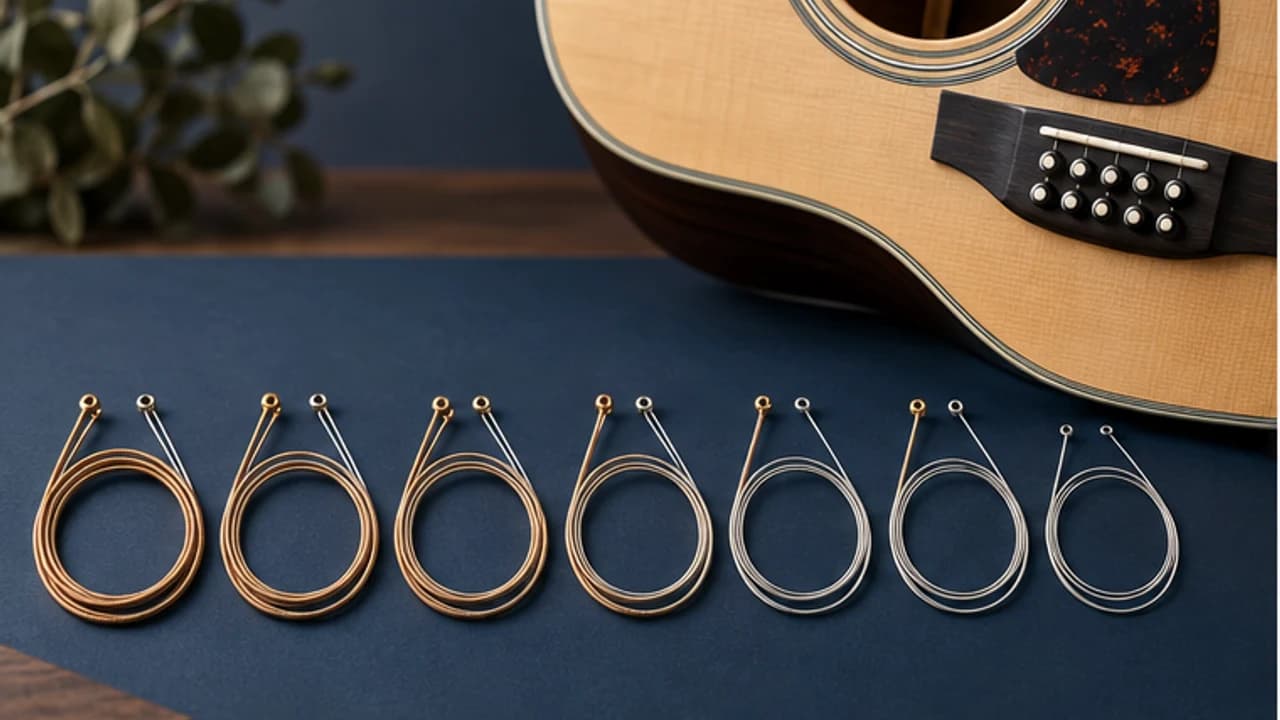
A useful 12-string acoustic guitar strings wholesale inquiry must describe twelve positions, not simply request “a light acoustic set with six extra strings.” A 12-string guitar has six courses. In standard tuning, the lower four courses normally pair a main string with a thinner string one octave higher, while the B and high-E courses use unison pairs. That pairing determines the gauge sequence, package order, installation instructions and sample test. If a quotation lists only the first and twelfth gauges, a buyer still cannot tell whether the set is complete or suitable for the intended instrument.
For a distributor, music retailer or private-label brand, the safest starting point is a position-by-position matrix. It should state tuning, main and companion gauge, plain or wound construction, wrap alloy, ball end, usable length, package order and product revision. D’Addario’s current tuning guide describes the standard pitch pattern as E2/E3, A2/A3, D3/D4, G3/G4, B3/B3 and E4/E4. Its published products and charts are reference examples for understanding the variables; they are not StringCrest specifications. Confirm every offered set through the applicable sample and approval record.
This guide shows how to turn the instrument application into a controlled RFQ, compare samples without inventing performance claims, and carry the selected revision into artwork, packing and shipment inspection.
Start with the six-course architecture
The word “12-string” describes the string count but not the complete construction. Begin the brief with a six-row course table. For each course, identify the standard-pitch string and its partner. The bass-side E, A, D and G partners are normally octave strings; the B and high-E partners are normally tuned in unison. Alternate tunings exist, so the buyer should state the intended tuning rather than ask the supplier to infer it.
Course order also matters. A drawing should show the physical order in which the main and companion strings sit at the bridge and nut. Package sequence must match the installation diagram. A correct set packed in an unclear order can still create customer complaints, especially when two plain strings have similar diameters.
Build a twelve-position control table
Use a line for every string instead of combining each course into one vague description.
| Control field | What to record | Why the buyer needs it |
|---|---|---|
| Position | Course and main/octave or unison role | Prevents missing or reversed strings |
| Target pitch | Note and octave where relevant | Defines the intended tuning |
| Nominal gauge | Diameter for the offered revision | Allows like-for-like comparison |
| Construction | Plain or wound; core and wrap direction | Gauge alone does not define a string |
| Material | Confirmed plain-wire and wrap description | Supports accurate product copy |
| Length | Overall and usable/wound length as applicable | Checks bridge-to-tuner fit |
| End | Ball-end construction and finish | Confirms hardware compatibility |
| Identification | Position code, envelope code and revision | Supports installation and repeat orders |
Do not copy one manufacturer’s gauge matrix into a new product brief and assume equivalent tension. Diameter, unit weight, material and construction all influence tension and response. Treat a published set as a market reference only; request applicable data for the exact proposed revision.
Define the product role before choosing gauges
Ask what job the SKU must do in the range. A general retail replacement set may prioritize a familiar feel and clear installation labeling. A studio-oriented set may emphasize a particular balance between the main and octave strings. A private-label range may need a simple opening assortment with one alloy and two carefully separated gauge directions. These are planning choices, not proof that a configuration will sell in every market.
Record the intended instrument type, typical scale length, standard or alternate tuning, bridge arrangement, target player, sales channel and price position. If the same SKU is expected to fit acoustic-electric and purely acoustic models, verify the relevant hardware path on representative instruments. If a customer asks for 12-string electric sets, treat that as a separate brief because materials, gauges and product expectations may differ.
D’Addario’s acoustic gauge education page shows that commercial 12-string ranges can span more than one gauge direction. That supports a buyer question—whether the assortment needs one or several feels—but it does not establish a universal best seller. Use sales data from the buyer’s own channel when available. When it is not available, launch a controlled test assortment and mark forecasts as assumptions.
Specify tuning, scale and total length together
Gauge discussions make sense only when tuning and vibrating length are known. The physical relationship can be summarized by the standard string-tension equation: for the same string construction and pitch, changing scale length changes tension. A buyer does not need to calculate a private-label set from another brand’s chart, but the RFQ should identify the instrument scale and tuning so the supplier can propose an applicable construction.
For each sample instrument, measure nut to saddle and record the bridge-to-ball-seat and nut-to-tuner path. A 12-string headstock has twelve tuners, and the farthest positions may need more total length than the nearest ones. Confirm that wound sections, transitions and any silk or coating do not sit in the nut slot or wrap incorrectly around the tuner.
Keep alternate tunings as separate revisions
Standard tuning, half-step-down use and open tunings should not be mixed into one unsupported claim. If the range is intended for another tuning, state every target pitch and test the complete set on the intended scale. Do not market one gauge sequence as “balanced tension” across several tunings unless the term is defined and supported for each case.
The high G octave deserves special attention because it is thin and tuned high. Sample evaluation should include careful installation, gradual tuning and breakage investigation that distinguishes handling damage, sharp contact points and product defects. Avoid promising that one construction “never breaks.” A useful control record explains the conditions under which the string was installed and tested.
Compare alloy directions without transferring claims
80/20 bronze and phosphor bronze are common acoustic wrap-wire descriptions. They can help organize a range, but the alloy name alone does not prove a specific tone, lifespan or corrosion result. Core geometry, wrap dimensions, surface treatment, gauge sequence, instrument and player all contribute to the observed outcome.
For a controlled comparison, keep the course layout, target gauges, scale, tuning, instruments, installation and evaluation tasks as consistent as possible. Code the samples so evaluators focus on behavior rather than expected marketing language. Record initial appearance, tuning process, course balance, pick and strum response, left-hand feel, unwanted noise and visible change during the planned trial. Attribute every observation to the tested sample and context.
If a coated or treated direction is considered, obtain a full base-string specification and a description of where the treatment is applied. “Coated” can refer to different architectures. Do not convert a supplier’s proposal into a lifespan claim without product-specific evidence and defined conditions.
Evaluate a complete sample set
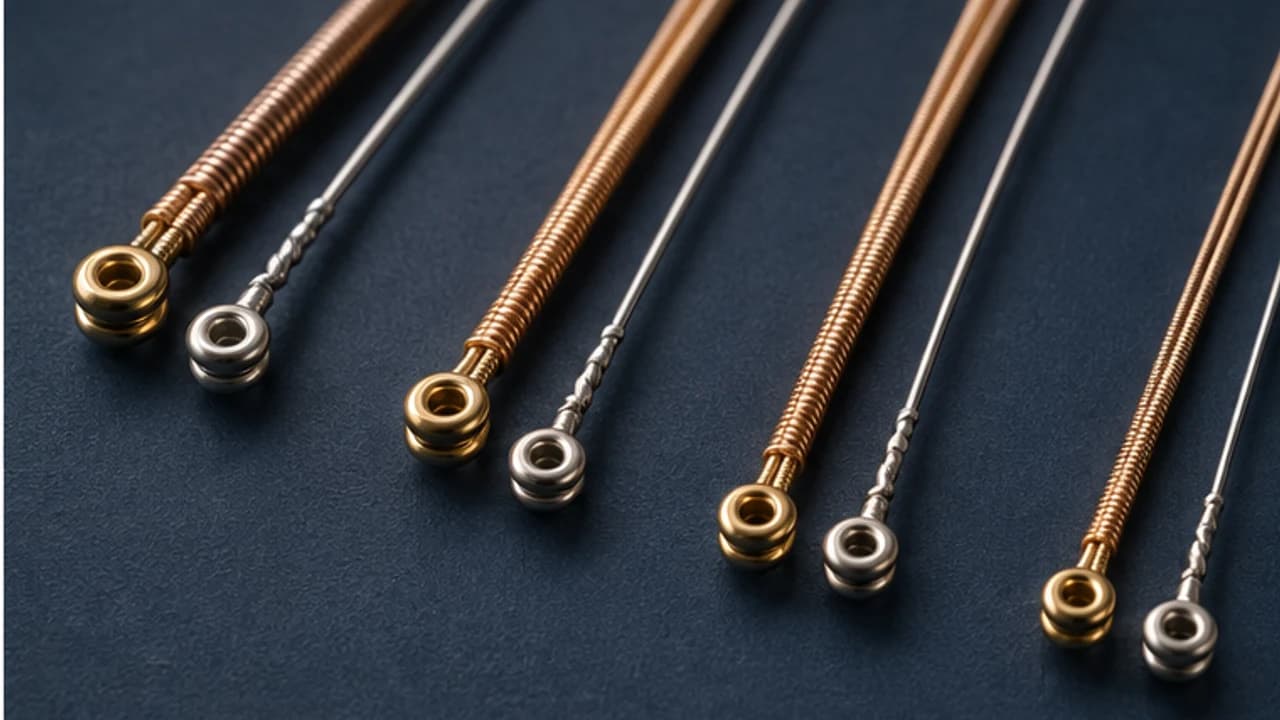
Assign each sample a code, date and revision. Photograph the unopened pack and record whether all twelve positions are separately identified. Before installation, check count, visible gauge sequence, plain/wound status, ball ends, surface condition and length. A loose bundle marked “12-string light” is not ready for responsible approval because it cannot be traced to a complete matrix.
Prepare the instrument by checking the bridge, nut and tuners for sharp edges, binding or damage. Record the instrument, scale, setup and prior string type. Install in the documented order and bring strings to pitch gradually. Note any string that is difficult to identify, too short for its tuner path, positioned incorrectly in the pack or unsuitable for the hardware.
After installation, use repeatable tasks: open-course tuning, common chord shapes, arpeggios, soft and firm strumming, capo use if relevant, and tuning checks across the planned evaluation period. Separate observations into fit, tuning behavior, balance, feel, tone direction and visible condition. A useful note reads “Sample B’s G course sounded less balanced on Instrument 2 during firm strumming,” not “Sample B is universally better.”
Design packaging that prevents position errors
Twelve strings create more opportunities for packing and installation mistakes than a six-string set. Decide whether the product uses one sealed set envelope, internal position sleeves, course pairs, or individually identified strings. The right configuration depends on protection, cost, artwork space and the level of support the channel needs.
The front panel should identify 12-string acoustic use, alloy or material direction, set name and complete gauge callout. The rear or internal panel should show course order and tuning. If the pack uses abbreviations, define them. A simple diagram can prevent a player from confusing an octave string with a unison partner.
Keep product identity consistent across the master specification, artwork, price list, barcode record, website, inner pack and shipping carton. When a gauge or construction changes, update the revision across all those records. Never silently substitute a string because its diameter looks similar.
Separate protection performance from graphic design
The printed envelope is part of the brand experience; the protective system is an engineering and logistics decision. Record barrier material, sealing method, internal arrangement, storage instructions and the evidence used for any protection claim. A metallic-looking pouch is not automatically a verified moisture barrier. If the project needs a target shelf-life statement, agree on product-specific packaging tests and acceptance criteria before printing the claim.

Compare supplier quotations on the same scope
Ask every supplier to price the same twelve-position matrix, quantity scenarios, packaging configuration, destination and trade term. Separate product, samples, artwork or tooling, retail packaging, outer cartons and freight-related items where possible. A quote for strings in bulk is not comparable with a quote for coded inner sleeves, sealed retail packs and printed cartons.
Request the offered specification with the quotation. Confirm which fields are fixed, which are proposed and which remain open. MOQ, sample charge and lead time may depend on alloy, number of gauge combinations, packaging construction, artwork count and order mix. Until those inputs are approved, describe commercial figures as project estimates rather than published standard capabilities.
Build the schedule from real dependencies: technical brief, sample production, installation test, revision, artwork, proof, purchase release, production, packing, inspection and shipment. Ask for a revised schedule when the specification or artwork changes.
Define inspection and shipment records
Inspection should begin with identity and completeness. For each sampled retail pack, verify product code, revision, twelve-string count, position identification, gauge callout, plain/wound sequence, ball ends, visible condition, pack seal and artwork. If gauges or lengths will be measured, define the instrument, measurement point, tolerance, sample size and decision rule.
Check inner and outer cartons against an approved packing diagram. Confirm quantity, mixed-SKU separation, readable carton labels and protection from movement or crushing. Link the result to an order, lot or shipment identifier. If the project does not yet have a verified batch-tracing method, keep it as a requirement to agree rather than claiming a capability.
Shipment inspection does not replace incoming checks. The buyer can define a receiving sample: carton condition, label match, pack count, seal condition and selected installation confirmation. Preserve the approved sample and specification so a later reorder can be compared to the same reference.
Create an RFQ buyers and suppliers can act on
A complete RFQ includes the buyer’s market and channel, product role, instrument and scale, intended tuning, twelve-position matrix, alloy and surface direction, end and length requirements, identification system, packaging languages, artwork scope, quantity scenarios, sample plan, inspection questions and unresolved decisions.
Ask the supplier to return the matrix with every line completed or marked “to confirm.” This exposes assumptions before they become packaging or production errors. When one sample is approved, record its code, revision, instrument context, evaluator notes, final product data and artwork files. A later change to a string position, coating or package should trigger a documented review.
FAQ
How are the twelve strings normally tuned?
Standard 12-string tuning uses six courses. The low E, A, D and G courses normally combine a main string with an octave-above partner. The B and high-E courses normally use unison pairs. State note and octave in the RFQ because alternate tunings exist.
Can a six-string gauge chart define a 12-string set?
No. A six-string chart omits the companion strings and does not define course order, total tension or packaging. Build a twelve-position matrix for the exact construction, tuning and scale under review.
Should a wholesale range start with 80/20 or phosphor bronze?
Either can be a valid direction. Define the target channel and desired product role, then compare complete sets under controlled conditions. Do not treat alloy name alone as proof of tone or service life.
What should be checked before approving samples?
Verify identity, count, string order, gauges, plain/wound construction, ends, length and packaging. Record the instrument and installation, then evaluate course balance, tuning behavior, feel, application and visible condition using repeatable tasks.
How should octave strings be identified in the package?
Use clear position or course codes and an installation diagram. Do not rely only on visual thickness. The product matrix, inner identification, outer artwork and website should use the same order and revision.
Can MOQ and lead time be fixed before the specification is complete?
A supplier may provide planning estimates, but final terms can change with the number of gauge combinations, alloy, treatment, inner sleeves, printed components and quantity mix. Confirm them against the approved matrix and artwork.
Conclusion
A dependable 12-string acoustic set is a coordinated system of six courses and twelve controlled positions. The wholesale brief must connect tuning, scale, gauge, construction, material, length, ball end and package order. Samples should be installed on representative instruments and assessed through documented tasks rather than broad claims.
Once the product revision is selected, use the same identity in artwork, quotation, inspection and shipment records. That discipline reduces packing errors, makes supplier offers comparable and gives dealers a product they can explain accurately.
FROM GUIDE TO PRODUCT
Connect this guide to Acoustic Guitar Strings.
Review the relevant range, then bring the instrument, complete specification and open questions into one project brief.
YOUR PRODUCT · YOUR BRAND
Discuss your next string project with Frank.
Share your instrument category, target market, gauge or material direction and private-label packaging requirements.

ABOUT THE AUTHOR
Frank Zou
Frank works directly with musical-instrument brands, importers and distributors on string specifications, product selection and private-label project requirements.
Meet Frank