
Quality Control
Wholesale Buying
How to Evaluate OEM Acoustic Guitar String Samples Before Bulk Ordering
A buyer-focused process for defining, installing, evaluating and approving OEM acoustic guitar string samples before a bulk order.
Introduction
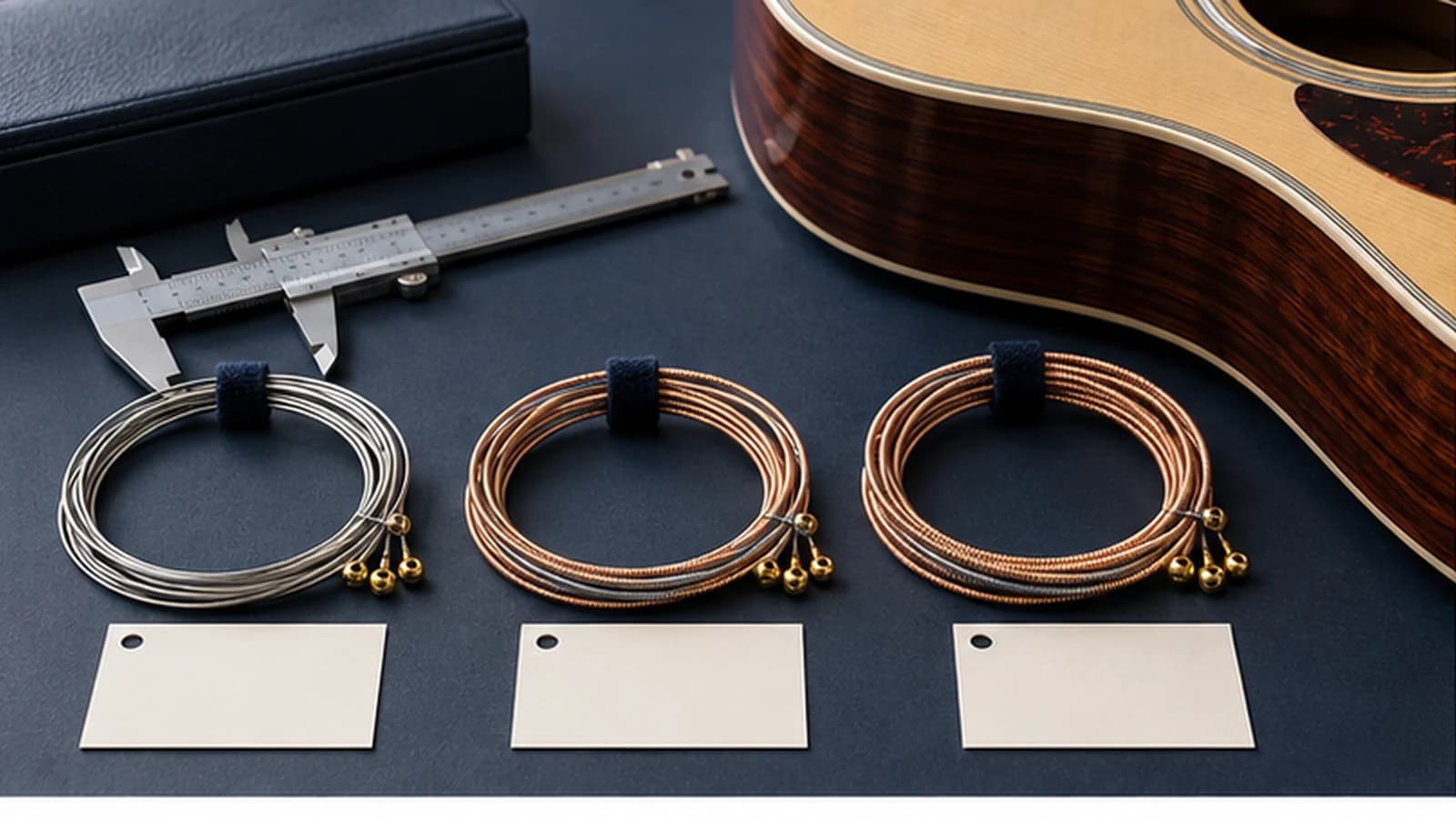
An OEM acoustic guitar string sample is useful only when it represents a defined product and a repeatable approval process. A buyer cannot approve a set from “good tone” alone. For the six-string steel-string acoustic trials covered here, the sample needs an agreed position matrix, declared construction, usable length, end format, packaging scope and revision. The guitar, setup, tuning, player and room also influence what is heard and felt.
For B2B buyers, the practical answer is to connect three references: a written specification, a coded physical sample and a packaging or pack-out sample. The written specification explains what should be supplied. The retained physical set identifies the sample accepted for a stated purpose. The packaging sample records the proposed identity and protection arrangement. None should silently replace another.
Use the shared guitar string sample-evaluation workflow for sample identity, agreed criteria, observations, authorization and the full sample-to-shipment process. This acoustic addendum supplies the instrument, bridge, playing and recording conditions that make those records interpretable. The blank fields below are a buyer's worksheet, not a completed StringCrest test or an approved company procedure.
Define the acoustic product and three references
“Light phosphor bronze acoustic set” leaves important questions unanswered. Create one revision-controlled sample brief and list physical positions 1 through 6 separately. Record each position's:
- target pitch, finished gauge and measurement unit;
- plain or wound construction, with core and wrap declarations as applicable;
- specified end format and any identification code;
- usable length, wound-length reference where relevant and total-length reference;
- coating or surface treatment when included in the proposal.
Two samples may both be called “12–53” while differing in intermediate gauges or construction. Keep the complete matrix with the sample ID. Do not infer an unseen position from the outer gauges, a coil's color or the way an illustrative image is arranged.
Treat alloy, gauge and tension as separate fields. If the decision needs numerical tension, record the actual construction and calculation or measurement basis rather than importing another brand's values. The acoustic tension-sheet review guide covers those input checks and limits.
| Connected reference | Record ID / revision / current scope |
|---|---|
| Written six-position specification | _____ |
| Coded physical sample and retained-reference location / condition | _____ |
| Packaging or pack-out sample, with provisional elements identified | _____ |
One installed set cannot also remain an untouched retained reference. The number of samples and the scope of any packaging review belong in the shared review record. A technical sample can be evaluated while artwork remains provisional, provided that distinction stays visible.
Record the actual bridge before installation
Select the evaluation guitar and document its make, model or internal ID, scale or speaking-length reference, bridge type, setup and tuning. Inspect the actual string path, nut, saddle and tuners, and record relevant condition concerns or setup work between trials.
Apply the pin-bridge check only where it belongs
For an applicable pin-bridge arrangement, the seating check concerns the ball end's intended contact at the bridge plate, rather than the tip of the pin. Taylor's published bridge-pin discussion describes that relationship for the Taylor arrangements being discussed. It is a source for that limited point, not a substitute for the actual evaluation guitar's instructions.
Model details matter. Martin's official Care & Feeding Guide specifically distinguishes Authentic-model bridge pins from its notched-pin description. Record the model and applicable manual section instead of assuming that one pin orientation or fit rule applies across brands and models.
A pinless or other bridge needs its own end-contact and installation entry. Mark the pin-bridge field not applicable with a reason when appropriate. Follow the guitar and string maker's applicable method; record the installer, date, instructions used and any required difference between variants.
If seating, clearance or fit cannot be confirmed, pause the application trial and document the affected position and hardware reference before continuing. A photograph of the outside of a bridge does not establish an unseen ball-end contact.
Confirm fit before listening
First confirm that the proposed product is usable on the identified guitar:
- all six positions are present and match the declared matrix;
- gauges, end formats and visible construction match the sample record;
- usable lengths and winding transitions suit the actual installation path;
- the specified ends seat as required by that bridge's instructions;
- the intended bridge, nut and tuner path does not present an unresolved fit concern;
- visible damage, loose winding or contamination is recorded before use.
Measure an agreed dimensional field at its defined location, with the method, tool and units recorded in the parent review. Labels and photographs support identity and location; they do not establish material composition or replace a required measurement. A fit issue must remain visible even if the evaluator likes the tone.
Use repeatable acoustic playing and recording conditions
Subjective evaluation becomes more useful when comparable samples receive the same musical tasks. Retain a short passage or task reference: open chords, single notes across registers, light and firm attack, dynamic changes and bends where appropriate to the brief. Record the player, pick or fingerstyle approach, task order and the actual take IDs.
For microphone recordings, keep the microphone, placement, guitar position, room and recording settings documented. If amplified output is also in scope, identify the pickup and signal path separately. Preserve the raw take reference and identify any processing or level adjustment used for the listening copy.
Note the reference set's ID, revision, age and condition. A new candidate compared only with a heavily used reference can confound the choice. Record elapsed time since installation and playing exposure instead of assuming every take has the same settling history.
Useful observations include balance across positions, response under the stated attack, fretting feel, handling noise, tuning readings at defined checkpoints and position-specific concerns. Collect evaluators' notes independently before discussion when more than one player participates. These are observations under stated conditions, not universal tone, stability or service-life guarantees.
Copy the acoustic addendum into the shared review
Use one addendum for one sample/set revision and instrument configuration. Link it to the parent evaluation record; duplicate it when the sample, guitar or relevant setup changes. The specification and coded references above carry the product identity, while these fields describe the acoustic trial.
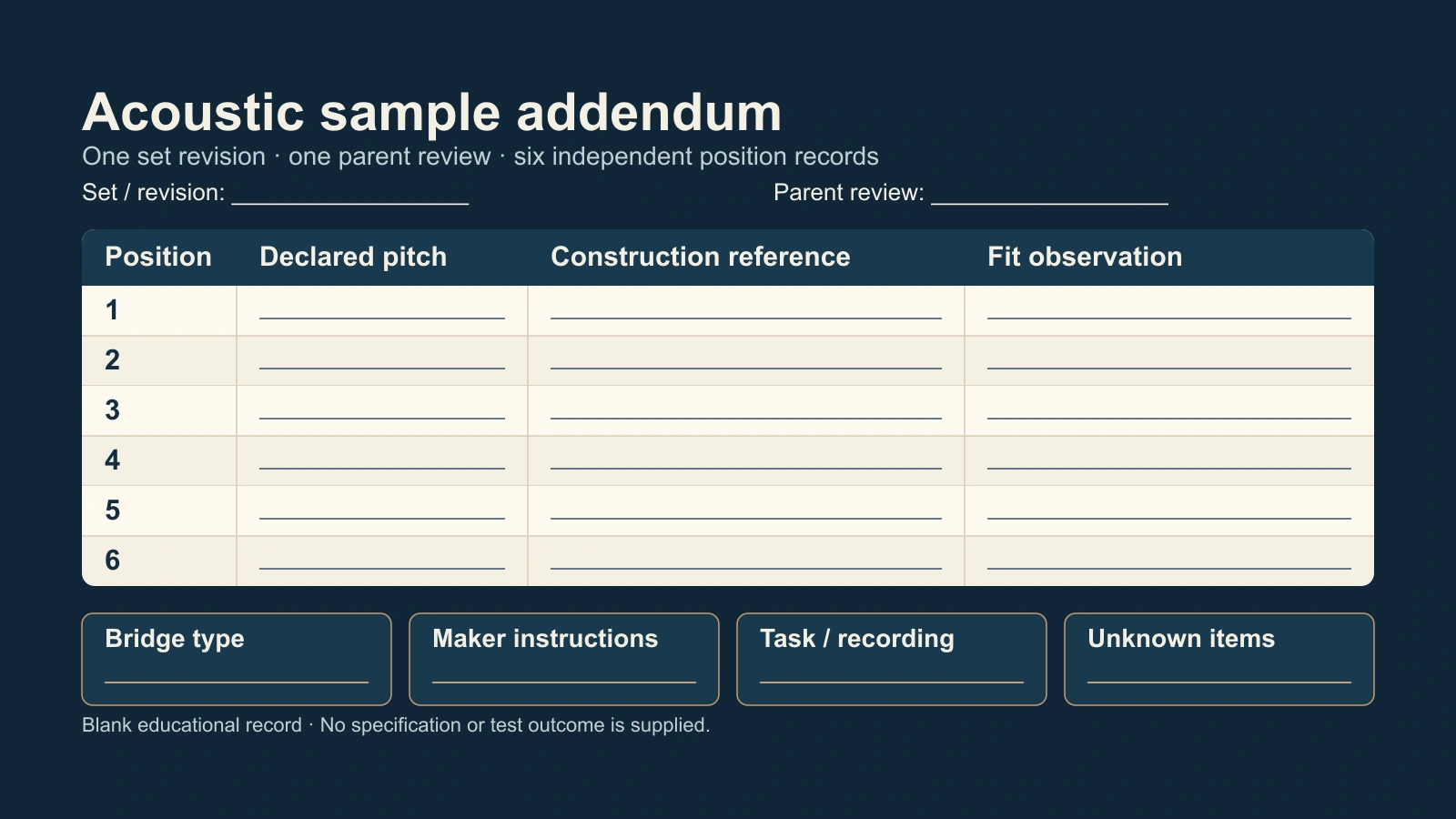
Parent review ID: _____
Sample / set ID and specification revision: _____
Six-position matrix reference: _____
Reviewer / date: _____
Instrument, bridge and installation record
| Acoustic field | Entry for this sample / set revision |
|---|---|
| Guitar make / model / year or internal ID | _____ |
| Scale / speaking-length reference and actual tuning by position | _____ |
| Actual bridge type and specified string-end format | _____ |
| Maker manual title / URL or file reference / section / revision or date checked | _____ |
| Why that instruction applies to this model and hardware configuration | _____ |
| Pin-bridge contact check, if applicable; instruction and observation reference | _____ |
| Other bridge's end-contact check, if applicable; instruction and observation reference | _____ |
| Nut / saddle / tuner condition and relevant setup changes | _____ |
| Installer / date / applicable method / unresolved fit observations by position | _____ |
Acoustic task, recording and environment record
| Acoustic field | Entry for this sample / set revision |
|---|---|
| Reference set ID / revision / age and condition | _____ |
| Passage or task ID / task order / tempo reference if used | _____ |
| Player / pick or fingerstyle / attack instructions | _____ |
| Take IDs / recording dates / elapsed time since installation / playing exposure | _____ |
| Microphone and guitar placement, with position reference or photograph ID | _____ |
| Recorder / interface / gain or other relevant settings / raw-file reference | _____ |
| Listening-copy reference / processing or level adjustment used | _____ |
| Pickup and amplified path, if included in scope | _____ |
| Room / instrument location / care and storage between sessions | _____ |
| Environment readings if taken: value, unit, time and method | _____ |
| Position-specific listening notes and tuning-check record references | _____ |
An environment entry may identify the room and conditions without claiming a controlled humidity test. Record any measured temperature or humidity with its units and method; this worksheet supplies no universal climate range or trial duration.
Link acoustic open items to the decision
| Item / affected position or condition | Parent open-item ID / action needed | Responsible role / date | Resolution and evidence reference |
|---|---|---|---|
| _____ | _____ | _____ | _____ |
| _____ | _____ | _____ | _____ |
Use Not checked for work not performed, Unconfirmed for missing information and Not applicable with a reason. A blank field is not a pass or zero. Keep an acoustic observation separate from a conformance decision against an agreed criterion. The parent record holds the authorized approval, its exact scope, exclusions, deviations and date.
Carry the acoustic references into the approved order
The approved record should connect the six-position specification, coded sample and packaging reference with this addendum. State whether the decision covers the strings, neutral pack-out or complete retail package. Artwork, barcode and protective-packaging decisions remain separate even when recorded on the same date.
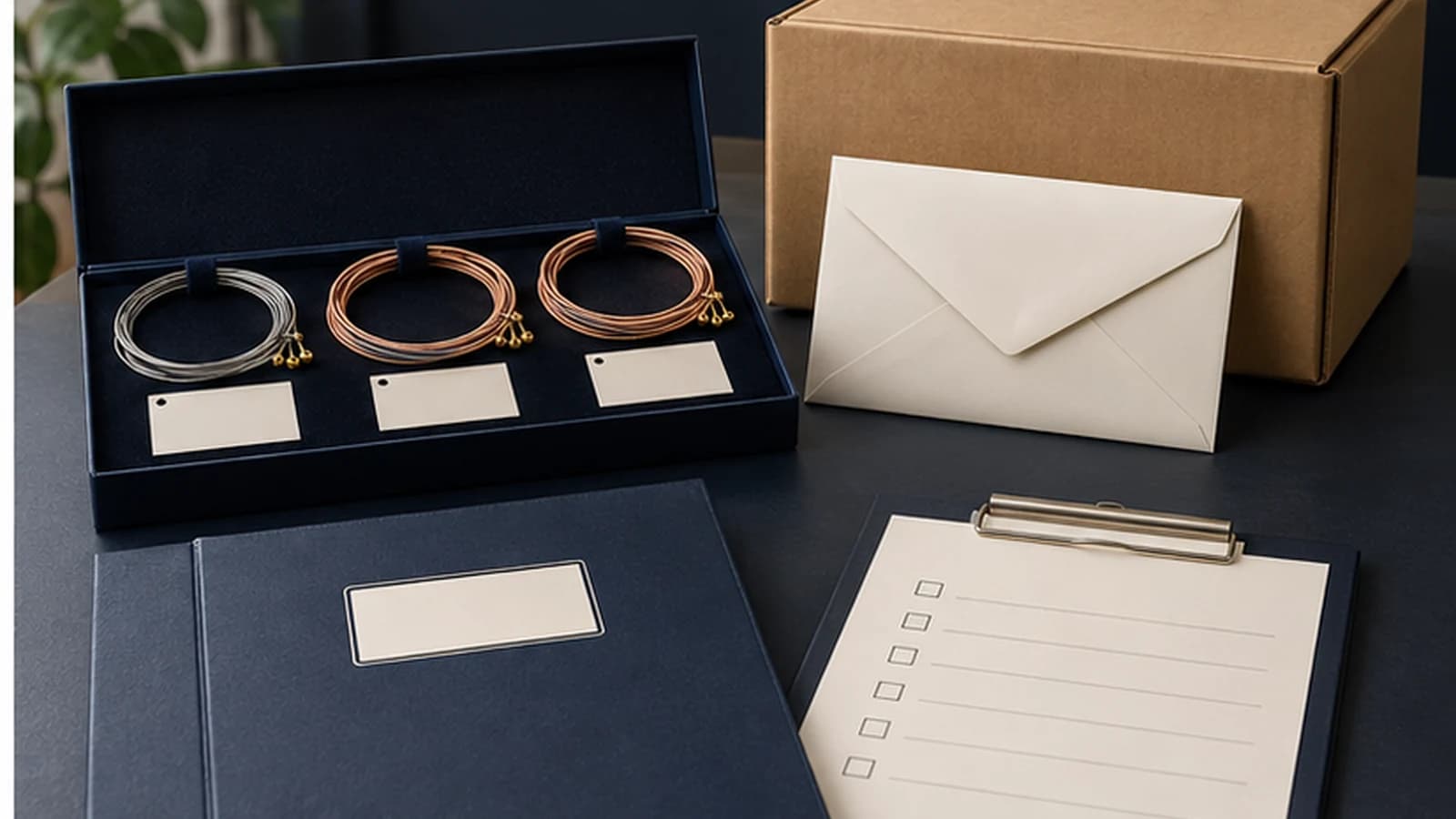
Use the shared workflow for sample quantities, evidence requirements, formal decisions, change control and production handover. The purchase order should cite the released revision, and relevant changes should be reviewed against it. The acoustic shipment inspection guide carries that identity into selected-unit receiving checks under the agreed plan; sample approval is not proof of every delivered unit.
If a sample breaks or unravels, preserve its identity and failed piece where practical, record the position, installation history and contact-point evidence, and keep the investigation separate from a listening preference. A small trial does not establish a break-resistance, corrosion or service-life claim. Actual methods, criteria and supporting records are needed for such claims.
FAQ
How many OEM acoustic string samples should I request?
There is no universal number. Account for installation trials, comparison, agreed checks, retained reference and packaging review in the shared evaluation record. Define the purpose of each set before requesting samples.
Can one guitarist approve the tone?
One evaluator can provide useful feedback under one setup. Record the passage, playing and recording conditions. Add appropriate evaluators for the intended decision without treating agreement as a universal market result.
Does every acoustic bridge use the bridgeplate seating check?
No. Apply that field only to the pin-bridge arrangement supported by the actual guitar's instructions. A pinless or other design needs its own end-contact record. An unverified bridge or an illustrative image is not an installation specification.
Should the sample use final packaging?
The technical string sample can precede final artwork, but the proposed delivered pack-out also needs review. Identify which decision covers strings, protection, artwork and carton configuration, and keep their reference revisions linked.
Can a competitor tension chart become the OEM specification?
No. Use data for the actual proposed construction and stated conditions. A different maker's chart cannot fill missing values in the sample specification or prove fit on the evaluation guitar.
What belongs in the acoustic addendum?
Link the sample and set revision to the guitar, bridge and applicable maker instructions; then record the musical tasks, player, takes, recording chain, room and relevant environment observations. Carry unresolved acoustic items into the parent approval record with an owner and evidence reference.
Conclusion
OEM acoustic guitar string samples should connect a clear specification, coded physical reference and packaging record. The acoustic addendum makes the bridge, instrument, installation, passage, recording and environment conditions traceable to the set revision. Resolve fit concerns before treating listening notes as a basis for approval, and keep the authorized decision in the shared review record.
Explore StringCrest acoustic guitar strings and send your acoustic sample brief. Describe the instrument and bridge, sample/set revision, evaluation purpose and unresolved items in the message; list any manual, photo or recording references for the project discussion.
FROM GUIDE TO PRODUCT
Connect this guide to Acoustic Guitar Strings.
Review the relevant range, then bring the instrument, complete specification and open questions into one project brief.
YOUR PRODUCT · YOUR BRAND
Discuss your next string project with Frank.
Share your instrument category, target market, gauge or material direction and private-label packaging requirements.

ABOUT THE AUTHOR
Frank Zou
Frank works directly with musical-instrument brands, importers and distributors on string specifications, product selection and private-label project requirements.
Meet Frank