
Wholesale Planning
Wholesale Planning
Acoustic Guitar String Shipment Inspection: A Receiving Checklist for Wholesale Buyers
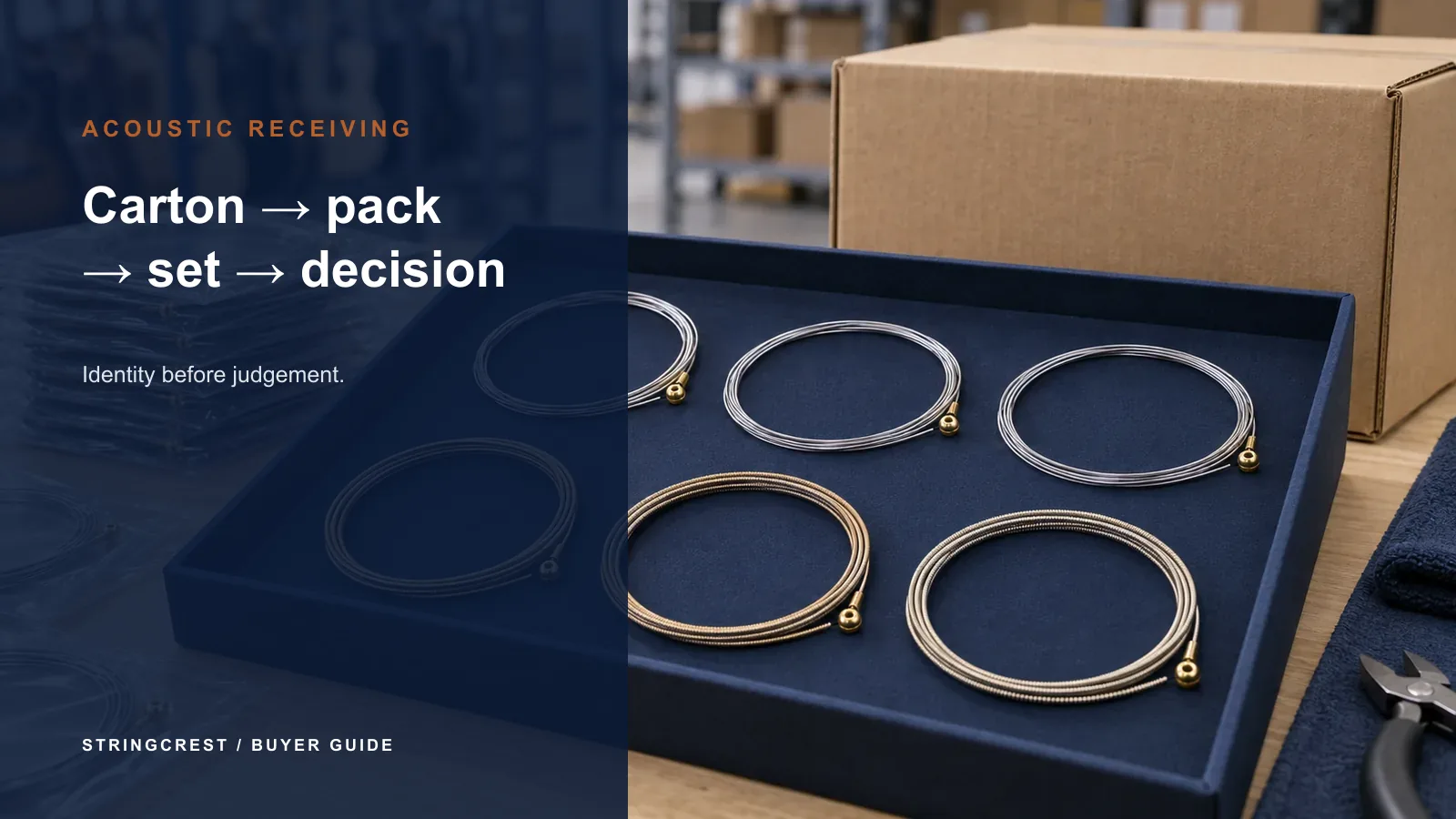
A carton-to-string receiving workflow for wholesale acoustic guitar string shipments.
Introduction
Sample approval and shipment inspection answer different questions. An approved acoustic guitar string sample shows what the buyer accepted; receiving inspection checks whether selected cartons and packs from a delivered lot match the order, approved specification and packaging revision. It should begin with identity and traceability before anyone makes a broad quality judgment.
This guide gives distributors, music retailers and private-label brands a practical receiving workflow for an agreed six-string steel-string acoustic product. It does not prescribe a universal sampling level, tolerance or acceptance limit, and it does not claim that a past StringCrest shipment passed these checks. Those details must come from the contract or buyer quality plan for the actual purchase order and product risk. A selected sample with no observed discrepancy does not prove that every unit in the lot conforms.
Prepare the inspection record before goods arrive
Gather the controlled references
The receiving team needs the purchase order, packing list, approved six-position specification, retained sample or documented reference, final artwork proof and any agreed inspection method. Put revision numbers and dates on the cover sheet. If the shipment uses several gauges or languages, list each SKU separately. For the earlier step of defining and approving the product, use the acoustic sample approval guide; this page starts with the delivered goods.
Do not rely on a pack name such as “12–53” alone. Record all six positions, material direction, plain or wound allocation, ball-end construction, usable length or other agreed dimensions, individual-string identification, retail pack version and units per carton. Mark unconfirmed fields rather than filling them from another maker’s catalog.
Check shipment and carton identity first
Count cartons and compare shipping marks, SKU codes, quantities and visible condition with the packing list. Record crushed, wet, opened or relabelled cartons before moving them. Photograph exceptions with the carton identifier visible where practical.
Keep different lots and SKUs separated
Do not mix cartons while the incoming identity is unresolved. If the supplier provides lot or production codes, record them exactly as shown. If a carton contains mixed retail SKUs by agreement, verify the expected pack-out pattern. A wrong carton label can turn a technically correct set into the wrong inventory item.
Quarantine does not mean rejection. It means the affected units remain identifiable while the buyer checks a discrepancy. Define who can release, hold or escalate a lot so a warehouse employee is not forced to make an unsupported technical decision.
Select and record the sample
The contract or buyer quality plan should define how cartons and packs are selected, the checks to perform and the applicable decision rule. Record the plan and revision, lot quantity with its unit, selected-unit identifiers, actual selected quantity and unit, time, inspector and any deviation from the plan. Follow that selection method rather than choosing only convenient packs. If no basis was agreed, resolve it with the authorized buyer role before treating a sample as acceptance evidence. Do not invent an AQL, sample count or acceptance limit after seeing the goods.
Preserve evidence when opening packs
Photograph the unopened retail pack and code, then open it without losing individual sleeves or labels. Keep the opened set together. If a question appears, retain the pack, strings and associated carton identity. A loose string on a table is weak evidence when its SKU and lot cannot be reconstructed.
Verify pack-out and artwork revision
Confirm the retail pack title, gauge family, material statement, language, barcode supplied by the buyer, importer or distributor information where required, artwork revision and pack quantity. Compare the physical pack with the approved proof, not with a screenshot of an earlier draft. The packaging brief covers how that controlled artwork and protection reference is defined.
Check that each set contains six intended positions and that individual sleeves or labels match the approved sequence. Look for mixed gauge stickers, duplicate positions or a missing string. Count outer-carton units and inner bundles using the agreed hierarchy. Reconcile discrepancies by SKU rather than adjusting a total across products.
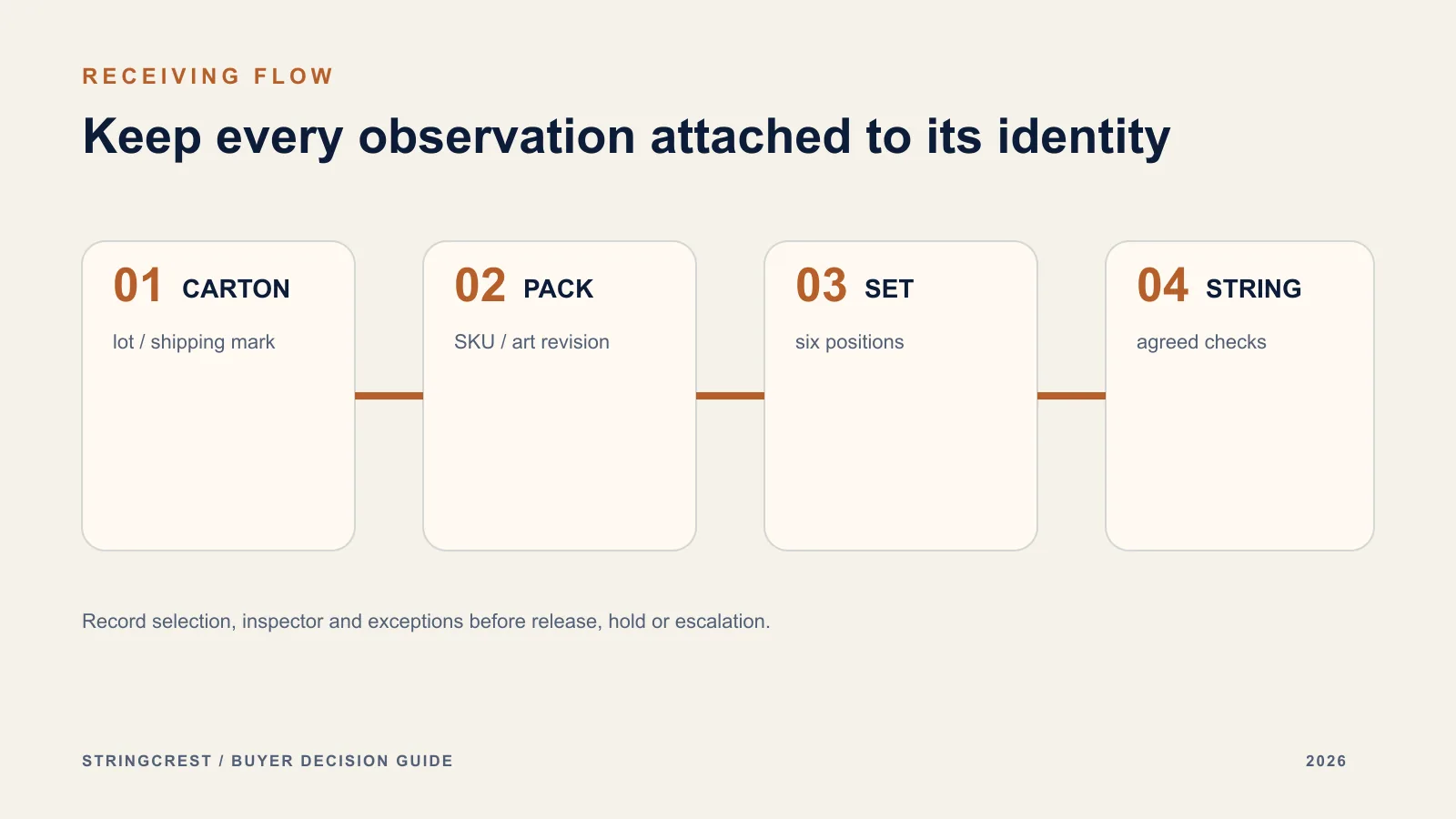
To define the receiving scope, describe the acoustic SKU, six-position specification, approved-reference IDs, carton hierarchy and proposed inspection requirements. Identify which sampling or measurement decisions still need agreement.
Inspect visible product identity and condition
For opened samples, verify six intended positions, ball ends where specified, visible winding transitions, obvious damage, contamination or corrosion signs, and individual identity. Compare coil presentation with the approved packaging reference and record kinks or handling damage. Coil appearance alone does not establish total or usable length. A staged illustration is not a measurement record; an actual inspection photograph needs its unit ID and context.
If diameter, overall length, usable winding length or another dimension is contractual, define the measuring tool, reference points, method and tolerance before inspection. A number without a common method can create a false disagreement. Calibrate or check the instrument as required by the buyer’s quality system and record actual results, not only “pass.”
Separate observation from diagnosis
Write “ball end detached on one sampled string” rather than immediately assigning a cause. Write “pack label says 12–53; opened set contains two identical sleeves” rather than assuming the strings themselves are identical. The supplier can investigate cause after the evidence is preserved.
Compare against the approved reference
Use the retained approved sample to investigate differences in visible construction, end geometry, coil presentation, packaging or identity. A retained sample is not an eternal standard: record its condition and storage. If the buyer approved only a digital photograph, acknowledge the limitation and request a stronger reference for future orders.
Do not make universal tone or durability claims from receiving inspection. A short installation trial may identify obvious fit or functional concerns, but longer performance statements need a defined test. If installation is part of the agreement, use named reference guitars, stated tuning and a controlled observation sheet. Follow the applicable instrument and string instructions and record required differences. Martin’s gauge guidance advises checking the instrument maker’s recommendations before a gauge change. Fender’s bridge-pin discussion addresses ball-end seating in a pin-bridge context. Neither provides a receiving sample size or approves the fit of a particular delivered SKU.
Decide: release, hold or escalate
Use documented categories
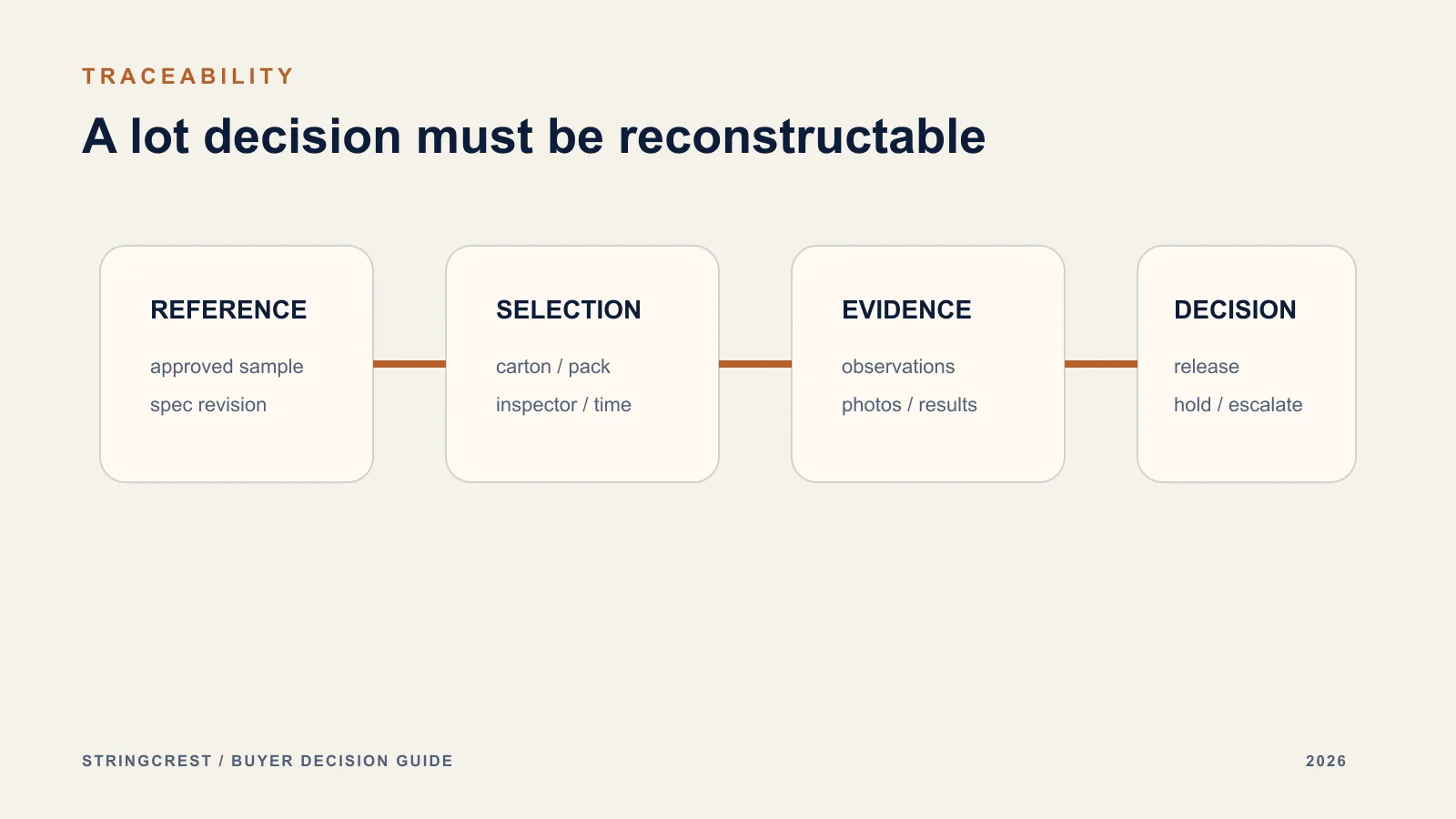
An authorized release applies the agreed plan to a defined inventory scope using the recorded evidence. It does not certify that every unexamined unit is defect-free. A hold means more information or inspection is needed. Escalation may request supplier review, further inspection under an agreed plan, sorting, replacement, concession or corrective action. The appropriate route depends on the contract or buyer quality plan and severity; this guide does not set a universal acceptance threshold.
Record affected SKU, lot, quantity, sample count, observation, photographs, specification reference, temporary disposition, owner and due date. If only part of a shipment is affected, keep released and held stock physically and digitally separated.
Fill a receiving record without turning blanks into passes
Use the blank acoustic-string receiving record (CSV) or copy the fields below into your own system. It is a buyer-side starting point, not a StringCrest inspection procedure, an approved sampling plan or a completed shipment record.
Use one CSV row per check on an identified unit or stated group. Repeat the receipt and reference fields so every row remains traceable when sorted. Complete fields according to the agreed plan and the particular check. Tool and measurement-reference fields apply where relevant; disposition and authorization fields are completed when that decision is made. Record a reason for a genuinely inapplicable field, and keep required missing information marked Unconfirmed. Repeated lot and selected quantities describe the same scope; do not add them across check rows. Keep separate SKUs, revisions and lots distinct.
Identify the receipt and selection basis
| Record field | Project entry |
|---|---|
| Receipt record ID / receipt date / inspector or role | _____ |
| Purchase order / packing list references | _____ |
| SKU / specification revision / approved sample reference | _____ |
| Artwork revision / lot or production code | _____ |
| Carton ID / pack or set ID / position or check scope | _____ |
| Lot quantity and unit | _____ |
| Contract or buyer sampling-plan reference and revision | _____ |
| Selection-method reference / selected-unit IDs or evidence reference | _____ |
| Actual selected quantity and unit / inspection date and time | _____ |
State whether a quantity counts cartons, packs, sets or individual strings. A carton count cannot stand in for the number of packs opened, and a six-string set count cannot identify which position was measured. Do not substitute a sample size from a manufacturer's catalog or another purchase order.
Record the check, then the result
| Unit / position / check | Criterion and source revision | Method, reference points and tool/check status | Actual observation or value + unit; result type | Check status / evidence reference |
|---|---|---|---|---|
| _____ | _____ | _____ | _____ | _____ |
| _____ | _____ | _____ | _____ | _____ |
For a dimensional check, enter the agreed method, reference points, tool ID and required tool-check status before interpreting the result. Record the unit and distinguish direct measurements from visual observations or counts. The blank template supplies no measurement method, tolerance or acceptance rule.
Use Not checked when work was not performed and Unconfirmed when information is missing. Use Not applicable only with a reason. A blank is not zero, a pass or proof that a feature is absent. “No discrepancy observed” should name the selected units and checks covered; it is not a whole-lot result.
Keep stock control and authorization visible
| Disposition field | Project entry |
|---|---|
| Affected quantity and unit / inventory scope | _____ |
| Temporary disposition / open item or action | _____ |
| Responsible role / due date | _____ |
| Decision status / exact scope covered | _____ |
| Authorized decision-maker / decision date / evidence reference | _____ |
Keep a review open while its required evidence or authority is unresolved. A check result does not authorize a warehouse release by itself. Record what is held, what may be released and any scope not yet determined.
Fictional teaching example: artwork identity remains open
Every identifier and observation below is invented for instruction. This is not a StringCrest shipment, customer case, inspection result or approved quality plan. Assume only that the exercise's order requires the artwork reference shown. No sampling rule, sample quantity, measurement result or acceptance limit is supplied.
| Field | Fictional entry |
|---|---|
| Receipt / SKU / lot | DEMO-RECEIPT / DEMO-SKU / DEMO-LOT |
| Identified carton and pack | DEMO-CARTON / DEMO-PACK |
| Check and criterion source | Artwork identity; assume the exercise order requires DEMO-ART-A |
| Selection basis and quantity | Unconfirmed; the exercise supplies neither a selection rule nor quantities |
| Hypothetical visual observation | The label on DEMO-PACK says DEMO-ART-B |
| Dimensional checks | Not checked; no tool, method or measurement is represented |
| Temporary disposition and scope | Hold DEMO-PACK for review; wider affected scope and quantity remain unconfirmed |
| Next action / role | Buyer quality role to reconcile the artwork reference and define any additional work under the agreed plan |
| Authorized release | Review open; no release decision recorded |
The entry preserves a specific identity question without diagnosing the strings or inventing a defect rate. In a real receipt, the authorized role would determine any broader stock-control or inspection action. This example supplies no rule for accepting or rejecting the lot.
Feed findings into the next order
Close each issue with a documented outcome. Update receiving instructions when an ambiguity caused the problem. If the supplier proposes a material, end, gauge, coil or packaging change, route it through sample and artwork review before treating the next shipment as unchanged.
Track recurring issues by SKU and revision, not only by supplier name. A clear history helps the buyer distinguish one handling incident from a repeated control problem. Avoid publishing private supplier records or personal information in public content.
FAQ
Can I inspect only the outside cartons?
Outer-carton checks are necessary but do not confirm retail pack identity or the six-string set. The agreed plan should state how inner packs and product samples are selected.
Does a correct gauge label prove the strings are correct?
No. The label is one identity field. The full position matrix, material, end construction, packaging and any agreed measurements also matter.
What should happen if packaging is damaged but strings look normal?
Record and isolate the affected units, then apply the agreed disposition. Protective-pack damage may affect saleability or protection even when no immediate string damage is visible.
Should every shipment use the same sample size?
Not automatically. Use the contract or buyer quality plan for the actual lot and purpose, including selection, checks and decision rules. If that basis is missing, resolve it rather than choosing a convenient count. Finding no issue in the selected units does not prove every unit in the lot conforms.
Can receiving inspection prove long service life?
No. It can document identity, condition and agreed checks at receipt. Durability or corrosion-resistance claims require a separate method and adequate observations.
Conclusion
An acoustic guitar string receiving inspection works from carton to pack to set to individual position, keeping every observation tied to a lot and approved reference. Define the method before arrival, preserve evidence, separate observations from causes, and use clear release, hold and escalation decisions. That discipline protects inventory without pretending a small sample proves more than it does.
To prepare a shipment-specific discussion, describe the acoustic SKU matrix, approved-reference IDs, packaging revision, carton configuration and unresolved inspection requirements. Use the requirements message to identify the fields that still need confirmation for the proposed order.
Sources and scope
- D’Addario acoustic guitar string collection: manufacturer product-family background only. Its catalog is not the delivered SKU specification or a receiving acceptance plan.
- Martin guide to acoustic guitar string gauge: instrument and gauge-selection context, including checking manufacturer recommendations before a gauge change. Its broader tone or service-life descriptions are not receiving criteria here.
- Fender guide to acoustic bridge-pin seating: a pin-bridge installation discussion, not universal bridge geometry, a shipment inspection method or a sampling standard.
The receiving sequence, blank worksheet and fictional entry are buyer-side educational tools. Inspection methods, sampling and authorized decisions must come from the applicable contract or buyer quality plan, not these manufacturer articles.
FROM GUIDE TO PRODUCT
Connect this guide to Acoustic Guitar Strings.
Review the relevant range, then bring the instrument, complete specification and open questions into one project brief.
YOUR PRODUCT · YOUR BRAND
Discuss your next string project with Frank.
Share your instrument category, target market, gauge or material direction and private-label packaging requirements.

ABOUT THE AUTHOR
Frank Zou
Frank works directly with musical-instrument brands, importers and distributors on string specifications, product selection and private-label project requirements.
Meet Frank