
Materials & Construction
Materials & Construction
Flatwound Acoustic Guitar Strings: How to Read the Complete Set
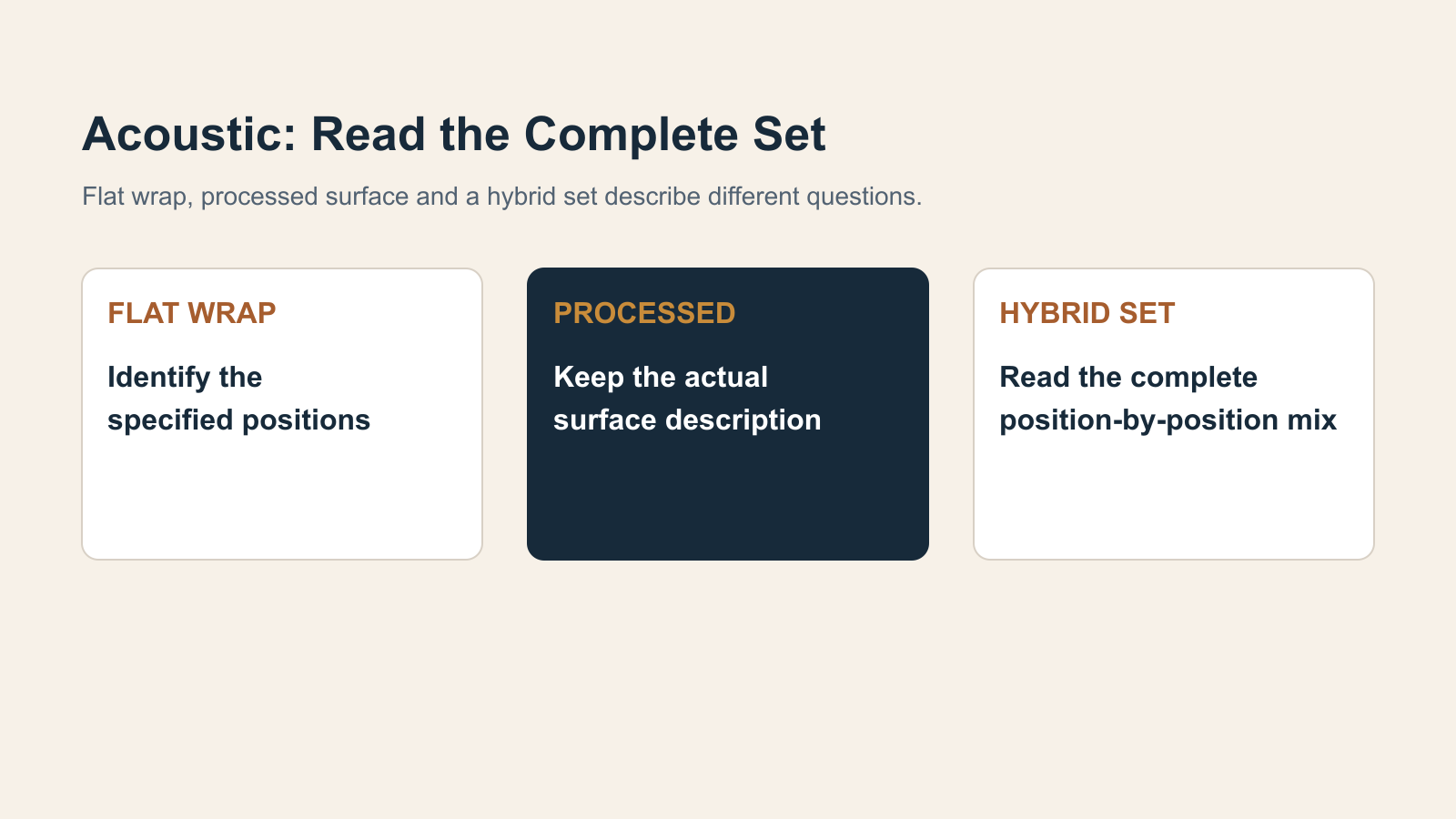
Read the exact wound-position map before treating a hybrid acoustic set, a flatwound construction and a ground-flat surface as the same product.
Introduction
Acoustic guitar sets can include flatwound strings, but the term flatwound acoustic guitar strings does not identify what is in every position. A named acoustic set may combine plain, flatwound and roundwound strings. A ground and polished wound string is another construction description. Choose the exact set and read its component list before recommending a replacement or writing a private-label specification.
For a US guitar dealer, the useful first question is what the customer wants to change: a particular wound-string surface, handling noise in an acoustic recording, or the response of the complete set. Those requests can lead to different comparisons. They do not make every smooth-looking packet an interchangeable acoustic set.
Separate the surface request from the construction
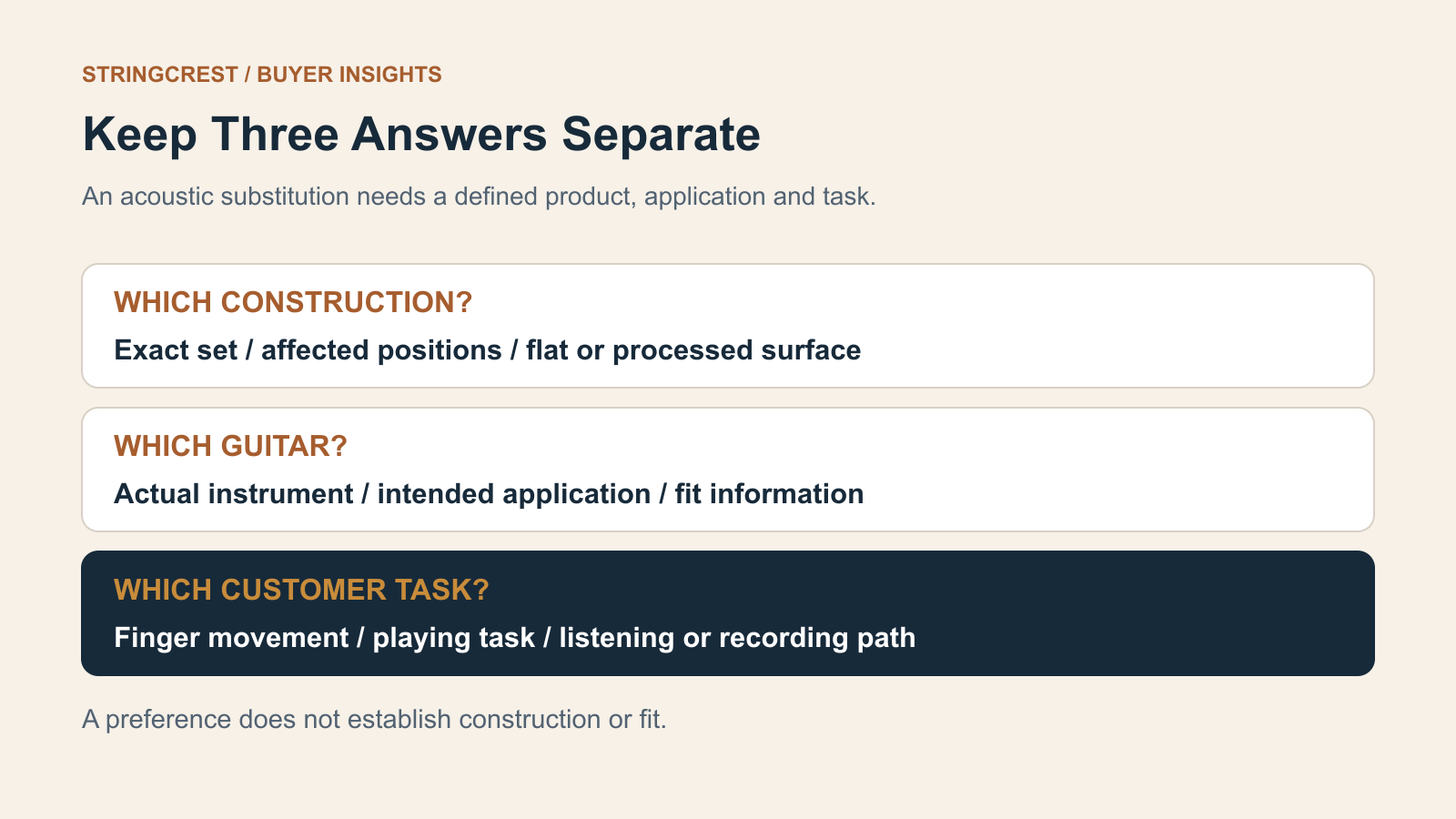
“Smooth” describes a preference or observation. “Flatwound” should describe an identified construction. “Acoustic guitar” identifies an intended application, while a family name identifies a manufacturer’s range. Keep those pieces separate when reading a catalog or describing a candidate to a customer.
A request for a smoother bass-string surface is incomplete until the buyer establishes whether a specific construction is required. If the customer specifically asks for flat wrap, a semi-flat alternative should be offered as an alternative and explained. Renaming it to match the search phrase conceals a difference the customer was trying to control.
D’Addario’s EFT16 Flat Tops page supplies a named distinction: it describes phosphor-bronze winding over a high-carbon steel core, followed by grinding and polishing to produce a semi-flat surface. That is a processed wound-string example, not a reason to label all polished strings as conventional flatwounds. Its construction description concerns that product.
Our half-round guitar guide discusses surface demonstrations on electric guitar. The useful distinction carries over as a question to ask; its electric-guitar sample specification and application do not become an acoustic recommendation.
Read a hybrid acoustic set by position
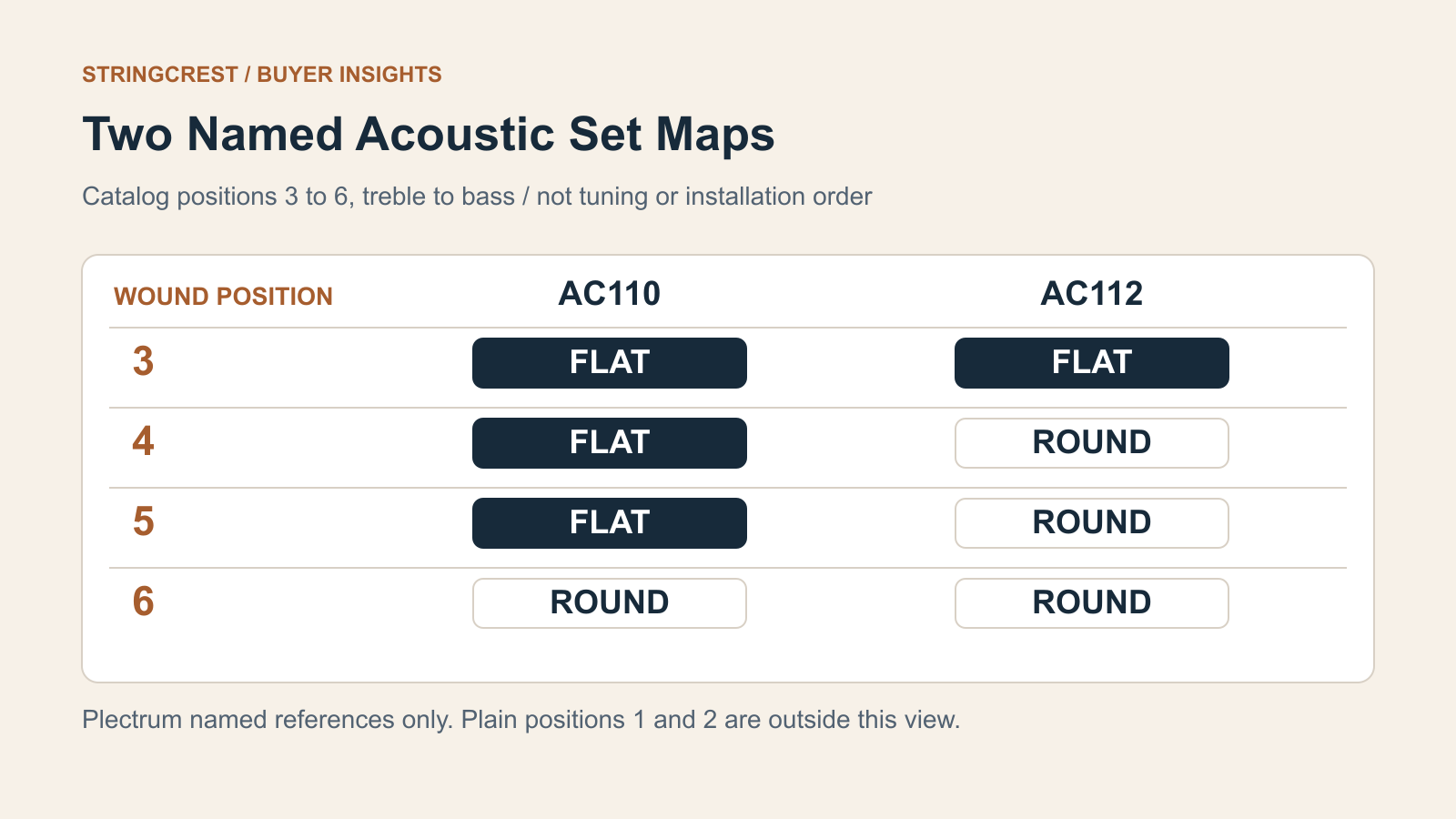
The Thomastik-Infeld Plectrum technical chart gives these component mappings for two named sets.
Positions run from 1, the treble side of the catalog set, to 6, the bass side. This table deliberately shows only wound positions 3–6; it is not a four-string pack or a tuning instruction.
| Wound position | AC110 component and declared type | AC112 component and declared type |
|---|---|---|
| 3 | AC016 — bronze flat wound | AC024 — bronze flat wound |
| 4 | AC022 — bronze flat wound | AC033 — bronze round wound |
| 5 | AC030 — bronze flat wound | AC044 — bronze round wound |
| 6 | AC041 — bronze round wound | AC059 — bronze round wound |
Both references use plain steel at positions 1 and 2. Their family name does not identify the wound-position mix in a different pack.
When explaining this at the counter, point to the position the customer asked about. A request concerning the surface of position 4 would produce a different construction answer for these two references. A request concerning position 3 would not reveal that particular difference. The appropriate discussion therefore starts with the customer’s task, then checks the actual component record.
This table does not compare measured feel, acoustic output or tension. It also does not reproduce a private-label specification. Its purpose is to demonstrate a catalog-reading decision that can be applied to a separately identified proposal.
Make the product description answer the whole-set question
A complete six-string packet needs a complete description even when only part of its construction is being highlighted. Specify which positions are plain and which are wound, then identify the winding type for each wound position. Keep the material declaration separate from the surface description.
If a proposed product is a hybrid, explain the division. “Flatwound positions 3–5 with a roundwound position 6” is clearer than a claim that every wound string is flat, provided that those are the confirmed contents. This wording is an example of how to describe an agreed configuration; it is not an offered StringCrest specification.
For a ground or polished alternative, preserve the supplier’s stated finishing method. Do not replace it with a more popular category term in the quotation, packet or shelf description. The underlying product might suit the customer, but that is a selection decision made with the difference visible.
A replacement single needs the same care. Record the existing set and the position being replaced before matching a component. A shared family name, approximate diameter or similar bronze color does not establish the required winding or the identity of the replacement.
Check acoustic application before comparing the surface
Identify the actual guitar and its maker’s applicable string guidance. Keep a steel-string acoustic request separate from a classical guitar request. The word “acoustic” can appear in a broad retail search without identifying the instrument’s designed string system.
The nylon-versus-steel guitar guide addresses that larger compatibility boundary. This article does not turn a flatwound or semi-flat surface into permission to change a guitar from one string system to another.
For the actual candidate, verify the complete gauge list, intended tuning and applicable length information. A pair of outer gauges does not supply the intermediate components. Compare the maker’s recommendation and product-specific documentation; do not derive equal tension or an unchanged setup from matching endpoint numbers.
Include the actual bridge, anchoring arrangement and tuner path where they affect fit. A string’s speaking length is not the same record as its complete installed path. Seek the candidate’s usable-length information and any construction-transition limits needed to establish that it fits the instrument.
If the player uses amplification, identify that listening path as well. Surface terminology does not establish pickup compatibility or a balanced amplified result. The acoustic-versus-electric string guide handles those broader application questions; a dealer should keep them separate from a preference about wound-string texture.
Keep an acoustic comparison focused on the customer’s task
Once a candidate has been judged appropriate for the guitar, compare the concern the customer actually raised. For a recording question, identify whether the result is being heard through a microphone, the instrument’s pickup system or a processed recording. A surface preference in one listening path should not be reported as a universal result.
Ask the player to demonstrate the relevant movement rather than treating every sound as finger noise. The observation may concern movement along a wound string, fret contact, the instrument or another part of the recording setup. A new surface should not be described as the automatic answer to all of those observations.
When two complete sets differ in more than their outer finish, preserve those differences in the explanation. A preferred set can still be a useful choice, but the comparison has not isolated the effect of winding shape alone. Do not turn a customer’s preference into a claim that a manufacturing process eliminates noise.
For dealer staff, a short comparison note is enough: the question, the identified reference and candidate, the actual guitar and listening path, the positions involved, and the result the player described. An unresolved result is a valid outcome. There is no need to manufacture a positive testimonial or a numeric improvement to justify the discussion.
Use a construction check before a substitute recommendation
This compact decision table helps a dealer keep the missing answer visible. Complete it from the actual candidate’s documentation and the customer’s stated requirement, rather than from a package photograph alone.
| Customer requirement | What must be established | When the answer remains open |
|---|---|---|
| Flat wrap on specified wound positions | The exact position-level winding description | Only a family headline or “smooth” adjective is available |
| A processed wound surface is acceptable | The maker’s actual finishing description and affected positions | The alternative is described as identical without explanation |
| Replacement for one member of a hybrid set | Existing set, position and exact component identity | Selection is based only on note name, color or outer gauge |
| A different acoustic playing or recording response | Suitable installed candidates and the relevant task | No appropriate comparison has been made |
A missing construction answer and a missing fit answer are different gaps. Resolve each with the relevant supplier or instrument guidance. A pleasing surface sample does not complete the application record, and a correctly identified component does not by itself prove the customer will prefer its response.
Use the acoustic guitar string category to begin a product discussion, then carry the actual requirements into the inquiry. A category entry is a starting point for confirming a proposal, not a substitute for the proposed set’s complete construction and fit information.
Conclusion
Select a flatwound acoustic direction from the complete position list. Preserve the distinction between flat wrap, a processed surface and a hybrid set, then establish that the identified candidate fits the actual guitar and answers the customer’s task.
FROM GUIDE TO PRODUCT
Connect this guide to Acoustic Guitar Strings.
Review the relevant range, then bring the instrument, complete specification and open questions into one project brief.
YOUR PRODUCT · YOUR BRAND
Discuss your next string project with Frank.
Share your instrument category, target market, gauge or material direction and private-label packaging requirements.

ABOUT THE AUTHOR
Frank Zou
Frank works directly with musical-instrument brands, importers and distributors on string specifications, product selection and private-label project requirements.
Meet Frank