
Materials & Construction
Materials & Construction
Silk and Steel Acoustic Guitar Strings Wholesale: A Construction, Tension and Range-Planning Guide
A B2B guide to silk-and-steel construction, gauge and tension direction, acoustic fit, sample approval, packaging and six- versus twelve-string planning.
Introduction
Buying silk and steel guitar strings wholesale requires a more precise brief than asking for a “soft” acoustic set. Silk-and-steel is a recognized market category, but the words do not provide a universal recipe. A buyer still needs to define the core system, wrap material, gauges, intended tension direction, string count, installed fit, sample method and packaging claims. Without those controls, two sets carrying the same category name can differ in feel, output, winding length and suitability for the target instrument.
The useful purchasing question is therefore not whether silk-and-steel strings are universally better or easier. It is whether a documented construction and gauge system produces an acceptable result on the buyer’s reference guitars for the intended customer group. That result should be established with identified samples and repeatable evaluation, not inferred from a material name or a competitor description.
This guide is for importers, distributors, acoustic-guitar retailers and private-label brands planning a silk-and-steel range. It explains how to turn a broad category into a comparable RFQ, how to separate construction facts from tonal language, how to review six- and twelve-string opportunities, and how to keep claims within the evidence. It does not publish a StringCrest product recipe, confirmed MOQ, lead time or performance guarantee. Those commercial and technical details belong in a current quotation and approved sample record.
Define “silk and steel” before requesting a quotation
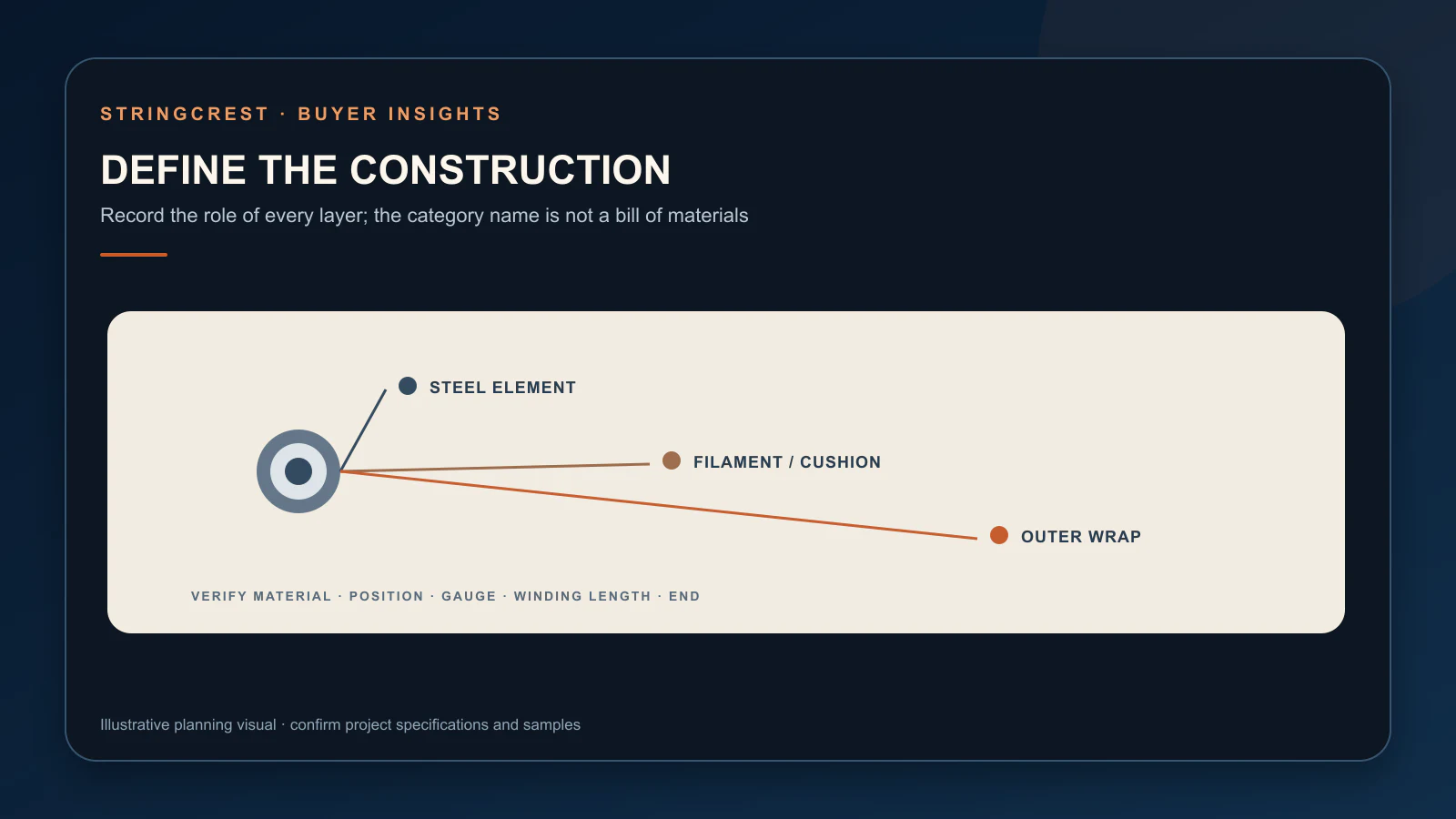
The category name is not a complete bill of materials
An official D’Addario educational page describes its Silk & Steel family as using silver-plated copper wrap wire and a core that combines silk and steel. Its current category page lists both six- and twelve-string sets. Those pages are useful evidence that the market category can involve a composite core and a metal outer wrap. They do not establish a universal construction for every supplier, and their specifications must not be copied into a private-label sheet as if they were StringCrest data.
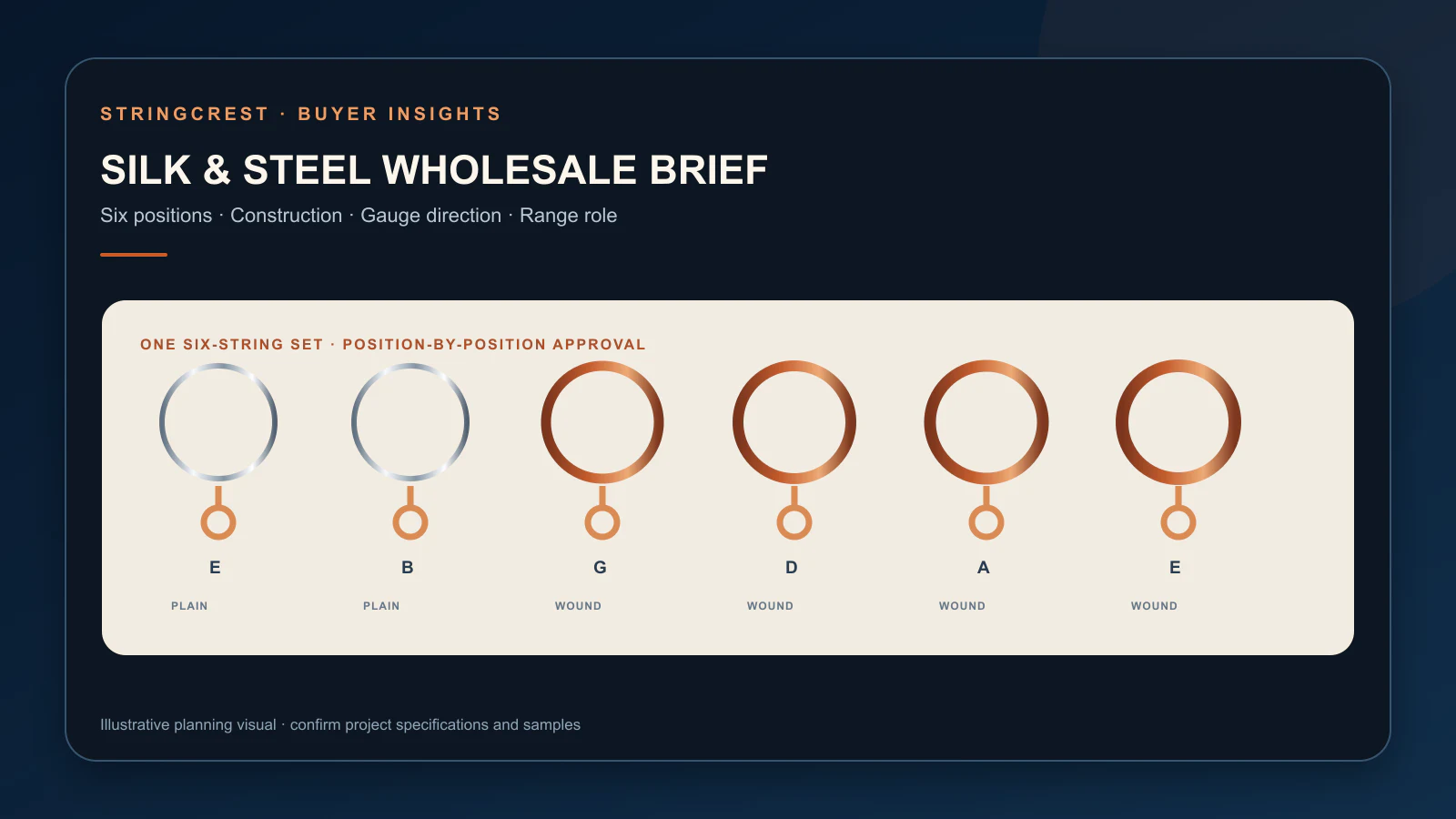
Ask a prospective supplier to identify the construction position by position. The two plain treble strings, if present in the proposed set, may not share the same architecture as the wound strings. A wound string may contain a steel element, cushioning or filament material and an outer wrap. The supplier should state the material role rather than answering with one broad phrase. If “silk” is used commercially for a filament or cushioning component, request the supplier’s exact material declaration and approved wording.
The buyer should also define what is outside the scope. A conventional phosphor-bronze set is not transformed into a silk-and-steel set by using a softer marketing description. A nylon classical set is a different construction and installation category. Likewise, “silver” in a wrap description can refer to appearance, plating or alloy terminology; it should not be converted into a precious-metal claim without documentation.
| Specification field | What the supplier should state | Why it matters |
|---|---|---|
| String position | E, B, G, D, A and E for a six-string set | Prevents one material phrase from hiding position differences |
| Core system | Material and construction by wound position | Defines the structural basis of the set |
| Cushioning or filament layer | Material type and location, if used | Clarifies what the category name actually means |
| Outer wrap | Material, surface and winding direction | Supports identification and sample comparison |
| Plain strings | Material, gauge and end construction | Completes the set rather than documenting only the basses |
| End and winding length | Ball-end type and usable wound length | Confirms acoustic bridge and tuner fit |
Separate feel, tension and setup
A lighter-feeling set is not defined by one gauge number
Silk-and-steel sets are often positioned toward a softer feel, but a B2B specification cannot rely on that phrase alone. Installed tension depends on the unit weight of each string, scale length and tuned frequency. Core architecture and wrap construction influence unit weight, so two strings with the same nominal diameter can load and feel different. A useful quotation therefore combines nominal gauges with a declared construction and a reference scale and tuning.
Do not treat “light” as a universal numeric standard. Record the complete proposed gauge sequence and the tuning for all six positions. If the supplier provides calculated tension, retain the scale, pitch and calculation basis. If the range is intended for guitars previously fitted with another construction, use the sample stage to assess whether neck relief, action or intonation needs attention. A set that reduces total load may change the instrument’s setup response; that possibility should become installation guidance rather than an unqualified benefit claim.
The reference guitars should represent the customer’s likely instruments. Include at least the common scale group used by the project, the intended bridge-pin arrangement and a documented nut and tuner path. If the range may be used on older or lightly built guitars, do not claim compatibility merely because the set feels flexible. Compatibility requires fit and setup review on the declared instruments.
Plan the six positions as one playing system
Balance matters more than one featured string
A six-string acoustic set must work as a sequence from treble to bass. Buyers should record the proposed gauge, construction and revision for each position, then evaluate how the strings relate. The transition between the plain and wound positions is particularly important because the construction changes. A set can be comfortable overall yet feel uneven if the G string, adjacent plain string or first wound bass responds very differently.
Sample comments should be tied to the reference guitar and player task. Ask evaluators to compare left-hand feel, attack, volume relationship, tuning stabilization and response across normal playing positions. Avoid a free-form question such as “Does it sound warm?” until basic fit and balance have been recorded. Words such as warm, mellow, soft and vintage are subjective and can mean different things to different channels.
For a private-label range, a single clearly defined set may be a better starting point than several near-duplicates. Adding a second gauge or construction should solve a documented customer need. If two candidates differ only slightly, keep them as sample alternatives until the buyer can explain the separate channel role of each SKU.
Confirm acoustic-guitar installation fit
Ball seat, bridge pins, winding transition and tuners all matter
The installed path begins where the ball end seats against the bridge plate or bridge system. Record the ball shape and dimensions supplied for the sample and verify that it seats correctly with the target bridge pin. The ball should not jam in an unintended position or pass through an opening. The string should leave the bridge cleanly without a wrap transition sitting on the saddle.
Measure from the ball seat to the nut and from the nut to each tuner. The wound portion must extend far enough for the intended guitar while the transition remains in an acceptable location. At the tuner, inspect whether thick wrap or auxiliary material enters a post hole or creates an awkward first wrap. A string described only by scale length can still fail if the usable winding length is wrong.
The sample record should state whether the guitar required setup changes. A minor adjustment may be normal when changing construction or total tension, but it must not disappear from the evaluation. If a retail customer is likely to replace a conventional bronze set directly, packaging and support content should advise users to check setup when changing string type. Do not promise that every guitar will need no adjustment.
Build a controlled sample evaluation
Identify every candidate and hold the reference conditions steady
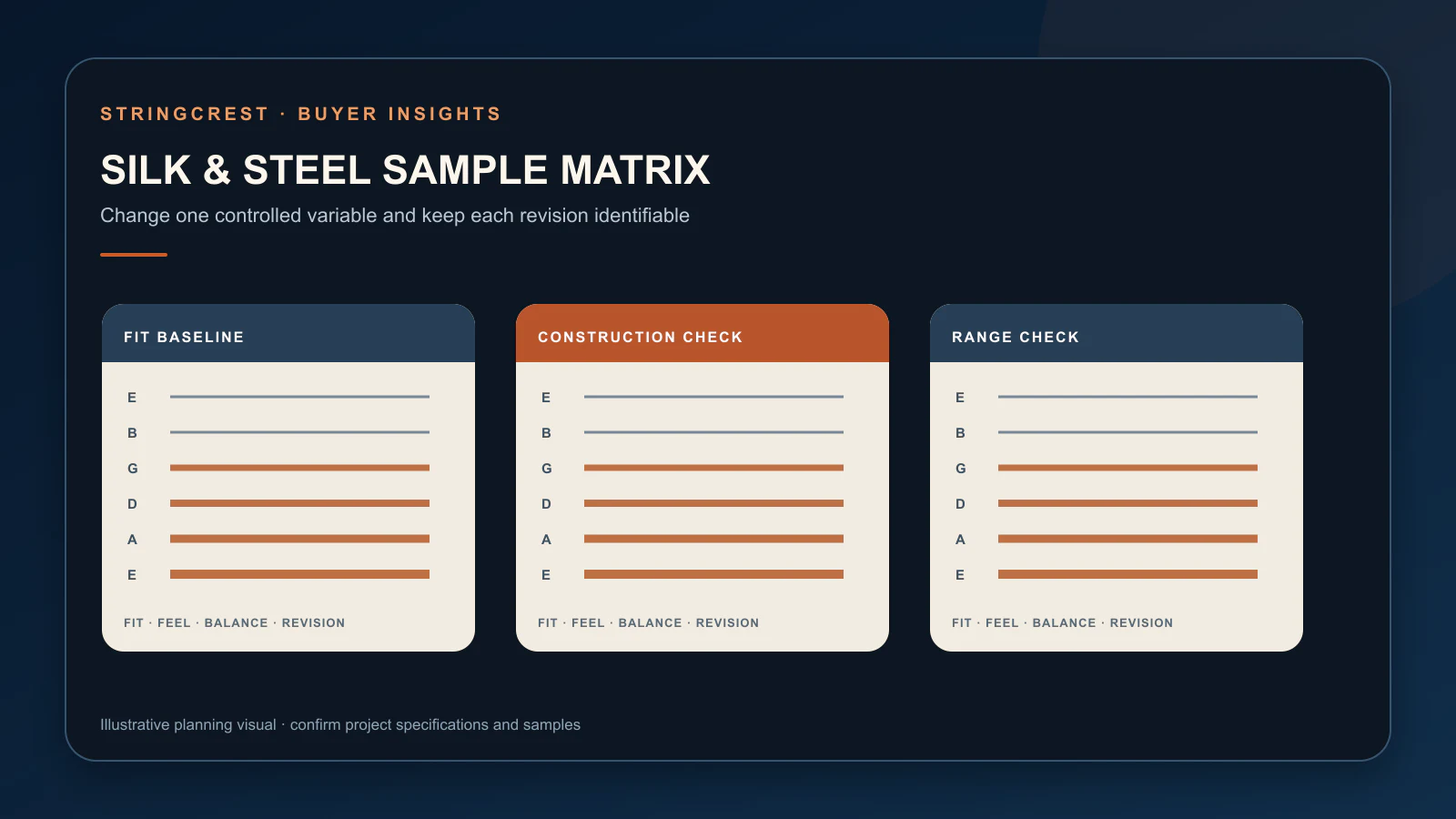
Assign a sample code linked to a dated specification. The code should identify gauge sequence, construction revision, outer wrap, string count and packaging state. Unmarked bags create avoidable confusion, especially when two candidates have similar color and surface appearance.
Begin with receiving inspection. Confirm the count and position labels, inspect winding surfaces and ball attachments, and photograph any visible anomaly. Then install on the correct reference guitar, record setup values relevant to the project, tune using the agreed method and note stabilization. A buyer does not need to invent a laboratory test. The objective is to keep sample identity and conditions clear enough that feedback can be compared and a supplier can reproduce the approved revision.
Use a short evaluation form with fixed questions. Does every string fit? Is the transition between plain and wound positions coherent? Are unwanted noises or surface defects present? Does the set remain within the intended feel direction on all reference guitars? Do player observations repeat across more than one evaluator? Any durability review must state the playing schedule, environment and acceptance rule. Do not convert a few days of use into a universal life claim.
| Sample gate | Review item | Evidence to retain |
|---|---|---|
| Receiving | Code, count, gauges, winding and ends match the sheet | Label photo and receiving record |
| Installation | Ball, bridge-pin, saddle, nut and tuner path fit | Installed photos and measurements |
| Setup | Relief, action and intonation checked when construction changes | Before-and-after notes |
| Playing review | Balance, feel, response and unwanted noise | Structured evaluator form |
| Approval | Physical sample, technical sheet and artwork share one revision | Signed release record |
Decide whether a twelve-string set belongs in the range
Course pairing creates a separate product, not a larger six-string pack
The keyword library and current official category evidence both show interest beyond a standard six-string set. A twelve-string silk-and-steel opportunity can be commercially relevant, but it needs a separate course-by-course specification. The buyer must define the six courses, octave or unison roles, individual gauges, wound-versus-plain construction, usable lengths and package identification.
Do not double every six-string position mechanically. Course balance and installation space need their own sample review. Confirm that paired strings seat correctly at the bridge, pass through the nut and reach the intended tuner arrangement. Evaluate tuning stabilization and the relationship within each course as well as across the instrument. If the supplier proposes a twelve-string set, request a complete position table rather than accepting a single range such as “11–47.”
Inventory planning should also be separate. A six-string set and a twelve-string set serve different instruments and purchase patterns. Use distinct SKU, barcode, pack count and front-panel identification. A twelve-string extension should be added because the channel supports it, not merely because an industry example exists.
Design packaging around clear identification
Material language must match the approved technical sheet
The front panel should identify acoustic guitar strings, silk-and-steel category, string count, gauge sequence or range, and the brand. If the exact outer wrap is a verified selling point, use wording approved from the supplier’s material declaration. Do not copy another brand’s alloy wording or tonal scale.
The rear panel can explain the intended feel direction, installation checks, storage and contact path. Subjective tone language should be presented as a range description, not a measurable guarantee. Phrases such as “lower tension,” “reduced finger noise” or “gentle on vintage instruments” need an evidence basis and defined comparison. Where the project has only sample observations, use accurate language such as “designed for a flexible feel; confirm suitability on the target instrument.”
Packaging protection must be specified separately from the string. Define the inner sleeve or barrier format, individual envelopes, labeling, outer carton and lot identification. A silk-and-steel article cannot prove corrosion life, humidity resistance or shelf life. If those claims are required, create an agreed test and acceptance plan before artwork approval.
Prepare a comparable wholesale RFQ
Separate fixed requirements from supplier recommendations
A useful RFQ states the target market, six- or twelve-string format, tuning, reference scale, complete gauge sequence, construction direction, outer wrap, ball end, usable length, packaging format, artwork status, sample quantity and expected order structure. Mark fields that are fixed and fields where supplier input is requested.
Ask every supplier to quote the same brief and identify deviations. If a proposed core does not match the requested architecture, the quotation should state the alternative. If a gauge changes, the position table should be revised. MOQ, sample charges, lead time and price must be confirmed in the current quotation because they depend on the final design and order conditions.
Before production approval, reconcile four items: the technical sheet, the identified physical sample, the packaging proof and the purchase order. They should share the same revision reference. This protects both buyer and supplier when a material term or gauge description changes during development.
Common sourcing mistakes
The first mistake is treating “silk and steel” as a universal bill of materials. The second is assuming that a smaller gauge automatically creates a specific installed tension. The third is approving a tonal adjective before checking position balance and installation fit.
Another frequent error is using a six-string sample to approve a twelve-string product. Course pairing, lengths and packaging make it a separate specification. Buyers also create risk when they copy a competitor’s material or longevity claim into private-label artwork. Competitor and official manufacturer pages can show which variables exist; they cannot prove the new product’s construction or performance.
Finally, avoid launching several nearly identical gauge sets without a clear channel role. Each additional SKU creates artwork, barcode, forecasting and replacement complexity. Start with a defensible product definition and expand from observed demand.
FAQ
Are silk-and-steel strings the same as nylon classical strings?
No. Silk-and-steel is an acoustic steel-string market category with its own composite and wound constructions. Classical nylon sets use different materials, end practices and installation requirements. Confirm the supplier’s position-by-position construction rather than relying on either category name.
Do silk-and-steel strings always have lower tension?
Many are positioned toward a softer or lighter feel, but actual tension depends on unit weight, scale length and pitch. Request the gauge sequence, construction and calculation basis, then verify the set on the target guitars.
Can one sample approve both six- and twelve-string sets?
No. A twelve-string set needs its own course map, gauges, lengths, installation review and sample approval. It should also have distinct packaging and inventory identity.
What should a wholesale buyer inspect first?
Confirm sample identity, string count, position construction, winding surface, ball attachment and usable length before assessing tone. Installation fit and setup effects should be recorded on the declared reference guitar.
What belongs in the final production approval?
Approve the position table, identified sample, material wording, gauge and length data, packaging artwork, pack configuration and purchase-order revision. Confirm commercial terms in the current quotation.
Conclusion
Silk-and-steel acoustic strings become a manageable wholesale product when the buyer replaces broad adjectives with a position-by-position construction brief. Core architecture, outer wrap, gauges, usable length and reference instruments establish what is being sampled. Controlled evaluation then shows whether the set fits, balances and supports the intended channel role.
A strong range does not need exaggerated softness, tone or longevity claims. It needs a traceable sample, clear six- or twelve-string identity, accurate packaging and a quotation that separates confirmed requirements from supplier recommendations.
Explore acoustic guitar string options · Send your silk-and-steel project requirements
Sources and interpretation limits
These official sources document one manufacturer’s category language and current product examples. They do not establish StringCrest specifications, availability, performance, test results or commercial terms. Confirm all project materials, samples and quotation details before publication or ordering.
FROM GUIDE TO PRODUCT
Connect this guide to Acoustic Guitar Strings.
Review the relevant range, then bring the instrument, complete specification and open questions into one project brief.
YOUR PRODUCT · YOUR BRAND
Discuss your next string project with Frank.
Share your instrument category, target market, gauge or material direction and private-label packaging requirements.

ABOUT THE AUTHOR
Frank Zou
Frank works directly with musical-instrument brands, importers and distributors on string specifications, product selection and private-label project requirements.
Meet Frank