
Wholesale Planning
Wholesale Planning
How Wholesale Buyers Should Review an Acoustic Guitar String Tension Sheet
Review acoustic guitar string tension data by gauge, scale length, pitch, construction, units, assumptions, set balance, samples and revision control.
Introduction
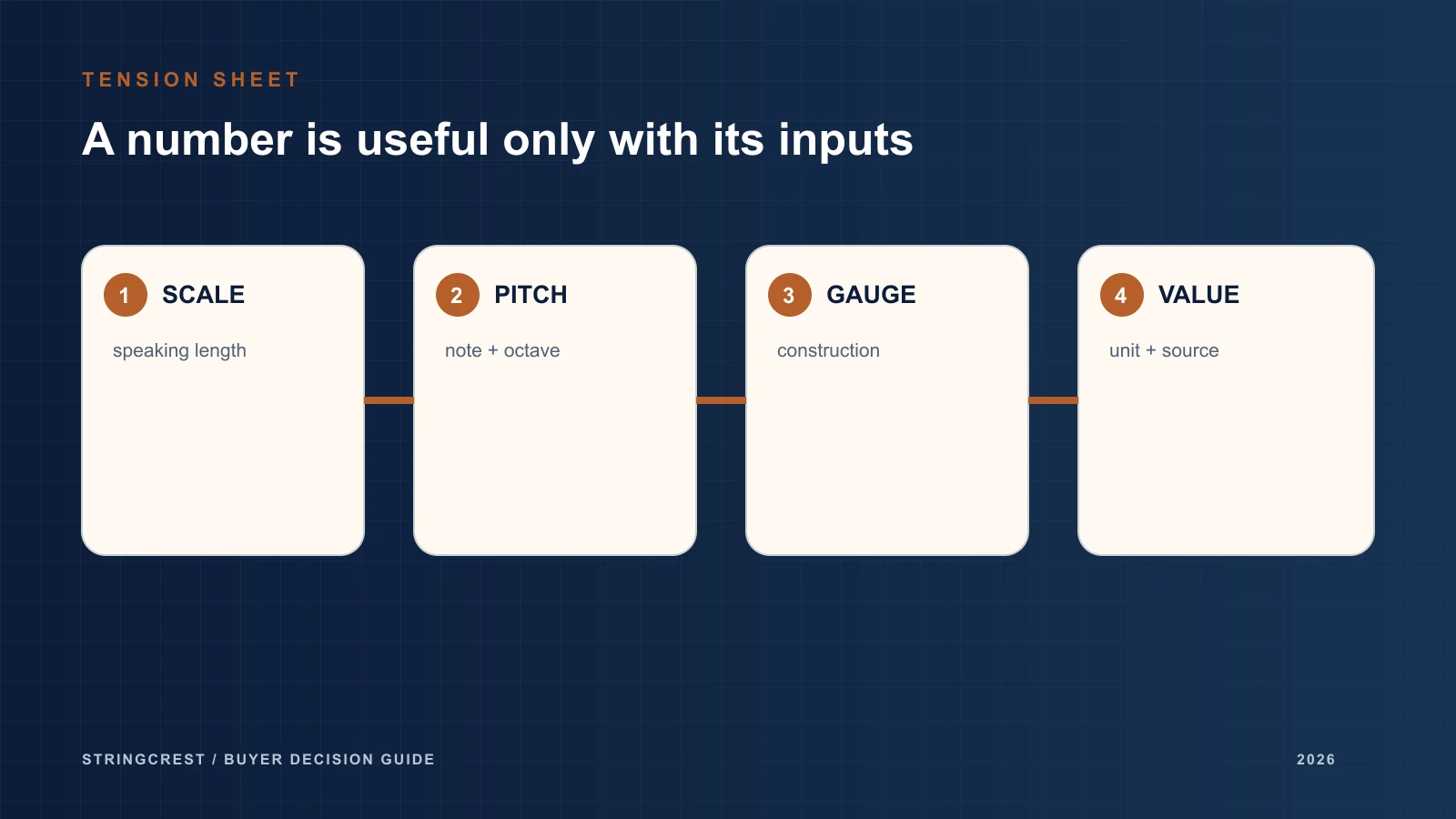
Before comparing acoustic-guitar tension sheets, verify each candidate's string identity and supported linear-mass input, then align the speaking-length, octave-pitch and force-unit conditions. Keep each construction's own mass input. A complete-set total cannot reveal which row uses a different assumption. A diameter label alone does not supply the mass per length required for a calculation.
For a brand, importer, distributor or music store, the first decision is whether a supplier's numbers describe the proposed construction under the intended conditions. The next is whether the arithmetic can be reproduced. Neither decision approves installation on a particular guitar. This guide provides a six-row teaching example and an audit record; the example is not a StringCrest product, measured sample or recommended load.
Identify the six rows before comparing the numbers
For the standard six-string reference here, physical positions 1–6 run from highest to lowest: E4, B3, G3, D3, A2 and E2. Put the string number and octave pitch in different columns. “String 4” is a position; the 4 in E4 is an octave designation.
D’Addario's named EJ16 acoustic-set chart uses those six octave notes. That is a manufacturer's product reference, not evidence of the mass, diameter or tension of a StringCrest proposal. None of its product tensions is used in the teaching table below.
Each proposed row needs a component code and revision, plain or wound construction, declared materials and treatment, finished gauge with unit, and the source of its linear mass. Keep these identifiers with the calculation. Two strings with the same outside diameter need not have the same internal construction or linear mass.
Record what the length means. The formula below uses the speaking length between the nut and saddle contacts for the stated open-string configuration, not the supplied end-to-end length or the route onward to the tuner. A nominal scale label also needs its reference convention; if compensated contacts or a multiscale design give different per-position inputs, preserve those differences. A changed tuning or capo state needs its own defined conditions.
Use one formula with consistent units
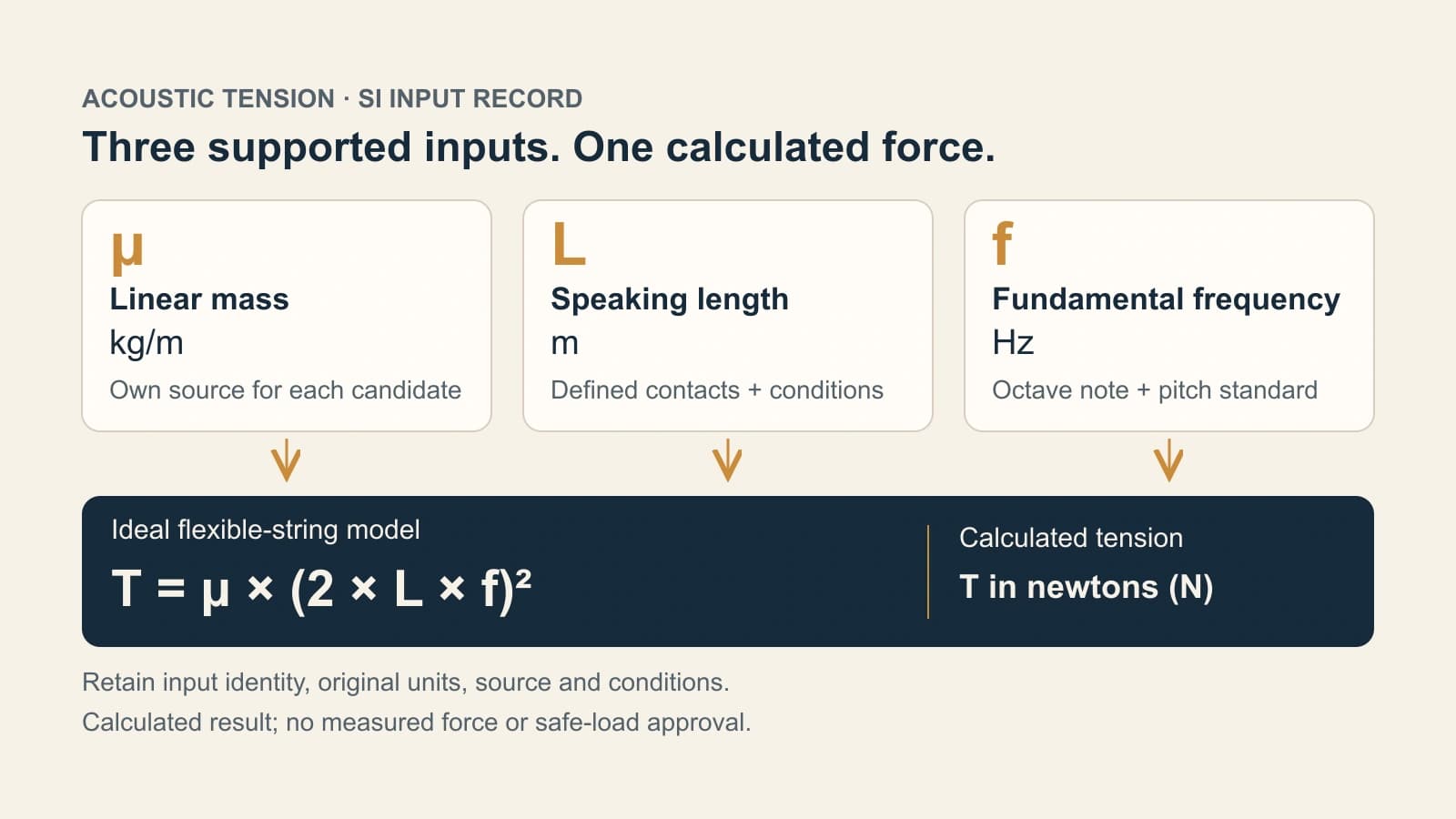
For an ideal flexible string in its fundamental mode, use:
T = μ × (2 × L × f)²
| Symbol | Meaning | SI input or output |
|---|---|---|
| T | Calculated axial tension | newtons, N |
| μ | Linear mass: mass per unit length | kilograms per meter, kg/m |
| L | Defined speaking length | meters, m |
| f | Fundamental frequency of the intended octave note | hertz, Hz |
This follows from the fixed-end fundamental and wave-speed relations in OpenStax University Physics, Standing Waves and Resonance. It is a model for a flexible string under defined conditions. Real construction, stiffness and the input measurement convention limit what the calculation establishes; it is not a direct force measurement or an instrument-strength assessment.
Linear mass is an input, not a gauge lookup
Ask whether μ is measured, supplied by the component maker or estimated from a declared construction model. Retain the source, method or calculation reference, revision, and relevant measurement conditions. An unexplained number copied from another material family cannot establish the offered string's mass per length.
Convert the input before applying the SI formula. For example, 0.60 g/m = 0.00060 kg/m. Preserve the original value and unit as well as the converted value. Do not put an imperial unit-weight figure into the μ column merely because both fields describe a quantity per length; first establish what the source unit represents and use its compatible equation or a documented conversion.
Choose a force unit explicitly
N, lbf and kgf are force units; kg by itself is a mass unit. If a sheet says only “kg,” ask what quantity is intended before comparing it. The NIST force-conversion table lists approximately 1 lbf = 4.448222 N and 1 kgf = 9.80665 N. Record the conversion used rather than silently relabeling a column.
Recalculate an explicitly hypothetical six-position sheet
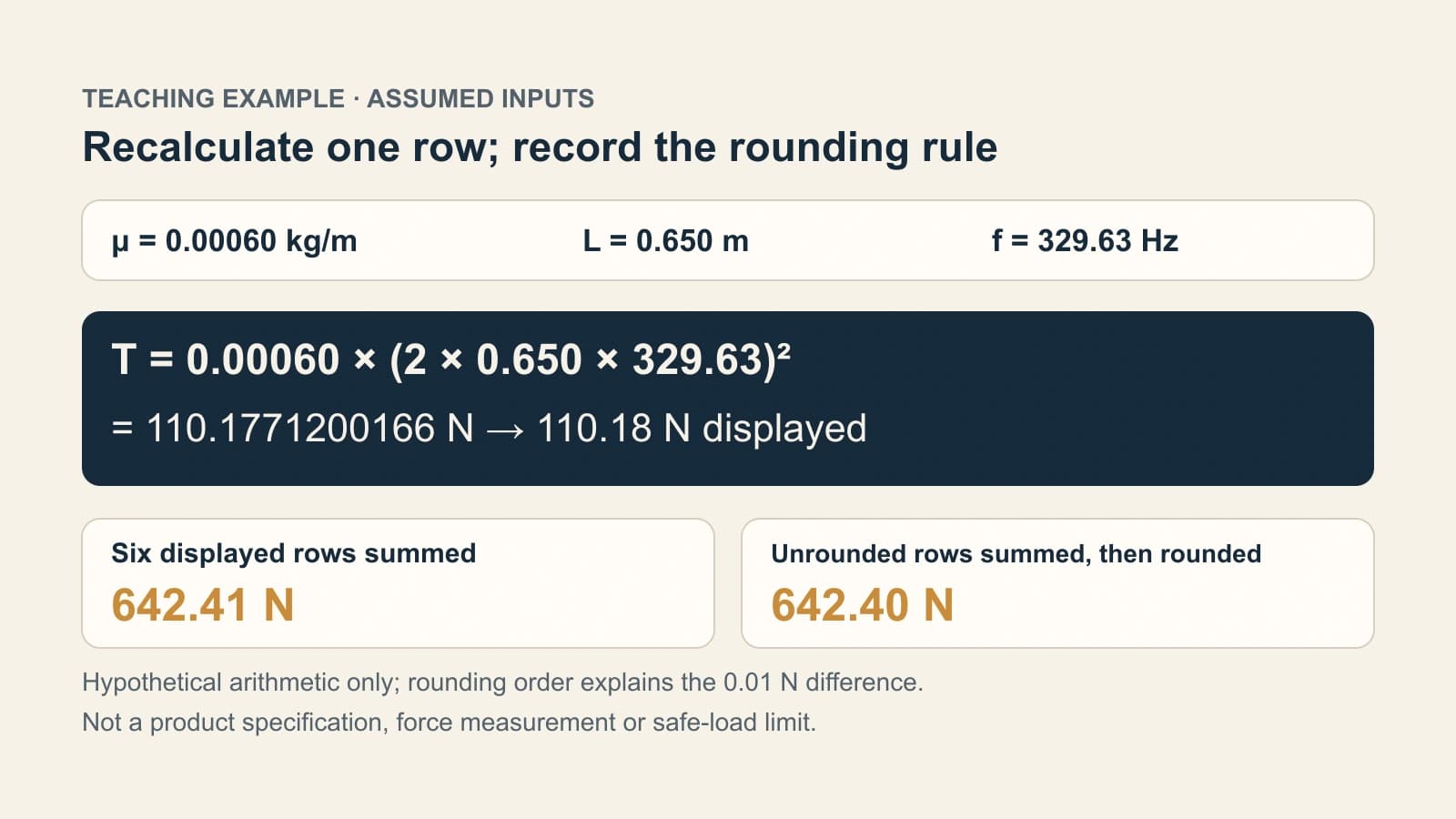
Teaching example only: assume L = 0.650 m for every row. Choose equal-tempered pitches with A4 = 440 Hz. The six μ values are invented inputs for checking arithmetic; they are not measurements, proposed gauges or a supplied set. No plain/wound or material identity is inferred from them.
The displayed frequencies are rounded to two decimals. Use exactly those displayed Hz inputs with the displayed μ and L to reproduce the tension column.
| Physical position | Octave note | Frequency, Hz | Assumed μ, kg/m | Assumed L, m | Calculated T, N |
|---|---|---|---|---|---|
| 1 | E4 | 329.63 | 0.00060 | 0.650 | 110.18 |
| 2 | B3 | 246.94 | 0.00105 | 0.650 | 108.21 |
| 3 | G3 | 196.00 | 0.00170 | 0.650 | 110.37 |
| 4 | D3 | 146.83 | 0.00310 | 0.650 | 112.95 |
| 5 | A2 | 110.00 | 0.00510 | 0.650 | 104.29 |
| 6 | E2 | 82.41 | 0.00840 | 0.650 | 96.41 |
For position 1, 0.00060 × (2 × 0.650 × 329.63)² = 110.1771200166 N, displayed as 110.18 N. Using the NIST factor above gives about 24.77 lbf for this hypothetical row. A calculator displaying extra digits has not established that the assumed inputs are accurate to that precision.
Adding the displayed two-decimal tensions gives 642.41 N. Summing the unrounded row results and then rounding gives 642.40 N. This 0.01 N difference comes from rounding order. Record the convention so a reviewer can distinguish it from a wrong input. The sum is an arithmetic total of axial tensions, not a calculation of bridge downforce or a safe-load limit.
Changing only L from 0.650 m to 0.660 m multiplies every calculated result by (0.660 / 0.650)², approximately 1.031006: a 3.10% increase. This sensitivity result holds only with μ and f unchanged under the same model. It does not authorize fitting or retuning a real set.
Describe the proposed acoustic set, tuning, length references and the tension-sheet questions you need to resolve. Include the component and calculation references in the requirements message; identify inputs that are still estimates or unknown.
Find spreadsheet errors before judging the product
Use these checks on individual rows before relying on the total:
| Check | Example of an error | What the reviewer should resolve |
|---|---|---|
| Note and octave | Entering E3 where the row calls for E4 | Halving f gives one quarter of T when μ and L stay fixed. Correct the intended note, not the result cell. |
| Length unit | Entering 650 as meters instead of converting 650 mm to 0.650 m | L becomes 1,000 times larger and its squared contribution 1,000,000 times larger. Preserve the original unit and conversion. |
| Linear-mass unit | Entering 0.60 as kg/m when the source says 0.60 g/m | The mass input, and therefore T, is 1,000 times larger. Check the unit, not just the decimal display. |
| Row identity | Copying a familiar μ into a different wound construction | A plausible output can still describe the wrong component. Recover the actual source and revision. |
| Formula references | One copied row still points at another position's frequency | Inspect row references and reproduce a changed row independently. A reasonable total may conceal opposing row errors. |
| Rounding | Comparing a sum of displayed values with an unrounded total | Establish the rounding stage before treating a small difference as a product revision. |
The first three effects follow from the equation; they are not observed supplier errors or test results. The one-octave example is an arithmetic diagnostic, not a suggestion to tune a string to a different register.
For a candidate comparison, align the intended length and pitch conditions while retaining each construction's actual μ. Do not force different products to share an invented mass input to make the tables appear comparable. If one mass source is missing, the corresponding product comparison remains unresolved even when its spreadsheet formula works.
Keep an auditable product sheet and a separate installation record
For an actual proposal, replace the teaching inputs with supported component data. Keep one row per position and retain the source values before conversion. A useful working record includes:
| Record group | Fields to complete for the actual proposal |
|---|---|
| Identity | Set/revision, component/revision, position and octave pitch |
| Construction | Plain/wound, core/wrap where relevant, treatment, finished gauge and unit |
| Mass input | Original linear mass or unit weight, unit, source/method, conditions, revision and any stated uncertainty |
| Length and pitch | Defined speaking-contact references, L/unit per position, tuning, frequency standard and any capo state |
| Calculation | Equation/version, conversions, full working precision, displayed result/unit and rounding rule |
| Review | Recalculation reference, unresolved input, owner and disposition |
A corrected document may be the next step when an input is missing. Do not turn an estimated row into an approved product value by copying it into the quotation or package artwork.
If a physical sample review follows, identify the guitar, exact sample, installation conditions and applicable instrument-maker guidance. Keep calculated tension, any separately measured force, setup observations and player preference in distinct records. Similar calculated force does not establish identical bending feel, tone or safe use on every acoustic guitar.
The sample-evaluation guide covers the broader sample identity and observation process. This tension audit supplies the calculation record for that process; it does not show that StringCrest has performed a force test or approved a particular build.
FAQ
Can we calculate a wound string's tension from its outside gauge alone?
Not with this equation. It requires a supported linear-mass input as well as speaking length and frequency. Different core, wrap and construction choices can share a finished diameter. Ask for the actual component's input or a clearly declared estimation model, and retain the distinction between estimation and measurement.
Does a lower calculated set total mean the set is suitable for the guitar?
No. Check each position and the instrument's permitted construction and conditions. The total does not identify contact fit, local loading, stiffness or setup behavior. Obtain the instrument maker's or an appropriately qualified technician's guidance for the actual guitar and proposed installation.
Conclusion
Begin the review with one fully identified row, verify its units and reproduce its arithmetic, then apply the same checks to all six positions. Resolve missing product inputs before treating two sheets as an actual range comparison. Keep the mathematical result separate from installation permission and sample observations.
The acoustic-guitar category provides the wider range context. To discuss a proposal, outline the six-position identities, length and pitch conditions, mass-input sources and remaining calculation questions. Actual StringCrest component data and the scope of any proposed review need confirmation for that project.
FROM GUIDE TO PRODUCT
Connect this guide to Acoustic Guitar Strings.
Review the relevant range, then bring the instrument, complete specification and open questions into one project brief.
YOUR PRODUCT · YOUR BRAND
Discuss your next string project with Frank.
Share your instrument category, target market, gauge or material direction and private-label packaging requirements.

ABOUT THE AUTHOR
Frank Zou
Frank works directly with musical-instrument brands, importers and distributors on string specifications, product selection and private-label project requirements.
Meet Frank