
Quality Control
Quality Control
Rusty Guitar Strings or Surface Tarnish? A Wholesale Receiving Guide
A receiving framework for documenting surface changes and preparing a supplier review without guessing causes or cleaning away evidence.
Introduction
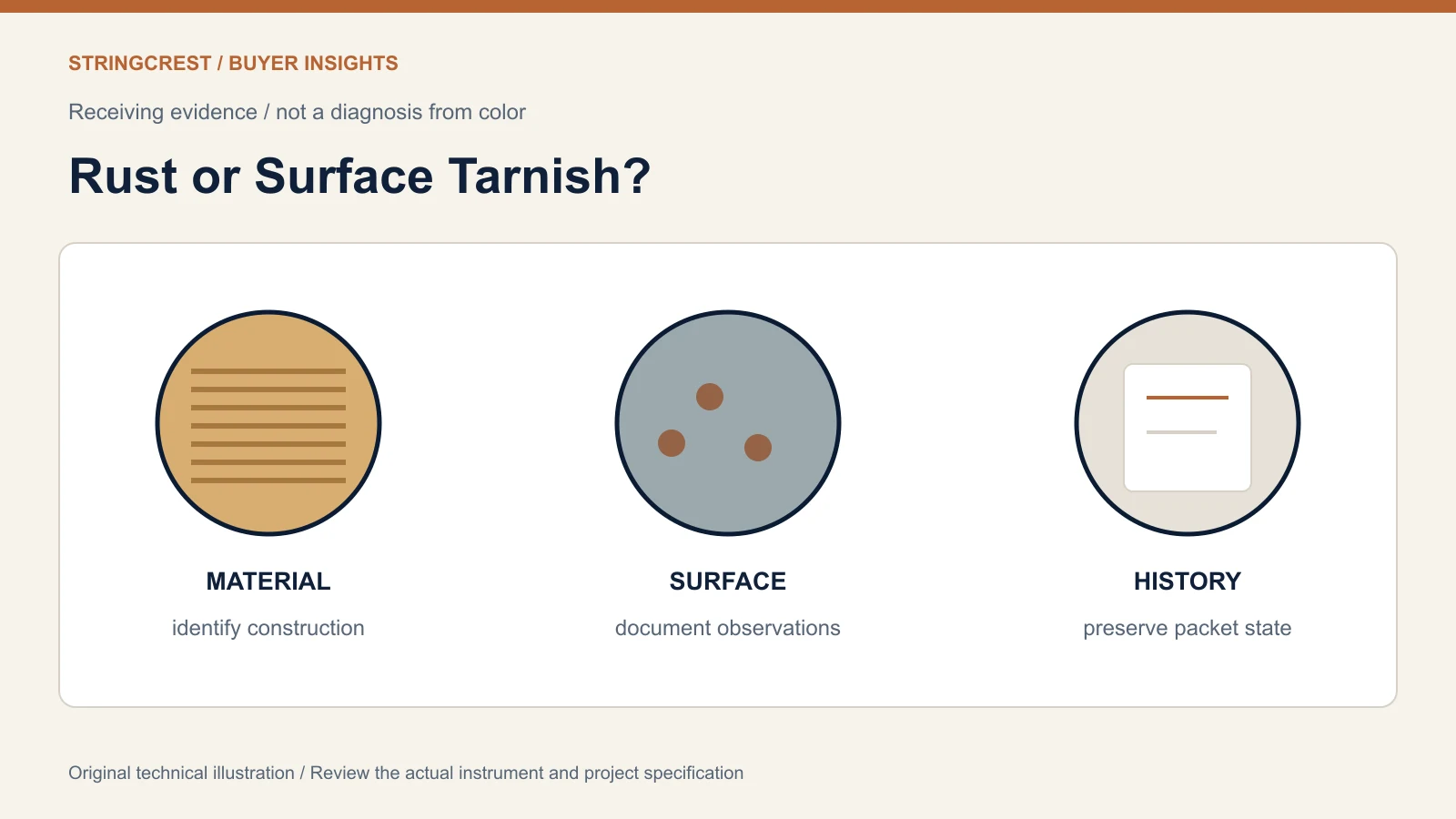
When a distributor opens a packet and sees a dark or discolored string, the first useful action is to document the material, position and condition. Color alone does not establish whether the problem is iron rust, a change on a copper-alloy surface, handling residue or another finish issue. Equally, an apparently cosmetic change should not be dismissed without considering the agreed product requirements.
For a wholesale buyer, the question is larger than whether a player can clean one string. Stock may include multiple materials, sealed packets and different shipment lots. The buyer needs to preserve evidence, identify affected units and reach a defensible disposition with the supplier. Cleaning everything immediately can make that investigation harder.
This article turns “rusty guitar strings” into a receiving and communication framework. It explains why material matters, what photographs can show, how to separate observations from diagnoses and how to prepare a supplier review. It does not give a universal corrosion acceptance limit, diagnose a shipment from an image or recommend chemical restoration of playable strings.
If you are developing a private-label range, agree appearance and condition requirements before the shipment. Product-family discussions can begin with StringCrest’s string categories, while the acceptance criteria and any supporting tests need confirmation for the actual order.
Rust, tarnish and residue describe different possibilities
Rust concerns iron-bearing material
Rust is associated with corrosion of iron and steel. A guitar set can contain plain steel components and wound strings whose core and outer wire differ. Naming only the outer wrap therefore does not describe every material exposed to handling or the environment.
Tarnish is still a surface change
Tarnish is not a synonym for dirt, and describing something as tarnished does not automatically make it acceptable. The Canadian Conservation Institute’s metal guidance distinguishes relatively stable surface changes from ongoing deterioration. That distinction is useful background; museum-object guidance is not a guitar-string release standard.
Residue needs its own description
A visible deposit may involve handling, packaging or another source. Photographs can locate and compare the deposit, but they may not identify its chemistry. Record “localized dark deposit on position two” when that is what you observed. Do not turn an uncertain picture into a definite material analysis.
The practical point is to keep the supplier’s material specification beside the receiving observations. Bronze-colored winding, nickel-colored winding and plain wire should not all be evaluated with an identical color assumption. Appearance, physical integrity and agreed functional requirements are separate questions.
Preserve the evidence before opening more stock
Stop the initial inspection long enough to label the affected packet and carton. Keep the outer label, purchase order, set identity and any supplied lot reference together. Note when and where the observation was made. Describe whether the packet was sealed, damaged, already opened or returned by a player.
Use clean handling appropriate to the investigation and avoid touching the affected area unnecessarily. A receiving sample should not acquire additional fingerprints while being photographed. Do not remove every inner envelope from its set and then reconstruct the identity from memory.
Take photographs of the complete packet, position envelope and affected area before any cleaning. Include an image under ordinary neutral lighting and a closer view that shows surface texture. Dramatic side lighting can exaggerate roughness; a single glossy image can hide it. Both should be identified rather than presented as equivalent evidence.
Hold opened samples separately from unopened comparison units. That lets the review distinguish the delivered condition from handling introduced during inspection. It also preserves the possibility of comparing stock from the same shipment without claiming the comparison has already established a cause.
Inspect the string’s position and construction
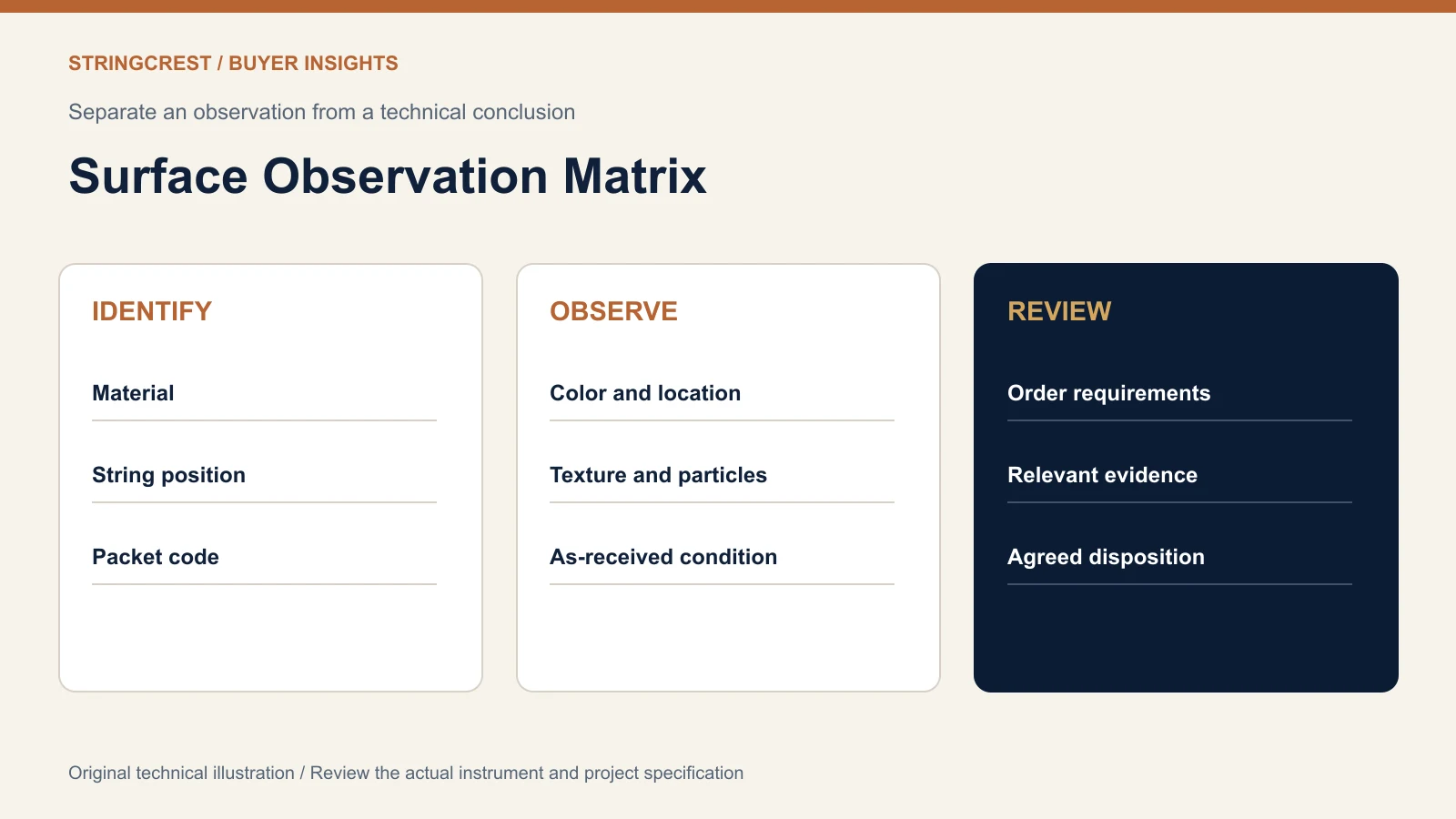
Ask which part has changed: plain wire, outer wrap, anchor assembly, cut end or a specific contact area. The distinction can guide questions about exposure and construction. It cannot, by itself, prove where in the supply chain the condition developed.
A winding can make surface examination difficult. Avoid pulling it apart to search for an explanation unless the supplier and appropriate reviewer agree to a destructive examination. The initial receiving record should say whether the observation is external or based on an opened component.
| Observation | Record initially | Do not infer from this alone |
|---|---|---|
| Uniform darkening | Material label, position and extent | That every string in the shipment has the same condition |
| Localized orange-brown area | Location, texture and original packet state | The responsible party or time of onset |
| Visible particles | Photograph particles and adjacent surface | Exact composition without suitable analysis |
| Rough or pitted-looking area | Close view and professional assessment request | A quantified strength loss from appearance |
| Packet moisture or damage | Packaging condition and carton reference | A universal packaging failure mechanism |
This vocabulary improves communication because it describes the sample without deciding the claim in advance. A supplier can then review the same evidence against its material and process records.
Use neutral photography and a comparison reference
Include the same framing and lighting when comparing an affected unit with an apparently unaffected one. Record the sample codes in the image or associated log. Do not rely on an unlabeled collage in which the viewer cannot connect a close-up to a packet.
A comparison should use the same string position and specification where possible. Comparing a bronze-wound string with a plain steel string mainly demonstrates different surfaces. It is not a control for a claimed change within one product.
Keep the original files and avoid filters that alter color. An annotated copy can point out a region while the unedited version preserves the visual record. If image compression obscures fine details, offer the original securely rather than asserting that a blurry spot proves pitting.
Separate incoming stock from used or returned strings
A sealed unit inspected at receiving and a string returned after playing represent different histories. Both deserve attention, but they should not be pooled into one defect count. A dealer return can include installation, playing, storage and cleaning conditions that were absent from incoming stock.
Ask for a timeline rather than an accusation: received, opened, installed, first observed and reported. Where dates are unknown, leave them unknown. A guessed timeline can create false confidence in a conclusion about storage or supplier responsibility.
Keep reports of rough feel, dull response or breakage separate from the appearance description. Those symptoms may be important, but they need their own method and context. Avoid using a customer’s tone description as proof of a particular chemical reaction.
Evaluate the shipment pattern without inventing a rate
Count what was actually inspected and identify the selection method. “Six affected packets” means little without the inspected quantity, positions, cartons and reason those samples were chosen. Samples selected because they already looked unusual should not be presented as a random estimate of the whole shipment.
A useful report separates each carton or lot reference where available. Record affected and unaffected observations within the inspected selection. If traceability information is missing, state that limitation rather than assigning every unit to an assumed production batch.
Do not extrapolate a shipment-wide percentage from a convenient handful. The appropriate sampling and acceptance approach should be agreed for the purchase. When the condition could affect function or safety, hold the relevant stock pending qualified review instead of trying to prove acceptability through informal playing alone.
Check packaging and storage as evidence streams
Inspect seals, punctures, inner-envelope identification, moisture observations and outer-carton condition. These records belong beside the string photographs. They may reveal an association, but a damaged carton does not automatically prove that every surface change occurred during transport.
If temperature or humidity records are available, preserve their location, device reference and time range. A warehouse average cannot establish the conditions inside every packet. Conversely, missing logger data does not establish ideal storage. Keep environmental evidence proportionate to what was actually measured.
Compare the approved packaging specification with the delivered format. A substitution, seal difference or missing inner barrier can be reviewed as a packaging issue even before the surface investigation is complete. Avoid claiming an untested protection period for the original or replacement material.
For future planning, the humid-market packaging guide addresses protection discussions. This receiving article focuses on evidence after a condition is observed, rather than repeating a packaging design checklist.
Do not convert conservation advice into string-cleaning instructions
Metal-conservation documents explain mechanisms and inspection concepts, but their treatments may be designed for artifacts rather than musical strings. Abrasives, acids, rust converters or aggressive polishing should not be adopted from an unrelated application.
Likewise, string-care instructions can be specific to a product’s coating. Elixir’s FAQ recommends dry wiping for its strings and advises against cleaners or lubricants on those products. That guidance illustrates why a generic “clean all strings with this chemical” instruction is unsuitable for a mixed range.
For a receiving claim, preservation usually comes before attempted restoration. If a reviewer agrees to cleaning or further examination, document the method and which sample was altered. Retain an unaltered reference when practical. A clean-looking result alone does not prove restored integrity or compliance with the original order.
Agree disposition using the order requirements
Appearance can be a legitimate requirement even when functional consequences have not been established. A brand may require a defined finish and clean delivered condition. Refer to that agreement rather than debating whether a particular discoloration is “only cosmetic.”
Set out the proposed disposition clearly: release, further examination, replacement, reinspection or another agreed action. The decision should identify affected product codes and units. A hold is an administrative precaution, not a final finding that the supplier caused the condition.
If a performance claim is disputed, agree the necessary evidence and qualified evaluation. Do not substitute an improvised stretch test for a validated strength assessment. If a safe handling or installation concern exists, avoid asking retail staff or customers to keep using the sample as an experiment.
Create a supplier review package
Identity and scope
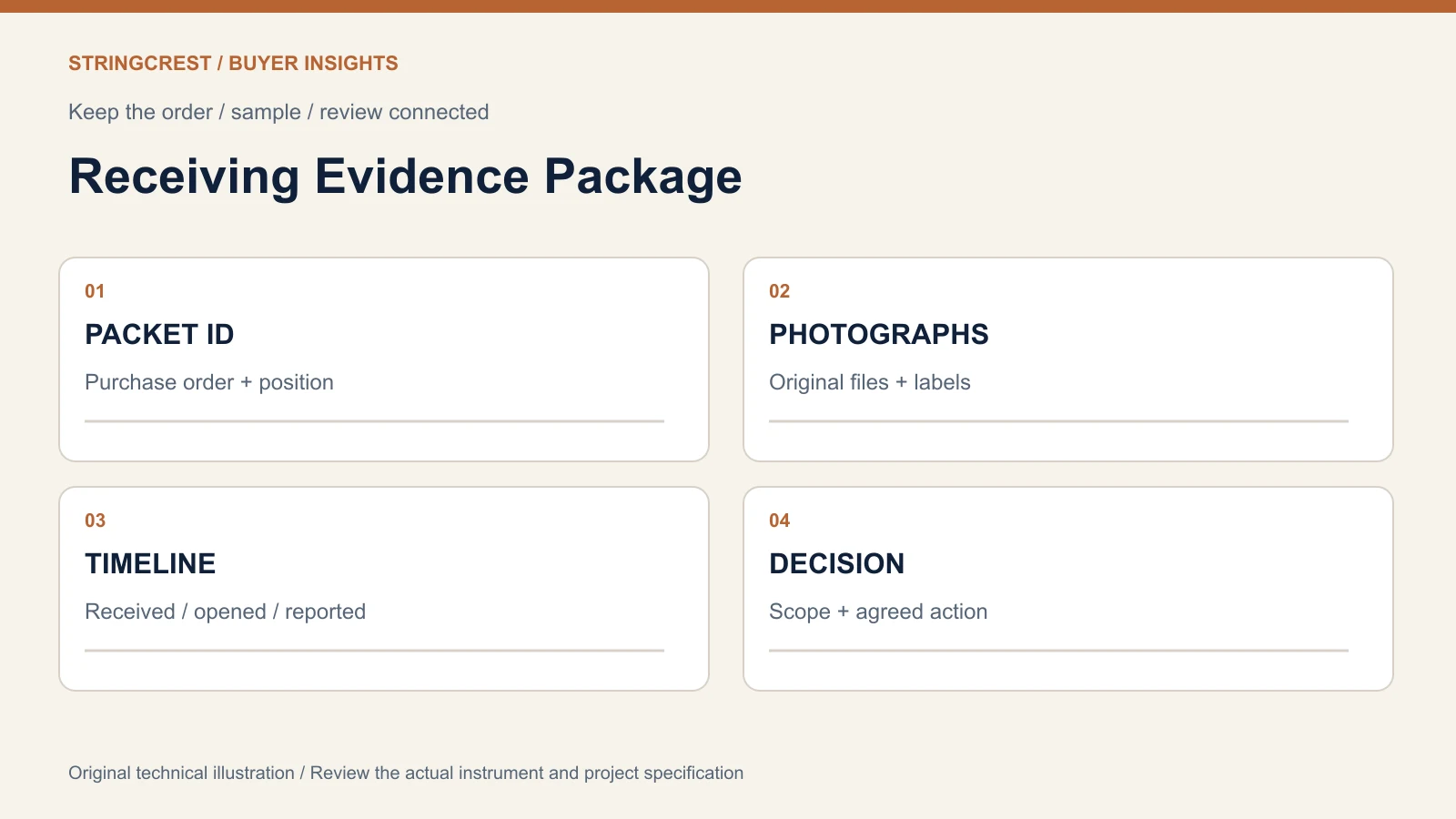
Provide the purchase order, set revision, material description, inspected quantities and carton or lot references. Include both the observed scope and the stock currently held. Keep original packet identification visible.
Condition and timeline
Attach the original photographs, date of observation and packet state. Distinguish incoming inspection from a used-string return. Include known storage and transport information without filling gaps with estimates.
Requested response
Ask the supplier to review the condition against the specification and explain any relevant records or further evidence needed. State the commercial action requested separately from the technical questions. This helps avoid an argument about remedy replacing the investigation.
Improve the next order without overpromising prevention
After the review, update the specific control that needs improvement. This could be packet identification, an appearance reference, seal inspection, handling instructions or a clearer storage record. A corrective action should follow the evidence; it should not be a generic promise that strings will never discolor.
For a new finish, coating or package, request relevant sample evaluation under agreed conditions. State what the evaluation is intended to demonstrate and what remains outside it. A laboratory result belongs to its method, material and exposure conditions, not to an unrestricted lifetime claim.
Keep the commercial catalog accurate. Terms such as corrosion-resistant, protected or long-lasting require appropriate product evidence and conditions. Neither a bright sample nor a resolved claim supplies that evidence for every string in the brand range.
FAQ
Are all dark guitar strings rusty?
No. Darkening can involve different materials and surface conditions. Identify the string’s construction and describe the observation before deciding whether iron corrosion, tarnish or residue is involved. A photograph alone may be insufficient for a diagnosis.
Can tarnish be ignored at receiving?
Not automatically. It must be considered against the agreed appearance and condition requirements. A relatively stable surface change can still be unacceptable for a new retail product, while its functional significance may require a separate assessment.
Should a distributor clean affected stock immediately?
Preserve identified samples and photographs first. Cleaning can alter evidence or affect a coating. Any later cleaning or examination should follow appropriate product guidance and an agreed review method, with the changed sample clearly identified.
Does one rusty string prove the whole shipment is affected?
It establishes an observation for that sample. Record inspected quantities and the selection method before discussing the wider shipment. The sampling plan and disposition should be agreed rather than inferred from an isolated packet.
Is humidity the only possible cause?
No. Material, moisture, handling contamination, packaging and exposure history can all be relevant questions. Their importance must be investigated for the actual sample. Missing evidence should remain a limitation rather than a reason to assign blame.
What should a brand approve before bulk ordering?
Agree material identity, delivered appearance, packaging construction, inspection references, evidence retention and a review process. Confirm any claimed protection performance separately. An approved sample should represent a defined specification rather than a broad marketing label.
Conclusion
A reliable receiving decision starts with identity, observation and preserved evidence. Rust, tarnish and residue should not be treated as interchangeable labels, and neither appearance nor an informal cleaning result should settle every question about a shipment.
By keeping packet history, material specification, sampling scope and requested disposition separate, brands can reach clearer supplier decisions and improve the next order’s controls. That is more useful than making an unsupported claim about a cause or a guaranteed shelf life.
To discuss a new private-label range, review custom string projects and Send Your Requirements. Include the material family, packaging format and the delivered-condition criteria that matter to your market.
Sources and interpretation limits
- Canadian Conservation Institute: recognizing active corrosion supplies general metal-condition context, not a musical-string acceptance standard.
- Canadian Conservation Institute: basic care of iron explains why moisture and contamination are relevant to iron corrosion. Its conservation treatments are not recommended here for strings.
- Elixir string-care FAQ is product-specific care guidance, not evidence about StringCrest’s materials or coatings.
The receiving records and review steps are recommendations. No shipment claim, laboratory result, corrosion rate or company inspection outcome is asserted in this article.
FROM GUIDE TO PRODUCT
Connect this guide to StringCrest product ranges.
Review the relevant range, then bring the instrument, complete specification and open questions into one project brief.
YOUR PRODUCT · YOUR BRAND
Discuss your next string project with Frank.
Share your instrument category, target market, gauge or material direction and private-label packaging requirements.

ABOUT THE AUTHOR
Frank Zou
Frank works directly with musical-instrument brands, importers and distributors on string specifications, product selection and private-label project requirements.
Meet Frank