
Buying Guides
Buying Guides
Requinto Guitar Strings: A Six-Position Selection Guide
Confirm the six-string nylon application, complete sounding pitches and required path before selecting a requinto set. Small-body labels alone do not establish fit or tuning.
Introduction
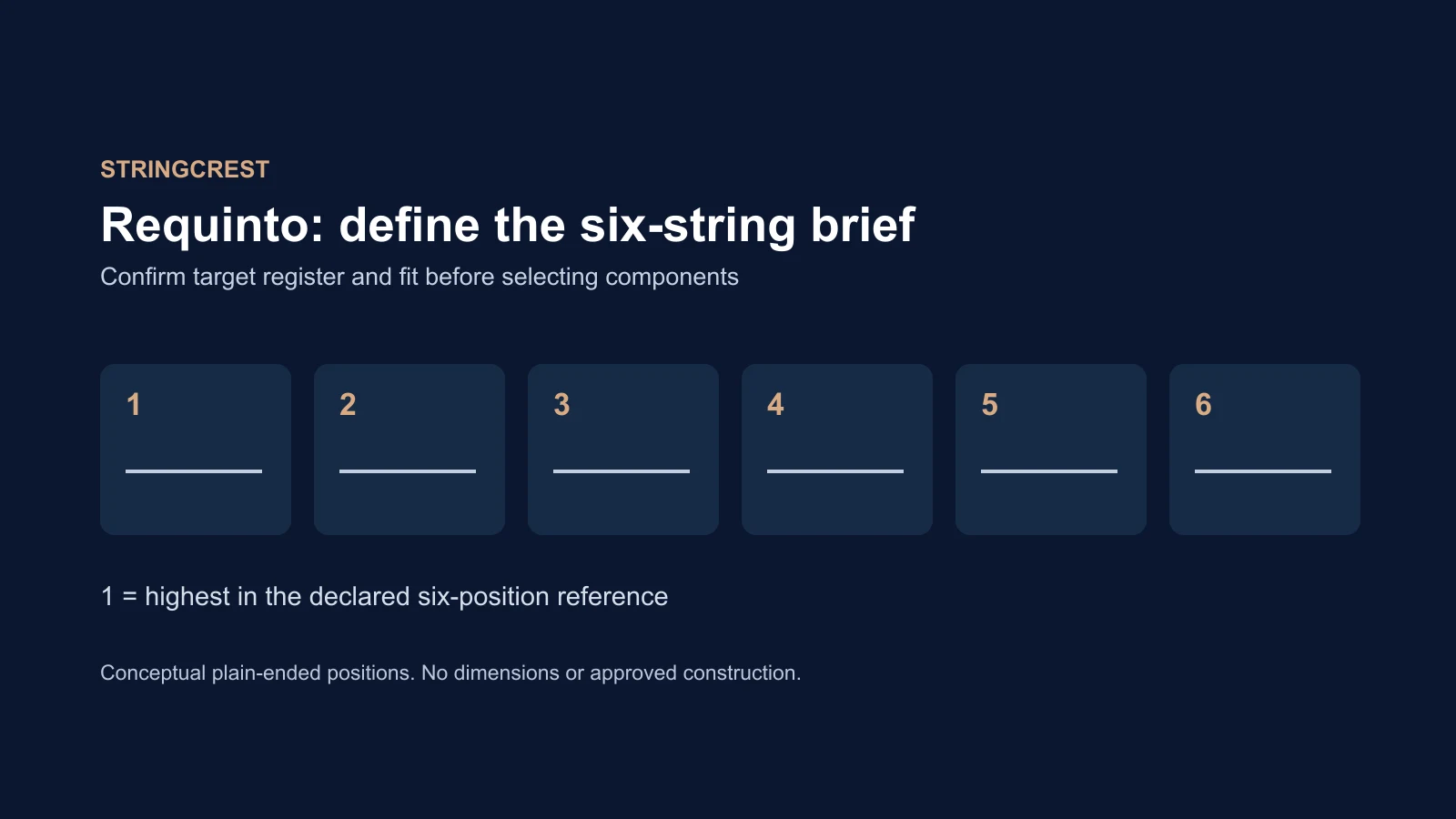
Select requinto guitar strings by the actual instrument, intended pitches and required string path. The six-string nylon application discussed here uses a higher-register reference than ordinary E–A–D–G–B–E guitar tuning. A small body or a half-size label does not establish the same tuning, usable string lengths or approved replacement set.
For a dealer, the first task is to clarify what the customer means by requinto. Confirm the maker and model, count the strings and identify whether the instrument needs this six-position nylon configuration. This guide gives a complete pitch reference and a practical fit brief without announcing a new StringCrest product or assuming that every similarly named instrument uses the same strings.
Define the six-position application
Ask for the instrument maker’s string recommendation, the intended tuning and a clear view of the bridge and tuning arrangement. Six individual positions differ from six paired courses on a twelve-string instrument. A shared instrument name should not cause either layout to inherit the other’s component list.
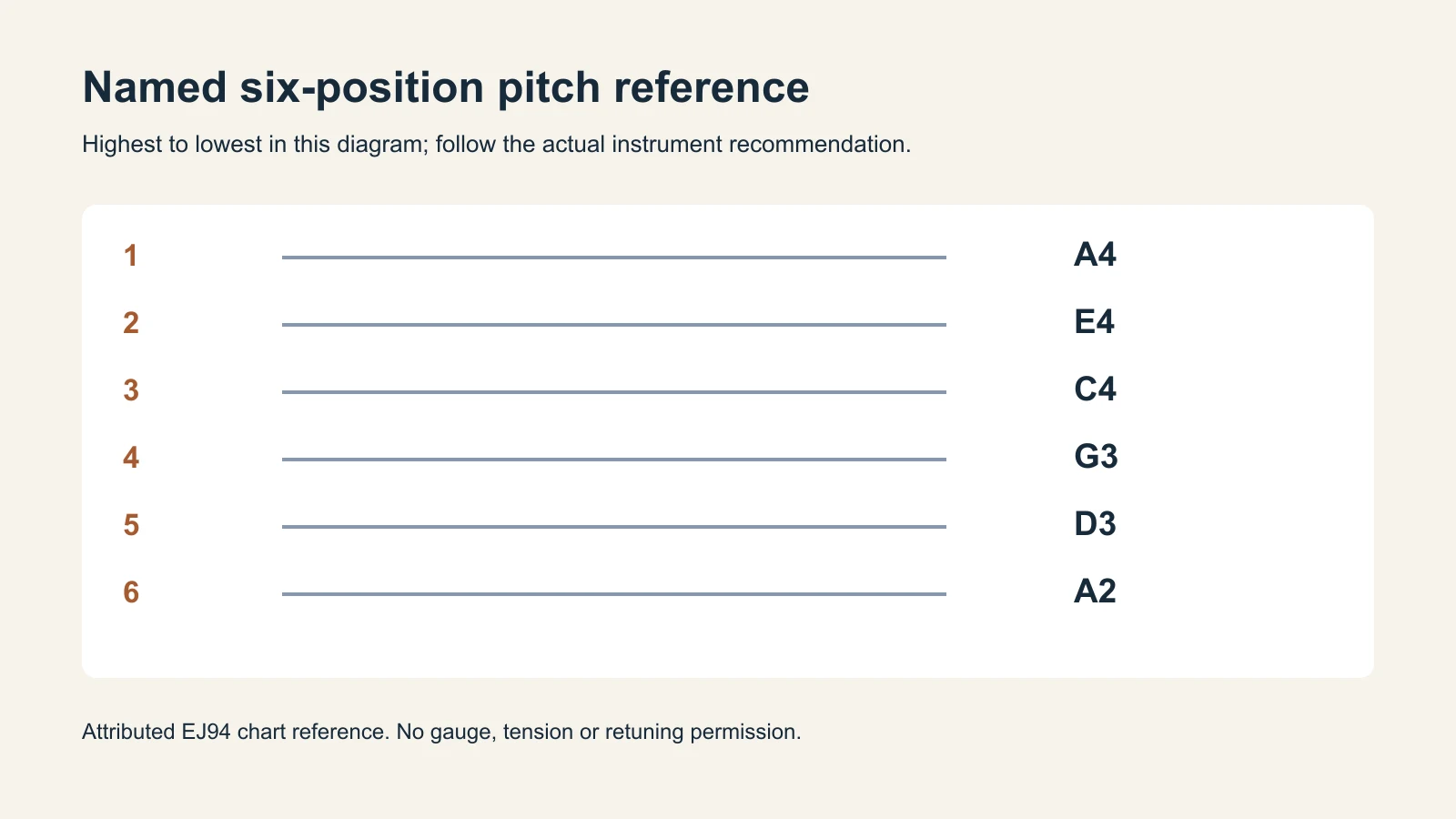
D’Addario’s EJ94 requinto page identifies a six-string tie-end set. The reference below follows its six-row pitch chart, reading from string 1, highest, to string 6, lowest. The target pitches are attributed to that named example; an actual instrument still needs its own applicable recommendation.
| Physical string in this reference | Sounding open pitch |
|---|---|
| 1, highest | A4 |
| 2 | E4 |
| 3 | C4 |
| 4 | G3 |
| 5 | D3 |
| 6, lowest | A2 |
Read in the opposite direction, the sequence is A2–D3–G3–C4–E4–A4. The octave numbers are part of the identity. A4 and A2 are different positions, even though both packets might otherwise be described with the letter A.
Relative to the familiar standard six-string guitar sequence, these corresponding pitches are a perfect fourth higher. This describes the reference tuning. It is not an instruction to raise an unidentified ordinary classical set to that register or a promise that any shorter guitar supports it.
Confirm what the customer’s size label means
A fractional size, body measurement or retail category can help identify an instrument, but none substitutes for its actual speaking length and intended tuning. Two instruments sold as small nylon-string guitars may have different maker recommendations.
Record the model rather than translating a half-size description into a universal scale dimension. If the customer provides only a photograph, request the missing maker information or an appropriate measurement. Do not invent a length from the apparent body proportions.
The six-string ukulele and guitalele guide describes another source of ambiguous six-string requests. Even where two configurations share note names, that does not establish identical instruments, supplied lengths, end treatment or approved component construction.
Read treble and bass construction separately
A nylon-family set can combine plain polymer trebles with metal-wound basses. Obtain the proposed material and construction at each position. The word nylon alone does not describe every layer, and a metallic outside surface does not prove a solid metal core.
The named EJ94 page distinguishes clear-nylon components from silver-plated-copper-wound components. Its material choices and dimensions belong to that product. Another supplier’s proposal needs its own six-component specification; matching a material label does not establish chemical identity, finished diameter or playing response.
The classical string materials guide explains the broader construction distinction. Use that language to ask a precise question, then keep the answer attached to the actual proposed component. In particular, do not infer a treble’s diameter from the outer diameter of a wound bass.
Confirm attachment using both the instrument and the proposed strings. The tie-end description above is specific to the named example. The explanatory images show plain-ended lines without metal balls; they are not photographs of an installed bridge or permission to improvise an end treatment.
Measure the path before comparing quotations
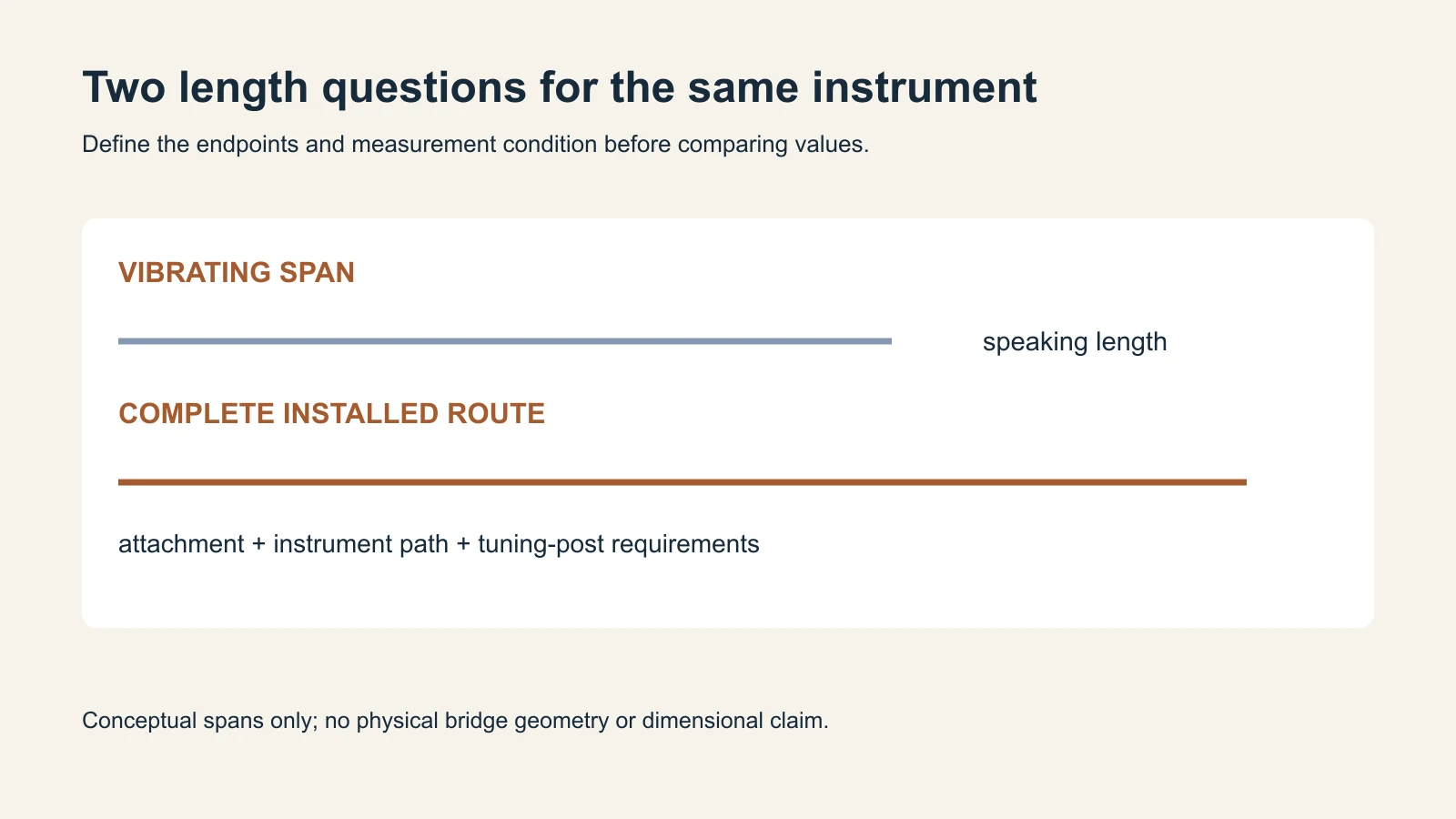
Record speaking length as the vibrating span relevant to each position. Then record the installed route through the required bridge attachment and to the appropriate tuning post. Supplied overall length and usable installation length answer different questions.
Where the proposal contains a winding transition, prepared end or other construction boundary, locate it against the actual contact points. State the measurement endpoints and condition. A length measured on a loose, uninstalled component should not silently become an installed dimension.
A nominally shorter instrument does not prove that every candidate has enough usable material for tying and tuning. Conversely, excess overall length does not resolve whether the intended construction occupies the required span. Obtain the supplier’s applicable dimensional description before cutting a sample.
Keep the requested set and supplier proposal side by side
Use the original worksheet to connect position, target and proposed component. For the actual request, complete the note and octave first. Add material, plain/wound construction, finished diameter with units, usable length, attachment and supplier reference in the relevant component record.
| Position | Requested note and octave | Buyer’s construction and fit record | Supplier proposal | Accepted reference |
|---|---|---|---|---|
| 1 | ||||
| 2 | ||||
| 3 | ||||
| 4 | ||||
| 5 | ||||
| 6 |
The table deliberately leaves specification fields empty. It is a buying tool, not a measured StringCrest set. If the supplier proposes an alternative, preserve both descriptions until the buyer has decided which one is being evaluated.
A hypothetical request for a replacement first string illustrates why the position matters. In the reference above, the target is A4. Asking for a standard classical first E string would specify a different intended pitch. The dealer still needs the actual instrument and an applicable component proposal rather than selecting by the words first string alone.
A tension category such as normal or hard is not a universal numerical rating. If numerical tension information is offered, retain its pitch, speaking length, construction, units and measurement or calculation basis. Do not borrow forces from the named reference product to fill another supplier’s blank proposal.
Resolve a six-string or twelve-string name conflict early
If the actual instrument has twelve strings, stop using the six-row worksheet. Establish its courses, member order, target pitches and construction with the maker. Adding a second copy of every component in the six-position reference would create an unverified twelve-string proposal.
The twelve-string acoustic specification guide addresses a defined acoustic paired-course format. Its diagram should not be adopted automatically for an instrument merely sold under a requinto name. The useful distinction is the verified physical arrangement, not a guess about what every regional label must mean.
Keep website and warehouse descriptions equally specific. An item name can identify the supported instrument, string count, intended tuning and set revision. When a specification changes, the component record should show it before the same retail name is reused for a different selection.
Evaluate one declared candidate at a time
Before installation, connect the sample to the returned six-position record and confirm its component count and identification. A qualified installer should follow the applicable instrument and string instructions. Uncertain nut, bridge or tuner requirements need clarification before tuning or modifying the instrument.
Record the exact instrument, candidate, tuning and any setup work with the comparison. Fit observations and playing preferences answer different questions. A candidate may be dimensionally suitable while the buyer wants a different feel; a pleasant tonal impression cannot excuse an unresolved attachment or usable-length question.
For the broader supplier and sample process, use the classical supplier specification guide. This page’s contribution is the requinto-specific pitch and fit brief. MOQ, sample arrangements, supply feasibility and packaging remain matters for the actual proposed project.
FAQ
Can I tune an ordinary classical set higher for this application?
The reference pitches do not establish that an unidentified set or instrument can safely support them. Obtain the maker’s requirements and a suitable component proposal. Do not use body size alone as permission to retune.
Does requinto always mean six nylon strings?
This article defines that particular application. Confirm the actual instrument’s count, course arrangement and recommended construction before choosing its record or replacement. A name alone is not a complete specification.
Is a guitalele set automatically a requinto replacement?
Shared note names do not establish compatible construction, length, attachment or instrument suitability. Compare the actual model and all six component requirements before considering a substitution.
Conclusion
A useful requinto inquiry identifies the instrument, all six sounding pitches and the required path before choosing components. Keep the higher-register example separate from a universal rule about small guitars.
Use the classical guitar string category as a starting point for the nylon-family discussion. Send Your Six-Position Requinto Requirements with the model, maker’s recommendation and completed fit record. Confirm any proposed product and terms for that specific application.
FROM GUIDE TO PRODUCT
Connect this guide to StringCrest product ranges.
Review the relevant range, then bring the instrument, complete specification and open questions into one project brief.
YOUR PRODUCT · YOUR BRAND
Discuss your next string project with Frank.
Share your instrument category, target market, gauge or material direction and private-label packaging requirements.

ABOUT THE AUTHOR
Frank Zou
Frank works directly with musical-instrument brands, importers and distributors on string specifications, product selection and private-label project requirements.
Meet Frank