
Buying Guides
Buying Guides
Lap Steel Guitar Strings: A Six-String Set Selection Guide
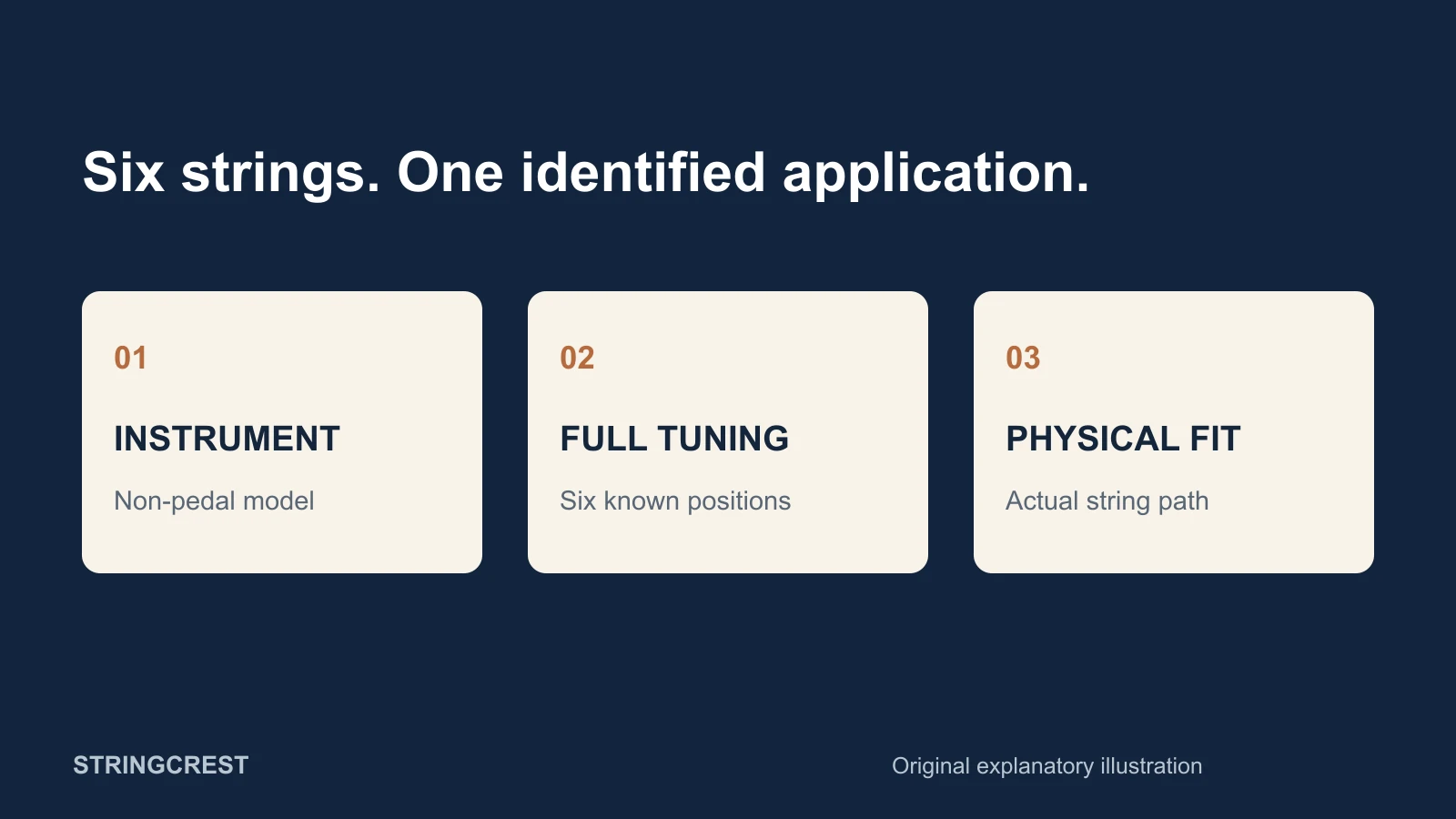
Identify the instrument, complete tuning and every string before choosing a six-string lap steel replacement.
Introduction
Choose lap steel guitar strings for the instrument's exact tuning and scale, then confirm every string position. A packet marked C6 or E is a useful starting point, but it does not identify every possible version of that tuning. A six-string lap steel also needs a different replacement decision from a pedal steel with a changer.
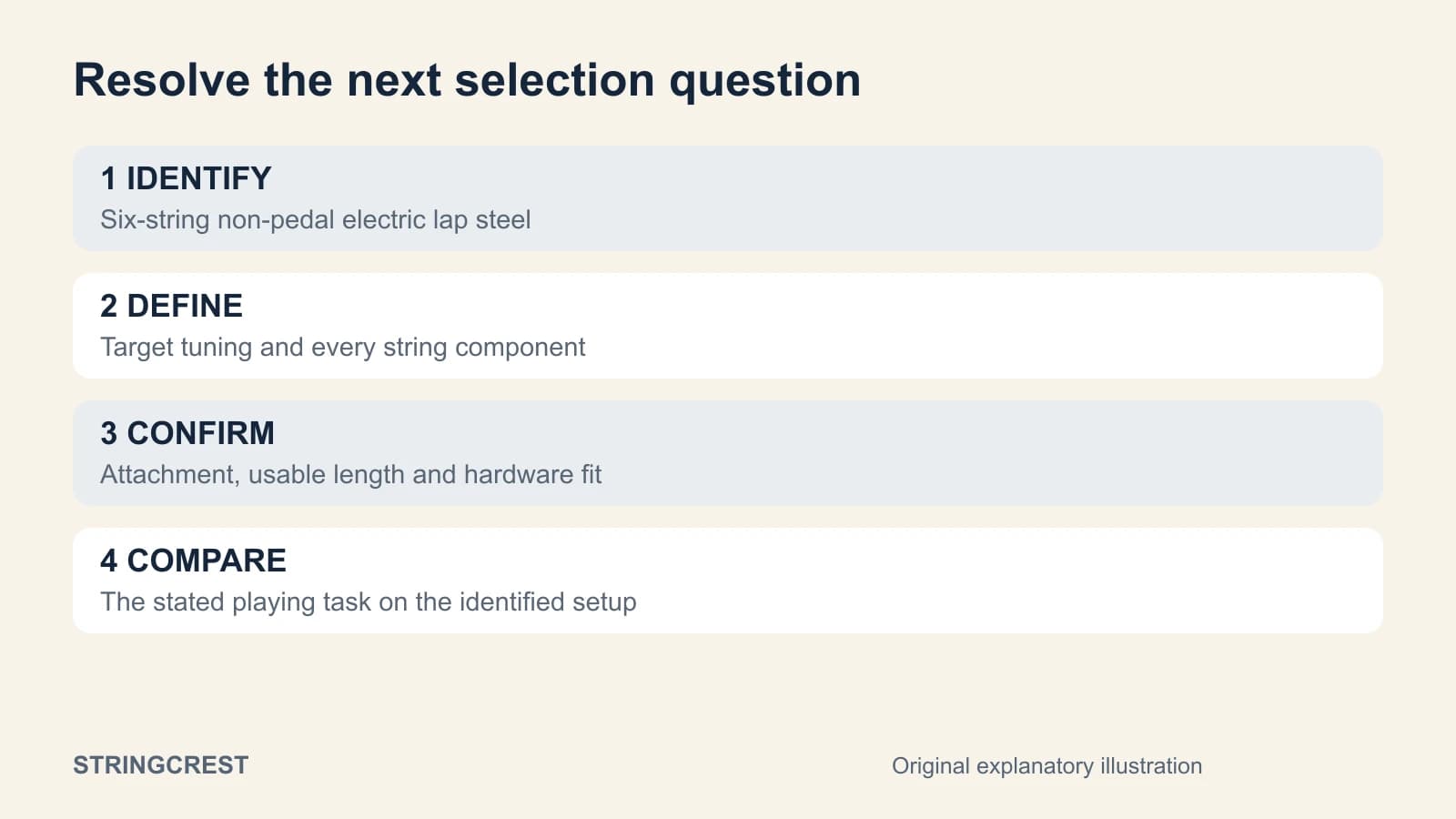
For a US dealer, the practical question is whether a complete identified set matches the customer's instrument, or whether the request needs a custom specification. This guide focuses on a six-string, non-pedal electric lap steel. Acoustic lap-slide instruments and resonators need their own instrument-maker guidance.
Establish which instrument is on the counter
Ask for the model and a clear view of the bridge and headstock. Confirm six strings and whether the instrument has a fixed tuning or a mechanism that changes selected pitches. Playing an instrument horizontally does not establish which string family it needs.
A converted fretted guitar, a square-neck resonator and a purpose-built electric lap steel can all be played with a bar. Their construction and approved loading can differ. Use the resonator identification guide for that category, and the pedal steel guide for instruments with mechanical pitch changes.
Keep the customer's present set if its identity is known. A successful existing configuration is useful evidence for a replacement discussion. It is not permission to raise the tuning or replace a string with any nearby diameter.
Write the tuning before selecting a gauge range
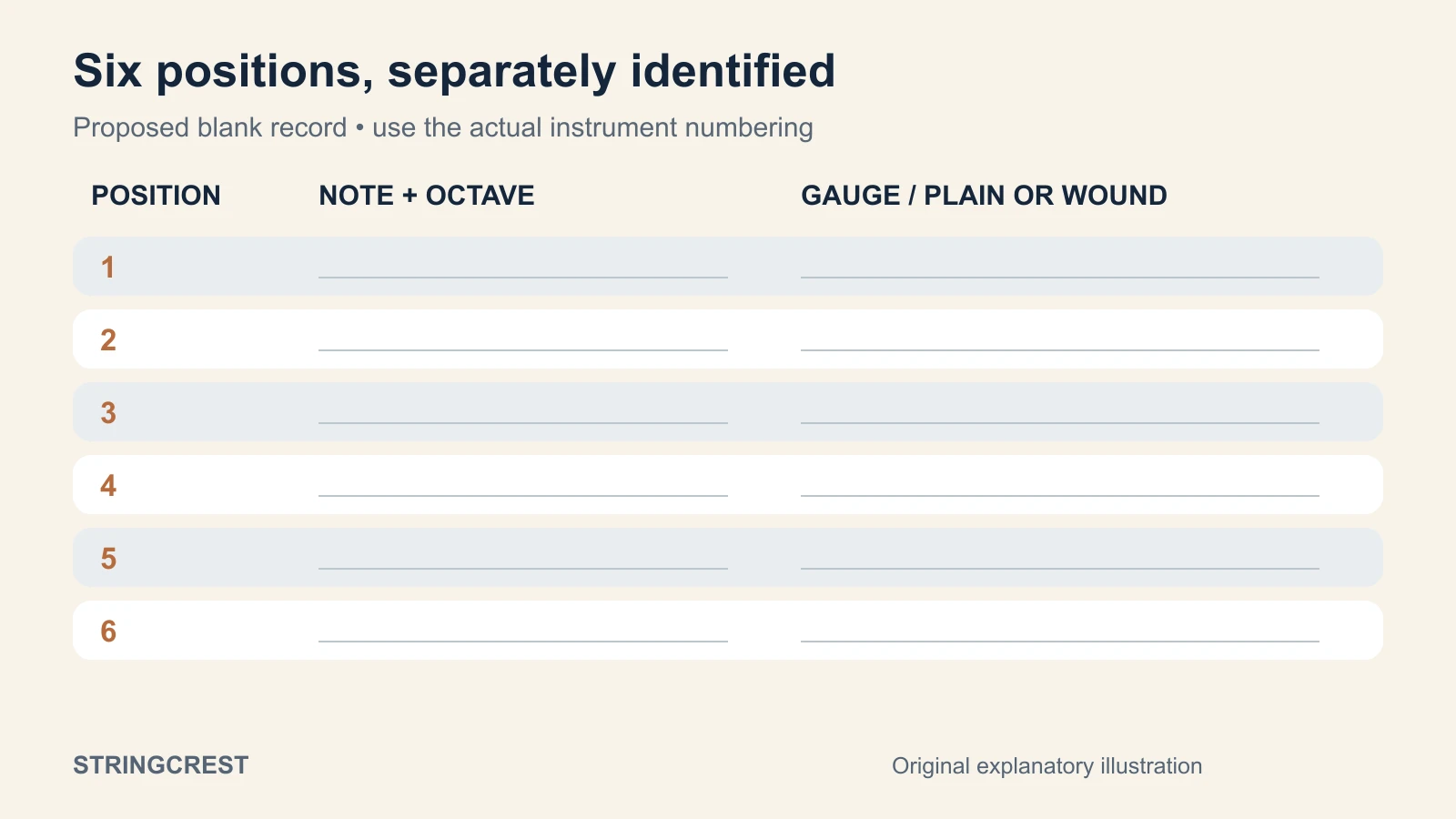
Have the customer provide each target pitch, including its octave, against the instrument's string numbering. State the direction on the sheet. A sequence read from the player's side can otherwise become a reversed packing instruction.
Do not fill a six-position sheet from an eight-string tuning diagram. Luna's lap steel FAQ discusses several tuning families and includes eight-note C6 examples. Those examples demonstrate why the tuning name and the actual number of positions must be read together; they are not a six-string order specification.
| Position | Information the dealer needs | Keep separate |
|---|---|---|
| String 1 through string 6, using the instrument's numbering | Target note and octave for each position | Tuning name printed on the packet |
| Each string | Finished gauge and plain or wound construction | A first-to-last gauge range |
| Complete set | Product code and intended tuning | Another set with a similar name |
| Instrument | Speaking scale and actual attachment path | Total supplied string length |
This is a proposed information sheet. Enter confirmed values from the instrument, existing set or applicable instructions. An empty field is a request for information, rather than an invitation to copy a value from another instrument.
Compare complete sets, not the C6 label alone
The current GHS lap steel page separates its LAP-E and LAP-C6 sets and supplies all six gauges. Its C6 set is listed as 015–036. La Bella's H6C6-1532 page lists a different six-string C6 sequence, spanning .015 to .032, including an explicitly plain .024 position and a wound .028 position.
These are named manufacturers' examples, not StringCrest specifications or a recommendation that either set fits an unidentified instrument. The useful comparison is the complete sequence and construction. Matching the first gauge and tuning label leaves other positions unresolved.
Preserve a plain-versus-wound difference
If the replacement changes a position from plain to wound, record it as a specification change. Do not hide it beneath the same gauge label. The customer's preferred bar response and feel should be evaluated with the actual proposed set, rather than inferred from the outer diameter alone.
For a distributor replacing an established line, retain both product references in the comparison. Identify the differing positions before approving packaging or preparing a quotation. The custom-gauge specification guide covers broader construction questions beyond the tuning label.
Send your six-string lap steel application and proposed set requirements to StringCrest. Include the instrument model, target pitches, scale and known set identity so the discussion can establish what is confirmed and what still needs review.
Check physical reach before a playing comparison
Measure the speaking scale between the relevant nut and saddle contact points. Separately establish how the string attaches and reaches its tuner. A scale measurement does not include every bend and attachment allowance in the installed path.
Photographs should show the actual end seating, bridge route and tuner. If a supplier's length drawing uses the end seat as its origin, retain that origin when recording a dimension. A measurement from the outside of the instrument is not interchangeable with a measurement from the string's attachment point.
Confirm that any winding transition will fall in a suitable location under the applicable installation instructions. Do not solve an uncertain fit by trimming first and identifying the string afterward. The electric string length guide explains the distinction between speaking scale, installed path and supplied length.
For a new application, the receiver should identify which end construction is needed. The word lap steel alone does not settle a bridge-fit question. Stop an installation that requires unapproved alteration and obtain the instrument or hardware maker's guidance.
Make the comparison answer a specific question
A dealer does not need a broad claim that one set is better for every lap steel. A useful comparison might ask whether the identified replacement reaches every post, whether a changed plain/wound position suits the intended playing task, or whether a full set can be supplied consistently for one model and tuning.
Keep the instrument, target tuning and listening arrangement consistent. Record installation or setup work separately. If the instrument is adjusted between candidates, describe the later result as the adjusted configuration.
For dealer stock, put the confirmed application and complete set code where staff can find them. A box of individually labeled singles is only a repeatable replacement solution when all six positions remain identifiable. Keep a later substitution tied to its own revision rather than silently changing the contents of an established set.
FAQ
Can a customer use six strings from a pedal steel pack?
String count alone cannot establish a match. Compare the selected positions, target pitches, construction, length and attachment requirements. A pedal steel pack may have been assembled for different string roles and mechanical changes. Treat a partial-pack proposal as a new set definition requiring review.
Is a thicker set automatically the right answer for a different tuning?
No. The complete tuning, scale and actual string construction matter. A range printed on the front of a packet cannot establish the suitability of every position. Ask for the applicable instrument and string guidance before changing the configuration.
Conclusion
A useful lap steel recommendation identifies one instrument, one complete target tuning and six known string components. That gives the dealer a clear basis for selecting an existing set or asking for a defined alternative.
Discuss your lap steel string specification with StringCrest, attaching the model, tuning sheet and bridge and tuner photographs. Availability and construction are confirmed during the project review.
FROM GUIDE TO PRODUCT
Connect this guide to StringCrest product ranges.
Review the relevant range, then bring the instrument, complete specification and open questions into one project brief.
YOUR PRODUCT · YOUR BRAND
Discuss your next string project with Frank.
Share your instrument category, target market, gauge or material direction and private-label packaging requirements.

ABOUT THE AUTHOR
Frank Zou
Frank works directly with musical-instrument brands, importers and distributors on string specifications, product selection and private-label project requirements.
Meet Frank