
Buying Guides
Private Label
Custom Gauge Guitar Strings: A Private-Label Specification and Sample Guide
A private-label method for turning a custom-gauge idea into a six-position specification, controlled sample ladder, accurate pack and repeatable production reference.
Introduction
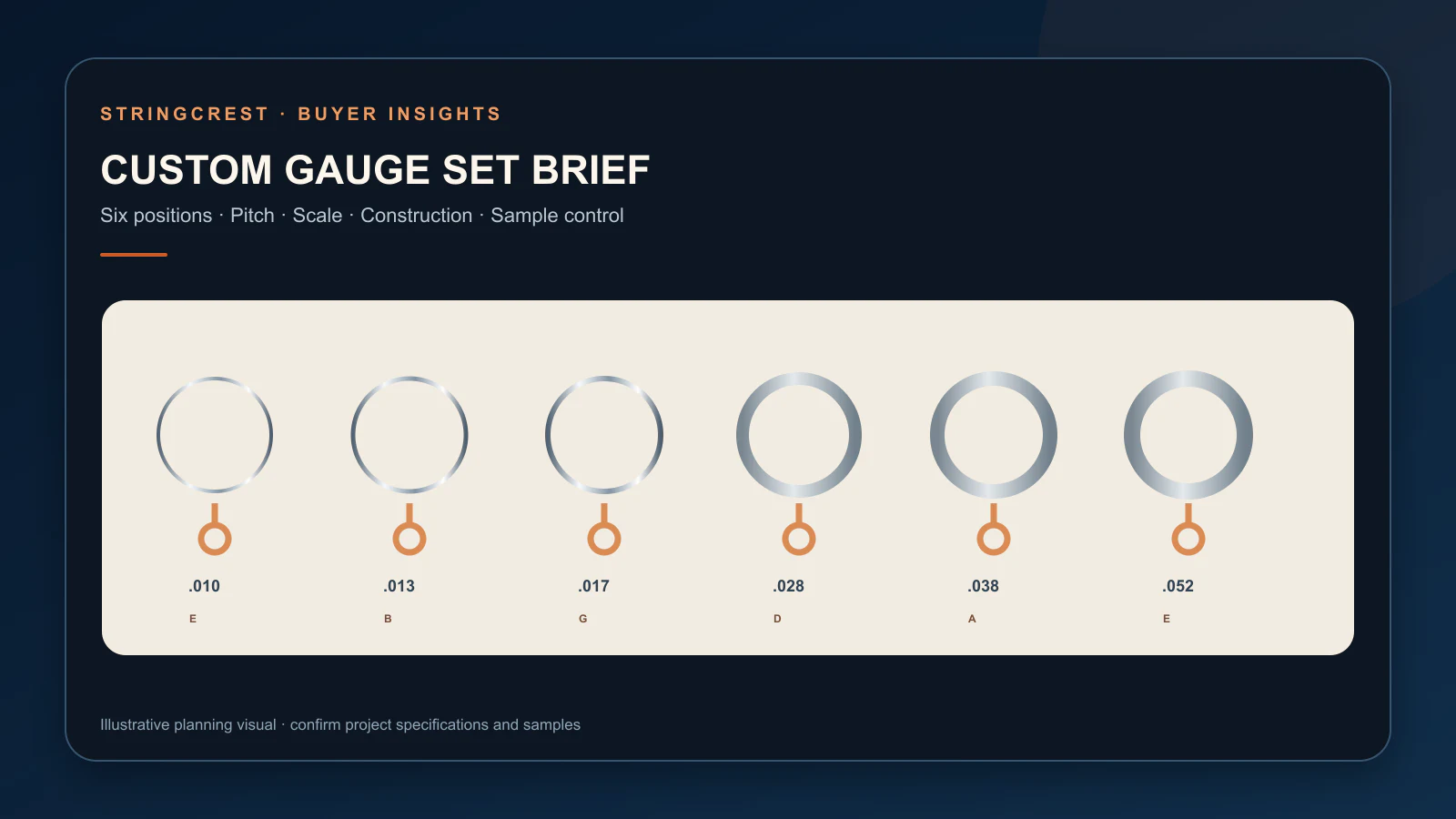
Ordering custom gauge guitar strings is not simply a matter of listing a thin first string and a heavy sixth string. The buyer must define every position, tuning, scale length, construction, material, end, usable length and intended application. A set can look logical in a spreadsheet and still produce uneven feel, setup problems or confusing packaging when installed on the reference guitar.
For a private-label project, “custom” should mean a controlled specification with a reason for each departure from the baseline range. It should not mean that a supplier guesses the middle gauges or combines available singles without an installed evaluation. Gauge affects tension direction, but tension also depends on scale, pitch, construction and unit weight. A gauge number alone cannot guarantee feel.
This guide gives B2B buyers a practical way to develop a custom-gauge electric or steel-string acoustic set. It explains how to define the use case, calculate and interpret tension cautiously, structure samples, review setup, approve packaging and control later revisions. It does not publish a StringCrest custom-set formula, confirmed availability, MOQ, capacity or delivery schedule. Those details require a current technical discussion and quotation.
Start with the musical and commercial problem
Write the application before the gauges
A useful brief begins with the instrument and player task. State whether the set is for standard tuning, a lower tuning, a hybrid top-and-bottom feel, an extended scale, a particular bridge route or a dealer-exclusive range position. Record whether the buyer wants an electric or acoustic construction, how many strings are required and which reference guitars will be used.
The commercial role matters too. A custom set may fill a gap between existing gauges, support an alternate tuning, simplify a dealer’s mixed-single recommendation or create a private-label signature direction. Each reason leads to different evaluation priorities. A set designed for lower tuning should not be approved only in standard tuning, and a range intended for broad retail should not depend on one unusual setup without clear labeling.
Do not use “balanced” without defining the method
Balanced feel can mean equal calculated tension, a smoother progression, familiar resistance under the picking hand or a player-approved result. These are related but not identical. If the project uses a numerical target, identify the calculation source, scale length, pitch and unit-weight data. If it uses a perceptual target, define the reference set and repeatable playing tasks.
Official D’Addario educational material notes that custom gauge choices can affect playability and tension, and its tension reference explains that scale length is required for exact calculations. Those principles support a careful development method. They do not validate any proposed StringCrest sequence by themselves.
| Brief element | Required detail | Common ambiguity prevented |
|---|---|---|
| Instrument | Electric or steel-string acoustic, string count | Mixing incompatible constructions |
| Scale | Measured nut-to-bridge length | Treating one gauge as the same on every guitar |
| Tuning | Pitch for every position | Hidden tension change from alternate tuning |
| Gauge sequence | Every string, not only first and last | Supplier-selected middle gauges |
| Construction | Plain/wound, core, wrap, coating | Assuming gauge defines the product |
| Fit | Bridge path, ball end, usable length | A set that reaches pitch but fits poorly |
| Range role | Customer and channel purpose | Customization without a sellable reason |
Build a position-by-position set architecture
Treat every string as a separate component
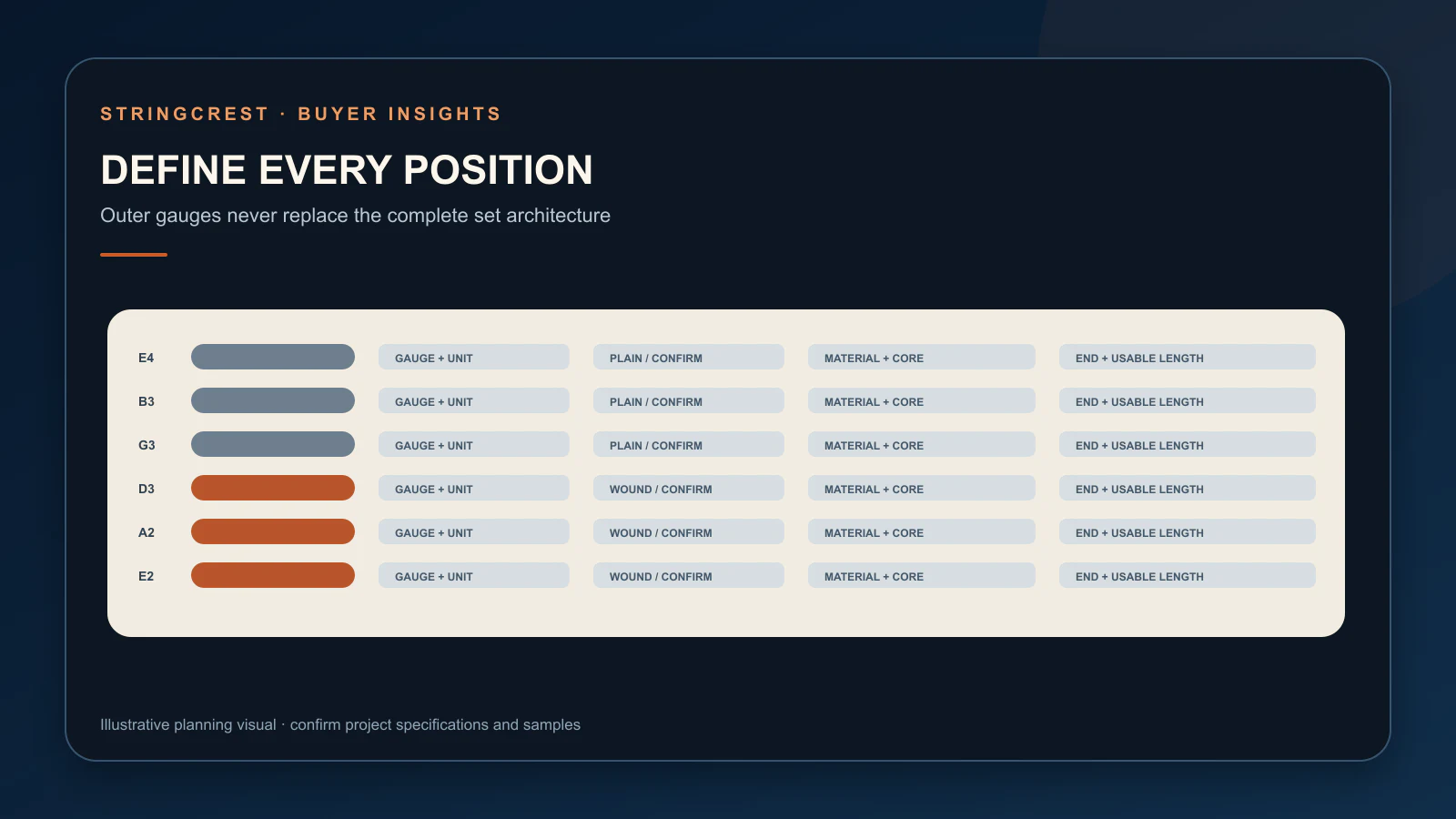
Create one row for each position from highest to lowest pitch. Include note, target pitch, gauge, plain or wound status, core direction, wrap material, coating or treatment, end type and usable length. For extended-range instruments, add the extra positions explicitly rather than appending “7-string” or “8-string” to a six-string table.
A hybrid set often changes more than the outer gauges. The transition from plain to wound strings can create a noticeable step, and the proposed third string may be plain or wound. A lower sixth string may need a different construction or taper to fit the tuner. The position table exposes these choices early enough to sample them.
Keep units and rounding consistent
State whether diameters are in inches, millimeters or both. Use the same precision across the table and confirm how the supplier controls finished diameter. A conversion shown on packaging should not imply more precision than the production specification supports.
When comparing quotations, make sure “.010” refers to the same finished string concept. A plain .010 and a wound string with the same nominal outside diameter are different constructions. Likewise, two wound strings of the same finished gauge can use different core-to-wrap relationships and feel different when installed.
Use tension calculations as planning evidence, not a promise
Gauge, pitch and scale work together
String tension is related to vibrating length, frequency and the physical characteristics represented by unit weight. Increasing scale, pitch or unit weight changes the calculated result. This is why moving a set from one scale or tuning to another can alter feel even when the printed gauges stay the same.
Use a reliable calculator or supplier data for the exact construction when available. Do not borrow unit-weight data from an unrelated string and present the output as a verified production value. If only directional analysis is possible, label it as an estimate and require an installed sample.
Look at the progression, not just a total
A total set-tension number can hide one unusually light or heavy position. Review each string and the transition between adjacent strings. Then compare the proposed sequence with the buyer’s reference set under the same scale and tuning assumptions.
The numerical review should flag questions for the sample, such as a large jump between G and D or a low string that may feel too loose in the target tuning. It should not replace the playing test. Construction, setup and technique influence perceived resistance and response.
Choose a sample ladder that answers one question at a time
Begin with a controlled baseline
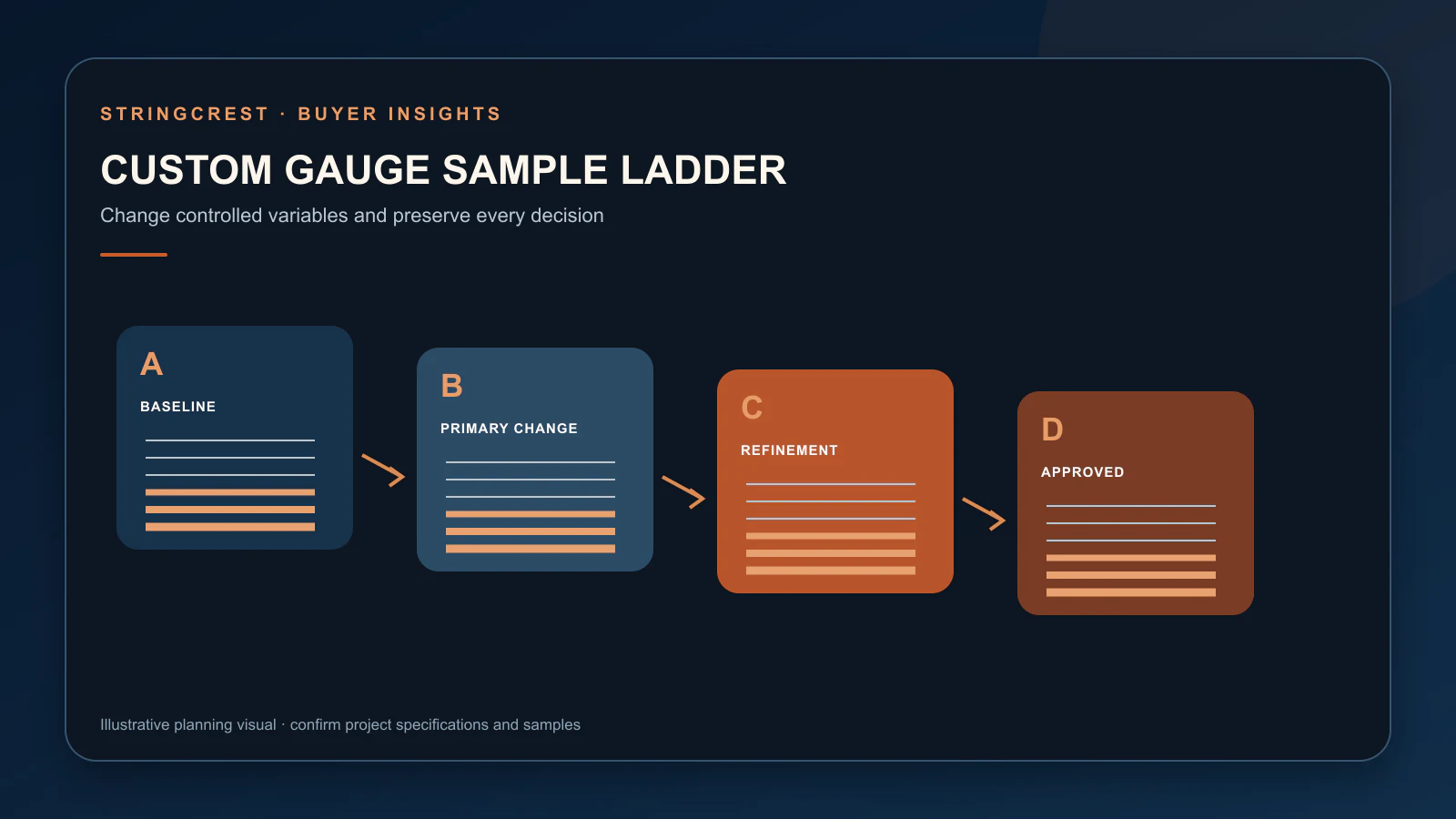
Use an existing, documented set as Sample A. Sample B should change only the main variable being investigated where feasible, such as the lower three gauges for a hybrid set. Sample C can refine the result after the first installed review. If material, coating and core all change at once, the team will not know which choice caused the observed difference.
Give each sample a code that cannot be confused with the eventual retail SKU. Put the same code on the inner pack, evaluation sheet and photo record. Loose strings must remain separated by position and revision. A handwritten gauge without the sample revision is not enough for later production approval.
Use more than one reference guitar when the range is broad
Record scale, bridge, nut, tuner and setup state for each reference instrument. The goal is not to test every guitar in the market. It is to reveal whether the set’s intended coverage is narrower than the packaging implies.
Install the set using normal procedures and record any setup work required. Evaluate tuning stability after installation, intonation range, nut and saddle interaction, tuner wraps, bends, chord response, alternate-tuning behavior and transitions between adjacent strings. If a professional setup is expected, include that limitation in dealer guidance rather than hiding it.
Separate electric and acoustic construction decisions
A gauge sequence does not cross categories automatically
Electric and steel-string acoustic sets may share familiar gauge numbers, but their wrap materials, response goals and common pack architecture differ. A custom 11–52 electric concept is not automatically the same product as an acoustic 11–52 set. Identify instrument category before material and construction are proposed.
For electric sets, define pickup interaction as an evaluation context without promising a universal output. For acoustic sets, define the wrap-material direction and reference guitars. In both cases, use the approved sample to support qualified language rather than importing claims from another brand’s product family.
Confirm ball ends and usable length
Both categories commonly use ball ends, but ball style, twist or lock details, color coding and total length can still differ. Record bridge routing, including through-body paths where relevant. Confirm that the full-diameter wound section reaches the intended tuner appropriately and that any taper does not enter the speaking length unless the design calls for it.
Fit approval should be recorded separately from tonal preference. A set that reviewers like but that fails the intended bridge or tuner route is not ready for the stated market.
Manage plain-versus-wound transitions deliberately
The third string deserves its own decision
Many electric sets use a plain third string, while some specialist or heavier concepts use a wound third. Acoustic sets commonly use a wound third in standard six-string architecture. The project brief must state the choice instead of assuming the supplier will infer it from the gauge.
Changing the third-string construction can affect intonation, bending, balance and setup. Include tasks that expose those effects on the reference guitar. If both variants are sampled, assign separate codes and packaging descriptions.
Avoid abrupt feel changes between adjacent positions
A custom set can meet the buyer’s outer-gauge goal while creating an awkward internal progression. Review the calculated direction and the installed result across B-to-G, G-to-D and the lower wound strings. Ask players to evaluate transitions using the intended tuning and technique.
Do not “correct” an unusual result silently at production. Any gauge or construction change after approval must produce a new revision and, when material, a new sample review.
Turn the approved set into a controlled product master
Freeze technical and commercial identity together
The master record should include the final position table, sample code, approval date, reference instruments, artwork version, item code, barcode, inner pack and case pack. Link the current quotation and purchase order to the same revision. This prevents an approved set from being paired with an old gauge table or a new pack from being filled with the previous sample.
| Position | Target pitch | Gauge/unit | Plain or wound | Material/construction | Approved sample |
|---|---|---|---|---|---|
| 1 | Confirm | Confirm | Confirm | Confirm | Revision code |
| 2 | Confirm | Confirm | Confirm | Confirm | Revision code |
| 3 | Confirm | Confirm | Confirm | Confirm | Revision code |
| 4 | Confirm | Confirm | Confirm | Confirm | Revision code |
| 5 | Confirm | Confirm | Confirm | Confirm | Revision code |
| 6 | Confirm | Confirm | Confirm | Confirm | Revision code |
Add tolerance and process controls in the technical agreement when they are verified. Avoid publishing confidential or unconfirmed production detail as marketing copy.
Define change control before reorders
The supplier should notify the buyer before changing any approved material, gauge, core, wrap, coating, end, usable length or packaging component. The buyer can then decide whether document review, dimensional inspection or a new installed sample is required. A reorder should not rely on the assumption that a familiar SKU name guarantees unchanged construction.
Write packaging for accurate customer decisions
Show the complete gauge sequence
Custom sets especially need the six or extended-position sequence on the pack. The first and last gauges are useful shorthand, but the middle strings explain why the set is custom. State tuning or application only when it is part of the approved brief and the wording has been reviewed.
Avoid terms such as “perfectly balanced,” “no setup required,” “unbreakable” or “lasts X times longer” unless the final product has evidence that supports the exact statement and conditions. A safer package explains what the set is: instrument, string count, complete gauges, construction, material, end and intended tuning direction.
Give dealers a qualification question
Dealer material can prompt the customer to confirm scale, tuning and setup before choosing the set. This is more useful than a broad claim that the pack suits every guitarist who uses a particular genre. It also reduces returns caused by selecting an alternate-tuning set for an incompatible setup.
Inspect samples and shipments with different goals
Development inspection finds the right specification
During development, the team compares revisions, installs strings, records setup and evaluates the intended task. The goal is to decide which specification to approve. Keep measurements and comments by position so that one problematic string is not hidden inside an overall score.
Shipment inspection confirms conformance
Receiving inspection checks whether production matches the approved identity. Verify item and lot codes, pack labels, gauge sequence, set count, end details, packaging condition and selected dimensional or installed-fit points defined in the agreement. Use an inspection plan that states sample size and acceptance rules.
Visual checks cannot prove alloy chemistry or every internal construction detail. When those attributes are critical, use supplier documentation or suitable testing. Do not describe shipment photos as laboratory evidence.
Prepare a complete custom-gauge RFQ
Include these fields so suppliers can quote the same project:
- instrument category, string count and intended range role;
- measured scale length, bridge route and reference guitar models;
- tuning and target pitch for every position;
- complete proposed gauge sequence with units;
- plain/wound status, core, wrap, coating and end requirements;
- baseline set and the problem the custom sequence should solve;
- sample ladder, evaluation tasks and approval record format;
- packaging, artwork, barcode, traceability and case-pack requirements;
- replacement-single or dealer-support needs;
- commercial request for sample terms, MOQ, lead time and quotation validity.
If a field is unknown, ask for a supplier proposal and the reason behind it. Keep that proposal separate from confirmed buyer requirements until it passes review. This produces a useful technical conversation instead of a quotation built on hidden assumptions.
FAQ
Can I specify only the first and sixth gauges?
That is not enough for a custom set. The intermediate strings control the progression and may differ between suppliers. Record every position and whether it is plain or wound.
Does a heavier gauge always mean better lower-tuning performance?
A heavier gauge changes the tension direction, but scale, pitch, construction, setup and player needs also matter. Calculate cautiously and approve the result on the target tuning and reference instrument.
Can an electric gauge sequence be used for an acoustic set?
Do not assume so. Confirm instrument category, wrap material, construction and intended response separately. Similar numbers do not make the products equivalent.
How many sample revisions are needed?
There is no universal number. Use enough controlled revisions to answer the main fit, progression and application questions. Stop when the buyer has a documented result, not when an arbitrary sample count is reached.
Will a custom set require a guitar setup?
It may. Changes in gauge, tuning or wound-string construction can affect nut, saddle, intonation and neck response. Evaluate this on the reference instruments and give dealers qualified guidance.
What prevents the production set from changing later?
A versioned product master, approved physical sample, artwork reference, purchase-order revision and written change-control requirement provide the practical controls. Recheck material changes before reorder approval.
Conclusion
A successful custom-gauge set begins with a defined problem and ends with a traceable production reference. Every position must have a pitch, gauge, construction and fit requirement. Tension calculations can guide the work, but the installed sample decides whether the complete set supports the intended guitar, tuning and channel role.
Private-label buyers who connect the position table, sample record, packaging and purchase order reduce ambiguity at every handoff. They can also explain the product to dealers using verified identity rather than exaggerated performance language.
Explore StringCrest string categories · Send your custom gauge set brief
Sources and interpretation limits
- D’Addario custom guitar strings configurator and gauge guidance
- D’Addario string-tension specifications reference
- D’Addario electric guitar string gauge education
These sources explain general relationships and one manufacturer’s available options. They do not confirm StringCrest custom-gauge availability, formula, calculation data, compatibility, sample results, MOQ, production capacity or lead time. Confirm all details in the project specification, quotation and approved samples.
FROM GUIDE TO PRODUCT
Connect this guide to private-label string development.
Review the relevant range, then bring the instrument, complete specification and open questions into one project brief.
YOUR PRODUCT · YOUR BRAND
Discuss your next string project with Frank.
Share your instrument category, target market, gauge or material direction and private-label packaging requirements.

ABOUT THE AUTHOR
Frank Zou
Frank works directly with musical-instrument brands, importers and distributors on string specifications, product selection and private-label project requirements.
Meet Frank