
Buying Guides
Classical Guitar Strings
Black Nylon Guitar Strings: A Dealer Material Selection Guide
Separate appearance from construction when comparing black nylon classical strings. A dealer guide to tension variants, complete sets, tie ends and reorder identity.
Introduction
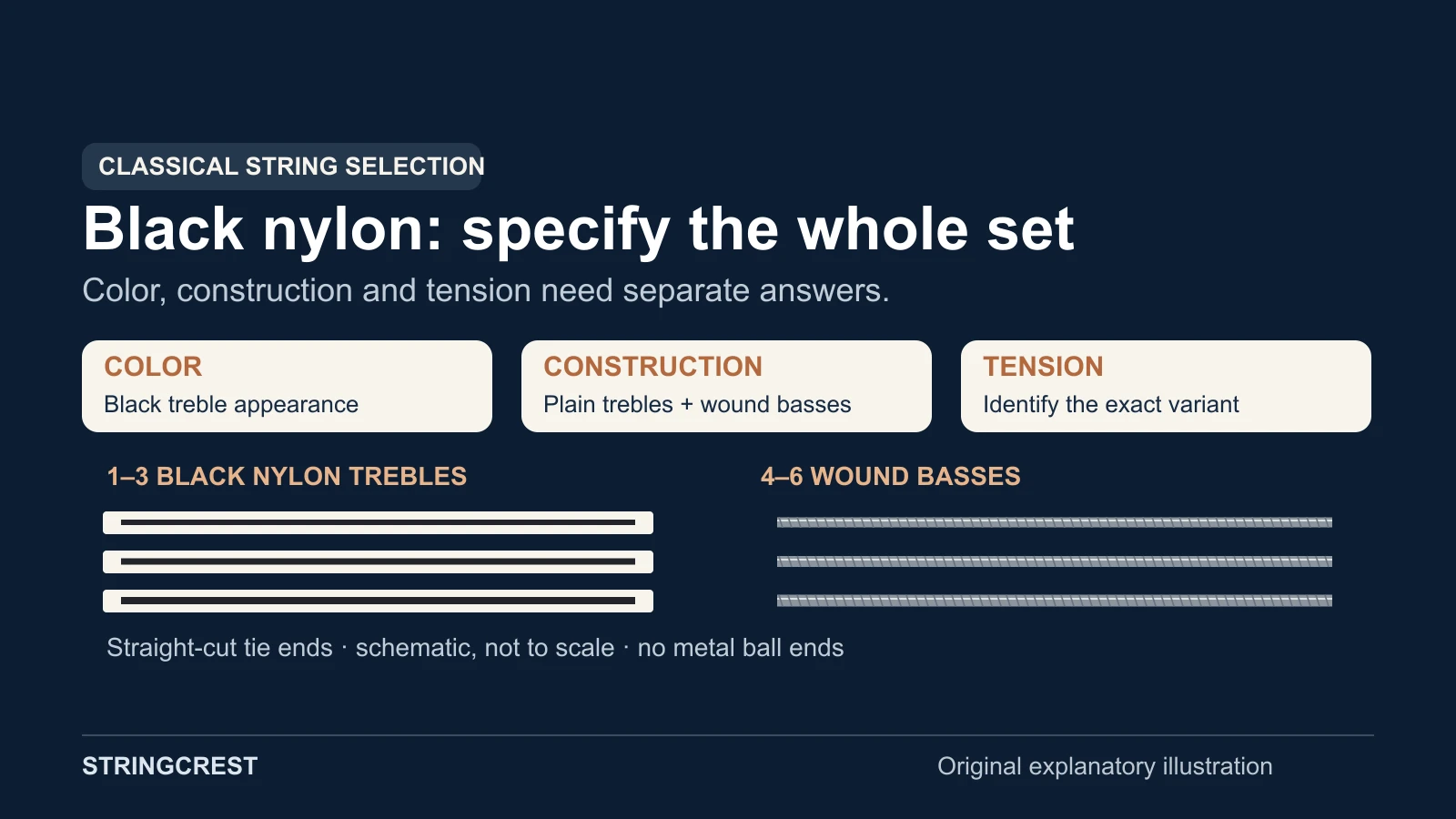
Black nylon guitar strings can give a classical range a distinctive appearance, but their color does not specify the complete set. A buyer still needs to establish the treble material, bass construction, tension option and attachment. For the tie-end classical configuration discussed here, the trebles have plain-cut ends, and the wound basses also attach by tying. This tie-end configuration uses no metal ball ends.
For a dealer deciding whether to add a black-nylon option, the useful question is whether the proposed set meets a different customer requirement from the existing clear-nylon reference. Appearance may be that requirement. Claims about a warmer sound, easier playing or longer life need their own evidence; a black strand alone cannot establish them.
This guide focuses on that selection decision. It explains how to read a black-nylon listing, separate unrelated constructions and compare a proposed option without turning a color preference into an unsupported performance claim.
Read the whole set, not just the black trebles
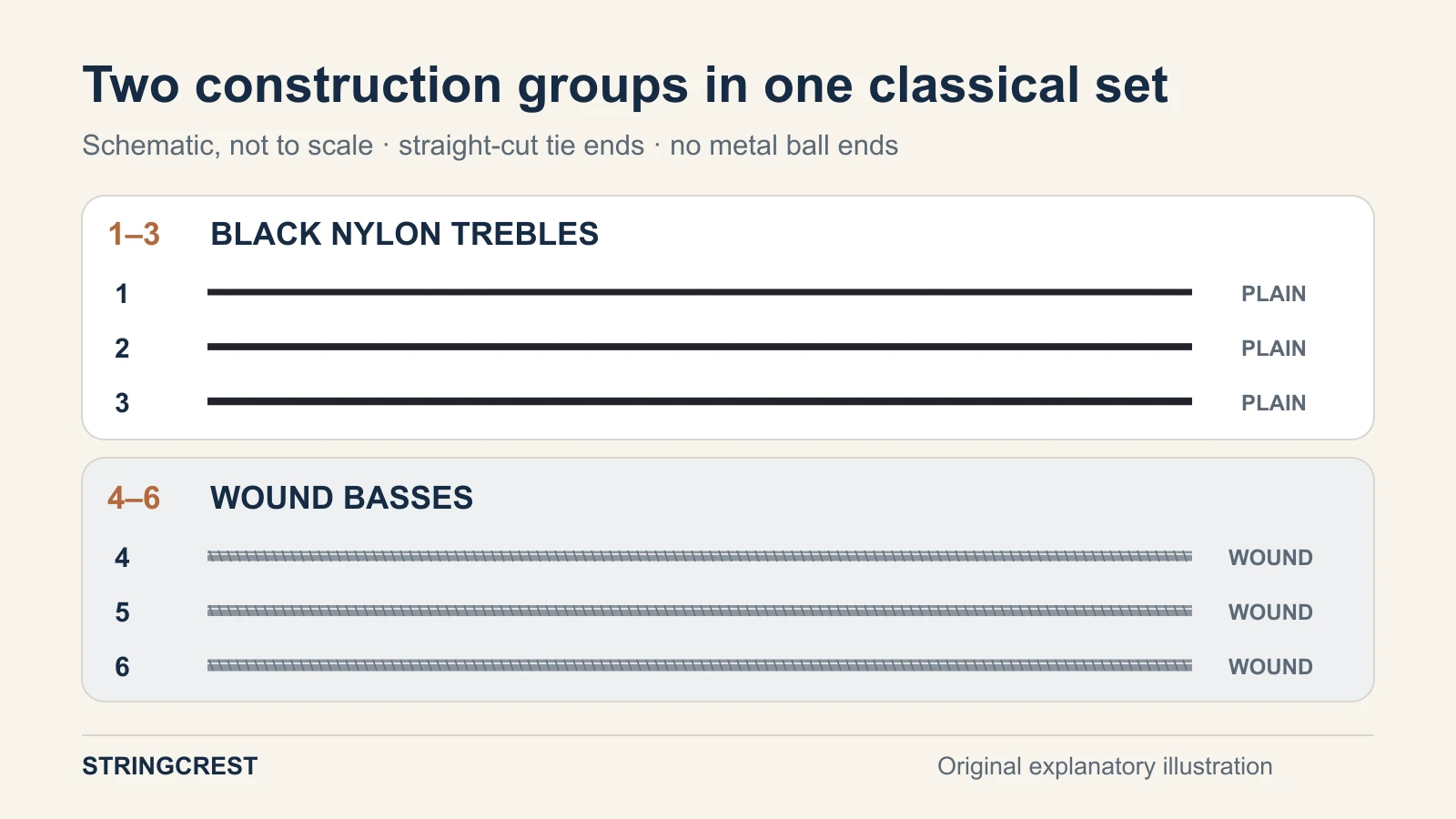
A conventional classical set combines two construction groups. The first three positions are trebles; the fourth, fifth and sixth are wound basses. A description of black nylon trebles therefore does not mean that all six strings are smooth black nylon.
D’Addario’s EJ49 product page provides a specific example. It identifies black nylon trebles and bass strings with a multifilament nylon core and silver-plated copper winding. It also identifies the set as six-string, full-scale, normal tension, uncoated and tie-end. Those details belong to EJ49, rather than defining every product sold under the phrase “black nylon.”
Read the construction and coating fields separately. A dark appearance does not prove that a protective coating is present. Conversely, a material described as nylon is not necessarily a nylon coating on a metal string. When a supplier uses broad catalog language, ask which component each word describes.
The classical material guide covers clear, rectified and alternative treble materials in more detail. For a black-nylon addition, concentrate first on what actually changes from the existing set and what stays the same.
Separate color, tension and instrument category
Black does not mean hard tension
D’Addario’s EJ50 listing describes a hard-tension black-nylon set. EJ49 is labeled normal tension. The two listings are a useful demonstration that the same treble color can appear in different tension options within one manufacturer’s range.
Use that distinction when stocking or specifying a set. A returning customer who asks for “the black ones” may still need a particular tension variant. Keep the full product code and tension wording together in the reorder record; the color is only one identification field. Do not replace a familiar normal-tension option with a hard-tension one because the photograph looks similar.
For a proposed private-label set, color approval and tension approval should be separate decisions. If numerical tension is supplied, retain its reference scale, tuning, method and individual positions. If it is not supplied, do not invent values from the label. The classical tension guide explains the broader comparison process.
Black nylon and black tapewound bass strings are different products
An especially important search-result ambiguity is black nylon tapewound bass strings. In D’Addario’s ETB92 example, flattened black nylon wraps a steel core for a bass-guitar application. That construction is different from the monofilament trebles in the classical example above.
Keep those categories separate in catalog filters, purchase descriptions and photography. “Black nylon” describes different parts of the string in the two cases. A supplier reply that names only a color and polymer has not yet answered the instrument question. Our tapewound bass guide belongs to the bass category; it is not an alternative classical specification.
Use a substitution test before adding a SKU
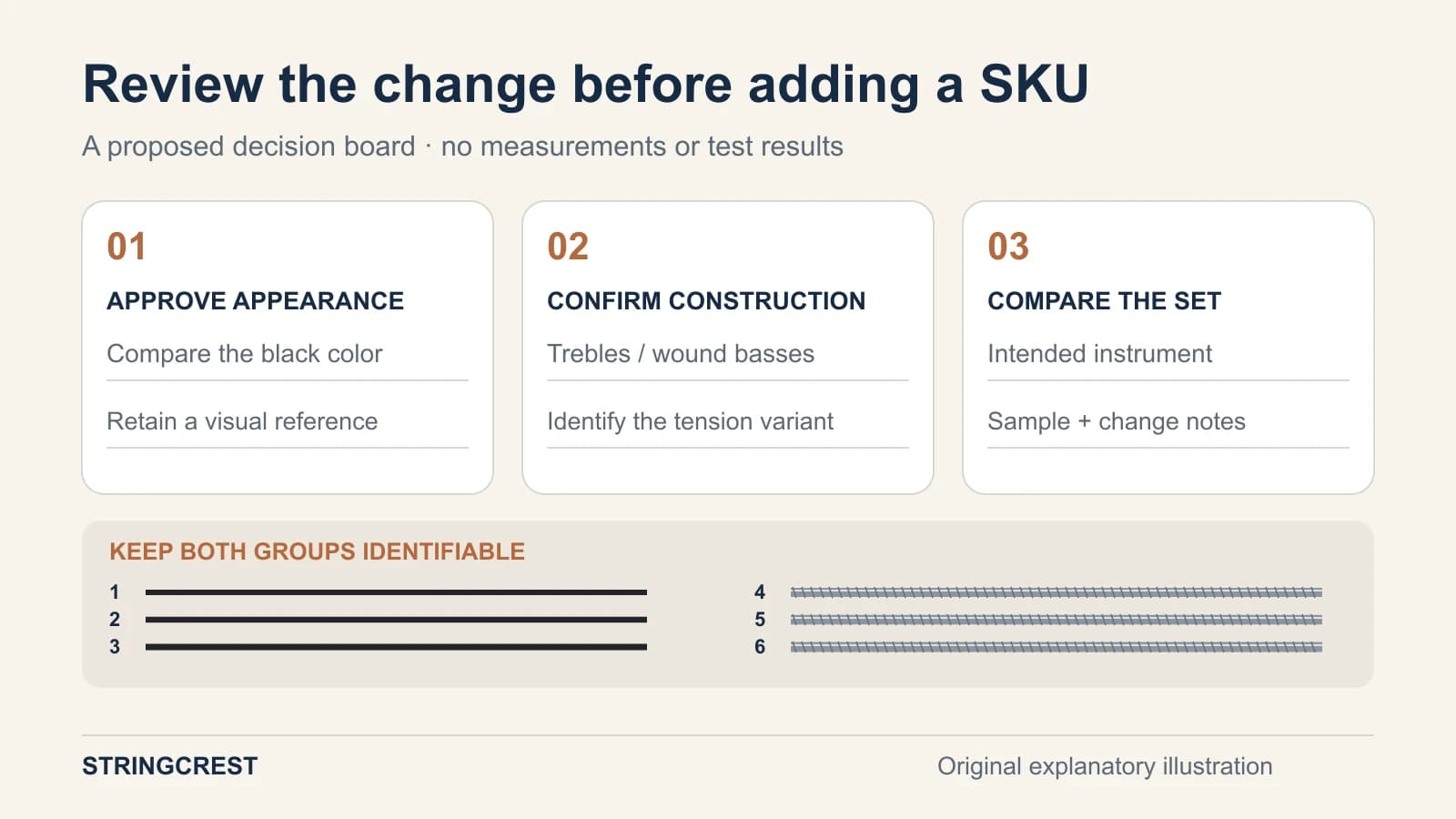
The following table is a selection tool for a dealer or independent brand. Fill it from the current product record and proposed sample information. It contains no assumed gauges or pre-approved substitutions.
| Selection question | Compare against the existing reference | Decision it supports |
|---|---|---|
| Which strings change color? | Trebles, basses or both, by position | Whether the photograph and listing describe the actual set |
| Is the treble material otherwise equivalent? | Declared polymer family and surface treatment | Whether this is mainly an appearance option or a construction change |
| Do the wound basses change? | Core, wrap, construction and position data | Whether feedback can reasonably be attributed to the trebles |
| Is the tension option the same? | Maker’s label and available reference data | Whether a reorder preserves the intended feel direction |
| Does the attachment match? | Confirmed tie-end project and usable length | Whether the set belongs to the intended installation category |
| Why would the channel carry both? | Identified customer request or a defined assortment role | Whether a separate SKU has a clear purpose |
A color-only brief should state explicitly which technical features are intended to remain unchanged. The supplier then needs to confirm what can actually be held constant. If the treble formulation, diameter or bass combination also changes, treat the result as a different set proposal. That does not make it unsuitable; it changes what the comparison can tell you.
For example, a proposed black-treble set paired with different wound basses cannot isolate the effect of treble color. Compare it as a complete option and describe observations accordingly. Avoid giving a cosmetic feature credit for every audible difference.
Compare appearance and playing response separately
Use an identified physical sample to approve the appearance. A screen photograph is useful for discussion, but lighting, exposure and display settings can change how dark or glossy a string looks. Agree which sample represents the intended color and surface, then keep that reference linked to the proposed product revision.
The review should distinguish a smooth dark monofilament from a wound or tape-covered surface. Photograph the complete set as well as a close view. For this classical tie-end project, the images should show black trebles, the separately specified wound basses and plain-cut ends. Adding metal ball ends would communicate the wrong construction.
For a playing comparison, record the guitar, existing set, installation date and what changed. Use the same instrument and ordinary playing tasks where practical. Let the installer follow the guitar and string maker’s instructions; this article is not a substitute for the correct tying method. Evaluate the treble group and its transition to the wound fourth string rather than judging only an isolated first string.
If the comparison changes material and tension together, record both changes and avoid assigning the result to color alone. “Preferred Sample B on the reference guitar” is a useful observation when the sample and conditions are identified. “Black nylon always sounds warmer” makes a much broader claim that the comparison cannot establish. No testing or customer preference results are asserted here.
Make the reorder and product listing unambiguous
Give the proposed set an identity that survives a change in staff. A usable listing names classical guitar, six strings, the approved treble material and color, bass construction, tension variant and attachment. Keep the full supplier or internal product code in the purchasing system. A photograph and the word “black” are too little information for a repeat order.
Inventory language also needs to distinguish a complete set from a treble-only group. A buyer replacing only the first three positions should not receive six strings by accident, and a complete-set customer should not receive only the colored trebles. State the contents in the title or the first visible product description.
For a new private-label option, start with a clear reason to carry it. A verified request for dark trebles may justify an appearance alternative. An expected sound difference needs a separate evaluation. Creating both normal and hard variants simply because both exist elsewhere adds another purchasing decision; it is not evidence of demand in your channel.
Keep the listing in the classical guitar category. If the customer is uncertain about the instrument, use the nylon-versus-steel compatibility guide before discussing color. Shared six-string tuning does not make classical and steel-string sets interchangeable.
FAQ
Does a black-nylon set have six black strings?
Not necessarily. The classical examples discussed here pair black nylon trebles with metal-wound bass strings. Check the description of all six positions and whether the pack is a complete set or a treble-only group.
Is black nylon a protective coating?
The words alone do not establish that. EJ49 and EJ50 identify black nylon as the treble material and list the products as uncoated. Other products need their own construction and treatment information; do not classify them solely by appearance.
Can black strings replace a clear-nylon reference without further review?
Only color may appear different in a photograph, while material, tension or the bass combination may also differ. Match the product record and intended instrument, then review the identified proposal before treating it as a repeat-order substitute.
Conclusion
A black-nylon addition is easiest to evaluate when appearance, construction and tension are documented separately. Define which positions change, retain the intended classical tie-end fit and give the proposed SKU a specific role beside the existing range. That lets dealers answer a customer’s color request without making promises the product record does not support.
Discuss a black-nylon classical string requirement with StringCrest. Include the current reference, complete-set or treble-only requirement, desired appearance, tension direction and instrument application.
FROM GUIDE TO PRODUCT
Connect this guide to StringCrest product ranges.
Review the relevant range, then bring the instrument, complete specification and open questions into one project brief.
YOUR PRODUCT · YOUR BRAND
Discuss your next string project with Frank.
Share your instrument category, target market, gauge or material direction and private-label packaging requirements.

ABOUT THE AUTHOR
Frank Zou
Frank works directly with musical-instrument brands, importers and distributors on string specifications, product selection and private-label project requirements.
Meet Frank