
Classical Guitar Strings
Buying Guides
Gold Guitar Strings: A Dealer Guide to Plating and Material
Distinguish gold plating, bronze-colored winding and a color finish before comparing guitar strings or writing a dealer product description.
Introduction
Gold guitar strings need a construction description before they become a useful purchasing specification. The customer may want real gold plating, a warm metallic appearance, or simply strings that match gold-colored hardware. Those requests can lead to different products. Confirm the intended instrument and ask whether the requirement concerns an actual material or a visual effect.
For a dealer, the first decision is whether the proposed item belongs in a material-based comparison or an appearance-based search. A photograph cannot settle that question. Keep the product code, named material and finish description together so that a replacement or repeat order does not depend on somebody recognizing a shade of yellow.
Separate three meanings of “gold”
Gold-plated strings
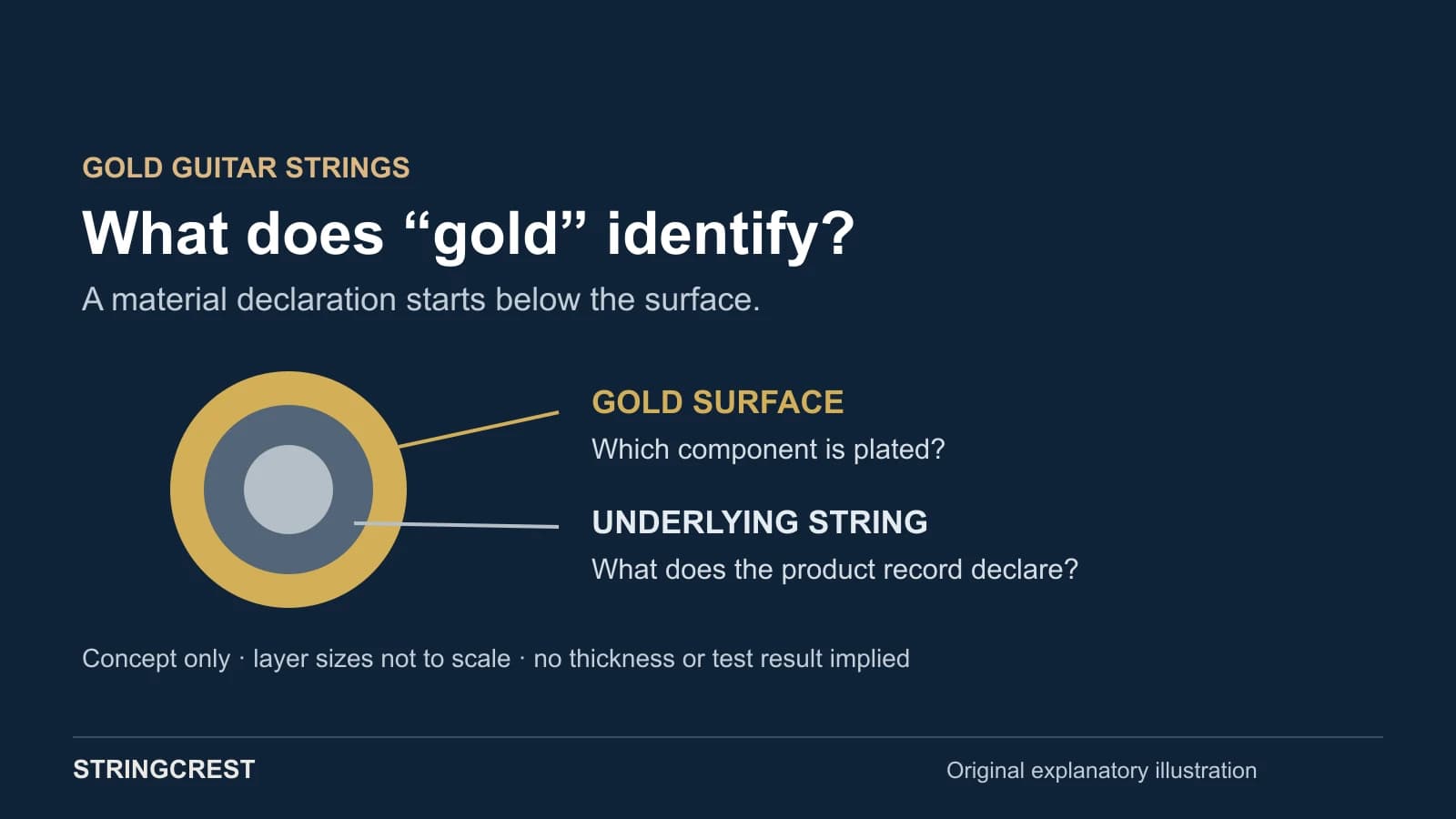
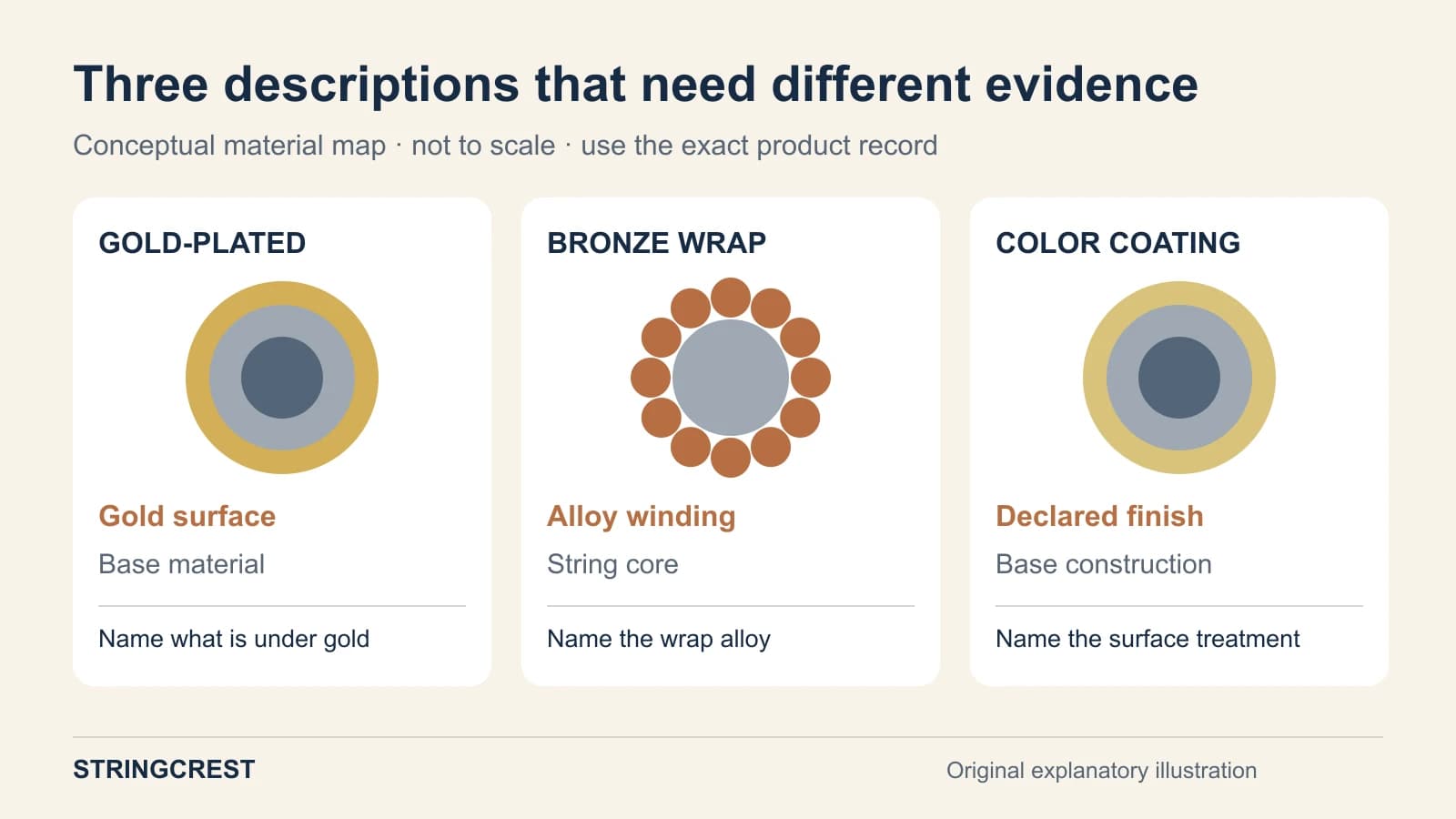
A gold-plated string has a gold surface layer over another construction. The word plated does not mean the complete string is solid gold. It also leaves questions about the underlying wire, the wound strings and which components receive that layer.
Optima’s 2028.RL electric set is a manufacturer-specific example. Its description identifies real 24-karat gold plating, nickel-plated steel for the three plain strings, and tinned hexagonal steel cores with gold-plated winding wire for the wound strings. This shows why a useful specification distinguishes the surface from what lies beneath it. It is not a construction declaration for a StringCrest product or every gold-colored set.
The karat description applies to the stated gold material, not the entire string. It does not give the layer thickness, total gold content, string diameter or service life. If any of those fields affect a buying decision, request the corresponding product information instead of deriving them from “24K.”
A bronze-colored winding
An acoustic string can have a warm metallic appearance without being specified as gold-plated. Read the wrap-material field. For example, D’Addario’s EJ11 listing identifies a steel core, 80/20 Bronze wrap and uncoated status. Its material description is different from the plated electric example above.
A similar color does not make those two sets substitutes. Keep acoustic and electric applications distinct and resolve the intended instrument before comparing appearance. The acoustic alloy guide covers the broader bronze-family choice; this article addresses what a gold request actually means.
A colored surface treatment
Color can also come from a separately specified coating. DR’s electric-string range distinguishes its silver-plated, color-coated NEON construction from its other material families. That is an example of color and underlying metal appearing as separate fields, not evidence that every gold-colored finish uses the same process.
When a listing says only “gold color,” ask whether it declares gold metal, another metallic finish, or a colored coating. Preserve the supplier’s accurate answer in the purchasing record. Do not silently upgrade an appearance description to “gold-plated” in a sales title.
Turn the customer’s request into a clear choice
Start with the reason for the request. Someone matching an instrument’s hardware may prioritize appearance; someone reordering a known gold-plated set needs the exact family and variant. A buyer comparing materials needs more information than either a color swatch or a familiar product name.
Use this short decision table at the counter or when reviewing a supplier reply. The suggested actions are an editorial tool, not a record of approved substitutions.
| What the buyer asks for | Evidence that resolves the request | Next step |
|---|---|---|
| The same gold set bought previously | Manufacturer, full product code and package reference | Match the actual variant before offering an alternative |
| Strings that look right beside gold hardware | Intended instrument, appearance reference and complete string specification | Compare identified physical samples under the same lighting |
| Real gold-plated guitar strings | Explicit material and plating description for the offered item | Confirm the base construction and which components are plated |
| A gold-looking acoustic winding | Wrap alloy and treatment information | Compare suitable acoustic constructions rather than color alone |
| A gold finish with a performance promise | Exact claim and evidence for the offered revision | Keep the promise out of the listing until it is supported |
If the supplier sends a beautiful photograph but no construction description, the appearance question has moved forward while the material question remains open. Ask one precise follow-up: “Which part contains gold, and what is the stated material underneath it?” For a color-only proposal, ask what the surface treatment actually is.
Send your instrument application, appearance reference and material questions to StringCrest. Include the existing product code when the request is for a replacement, or identify which parts of a new proposal are still under discussion.
Check the whole set before treating it as equivalent
A gold treatment does not supply the set’s gauge sequence, winding style, attachment or usable length. Nor does it tell a dealer whether every position has the same surface construction. Ask for a description of the plain and wound groups separately, then connect that description to the exact offered set.
For an electric application, keep the intended pickup and instrument requirements in the comparison. Do not substitute an acoustic bronze set merely because its winding looks similar in a photograph. The acoustic-versus-electric compatibility guide explains that decision in more detail.
Keep the end construction distinct too. A gold-colored ball end can be an identification feature while the string itself has a different material description. The guitar string color-code guide concerns position markers, not proof of gold plating along the string.
If the proposed item changes finish and base construction together, evaluate it as a complete alternative. A playing comparison could help a dealer choose between the two identified sets, but it could not isolate the effect of gold plating. Avoid attributing every difference in feel or response to the most visible feature.
Approve appearance without inventing performance
For a hardware-matching request, compare the actual sample beside the intended instrument under consistent lighting. Retain an overview and a close view with the sample’s product reference. This is a practical visual comparison; it does not establish the chemistry or thickness of the finish.
Keep appearance comments separate from playing observations. “This sample is a closer visual match to the reference hardware” answers a specific question. “Gold strings always sound better” does not identify an instrument, construction or comparison. The coated-string guide covers controlled evaluation when surface treatments are the subject of a broader range decision.
Do not infer “nickel-free” from a gold exterior. The named Optima example includes nickel-plated steel beneath the additional gold on its plain strings. A material description also does not independently establish suitability for a person with a sensitivity. Keep health-related assurances out of a dealer recommendation unless they have been appropriately substantiated for the exact product and use.
Likewise, a surface color supplies no universal corrosion or lifetime guarantee. If a proposal includes such a claim, ask for the conditions and evidence tied to that item. No durability, sound or wearer-sensitivity test is asserted in this guide.
Write a product description that survives a reorder
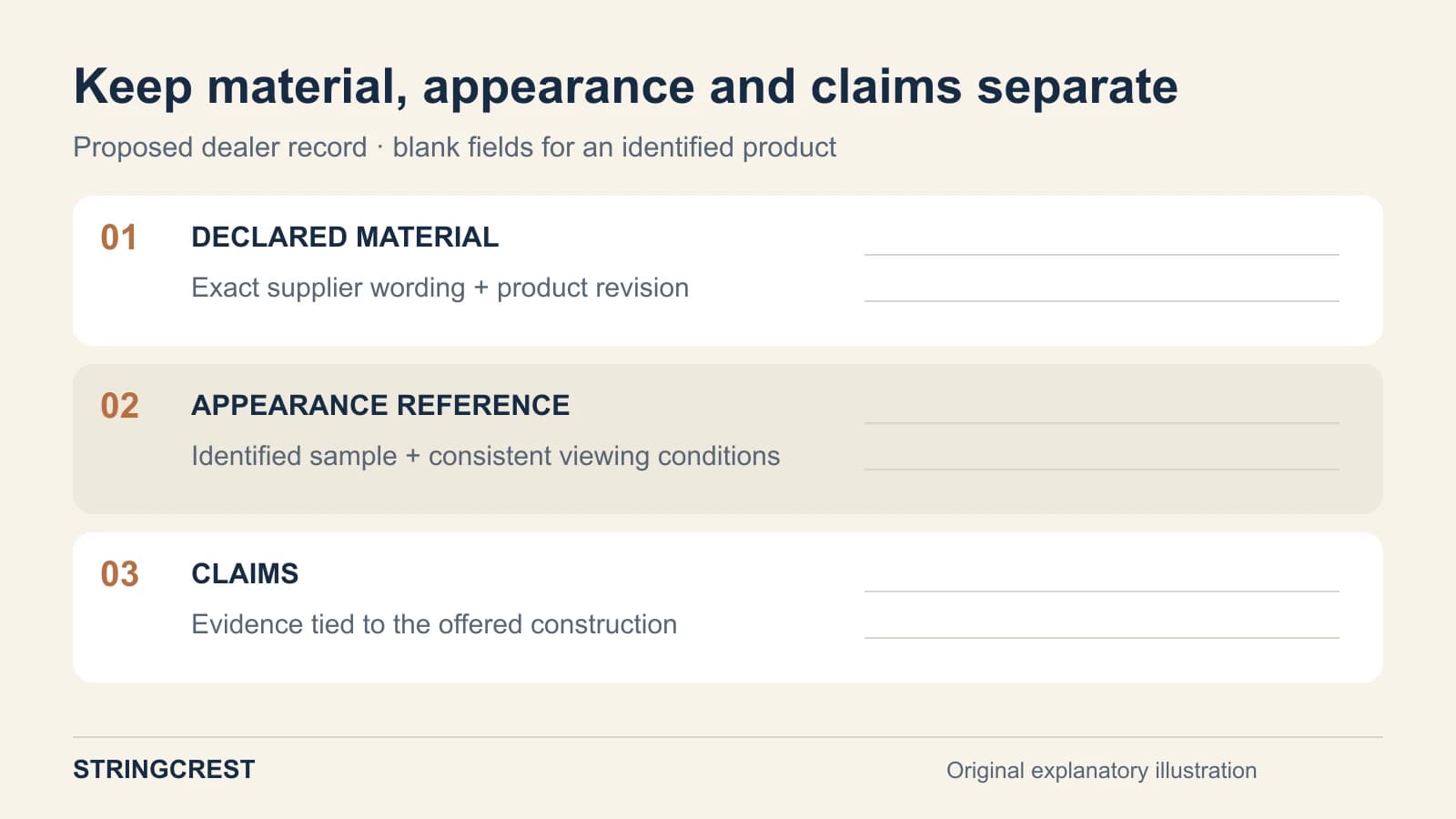
Give the item a complete identity: instrument category, product code, gauge sequence, construction, treatment and attachment. Use “gold-plated” only when that is the supported description. If the confirmed requirement is appearance, describe the color without claiming a gold composition.
The same distinction should appear in the stock record and customer-facing copy. An internal note that says “gold look only” does not correct a public title claiming genuine gold plating. Resolve the wording before approving a retail label or an online product entry.
Retain the supplier’s dated specification and the approved sample reference together. If the finish or underlying construction later changes, review the description again. A close color match may still represent a different product revision.
FAQ
Does 24-karat mean the whole string is gold?
Not in a product described as gold-plated. The term identifies the stated gold material at the surface; the underlying string construction needs its own description. It does not establish layer thickness or the amount of gold in a set.
Can a photograph prove a string is gold-plated?
No. It can document visible appearance, but the material claim needs a product-specific declaration. A warm metallic color can be confused with another alloy or treatment, especially under different lighting.
Should every gold-colored set share one catalog filter?
An appearance filter can help browsing if it is clearly labeled as color. Keep construction filters separate so customers can distinguish confirmed gold plating, bronze wrap materials and other finishes. Maintain the instrument category and actual product code in the results.
Conclusion
Resolve whether “gold” names a material, an appearance target or an existing product. Then confirm the complete string construction and use wording that the product record supports. Dealers can meet a visual request without letting a color stand in for compatibility or performance evidence.
Discuss a guitar-string material and finish requirement with StringCrest. Send the instrument type, reference set, desired appearance, proposed material wording and the decision your team needs to make.
FROM GUIDE TO PRODUCT
Connect this guide to StringCrest product ranges.
Review the relevant range, then bring the instrument, complete specification and open questions into one project brief.
YOUR PRODUCT · YOUR BRAND
Discuss your next string project with Frank.
Share your instrument category, target market, gauge or material direction and private-label packaging requirements.

ABOUT THE AUTHOR
Frank Zou
Frank works directly with musical-instrument brands, importers and distributors on string specifications, product selection and private-label project requirements.
Meet Frank