
Buying Guides
Buying Guides
Guitar String Recycling: A US Dealer Collection Guide
Choose a referral, internal collection or public drop-off route, then record what your store has actually collected and dispatched.
Introduction
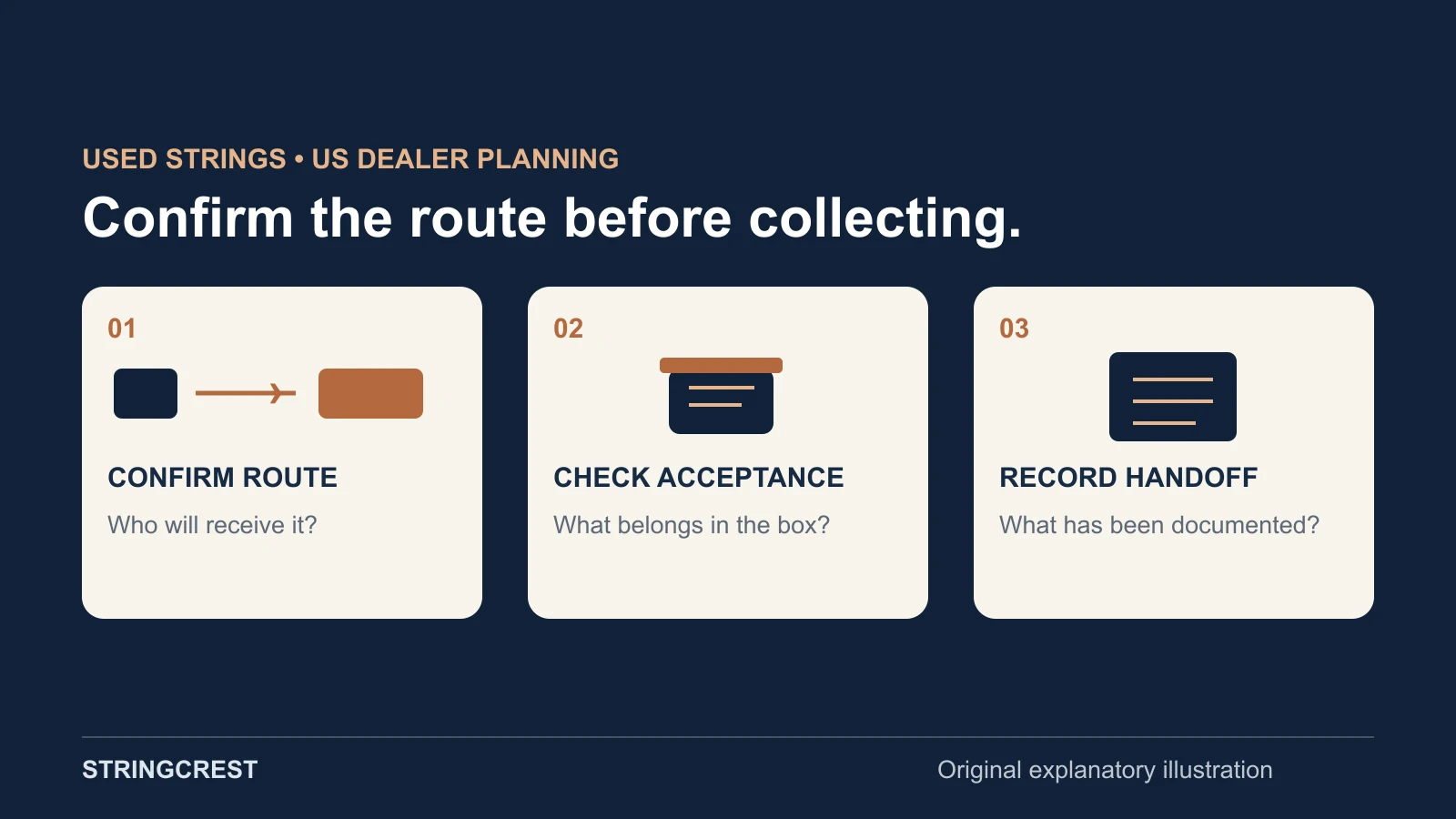
A US guitar shop should confirm a recycling destination before inviting customers to leave used strings. The useful first decision is whether to refer customers to an existing collection point, collect only the shop's own restringing waste, or operate a public drop-off point. Each route needs an identified receiver and current acceptance instructions.
A container behind the counter does not, by itself, establish a recycling service. This guide gives store managers a routing decision and a collection record they can use without promising a take-back service that has not been arranged. StringCrest inquiries linked here concern string-product and packaging requirements; recycling enrollment belongs with the program operator.
Choose the route before placing a collection bin
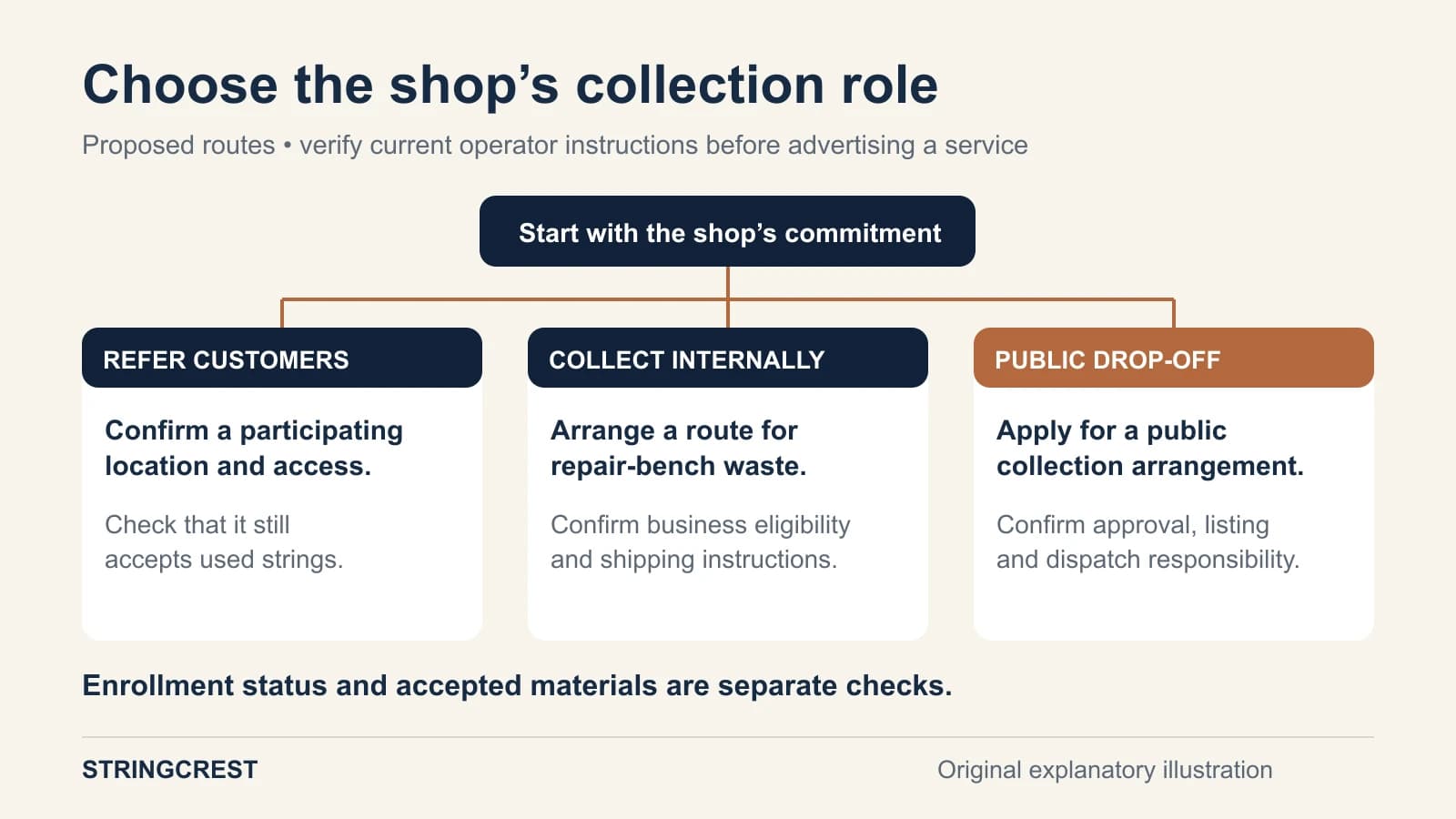
Start with the scope of the shop's commitment. A small store that rarely restrings instruments may only need a reliable referral. A repair department may need an internal collection route. A retailer inviting walk-in donations needs a public arrangement that its staff can explain and maintain.
| Shop situation | Practical route to investigate | Confirm before telling customers |
|---|---|---|
| Customers occasionally ask where to take old strings | Refer them to an existing participating location | Current address, opening hours and whether that location still accepts strings |
| The repair bench generates used strings and offcuts | Join a suitable business collection route | Business eligibility, accepted items and account-specific shipping instructions |
| The shop wants to accept strings from anyone | Apply to operate a public drop-off point | Approval, public listing, customer access and responsibility for dispatch |
| No confirmed receiving route is available | Keep the service unannounced while investigating | A receiver willing to accept the actual material and quantity |
These are proposed operating choices. They are not evidence that a particular store is enrolled. Assign one staff member to confirm the route and keep the instructions available to whoever closes and ships the container.
D'Addario's Playback program page provides an example of a US collection network. It identifies continental-US availability and directs dealers, luthiers, retailers and schools to arrange recycling-center participation rather than use its individual-player shipping label. Check the operator's current instructions for your account before shipping.
Separate material acceptance from business enrollment
TerraCycle's private D'Addario recycling program lists instrument strings and clippings from all brands, including electric, acoustic, bass, nylon and orchestral strings. It also says enrollment limits can apply. Its private route does not place a business on the public drop-off map.
For a dealer, those are separate questions: the item may be in the accepted material category while the shop has not yet secured an active route. Do not turn an all-brand material statement into a promise that every store can accept every shipment immediately.
Keep the acceptance page or confirmation with the collection record. If staff are unsure whether an item belongs, set it aside for the receiver's answer. Strings, outer cartons, inner sleeves, picks and removed hardware should not become one mixed stream just because they came from the same restringing job. Ask about items outside the receiver's published list.
The same distinction applies to municipal recycling. A string's metallic appearance is insufficient grounds to place it in a curbside container. Ask the local service about that exact item, or use a confirmed specialist route. This is a routing question, not a claim that every municipality follows the same rules.
Make the bench collection easy to maintain
Keep removed strings separate from saleable inventory and customer property awaiting a repair decision. A used string retained to investigate a breakage belongs with its job reference until that review is finished; dropping it into mixed collection loses the link to the instrument and reported fault.
For routine waste, choose a designated collection container that keeps loose ends contained and follows the receiver's instructions. Place it where staff can use it without reaching through a mass of offcuts. Set a simple closing and inspection routine, and replace a damaged container before moving its contents. Follow the shop's own handling procedures rather than improvising with exposed cut ends.
Label the container with the material scope and responsible staff member. Keep food, liquid, cleaning cloths and unrelated bench waste out. TerraCycle's private-program shipping advice requires dry contents; its page also gives a business-shipment weight range. Use the current instructions for the enrolled route, since the individual-player and business pages do not give interchangeable shipment thresholds.
Do not create a calendar-based promise such as a weekly dispatch unless the shop has arranged it. A volume-dependent collection can have a check date without a guaranteed shipment date. When the receiver changes a rule, update both the staff instruction and the customer-facing information before taking more material under the old description.
Discuss the string identification and packaging information your dealer channel needs with StringCrest. Include the instrument categories and the customer-care message you plan to provide. Ask the recycling operator separately about enrollment and transport.
Record the handoff, not an assumed recycling result
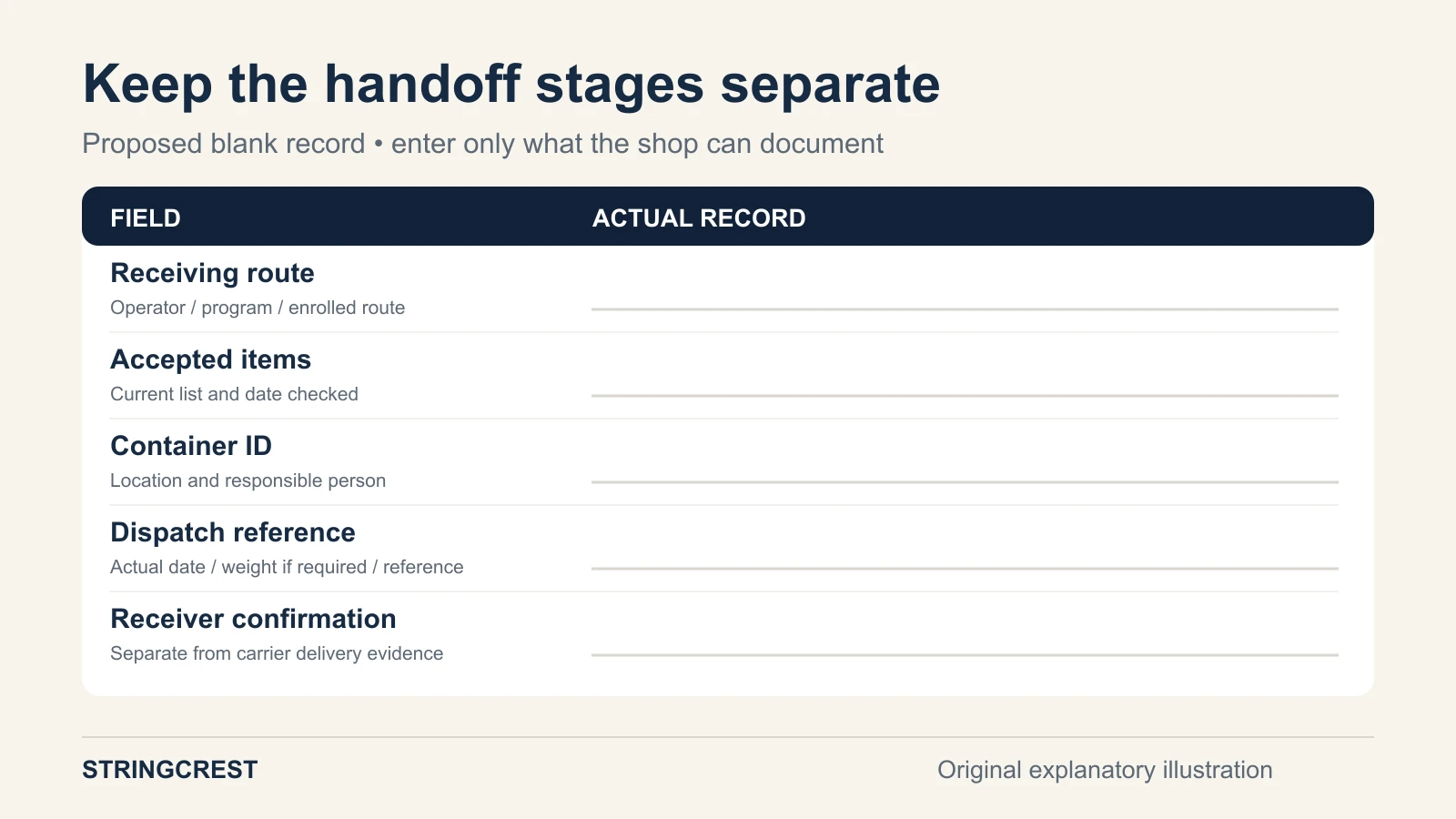
A basic log can distinguish strings waiting for dispatch from a shipment already handed over. It should also distinguish a carrier's delivery scan from a processing confirmation, if the receiver provides one. A customer-service answer should state the stage the shop can document.
| Record field | What to enter | What it does not establish |
|---|---|---|
| Receiving route | Operator, program and enrolled account or confirmed drop-off location | That any similar program accepts the same shipment |
| Accepted material | Current item list and date checked | Approval for loose packaging or other accessories |
| Collection unit | Container ID, location and responsible staff member | A completed recycling result |
| Dispatch record | Actual date, measured shipment weight if required, and tracking/reference | An environmental saving calculated from that weight |
| Receipt or follow-up | Carrier result and any separate operator confirmation | Processing details absent from the confirmation |
Use actual observations in the log. Leave a future dispatch blank rather than recording an expected date as completed. If a shipment is refused, retain the reason and resolve it before sending the next one. Keep customer names out of a general collection log when a container-level record is enough for the task.
This record is for the shop's operation. It does not replace a program's reporting requirements or provide a product certification. A photographed box proves the existence of that box; a shipping reference supports a particular handoff. Neither should be relabeled as proof of recycled content in a new set of strings.
Give customers a short, accurate answer
If the shop is only referring customers, provide the operator's locator and suggest confirming acceptance with the receiving location before traveling. Avoid putting a collection logo on the counter in a way that suggests the shop itself is an approved drop-off point.
If the shop has an active public arrangement, a useful notice names the accepted item, access hours and any preparation instruction supplied by the operator. Give staff a contact or instruction for unusual items. Keep the detailed program terms online where they can be checked, rather than copying a changing shipping threshold onto permanent packaging.
A replacement discussion remains a separate service. A customer should not be encouraged to discard usable strings merely to increase collection volume. Use the condition-based replacement guide for wear and setup questions. For unsold stock, follow the unopened-stock assessment guide before treating age alone as a disposal decision.
For a private-label line, assign care information and collection information separate owners. The supplier can confirm the actual string and package specification. The receiving program confirms its acceptance rules. A label designer should carry those decisions into the approved artwork without merging them into an unsupported whole-product environmental claim. The packaging-claims review guide explains that evidence boundary in more detail.
FAQ
Can a shop use a customer's individual-player shipping account?
Use the operator's business instructions. Playback's published guidance specifically distinguishes retailers and other organizations from individual players. Having a customer's label available does not establish that it is the correct route for the shop's collected waste.
Must we sort every string by alloy at the counter?
Ask the receiver what separation it requires. The cited private program accepts several string categories together; that does not require a dealer to identify an unknown winding alloy by appearance. Keep unrelated items out and follow the specific collection instructions.
Does a collection service prove a new string contains recycled material?
No. Collection and new-product composition are separate matters. A recycled-content description needs evidence for the actual supplied product or packaging component. A collection record cannot supply that missing specification.
Conclusion
Confirm the receiving route, define what the shop will accept and keep an honest record of each handoff. Those choices let staff answer a recycling question without confusing a public drop-off service, an internal collection container and a shipment that has already been processed.
Send your dealer-channel string and packaging requirements to StringCrest, including the product categories and proposed care information. For recycling participation, contact the relevant program operator and verify its current terms.
FROM GUIDE TO PRODUCT
Connect this guide to StringCrest product ranges.
Review the relevant range, then bring the instrument, complete specification and open questions into one project brief.
YOUR PRODUCT · YOUR BRAND
Discuss your next string project with Frank.
Share your instrument category, target market, gauge or material direction and private-label packaging requirements.

ABOUT THE AUTHOR
Frank Zou
Frank works directly with musical-instrument brands, importers and distributors on string specifications, product selection and private-label project requirements.
Meet Frank