
Buying Guides
Buying Guides
Left-Handed Guitar String Order: A Dealer Identification Guide
Identify conventional left-handed and intentional inverted guitar setups with a six-position pitch map and a practical dealer counter worksheet.
Introduction
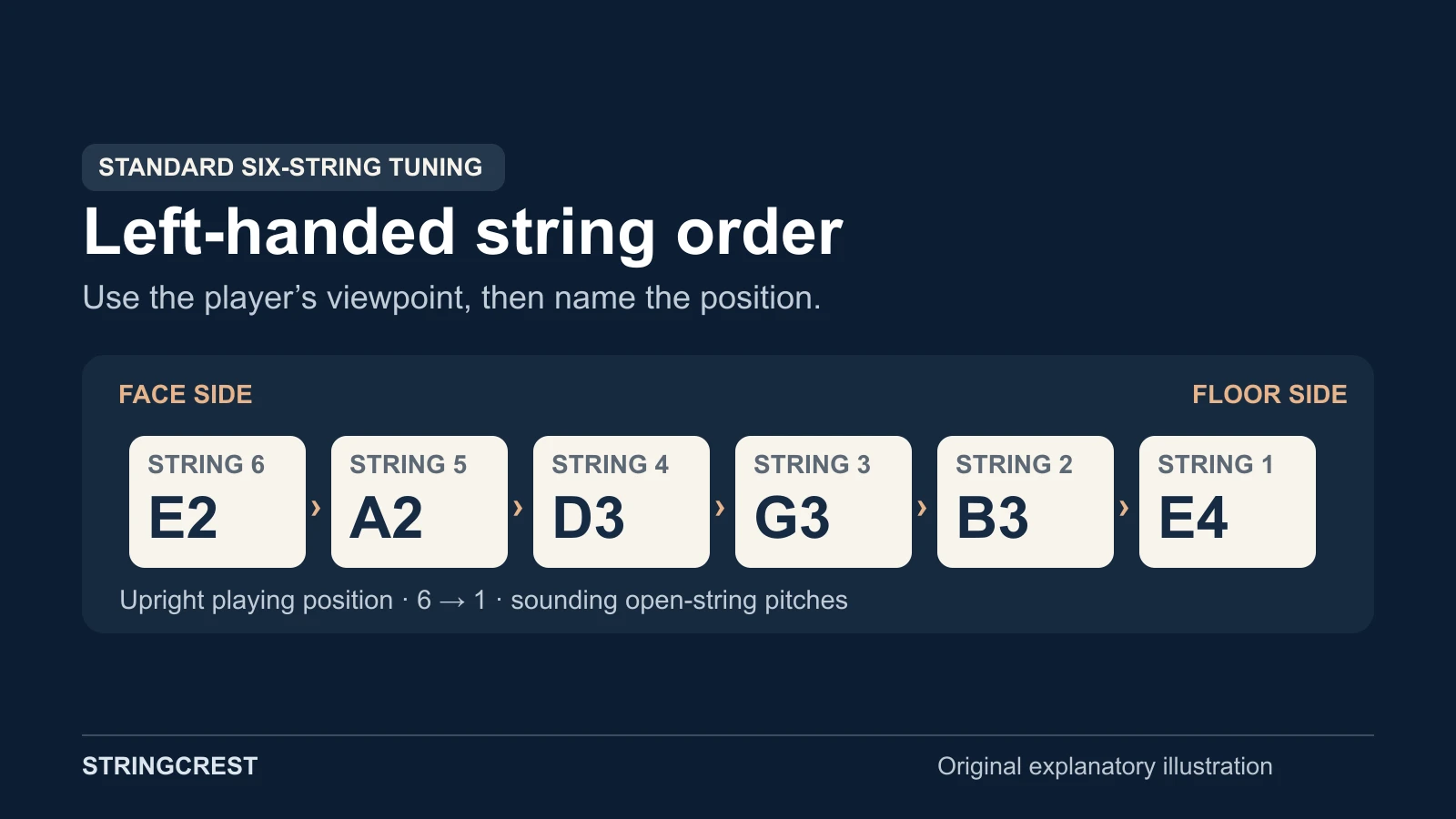
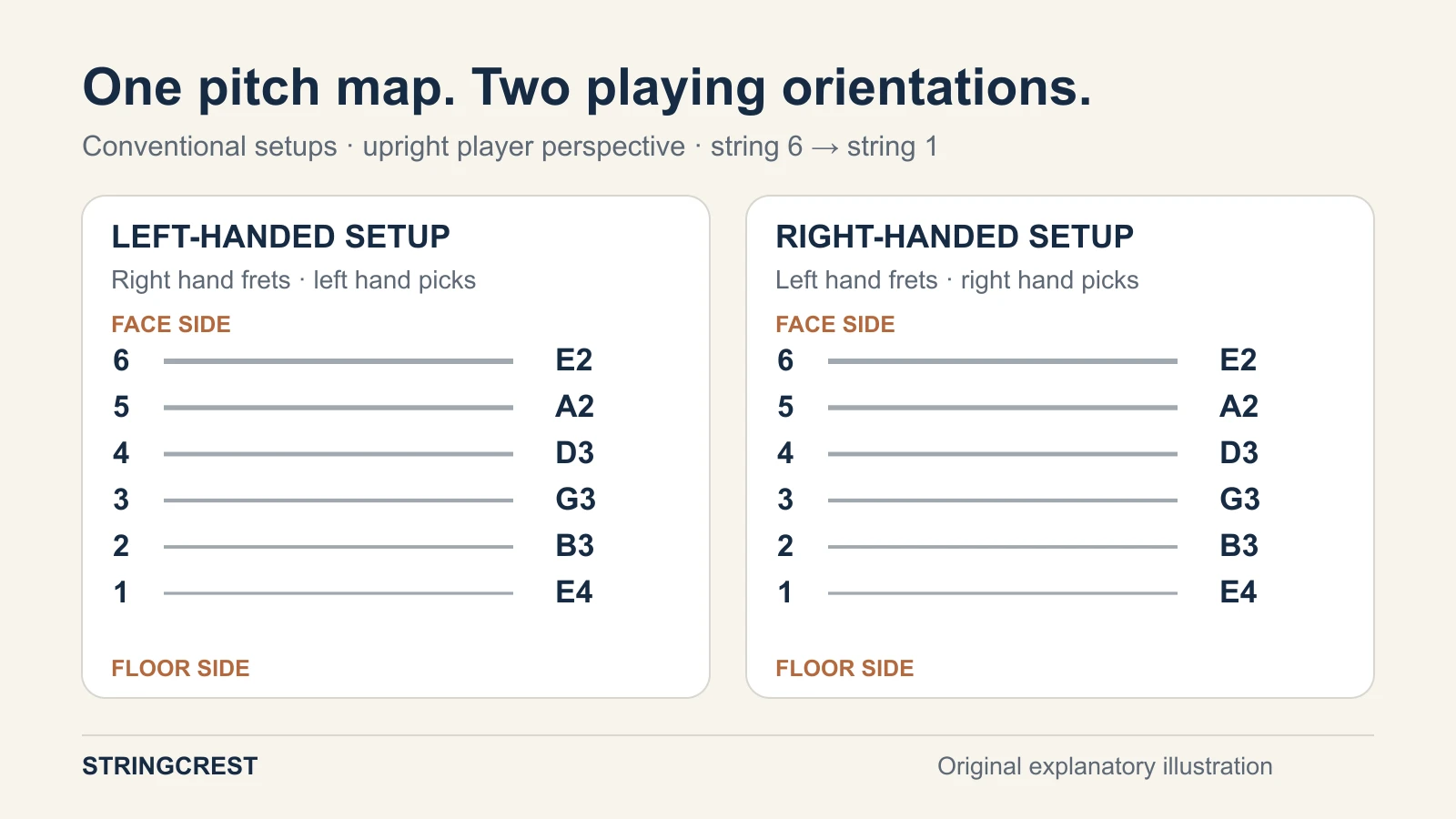
On a conventionally strung left-handed six-string guitar held upright for playing in standard tuning, the order from the player's face side toward the floor is 6-E2, 5-A2, 4-D3, 3-G3, 2-B3, 1-E4. The sixth string is low E; the first is high E. A conventional right-handed guitar in standard tuning uses the same numbered pitches. The neck points in the opposite direction when each instrument is held for playing.
That answer applies to a purpose-built or correctly configured left-handed instrument. A right-handed guitar turned over without rearranging its strings presents a different physical order to its player. A photograph labeled “left-handed” therefore cannot identify the required replacement by itself.
For a music store or private-label team, the useful question is which numbered string belongs in the identified instrument. This guide provides a viewpoint check, a six-position reference and a short counter worksheet. It covers conventional six-string standard tuning; alternate tunings, baritone guitars and extended-range instruments need their own records.
Keep string identity separate from image direction
Number the strings before reading a photo
D'Addario's standard-tuning guide identifies the sixth string as low E and the first as high E. Handedness does not require a new numbering system. Use the following map for the ordinary standard-tuned six-string case, reading from string 6 to string 1. The octave labels describe sounding open-string pitches; E2 and E4 are different registers of E.
| String number | Open-string pitch | Common name | Position in conventional playing setup |
|---|---|---|---|
| 6 | E2 | Low E | Closest to the player's face |
| 5 | A2 | A | Next toward the floor |
| 4 | D3 | D | Next toward the floor |
| 3 | G3 | G | Next toward the floor |
| 2 | B3 | B | Next toward the floor |
| 1 | E4 | High E | Closest to the floor |
The official EJ21 product chart provides an external example of these six pitch registers, listed in the reverse direction, from first to sixth. Its gauges and wound third belong to that specific product; the reference above does not prescribe those constructions for every guitar.
Use the player's face and floor as anchors
Avoid telling a customer to install a string on “the left.” That instruction changes meaning when the guitar faces a camera, lies on a bench or appears in a mirrored selfie. Ask the player to hold the instrument in the intended playing position. Identify the face-side edge and floor-side edge before discussing string order.
Fender's left-handed playing guide describes a conventional left-handed player fretting with the right hand and strumming with the left. Its discussion also recognizes players who use an instrument upside down. The two practices should not share an unlabeled diagram.
Distinguish three configurations at the counter
A conventional left-handed guitar
Here the player normally frets with the right hand, and low E is on the face side. Check the actual model and installed setup. Left-handed identification tells you the orientation; it does not specify electric versus steel-string acoustic versus classical construction, gauges, tension category, end attachment or usable length.
Select within the appropriate guitar-string category, then match the approved set specification. A six-position package can still list strings 1–6 even though the instrument diagram faces a different direction. Numbered identities remain consistent.
An inverted instrument with the original order retained
Some left-handed players use a right-handed guitar turned over while retaining its original string arrangement. Low E then lies toward the floor and high E toward the player's face. Confirm that this is the player's intentional setup before labeling it a packing or installation mistake.
For a replacement request, identify the broken string by number and pitch. “The top string” is insufficient: it may mean highest pitch, uppermost physical position or the first line of a diagram. Write “string 1, high E, E4,” for example, and confirm the material and gauge from the actual set record.
A proposed right-to-left conversion
Reversing the loose strings does not establish that a guitar is suitable for conversion. Nut slots, saddle compensation and the bridge arrangement need assessment for the exact instrument. Controls and playing access can also affect whether the result is useful to the player.
In Taylor's Fall 2016 Wood&Steel service discussion, printed page 11, the company explains that retaining a right-handed bridge position while restringing left-handed can affect intonation. Its response also distinguishes a deliberately upside-down string arrangement. That is maker-specific service guidance, not a universal conversion procedure or current repair quotation.
Refer a proposed conversion to the instrument maker or a qualified technician. If fretted notes sound wrong after a change, the separate intonation assessment guide helps record the complaint without assuming the new strings caused it.
Send your left-handed string-selection requirements with the guitar model, playing orientation, current tuning and existing set details. A clear configuration record lets us discuss the intended strings without treating a photograph as a full specification.
Check photographs before approving instructions
Ask for one overall image showing the guitar as the player uses it, plus close views of the nut and bridge. Include a handwritten word in the overall frame if mirroring is uncertain. A reversed word can flag that the image needs checking; readable text alone does not prove the instrument has never been modified.
Trace the visible strings between the bridge, nut and tuners. Headstock shape, logo position and a pickguard may suggest a model orientation, but they do not establish the current string order. If the strings cannot be followed clearly, request a better view instead of filling in hidden sections.
For instructional artwork, place string numbers beside their pitch labels. Keep the viewpoint statement adjacent to the drawing, and proof the exported image after any horizontal flip. Mirroring an instrument illustration without redrawing its text can make labels unreadable; flipping only its text can leave a clean-looking but incorrect map.
This is a visual identity check. It does not measure intonation or certify a conversion. Any string-system question should also preserve the nylon-versus-steel compatibility boundary; handedness cannot make those systems interchangeable.
Use a short replacement-request worksheet
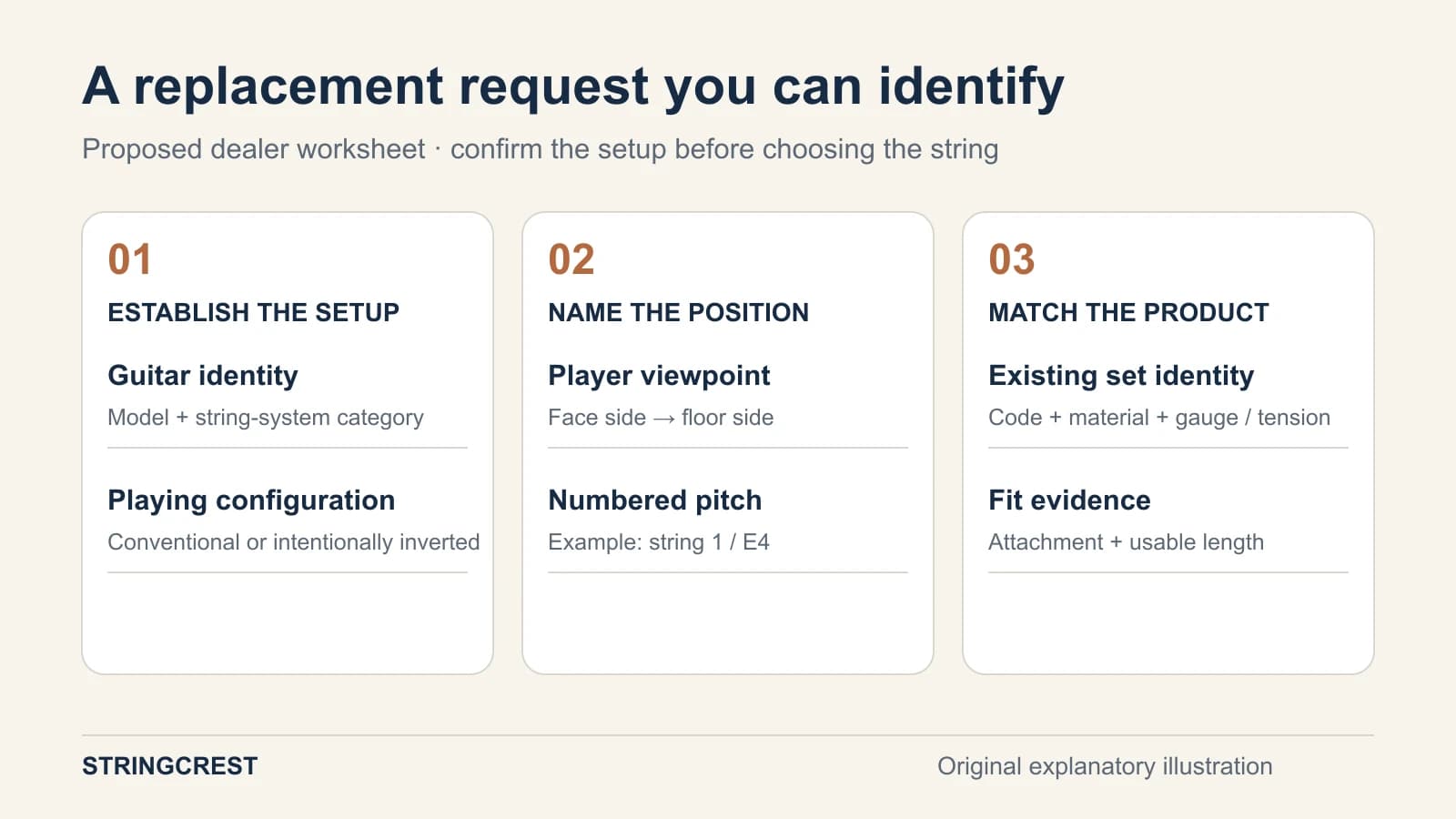
The following is a proposed dealer worksheet, not a completed inspection or a published StringCrest specification. Complete it from the instrument, its maker's guidance and the identified set. Keep uncertain fields unresolved until they can be checked.
| Check | What to write | What it prevents |
|---|---|---|
| Guitar identity | Maker, exact model, string-system category | Selecting by appearance alone |
| Playing configuration | Conventional left-handed, conventional right-handed, or intentional inverted order | Treating every left-handed player as the same setup |
| Viewpoint | Player's face side to floor side | Ambiguous left/right and top/bottom directions |
| Position requested | String number plus note and octave | Confusing low E with high E |
| Product identity | Set code, material, gauge or tension designation, attachment | Assuming pitch names define the product |
| Fit evidence | Existing installation details and any maker restrictions | Assuming orientation proves fit |
If the customer needs a complete set, record all six positions. If only one string is needed, retain the parent set code so future staff can identify the construction. Never infer the third string's plain or wound construction from its G3 pitch alone.
For a private-label range, number the inner envelopes consistently with the outer chart. An optional orientation illustration should show which side faces the player. A left-handed diagram can accompany an otherwise unchanged six-position specification when the actual material, dimensions and fit requirements are the same; confirm that equivalence before reusing the product record.
FAQ
Does a left-handed player need specially handed strings?
Handedness alone does not specify a different string material or gauge. Match the intended guitar system, tuning, six-position construction, attachment and usable length. Verify any unusual bridge or tuner arrangement separately. The instrument's configuration and the string product are related checks, not interchangeable descriptions.
Why does a left-handed photo appear to show E–B–G–D–A–E?
The picture may be read from string 1 toward string 6, show an intentional inverted arrangement, or have been mirrored. State the direction and identify the numbered pitches before deciding whether anything is wrong. A note sequence without a viewpoint is incomplete.
Should a dealer reverse an unfamiliar guitar's strings immediately?
No. First confirm the player's intended arrangement and the maker's requirements. A conversion may involve instrument work. A replacement-string sale should not become an unassessed repair operation.
Conclusion
Use string number and sounding pitch as the stable identifiers: conventional standard tuning runs 6-E2 through 1-E4. Use player-view anchors to explain physical placement, and record intentional upside-down arrangements explicitly. Refer instrument conversion questions for a separate assessment.
For a proposed StringCrest project, provide the exact guitar type, six-position requirements, orientation photographs and current reference set. Discuss the numbered string specification before preparing packaging or ordering samples.
FROM GUIDE TO PRODUCT
Connect this guide to StringCrest product ranges.
Review the relevant range, then bring the instrument, complete specification and open questions into one project brief.
YOUR PRODUCT · YOUR BRAND
Discuss your next string project with Frank.
Share your instrument category, target market, gauge or material direction and private-label packaging requirements.

ABOUT THE AUTHOR
Frank Zou
Frank works directly with musical-instrument brands, importers and distributors on string specifications, product selection and private-label project requirements.
Meet Frank