
Buying Guides
Guitar String Guides
Guitar String Color Codes: A Dealer Identification Guide
Identify the scope of a guitar string color chart, separate markers from specifications, and handle ambiguous loose strings with a written identity record.
Introduction
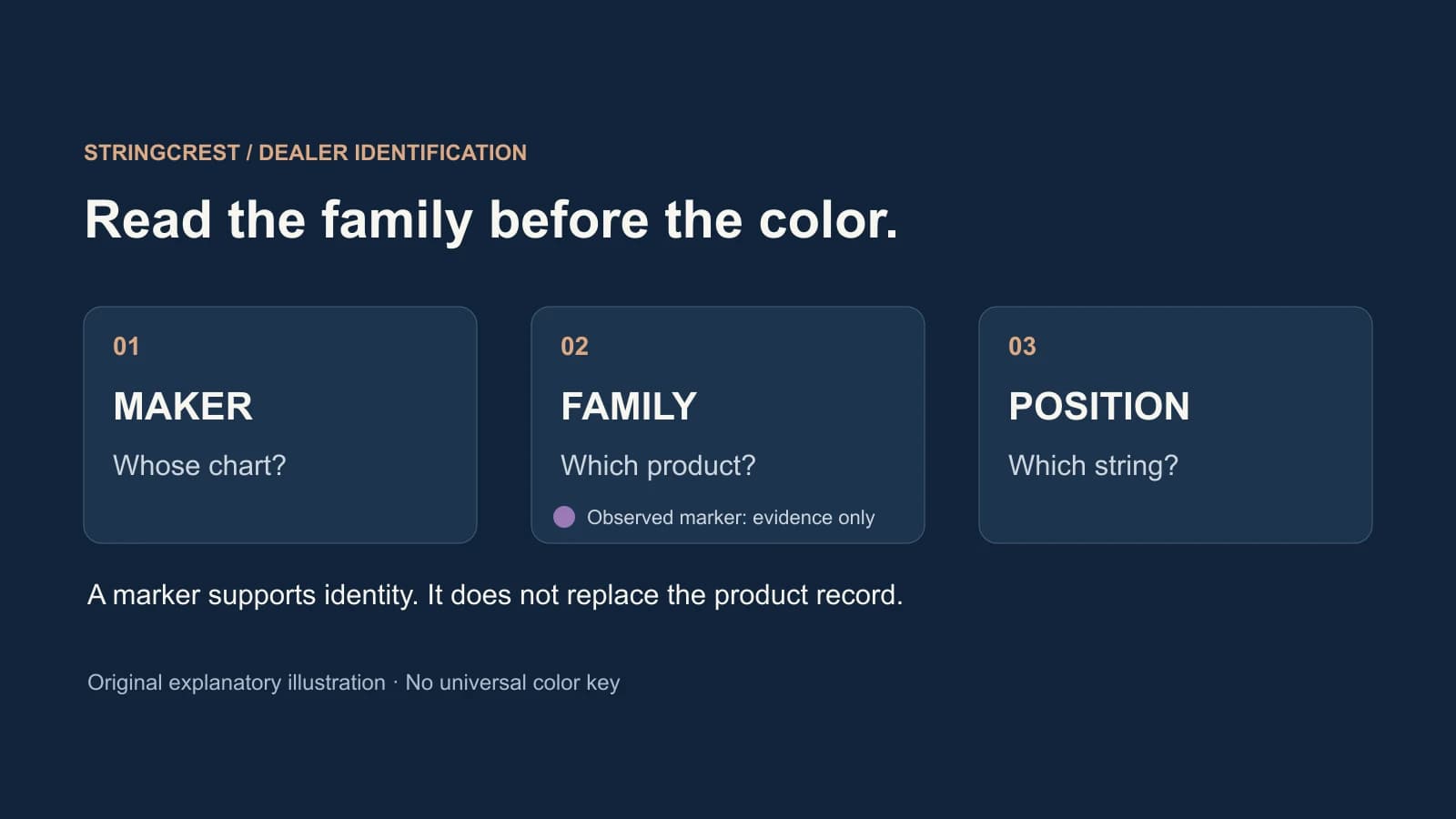
A guitar string color code identifies a position only within the manufacturer's applicable chart. Start with the maker, product family and packet before reading the ball-end color. A familiar six-color sequence is useful for some sets, but another family from the same manufacturer can use a different sequence. Color alone cannot confirm gauge, alloy, coating or authenticity.
For a music retailer, this becomes a practical problem when a customer brings in a loose replacement, an opened packet contains mixed strings, or staff split a set into singles. The aim is to keep each component connected to its documented identity. This guide gives dealers a reference example and a compact decision process for accepting or holding that identification.
It covers ball-end markings on guitar strings. The acoustic guitar string category and electric guitar string category are starting points for a specification discussion. These examples do not define a color scheme for StringCrest, and a colored end does not establish whether a string fits a particular bridge.
Begin with the family, then use its chart
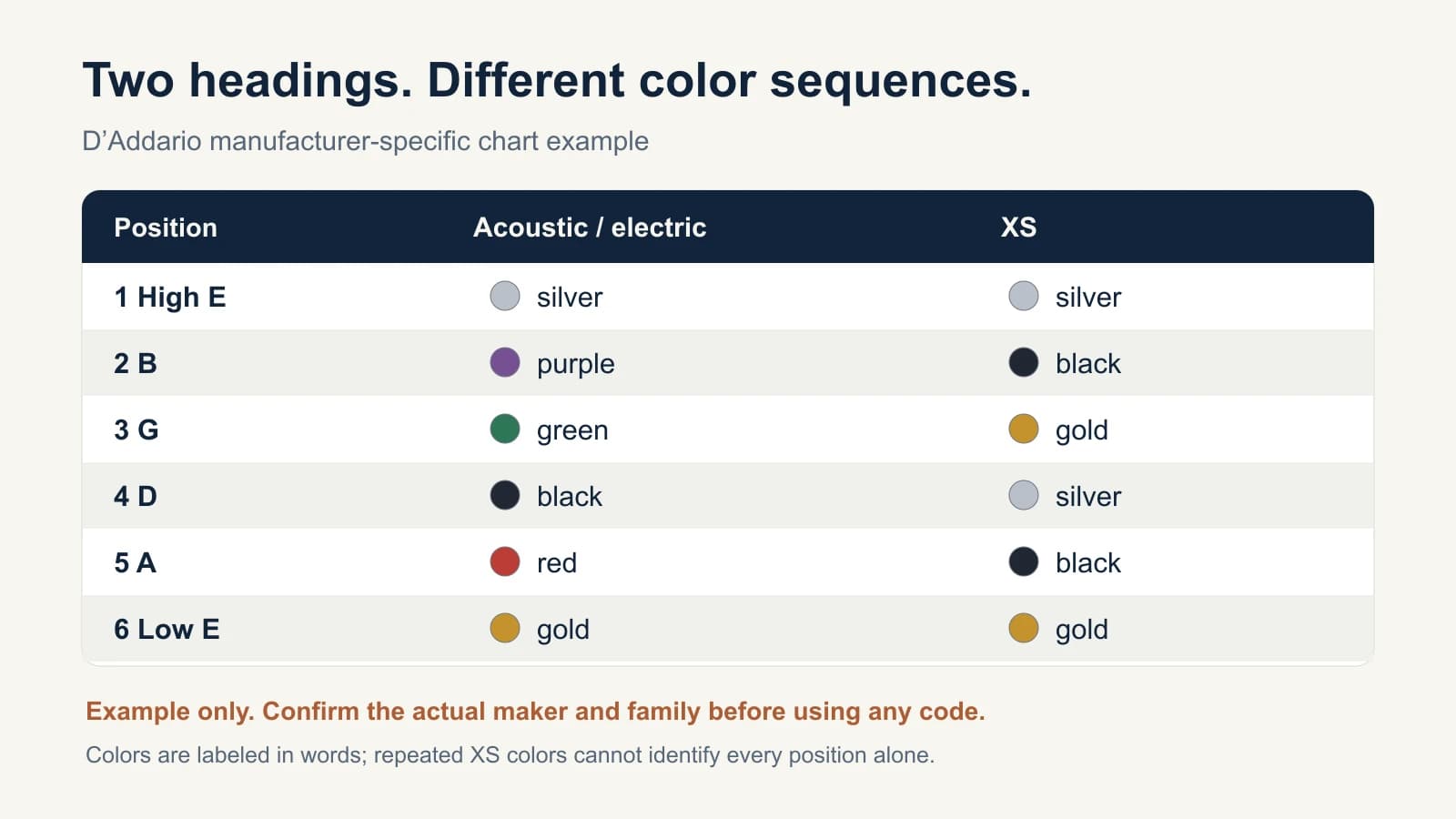
D’Addario's official ball-end color reference lists an acoustic/electric sequence and a separate XS sequence. The comparison below is deliberately limited to those headings on that reference, checked on October 22, 2026. Check the packet and applicable current guidance for the specific product in hand, particularly for variants outside a standard six-string set.
The table runs from string 1 to string 6. The two E positions are different strings; the position number prevents the letter alone from creating ambiguity. The note labels describe the usual six-string positions, not instructions to tune an unidentified component.
| Guitar position | Acoustic/electric heading on the cited chart | XS heading on the cited chart |
|---|---|---|
| 1 — high E | Silver | Silver |
| 2 — B | Purple | Black |
| 3 — G | Green | Gold |
| 4 — D | Black | Silver |
| 5 — A | Red | Black |
| 6 — low E | Gold | Gold |
The manufacturer example answers two useful questions. A black ball end does not always point to the fourth string, and a single family can reuse a color at different positions. With the XS sequence shown here, color by itself cannot distinguish positions 1 and 4, 2 and 5, or 3 and 6. Written position information and the identified contents remain necessary.
Keep the chart's scope beside any staff copy. A cropped image that loses the family heading can turn a correct reference into misleading counter advice. This is an attributed example, not an industry standard or a StringCrest production specification.
Separate the marker from the string's specification
The colored part may serve as a position marker. The string still has its own gauge, core, wrap material, coating and attachment construction. Recognizing the marker resolves only the field that the applicable chart actually defines.
For example, locating the second-string position does not tell a dealer which gauge from that family was purchased. Nor does a gold-colored ball prove that the wound portion is a bronze alloy. Keep the end's appearance separate from the material description on the product record.
A ball end also has a physical job at the instrument. Color does not supply its dimensions or establish the approved installation route. Use the guitar end and bridge-fit guide when the question concerns the anchor or bridge. Do not modify an uncertain end just to make it match an identification guess.
This distinction helps staff ask the next useful question. If the maker and family are known but gauge remains unknown, request the set code or inner envelope. Repeating a clearer photograph of the same color will not recover an absent gauge specification.
Use a short counter decision process
First, record what is actually available: a sealed product, an opened packet, a labeled single or a loose string. Ask whether the customer needs the intended position, a matching replacement SKU, or a response to a possible packing error. Those requests need different levels of evidence.
Next, connect the component to a product family. Retain the outer packet and any inner labels. An opened packet is a clue with a handling history; it may contain a string from another set. If its identity is uncertain, say so before applying a chart.
Then compare the marker with the correct reference and the written position. Look for agreement across the component, packet and product record. When they disagree, hold the identification for review. Do not pick whichever evidence makes the stock easiest to sell.
| Evidence available | What the dealer can establish | What still needs checking |
|---|---|---|
| Identified family, labeled component and matching chart | The documented position is consistent with its marker | Gauge and other variants against the product code |
| Family known; colors repeated within its chart | A limited group of possible positions | Written position or reliable component reference |
| Loose string with a familiar color | The visible appearance of that end | Maker, family, position and specification |
| Packet and physical marker disagree | An identification mismatch exists | Contents, reference scope and handling history |
This is a proposed support process, not a report of inspected stock. Keep unverified components separate from confirmed saleable inventory under the dealer's own returns policy. A reasonable technical question can remain unresolved without inventing a product identity.
Planning an identification system for your guitar string range? Send your instrument types, position labels, set structure and packaging requirements. Include an existing chart or sample reference if one has already been approved.
Photograph the evidence without losing the connection
Make one overview showing the packet beside the component, then a close view of the marked end. Use neutral lighting and keep the original images. Strong warm light or heavy editing can change the apparent distinction between nearby colors.
Label the views so another person can tell they show the same item. If several strings are being compared, give each a temporary reference and keep it with its own packet. An attractive pile of mixed coils is poor identification evidence because the relationship between each end and each label is lost.
A photograph can help interpret a visible marker. It cannot prove the core material, recover an unknown product history, or authenticate a product on its own. Request the missing documentation directly when those are the actual support questions.
Design private-label identification around written identity
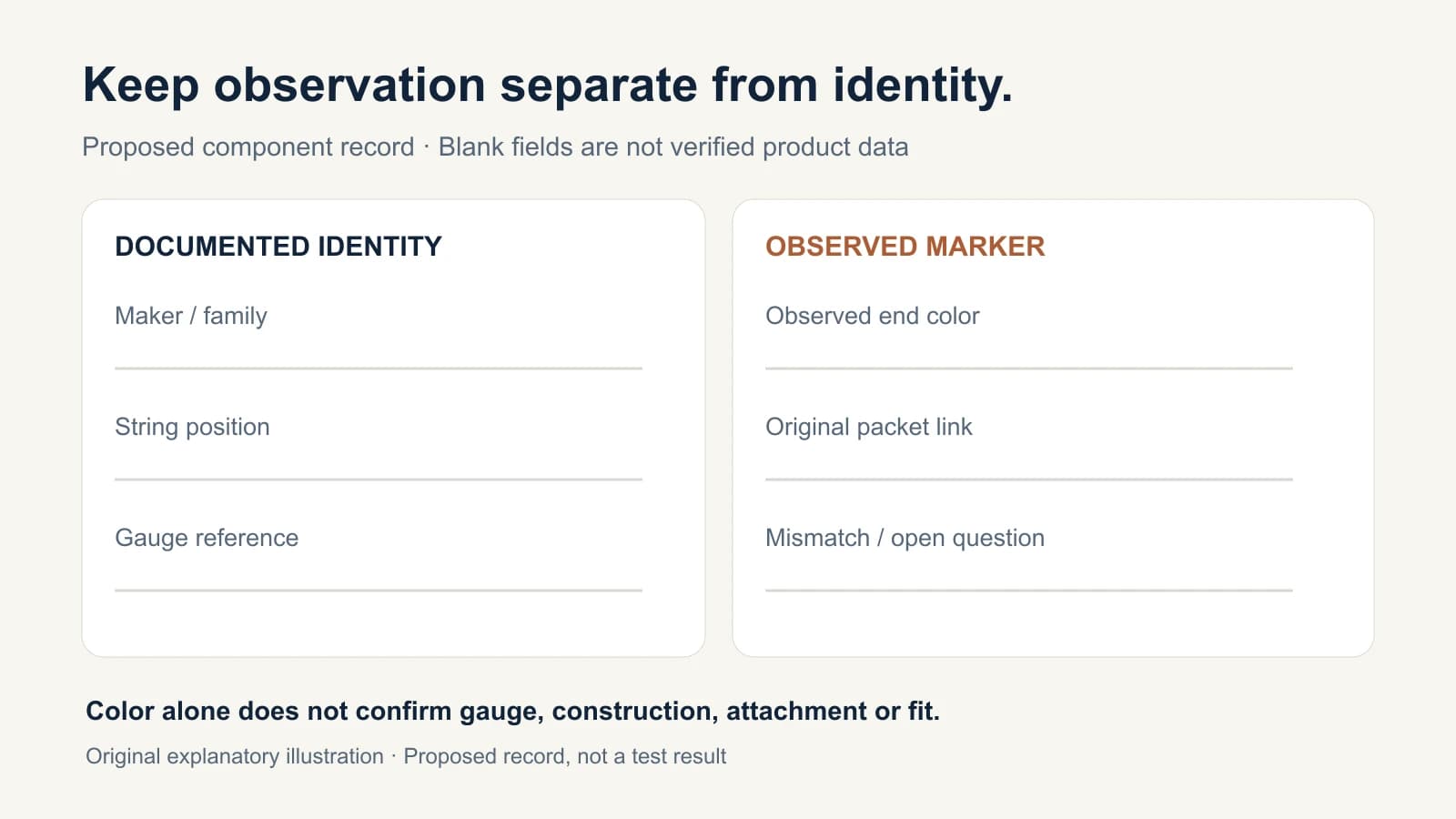
For a new private-label range, agree a component record before choosing decorative colors. Give each string a position number, the relevant set or single-string code, and the variant fields needed to distinguish it from nearby products. If the intended pitch is printed, state the tuning context where ambiguity matters.
An optional color scheme should support that written system. Define where the color appears and whether it means position, product family or another field. Confirm the scope in the artwork and product references. Reusing a color is workable only when staff have another reliable way to distinguish the affected items.
Make the picking reference usable without color perception alone. Written numbers and product codes help under poor lighting, in monochrome printouts and when a user cannot distinguish the chosen colors. Do not rely on the arrangement of unlabeled colored circles as the entire instruction.
When reviewing a packaging proof, compare the inner label with the outer set identity and physical sample reference. A barcode resolves a different part of the job. The barcode artwork checklist covers encoded product identity and print proofing; it cannot establish that a loose string inside the packet matches its marker.
Keep a dated version of the agreed reference for each relevant product. If a color, component or label changes, review the connected artwork and dealer instructions together. An old chart may still explain an older packet, but it should not silently approve a changed configuration.
FAQ
Does a guitar string's ball-end color tell me its gauge?
Use the exact maker's documentation. The example above maps colors to positions within specified chart headings; it does not provide a universal gauge key. A set code or component specification is needed to identify the actual gauge.
Can I apply a guitar chart to bass or violin strings?
Use an instrument-specific reference. A familiar color does not carry its interpretation into another instrument family. The violin identification guide addresses peg-end and tailpiece-end markings separately.
What should I do with an unidentified loose string?
Record its appearance and available history, seek the relevant packet or product reference, and retain an unverified status if the evidence is insufficient. Measuring a diameter may support a review, but it does not independently establish maker, family or all construction details.
Conclusion
A useful color-code answer names the manufacturer and family, identifies the chart's scope, and shows which product fields remain unresolved. Keep the marker connected to written identity at the counter and in the warehouse. Where that connection is missing, resolve the evidence before recommending a matching replacement.
Developing clearer labels for sets or replacement singles? Send your product list, proposed position markings and sample or artwork references to discuss an identification brief tied to the actual order.
FROM GUIDE TO PRODUCT
Connect this guide to StringCrest product ranges.
Review the relevant range, then bring the instrument, complete specification and open questions into one project brief.
YOUR PRODUCT · YOUR BRAND
Discuss your next string project with Frank.
Share your instrument category, target market, gauge or material direction and private-label packaging requirements.

ABOUT THE AUTHOR
Frank Zou
Frank works directly with musical-instrument brands, importers and distributors on string specifications, product selection and private-label project requirements.
Meet Frank