
Specifications & Fit
Buying Guides
Drop D Guitar Strings: When to Change One String or the Whole Set
A dealer decision guide for retaining a working set, comparing one sixth string or assessing a complete replacement for Drop D.
Introduction
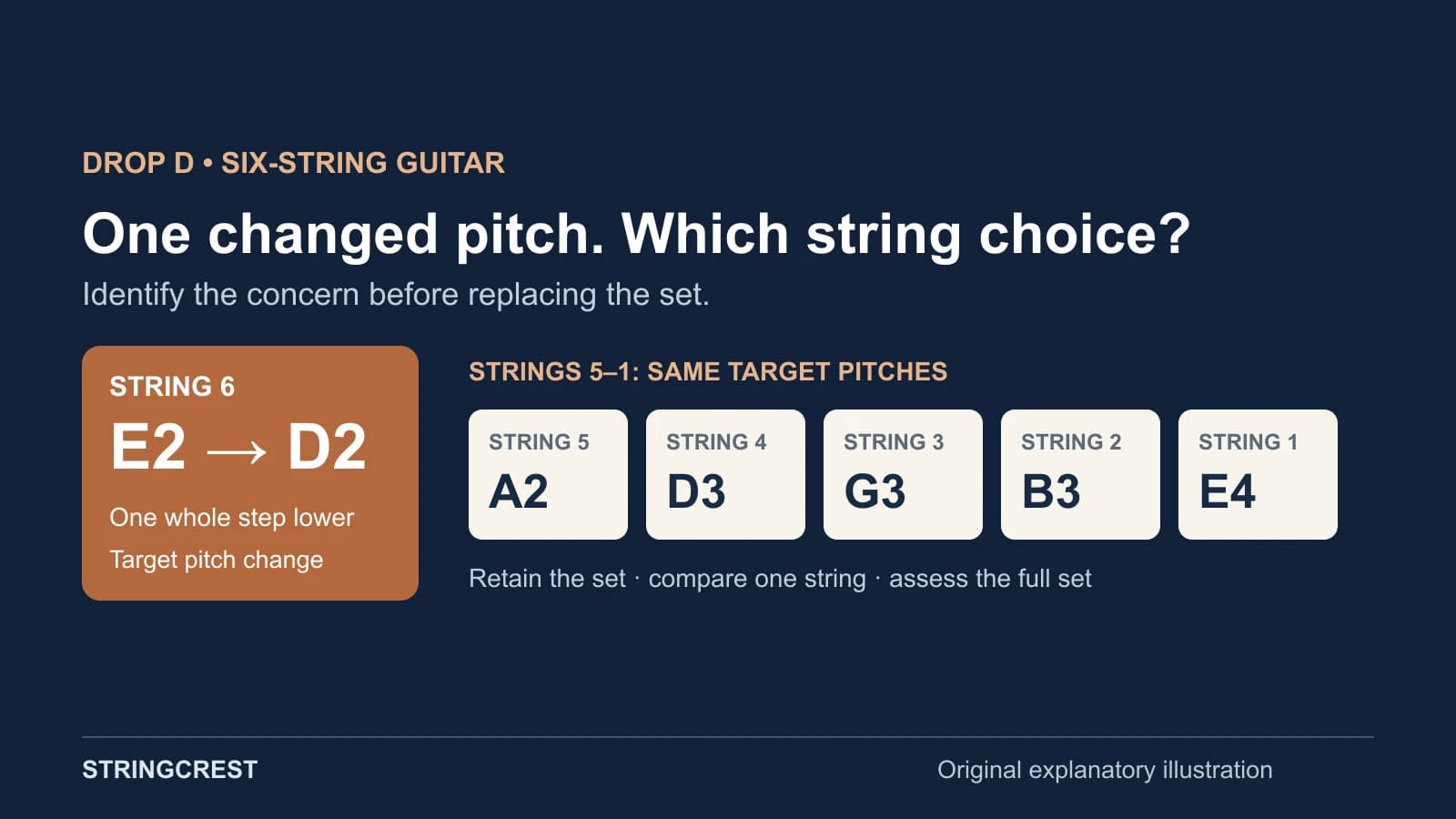
Drop D guitar strings do not always need to be a different set. On a conventional six-string guitar, Drop D lowers only string 6 from E2 to D2; strings 5 through 1 retain the standard tuning targets A2, D3, G3, B3 and E4. If the existing set is correctly fitted, in usable condition and comfortable for the player's Drop D passages, a dealer may have no string change to recommend. If the concern is confined to the low D, evaluate that position before changing five strings the player already likes.
The useful counter question is therefore: retain the set, evaluate a different sixth string, replace the whole set, or refer the instrument for setup assessment? That decision depends on the actual guitar, installed product and intended use. This guide concerns conventional six-string steel-string acoustic and electric guitars; classical, baritone and extended-range instruments need their own product context.
Identify which D tuning the customer means
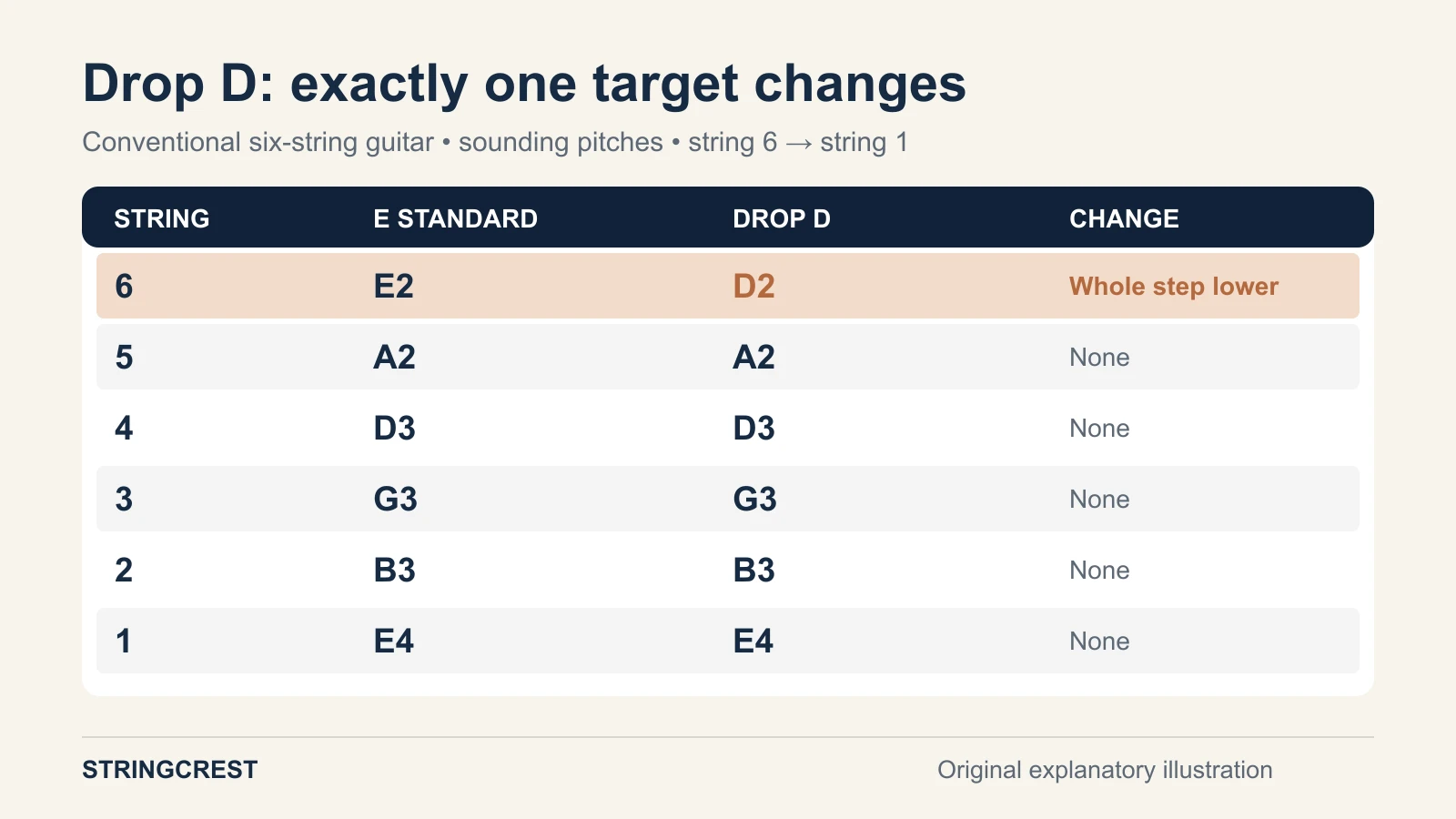
Write pitches in string-number order. The following map runs from string 6 to string 1, normally lowest to highest sounding pitch. Octave numbers identify the register, so the low D2 is not confused with the existing fourth-string D3.
| String number | E standard | Drop D | Intended change |
|---|---|---|---|
| 6 | E2 | D2 | Lower one whole step |
| 5 | A2 | A2 | None |
| 4 | D3 | D3 | None |
| 3 | G3 | G3 | None |
| 2 | B3 | B3 | None |
| 1 | E4 | E4 | None |
Fender's Drop D explanation confirms the single-position change. Ask the customer to show the intended tuning or a reliable reference rather than accepting “in D” as a complete specification.
D standard lowers all six strings a whole step: D2, G2, C3, F3, A3, D4. Conventional open D major uses D2, A2, D3, F#3, A3, D4. Both differ from Drop D, even though their lowest note is also D2. These distinctions agree with the named rows in D'Addario's alternate-tuning chart. Its listed product examples are that manufacturer's recommendations, not a universal gauge recipe.
If the customer's actual goal is C2, G2, C3, F3, A3, D4, use the separate Drop C specification guide. A Drop D sales label should not be used to cover every lower tuning.
Start with the set that is already installed
Record the complete set reference and the guitar's speaking scale—the vibrating length between nut and saddle—and bridge type. Ask whether the player normally stays in Drop D or switches back to E standard. Then establish what is unsatisfactory: the sixth string's response, the condition of the whole set, pitch movement on several strings, or a general desire for a different playing feel.
A usable existing set provides a practical reference. Ask the player to demonstrate the actual passage and describe what changes when the sixth string is lowered. A quieter acoustic passage and a forceful electric rhythm part are different evaluation tasks; genre names alone do not identify the customer's preference.
D'Addario's Drop D guide explains that an existing set can be suitable depending on the setup, and discusses changing the sixth string while retaining familiar choices elsewhere. Treat that as support for considering alternatives, not proof that a particular diameter will suit every guitar.
Lowering a given string's pitch at the same speaking length reduces its tension. Whether the resulting response is acceptable is a separate playing judgment. Avoid turning “it feels loose” into an unmeasured force value or a diagnosis that the string is defective.
Choose the smallest useful product change
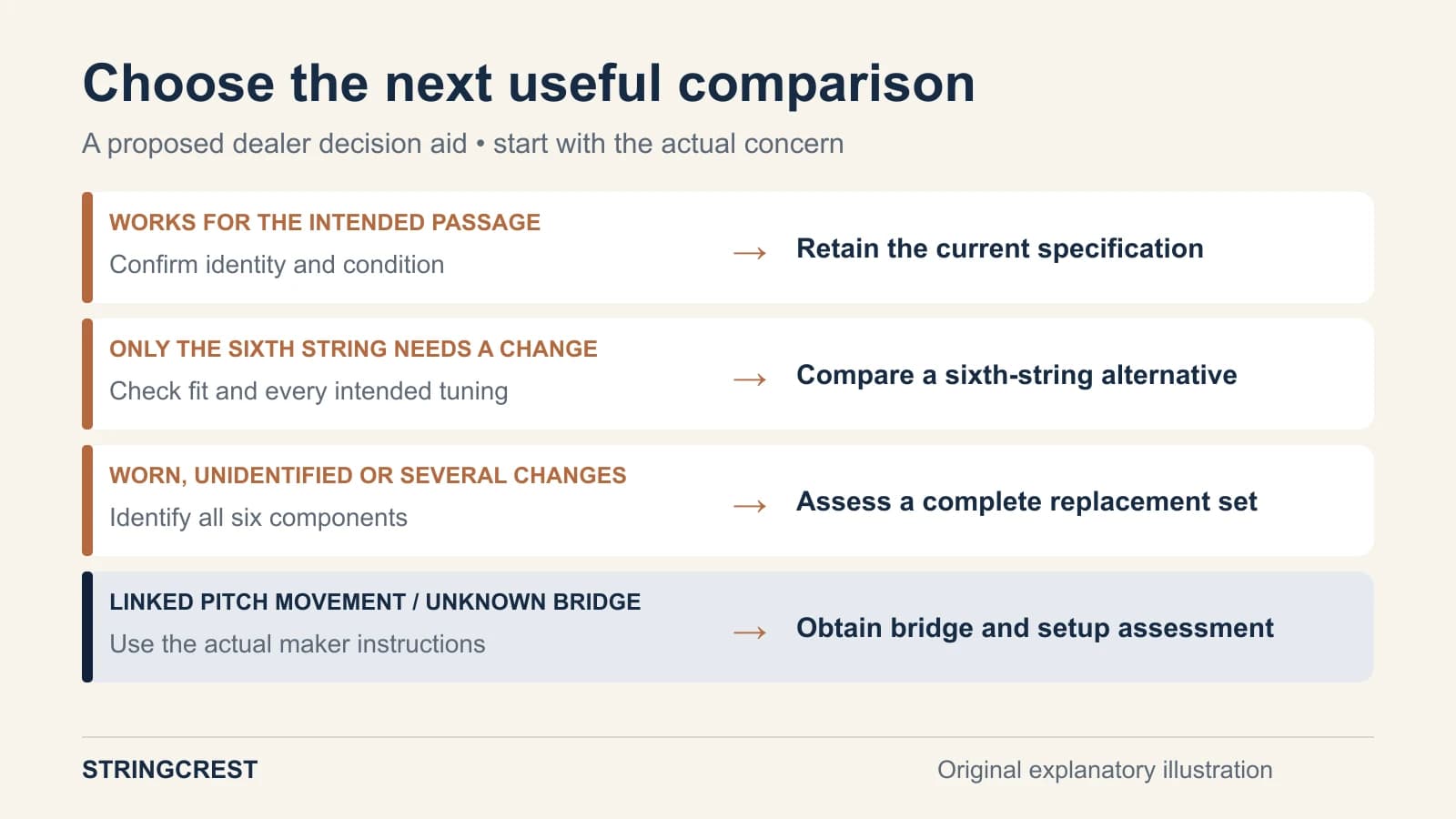
| What the dealer establishes | Candidate next step | What still needs checking |
|---|---|---|
| Existing set works for the intended Drop D passages | Retain the current specification | Correct tuning, condition and repeatable playing result |
| Strings 1–5 suit the player; only the sixth needs a different response | Compare a suitable sixth-string alternative | Construction, fit and response in every intended tuning |
| The set is worn, unidentified or several positions need to change | Evaluate a complete replacement set | All six components and the instrument's setup requirements |
| Several pitches move as one string is retuned, or hardware behavior is unclear | Obtain bridge and setup assessment | Actual bridge model, configuration and maker instructions |
A full replacement can be appropriate even when only one target pitch changes: the current set may be due for replacement, or the customer may deliberately want a different response across the instrument. State that reason instead of presenting a whole-set change as inherent to Drop D.
For a sixth-only comparison, identify the existing component as well as the candidate. Match the required instrument category, attachment and usable length. Gauge is one field in that comparison, not a complete product identity. A string that fits a steel-string acoustic application is not automatically the right magnetic-pickup electric component.
If the customer also uses E standard, assess the candidate at E2 as well as D2. A choice made for one setting should not be described as equally comfortable in the other without that comparison. Preserve what the player wants from the unchanged five strings when discussing a mixed-gauge or hybrid option.
Check the bridge before promising a quick switch
“One target pitch changes” describes the tuning map. It does not promise that every guitar reaches that map through one isolated adjustment. On a floating tremolo, changing one string's tension can affect the other strings' pitches because they share a moving bridge system.
Floyd Rose's official tuning instructions require repeated checks across the strings and a bridge-balance review when changing tuning or gauge. That is maker-specific guidance for the identified system. Use the correct guitar and bridge instructions; do not copy its adjustments onto unrelated hardware.
Ask whether the bridge is floating, fixed, or configured differently from its original arrangement. If staff cannot identify the configuration, refer the instrument before promising rapid E-to-D switching or recommending a heavier sixth string as a cure. Locking hardware also needs its own permitted tuning procedure.
A fixed bridge removes that particular shared moving-bridge issue, but it does not establish that every gauge will fit or that no setup review is needed. If a changed component produces unwanted fretted pitch behavior, use the post-change intonation assessment guide rather than adding another speculative gauge change.
Turn the comparison into a clear reorder
A store's selected option needs an identity another employee can reproduce. Keep the full set reference, the sixth-string replacement reference if one was used, and the approved tuning description together. An endpoint label such as a first-to-sixth gauge range does not identify the four intermediate components.
For a private-label brief, name the intended customer use: mostly Drop D, or regular switching with E standard. List the candidate configuration and what the sample review should determine. The custom-gauge specification guide covers the complete production record; there is no need to rebuild that record around a tuning nickname.
Use precise shop wording, such as “evaluate the sixth-string option on this identified guitar in E standard and Drop D.” Avoid a universal claim that the packet works for all scales, bridges or playing approaches. Keep a customer's preference separate from a measured specification or a general promise on the shelf label.
FAQ
Can a low D that feels loose prove the whole set is wrong?
No. It identifies a concern at one position under the stated tuning and playing task. Confirm product identity and setup, then decide whether a component comparison would be useful. The other five strings may already meet the player's needs.
Should a dealer stock only a dedicated Drop D set?
That depends on the customers and service model. Existing sets, separately identified singles and a defined complete-set option serve different requests. Review actual inquiries and demand for singles before adding a new reference.
Does a Drop D label confirm measured tension balance?
No. It identifies an intended tuning. A numerical balance claim needs the actual components and calculation or measurement conditions, as described in the balanced-tension specification guide.
Conclusion
For Drop D, establish the six pitches first, then decide what product question remains. Retain a working specification, compare a sixth-string alternative when the concern is isolated, or evaluate a complete set when the condition or intended response calls for it. Identify bridge behavior before making switching promises.
Review the electric guitar string category and Send Your Requirements with the installed set, intended tuning pattern and comparison goal. StringCrest can discuss customer requirements without treating a tuning name as a confirmed product specification.
FROM GUIDE TO PRODUCT
Connect this guide to StringCrest product ranges.
Review the relevant range, then bring the instrument, complete specification and open questions into one project brief.
YOUR PRODUCT · YOUR BRAND
Discuss your next string project with Frank.
Share your instrument category, target market, gauge or material direction and private-label packaging requirements.

ABOUT THE AUTHOR
Frank Zou
Frank works directly with musical-instrument brands, importers and distributors on string specifications, product selection and private-label project requirements.
Meet Frank