
Wholesale Planning
Specifications & Fit
Fretless Bass Strings: A Fingerboard and Dealer Recommendation Guide
Connect fretless instrument requirements to a candidate surface and an explainable dealer recommendation.
Introduction
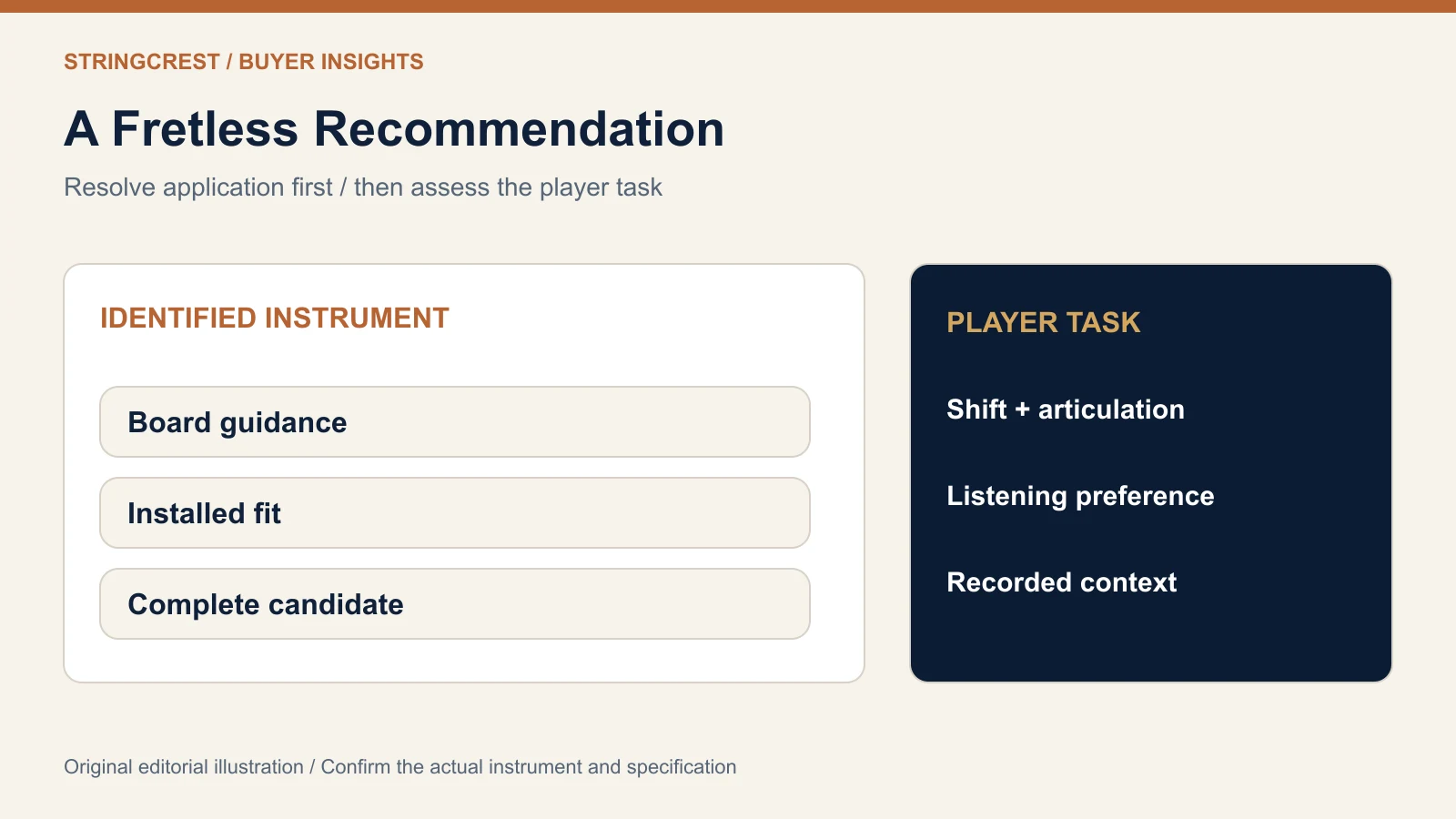
Choose fretless bass strings by the actual instrument’s fingerboard guidance, the complete installed-fit requirements and the player’s intended feel and sound. A smooth surface can be a useful candidate, but it does not establish damage-free service life or universal suitability. Review the identified bass before recommending a set, then keep playing observations separate from fingerboard-condition observations.
For a bass retailer, “What strings should I use on a fretless?” is an application question. The reply needs more than a surface label. A customer may value smooth shifts, a particular attack or a familiar replacement, while the instrument has requirements that must also be respected.
This guide helps dealers and private-label buyers prepare a recommendation that can be explained and reviewed. It adds a fingerboard-specific assessment to the construction and length questions covered elsewhere. The proposed records and demonstrations are editorial suggestions, not StringCrest wear testing, customer case histories or guarantees.
Start with the particular fretless instrument
Record the maker and model, string count, intended tuning and current complete set. Ask whether the fretless configuration is original or modified, and whether the player has reliable instrument guidance. A converted instrument should not automatically inherit instructions written for its original fretted version.
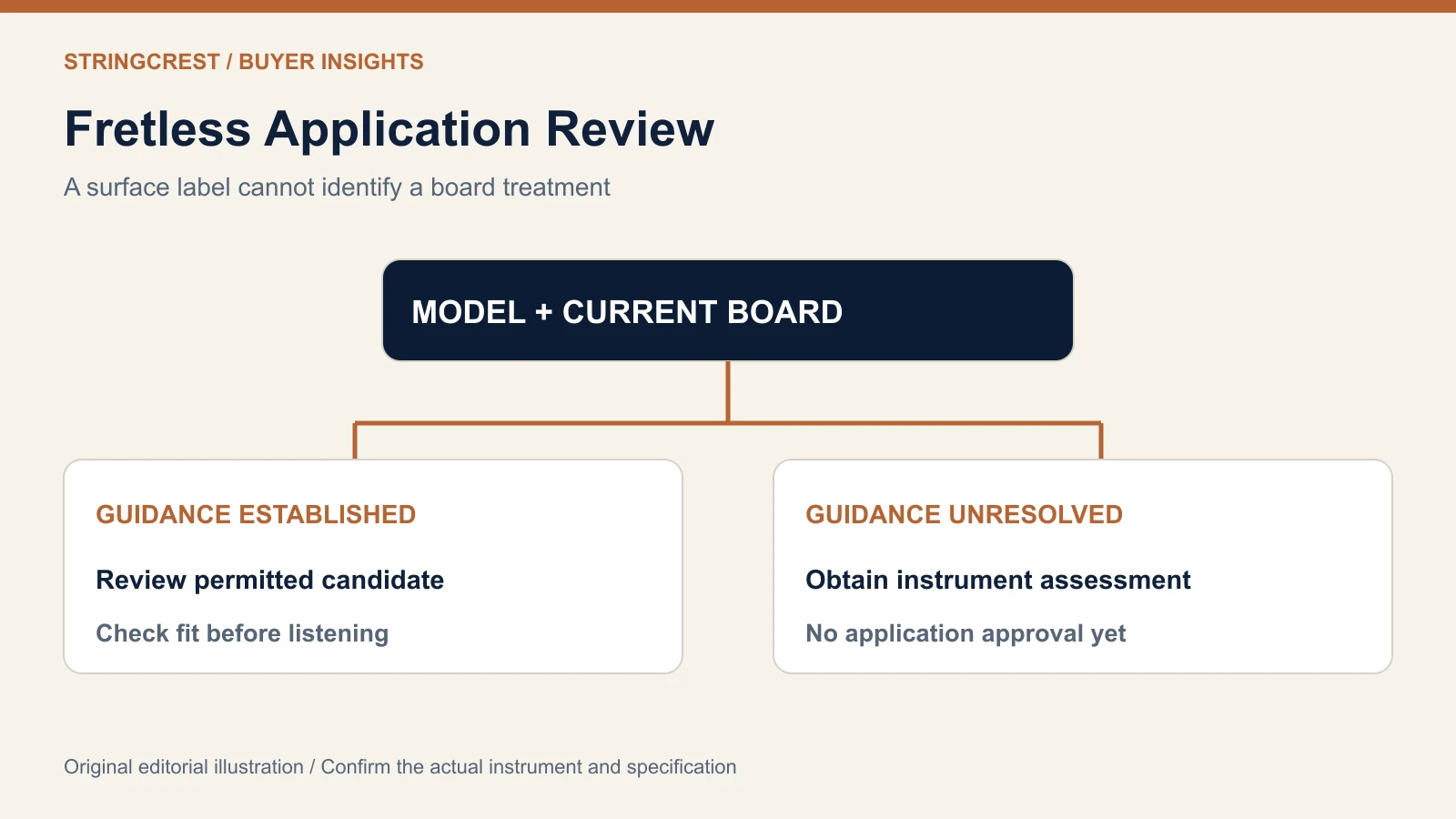
Include the fingerboard material and any documented surface treatment when those are known. A photograph may help identify the instrument, but do not infer an exact finish or treatment from appearance alone. If an important detail is unavailable, ask the maker or a qualified instrument specialist before presenting a surface recommendation as approved.
Keep the distinction between a replacement and a new experiment explicit. Replacing an identified accepted set and trying a different surface need different conversations. The first begins with its exact reference; the second needs a proposed candidate and an agreed assessment scope.
For a converted fretless bass, ask the specialist to identify the current board condition and the requirements applicable to the modified instrument. The original model name remains useful for identification, but it may not describe the present surface or setup. Preserve any assessment or maker correspondence with the proposed candidate so another member of staff can understand the basis of the recommendation.
If that information cannot be established, limit the conversation to collecting the brief and explaining the candidate differences. Do not complete an application approval by substituting a general statement about smooth strings. The retailer can still help the customer identify the missing instrument information and arrange the appropriate assessment.
Ask what the customer is trying to change. “Less noise when shifting” and “more attack in the band mix” are useful starting points. They should lead to a listening task and a preference record, not an unsupported assertion that a winding family always delivers the same result.
Use surface guidance without turning it into a guarantee
Fender’s Bass Strings 101 describes flatwound strings as smoother than roundwounds and less abrasive to fingerboards. It presents them as a common fretless choice. This is a qualitative construction comparison, not a numerical wear result for every fingerboard and playing method.
A retailer can explain why a smoother surface deserves consideration while still checking the actual instrument guidance. Avoid statements such as “these cannot mark the board” or “these protect it for years.” Those claims require evidence this article does not provide.
The maker’s guidance and the customer’s preference have different roles. A preferred sound does not establish that a proposed string meets the instrument requirements. Conversely, an appropriate surface may still feel or sound different from what the player wants. Discuss both before the customer commits to a change.
If the condition of the board is uncertain, have it assessed before using a new set to draw conclusions about wear. Existing marks should not be silently attributed to the next product. Keep the initial observations available for the person responsible for the instrument.
Compare candidates by the question they answer
Construction guides help identify what a product is. For a fretless recommendation, add the instrument-specific acceptance question and the player’s task. The following framework organizes candidate discussions; it is not a list of confirmed StringCrest stock items.
| Candidate surface family | Useful discussion | Limit to keep visible |
|---|---|---|
| Flatwound | Smooth contact feel and the actual bass’s permitted construction | A smooth exterior does not prove zero wear |
| Roundwound | The player’s preferred attack and the maker’s guidance for that fingerboard | Preference does not demonstrate board suitability |
| Half-round or a related processed surface | The supplier’s exact surface definition and sample feel | Similar naming does not establish identical construction |
| Tapewound | The complete construction, external diameter and instrument fit | An outer tape layer is not a complete set specification |
Our flatwound versus roundwound bass guide covers the construction and assortment comparison. Use that information alongside the board-specific questions here rather than repeating a generic tone ranking at the counter.
The half-round bass guide explains why a processed surface needs its own definition. A retailer should request a candidate reference before discussing how that surface will feel on the player’s instrument.
For a tape-covered candidate, consult the tapewound bass guide for the complete construction and fit brief. Do not substitute a general observation about nylon instruments or plain nylon strings for the details of a bass product with an outer covering.
Verify installed fit before judging the playing result
Record the actual end-to-nut path, bridge routing and tuner requirements relevant to the bass. Keep those measurements attached to the candidate specification. A nominal scale label alone does not resolve where the usable winding and transitions will lie when installed.
The bass string scale and installed-length guide separates those questions. Use it when the customer identifies the bass by scale alone. The correct listening comparison starts with a correctly specified and installed candidate.
Check every position, including a low or high extension on an instrument with more strings. Do not assume that a four-string packet’s suitability automatically applies to another set in the same family. Each candidate needs a complete position record and the actual configuration.
Keep diameter, construction and fit distinct. If a proposed surface changes the external diameter, refer the relevant nut and hardware fit questions to the appropriate specialist. Do not tell the customer to enlarge a slot simply to make an unreviewed product fit.
An uncertain attachment or transition location should pause the demonstration. Record the reason and request the missing information before cutting or tuning the string. A completed installation is not useful evidence if nobody can identify which requirement it met.
Record the fingerboard condition before the sample
With the owner’s agreement, make a clear record of the board’s visible condition before installing a candidate. Identify the instrument and capture relevant areas using consistent lighting and a view that can be repeated. These are observations, not a material-hardness test or an estimate of remaining service life.
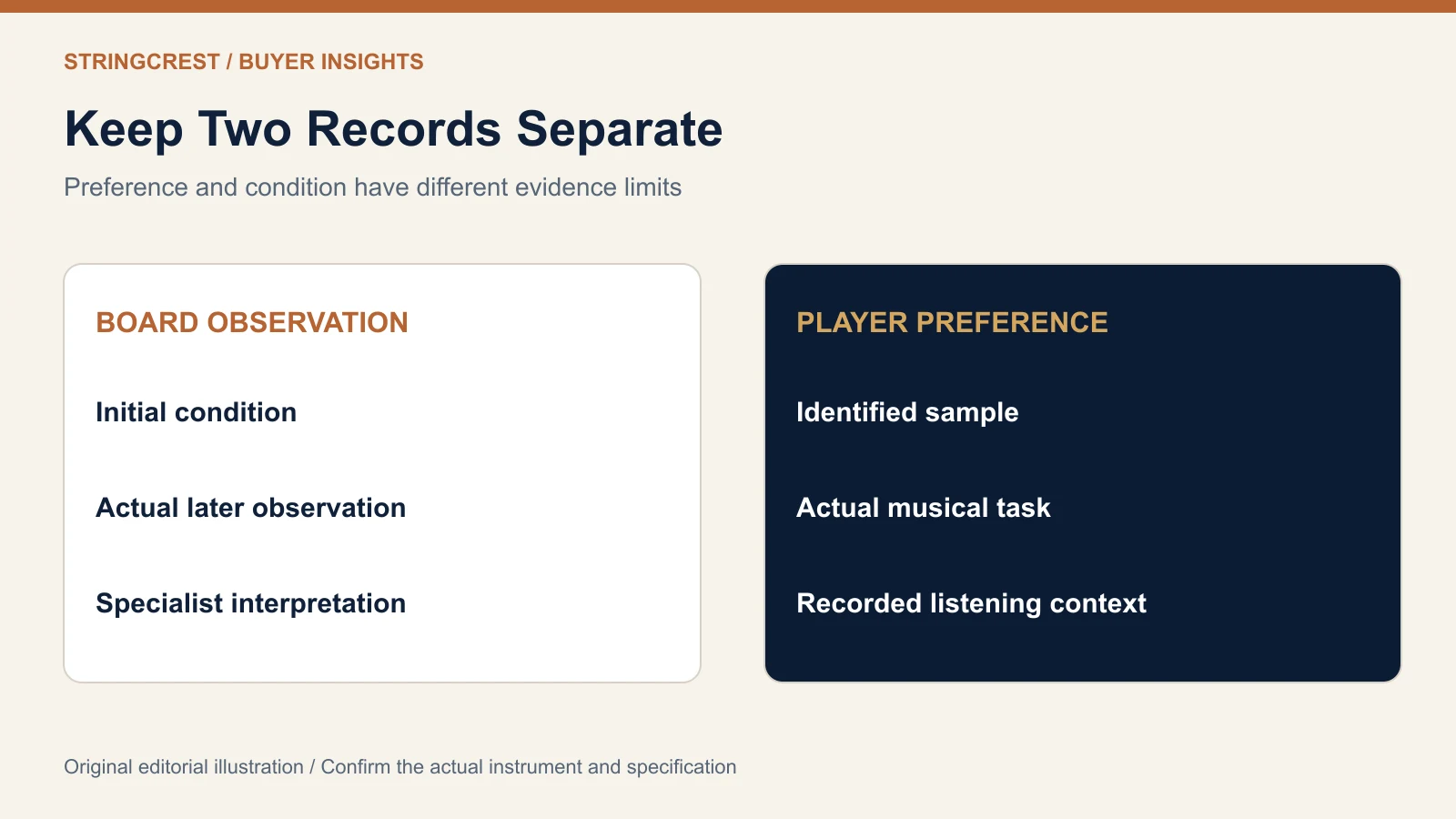
Distinguish marks that were already present from anything reported later. If a photograph cannot establish that distinction, say so. A confident cause statement should not come from changing shadows or a comparison between unrelated instruments.
Let a qualified specialist interpret concerns about damage, finish or wear. Retail photographs can preserve context, but they do not determine the board’s treatment or diagnose the cause of a mark. If the specialist recommends service, resolve that requirement before continuing a preference demonstration.
Avoid describing a short sample session as long-term wear approval. The record should state the actual observation interval and playing task only when those are known. Do not convert a brief check with no visible change into a forecast for months of use.
For a distributor’s sample plan, decide who is responsible for the instrument condition review and who records the player feedback. Those responsibilities can belong to different people. Keeping their observations distinct lets a purchasing team understand what was actually assessed.
Give the listening task enough context
Use the actual instrument and a defined passage that reflects the customer’s playing. Record the pickup settings, amplification and relevant effects. If the task concerns shifting noise, include the intended shift. If it concerns attack, use the articulation the player normally employs.
Fretless pitch depends on where the player stops the string. Do not treat a changing stopping position as a direct measurement of the candidate’s construction. Keep the player and task context with any listening observation so the evaluator understands what was compared.
For a candidate comparison, avoid changing multiple recording conditions at once. If an adjustment is needed, note it and explain which result belongs to which condition. This is a practical comparison recommendation, not a controlled scientific claim or a promise of a particular tone.
Record preferences in the player’s terms and attach them to the candidate. “The shift felt easier in this passage” is useful feedback when the passage and set are identified. “The best strings for fretless bass” is too broad to describe that result accurately.
Include any unresolved fingerboard or fit requirement beside the listening result. A purchasing team should not mistake a liked sound for permission to proceed with an application that still needs instrument approval.
Prepare a retail recommendation the customer can use
Explain why the proposed set entered the discussion. The reason might be an identified accepted replacement or a smoother candidate considered under the maker’s requirements. State the basis plainly instead of presenting a surface family as an unconditional endorsement.
Put the exact product reference on the handover record. Include the instrument configuration and relevant installation information. The customer should be able to reorder the accepted set without relying on its color, packet artwork or the phrase “the fretless one.”
Discuss what the customer should report if the experience changes. Ask for the position, playing task and condition observed rather than asking for a general good-or-bad verdict. Do not give an invented inspection interval; follow the applicable instrument guidance and agreed follow-up scope.
Keep unresolved matters visible in the recommendation. If the instrument’s treatment has not been identified, say which specialist is reviewing it. If the player is comparing candidates, distinguish a provisional preference from an accepted replacement specification.
For music-shop staff, use a short decision card with the approved reference and the questions that require referral. It should help a colleague recognize when they can supply a like-for-like set and when a change needs further assessment.
Translate the accepted application into an order record
A private-label buyer should attach the accepted instrument scope to the complete candidate specification. Include each string position, target pitch, construction, external gauge, end fit and usable length. Describe the surface in the supplier’s defined terms and identify the approved sample revision.
Keep subjective preferences separate from inspectable requirements. A sample comment about feel can guide development, but a shipment requirement needs a defined product identity or agreed inspection method. Do not turn the adjective “smooth” into an undocumented numerical finish standard.
For factory testing or sample review, request the actual method, conditions and available evidence rather than assuming a wear test has been completed. A quotation can discuss what will be evaluated. It should not announce an unperformed test result or a certificate that has not been supplied.
The packet proof should identify the complete set and its application scope. Avoid universal “fingerboard safe” wording without appropriate evidence. General instrument compatibility language also needs review so it does not broaden an accepted sample to every fretless model.
At shipment inspection, compare product references, accepted packet proofs and agreed unit counts. These checks support receiving identity. They do not demonstrate long-term board behavior on instruments that were never evaluated.
Handle single replacements and later concerns carefully
If a player needs one string, identify its position and the exact accepted set. A matching surface name or gauge alone may leave the construction and installed fit unresolved. Keep individual replacement references tied to the full product revision.
Keep the earlier complete-set reference in the record when a different single is proposed. Identify the changed position and the construction being considered, then review any affected fit or instrument requirement. Listening feedback about the original full set describes that earlier configuration. It should remain available, but it cannot demonstrate how the proposed mixed configuration will feel or behave on the board.
Ask whether the customer intends a like-for-like replacement or a change in one position. A mixed proposal should be documented as a different configuration. Do not silently treat it as the complete set previously assessed, especially when the player expects the same feel across positions.
When a later board concern is reported, preserve the initial condition record, installed product identity and actual playing context. Request appropriate specialist assessment before assigning a cause. A chronology is useful evidence, but it does not independently demonstrate that a particular surface caused the condition.
For a supplier conversation, state which question needs answering: product identity, construction difference, installed fit or a reported condition. The supplier can then address the specific concern; a replacement cannot be promised to correct an unidentified instrument issue.
FAQ
Are flatwound strings mandatory on a fretless bass?
Do not prescribe one family for every instrument. Fender presents flats as a common choice with a smoother surface, but the actual bass’s guidance and the player’s requirements still need review. A retailer should identify the instrument before making a recommendation.
Does a smooth string guarantee no fingerboard marks?
No such guarantee follows from a smooth exterior. Record the initial condition and consult an appropriate specialist about any concern. This guide provides no numerical wear rate, lifespan forecast or evidence that a construction is damage-free.
Can the best-sounding sample be approved immediately?
Only when its relevant instrument and fit requirements have also been resolved. A listening preference is one part of the decision. Preserve it separately from fingerboard-condition observations and any remaining application question.
Is scale length enough information for a quote?
No. Include the installed path and usable winding requirements, complete position specifications and the actual instrument configuration. A scale label does not describe every end attachment, transition or tuner requirement.
What should a private-label buyer ask about wear claims?
Ask which instrument and board were evaluated, under what method and conditions, and what the evidence actually supports. If that evidence is unavailable, omit the claim. An accepted sound sample or shipment count is not a wear test.
Conclusion
A fretless recommendation should connect an identified fingerboard, an appropriate candidate and a documented playing task. Resolve instrument and fit questions first, then record the player’s preferences and any condition observations separately. Keep the accepted set reference available for replacement and follow-up enquiries.
Sources and interpretation limits
Fender’s linked Bass Strings 101 provides the qualitative surface comparison, read on 13 October 2026. StringCrest’s related guides provide separate construction and installed-fit context. Sample tasks and condition records here are proposed dealer practices, not existing company wear results, certificates or confirmed specialist-stock availability.
FROM GUIDE TO PRODUCT
Connect this guide to Bass Guitar Strings.
Review the relevant range, then bring the instrument, complete specification and open questions into one project brief.
YOUR PRODUCT · YOUR BRAND
Discuss your next string project with Frank.
Share your instrument category, target market, gauge or material direction and private-label packaging requirements.

ABOUT THE AUTHOR
Frank Zou
Frank works directly with musical-instrument brands, importers and distributors on string specifications, product selection and private-label project requirements.
Meet Frank