
Product Selection
Product Selection
Bass Strings for Slap: A Wholesale Selection and Sample Guide
Turn slap-bass retail searches into a buyer brief that separates instrument fit, feel, recorded sound and a defensible dealer range role.
Introduction
There is no single bass string set that is best for every slap player. For a distributor or private-label brand, the useful choice starts with the intended bass, tuning, playing feel and sound direction, then compares clearly specified samples under repeatable conditions. Winding, material and complete gauge sequence are purchasing variables; a genre label is not a complete specification.
The search phrase “best bass strings for slap” often leads to artist examples or retail rankings. Those can suggest questions, but they do not establish the right inventory for a dealer network. A buyer needs to know which customer segment the set serves, which instruments it fits and what the sample evaluation actually demonstrated.
This guide uses slap-oriented product application as a range-planning problem. It explains how to organize a small sample comparison, separate feel from recording variables, review installation fit and produce useful dealer descriptions. It does not rank competing brands or claim that StringCrest has a tested signature slap set available.
Begin with bass guitar string specifications and discuss the relevant options. Availability, gauges, scale fit and construction must be confirmed for the project. The goal is a defensible selection brief rather than a universal promise about brightness, speed or a particular artist’s sound.
Describe the application before choosing a construction
Ask what “slap” means for the customer segment. Some players want a pronounced percussive attack, others combine occasional thumb accents with fingerstyle, and some prioritize a smoother contact feel. These preferences can lead to different evaluations even when the customers use the same instrument category.
Write the desired outcome in observable terms. Examples include clear articulation in a band mix, comfortable response during repeated playing, or a useful transition between fingerstyle and slap passages. These are sample-review aims, not measured guarantees until a method and result support them.
Also identify the normal signal path. A player using a clean direct signal and a player using strong compression, equalization and effects may describe the same sample differently. The range brief should distinguish a string’s construction from the complete recorded sound.
For a dealer network, collect the recurring questions from staff rather than assuming every funk-oriented customer needs the same packet. A modest assortment with clear differentiation can be easier to explain than several nearly identical sets carrying unsupported “maximum slap” claims.
Treat winding style as a comparison variable
Roundwound candidates
Roundwound strings are a common starting point when buyers want to investigate a more pronounced attack and textured playing surface. They should still be assessed on the intended bass. The winding label alone cannot determine how a player will respond to the sample.
Flatwound and other constructions
A smoother outer surface can be attractive to a customer who prioritizes contact feel or a different response. Do not exclude such a construction solely because the customer sometimes uses slap. Equally, do not promise that every smooth string duplicates a roundwound sound.
Define each actual sample
D’Addario’s bass collection distinguishes roundwound, half-round and flatwound options. This is useful terminology for a sample matrix, not proof that every manufacturer’s version behaves identically. Record the actual material, winding and set revision for every candidate.
The existing flatwound versus roundwound guide explains the broad assortment distinction. Here, the task is narrower: decide which complete sample meets a defined slap-oriented application and how the dealer should describe it.
Compare materials without assigning automatic winners
A supplier may propose nickel-plated steel or stainless steel roundwound directions. Record those descriptions accurately and ask for the complete construction. The outer material is one part of the string; core, winding dimensions, surface treatment and installed conditions can also matter to the comparison.
Ernie Ball’s bass buying guide discusses material, winding and gauge alongside playing preference. Use that as support for evaluating several variables rather than treating one alloy as a guaranteed sound result.
Avoid importing another brand’s output or corrosion claims into a private-label brief. If a candidate needs a specific finish or protective treatment, identify it separately and request relevant evidence. “Stainless” is not permission to promise an unlimited life, and a bright description is not a standardized output measurement.
Ask reviewers to describe what they heard and felt on the test instrument. Keep those comments alongside the sample code so they can be assessed in context. A preference can be useful for product selection without becoming an objective superiority claim.
Record the entire gauge sequence and tuning
The largest gauge on the packet does not fully describe a set. Define every position and intended pitch, and ask whether each component is plain or wound where relevant. A branded range should retain that information even if the retail packet uses a short shorthand label.
Gauge is a diameter description, while installed tension depends on more than diameter. Construction, vibrating length and pitch are relevant. Do not assume two different materials or windings have equal tension because their listed gauges match. Request measured or calculated data with its method when numerical tension is important.
There are commercially published light-gauge slap-oriented sets. For example, Rotosound’s Funkmaster product page presents a specific stainless roundwound configuration. It demonstrates that a lighter direction is a valid candidate to investigate, not that the artist-associated set or its gauges should be copied for every buyer.
Changing gauges may alter setup requirements. Include that in the evaluation plan and use competent assistance where adjustment is needed. Do not ask a reviewer to compare a poorly fitted sample with a properly set up reference and then attribute the difference entirely to material.
Check scale fit before playing impressions
Verify the anchor, bridge route, full-diameter winding region, transition and tuner attachment on the intended bass. A “long scale” label is not a complete dimensional drawing. The speaking scale and the required construction length should be discussed separately.
If the range serves different bass models, create a fit row for each relevant combination. Keep through-body and top-loading routes distinct where they differ. A candidate that sounds appealing on one bass cannot establish compatibility across an untested range.
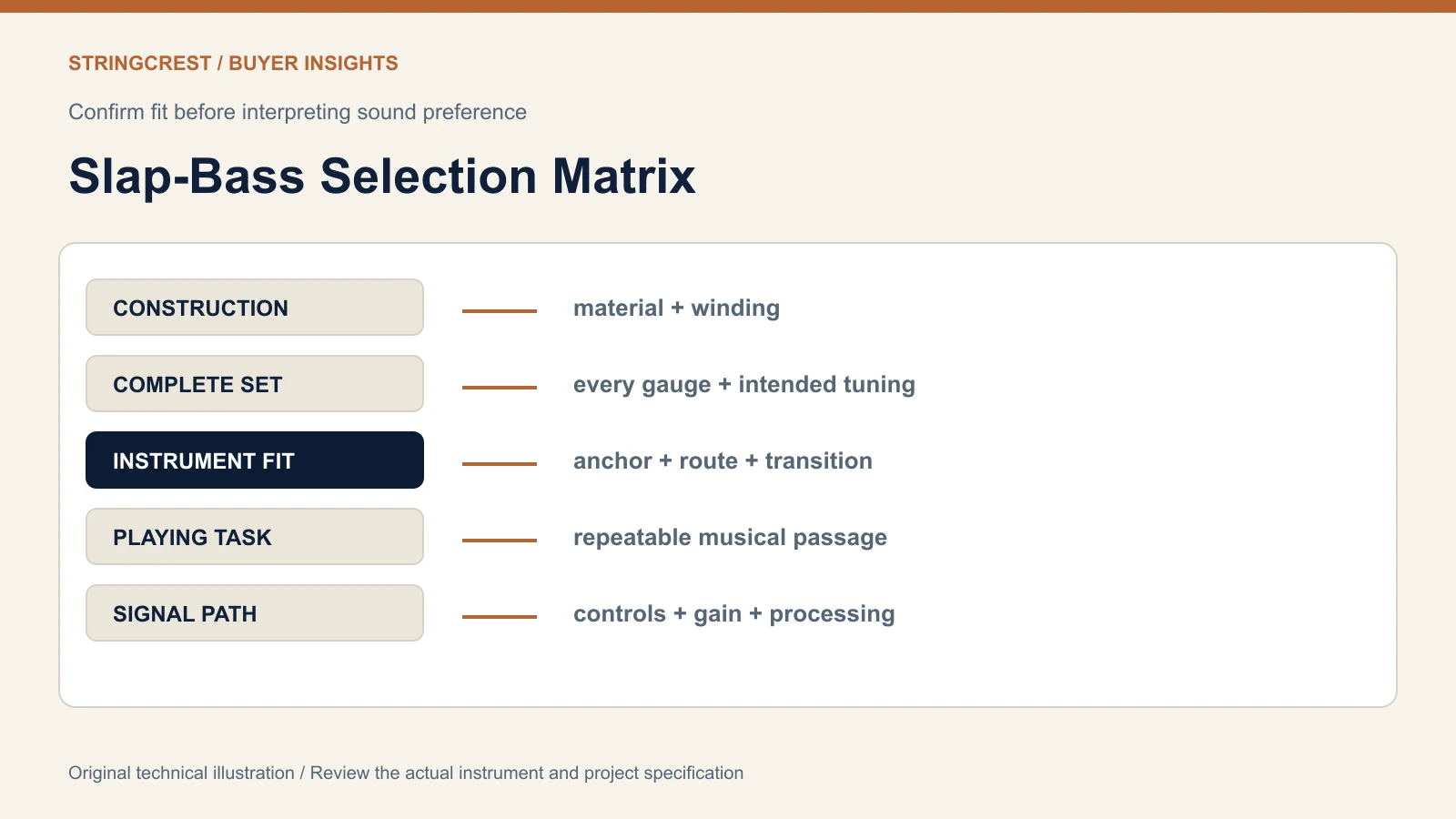
| Application record | Capture | Keep separate from |
|---|---|---|
| Instrument and hardware | Reference bass, route and tuner identity | A broad scale label |
| Complete set | Position gauges, tuning and construction | One gauge printed as shorthand |
| Fit observation | Anchor, contact points and transition location | Tone preference |
| Playing task | Same phrases and comparable effort | A different performance on every sample |
| Signal path | Controls, gain, effects and recording setup | The string’s material description |
| Reviewer result | Specific preference and limitations | A universal product guarantee |
Build a comparison that can answer the buying question
Begin with a useful reference
Choose a reference set that the reviewers know and identify its condition. A heavily used reference and a fresh candidate can exaggerate a perceived difference. Record installation and playing history rather than presenting the comparison as equivalent when it is not.
Change one main variable when practical
If the purpose is material selection, keep the other relevant factors as comparable as the available samples permit. If gauge, material and winding all change together, describe the exercise as a complete-set preference test. Do not isolate a causal conclusion that the design cannot support.
Use repeatable musical tasks
Agree short passages that represent the customers’ actual use. Include thumb attack, popped notes where appropriate, and a fingerstyle passage if the set is expected to support both. Repeating the same musical task makes notes easier to interpret than recording unrelated demonstrations.
Keep a short log of tuning, setup changes and reviewer comments. If the sample requires adjustment, make that intervention visible. A test record is stronger when it explains why the playing conditions changed rather than hiding the intervention behind a rating.
Separate feel, sound and handling in the scorecard
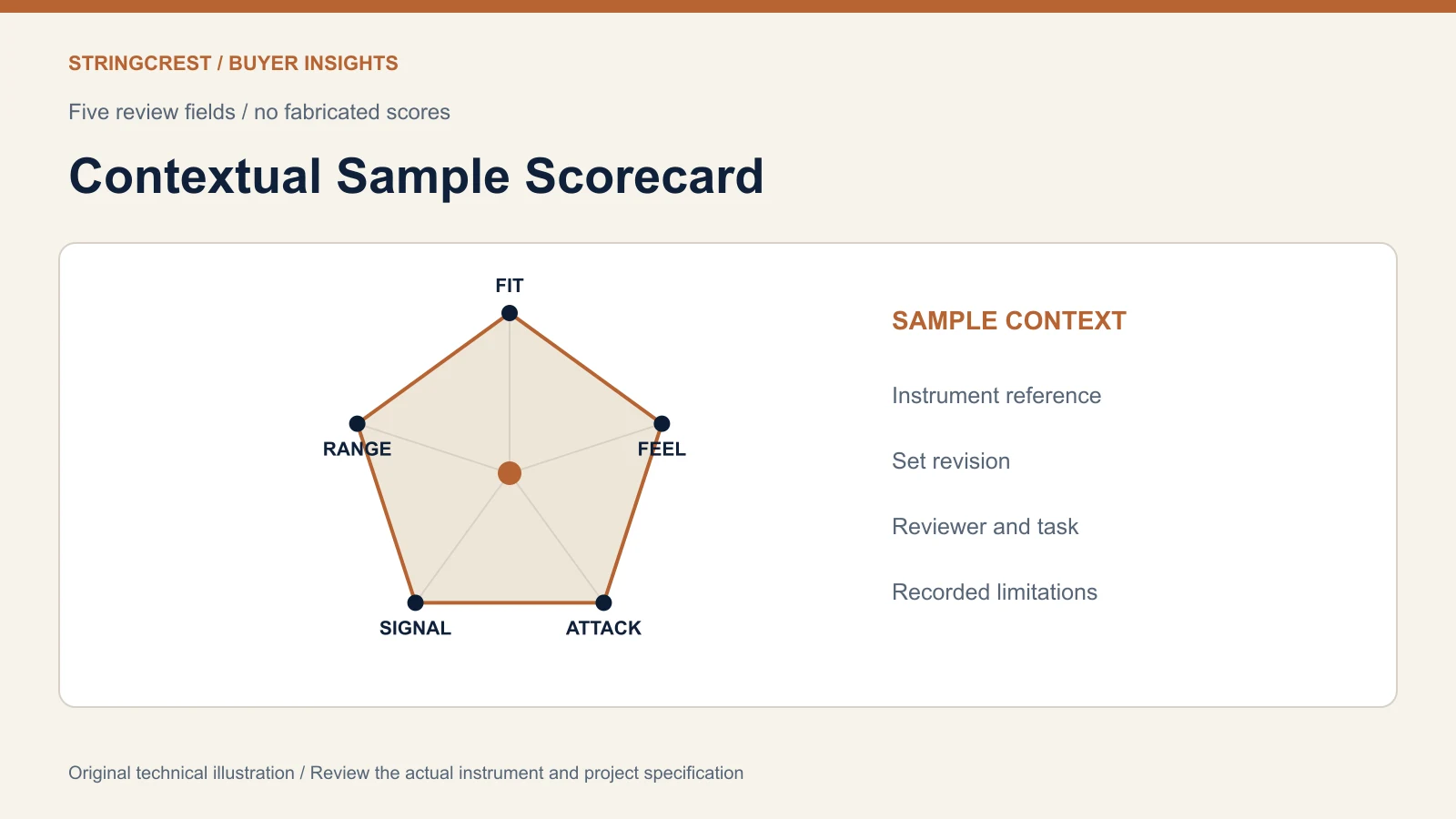
“Good for slap” combines several judgments. Divide the record into contact feel, response under the agreed playing task, recorded attack, note balance and installation handling. A reviewer may favor the sound of a sample while finding its surface less comfortable.
Use plain observations such as “preferred for the mixed fingerstyle passage” or “upper-position attack more prominent in this recording.” If you use numeric ratings, define the scale and reviewer context. A personal score is not a laboratory measurement or a forecast of market demand.
Do not automatically award the loudest sample the highest quality rating. Pickup settings, player effort and recording gain can influence loudness. Ask what sound direction the range needs before judging whether a difference is desirable.
Keep set balance under review. The low position and the popped upper positions serve different roles in the application, so a shorthand statement about overall brightness can miss an uneven response. Record each position without promising a quantified balance that was never measured.
Control the recording chain for dealer demonstrations
Use consistent instrument controls, input settings and monitoring conditions. Note whether the recording is direct, amplified or microphone-based. Document equalization, compression and effects when used, including any settings changed between samples.
Maintain headroom for the playing task and inspect the recording for overload. Distortion introduced at the input should not be described as an intrinsic property of a string. If a performer’s effort varies markedly, repeat the passage or record the limitation.
For commercial clips, label the set and the conditions clearly. A processed demonstration can be useful, but it should not imply an unprocessed sound or reproduce an artist’s signature tone merely because a packet says “slap.” Let the demonstration support the description rather than replace the specification.
Consider keeping both the comparison files and the written notes. Purchasing can then revisit why a candidate was selected after the reviewer is no longer available. A file called “best take” without a sample code is difficult to use as a reorder reference.
Translate the result into a small range architecture
A sample review might justify one roundwound direction for a more pronounced attack and another option serving customers who value different feel or versatility. That is a planning possibility, not a recommended SKU count or a sales forecast.
Ask dealers whether the proposed differences are understandable at the counter. If two packets need a long technical explanation to tell apart, the brand may need clearer descriptions or fewer overlapping options. Avoid creating more stock merely because several keyword variations exist.
Tie each range role to a confirmed set specification. Keep the customer-facing descriptions consistent with the approved sample and its limitations. A purchasing shorthand such as “light slap set” must still resolve to a complete gauge and construction record internally.
Write honest catalog and packaging language
Prefer a description of intended application and construction over a universal ranking. “Roundwound option for players exploring a pronounced attack” leaves room for the instrument and player; “the fastest strings for every slap bassist” does not have a clear evidentiary basis.
Use gauge, string count and confirmed scale information to help customers select the right product. Where compatibility is restricted, make the restriction accessible before purchase. Avoid hiding fit requirements behind genre imagery.
Artist associations, endorsed reviews and numerical performance claims require their own permissions and evidence. None is created by choosing a similar gauge sequence. A private-label range should earn trust through accurate information and reproducible samples rather than borrowing another product’s reputation.
Preserve the approved sample for future orders
Keep the selected construction revision, complete position record and evaluation notes together. If material, coating, winding or gauges change later, assess whether the previous sample evidence still applies. A visually similar packet can contain a changed product.
Receiving inspection should compare the delivered identity and agreed construction requirements with that record. Listening to a random set is not a substitute for checking labels and traceability. Where application sampling forms part of the inspection plan, state its method and limited scope.
Record dealer feedback by product code and use situation. Complaints about reach, feel and sound should not be merged into one quality category. That separation helps identify whether the range description, instrument compatibility or actual product needs attention.
FAQ
Are roundwound bass strings always best for slap?
They are a common comparison starting point for a pronounced attack, but player preference and instrument conditions matter. Assess the actual candidates rather than treating a winding category as a universal winner.
Should a slap-oriented range always use light gauges?
No. Lighter configurations exist, but the choice should consider the full sequence, tuning, setup and desired response. A buyer can investigate a lighter direction without claiming it suits every player or every bass.
Does stainless steel guarantee more output?
Do not make that promise from a material label alone. A complete construction and defined recording or measurement method are needed for an output claim. A perceived sound difference can remain a contextual reviewer observation.
Can one sample approve every scale length?
Only the measured and installed combinations are demonstrated. Review bridge routes, winding transitions and tuner attachment for the intended instruments. Keep that fit evidence separate from the sound evaluation.
How many sets should a distributor launch?
Base the assortment on confirmed product differences and dealer demand evidence. This article does not prescribe a SKU count. Fewer well-described options can be more useful than several overlapping products with indistinct claims.
What belongs in a sample request?
Send the bass references, complete gauges, tuning, winding and material candidates, playing aims and evaluation conditions. Explain whether the comparison is for material selection, a whole-set preference or a new range role.
Conclusion
Choosing bass strings for slap is a purchasing decision best handled through fit records and focused sample comparisons. Material and winding offer useful directions, while the full set, instrument, setup and signal path determine what a particular review can establish.
Use the result to define an understandable range role and accurate dealer language. Preserve the chosen specification so a future reorder can be evaluated against the same product rather than a vague memory of a preferred sound.
Explore bass guitar string options and Send Your Requirements to discuss your instrument coverage, gauge sequence and intended customer segment. Any proposed set or performance statement remains subject to product confirmation and relevant evaluation.
Sources and interpretation limits
- D’Addario bass string collection provides manufacturer terminology for construction and material options.
- Ernie Ball bass buying guide supplies product-selection context; its proprietary claims are not assigned to StringCrest.
- Rotosound Funkmaster product information is an example of a published slap-oriented configuration, not a StringCrest SKU or a universal gauge prescription.
The comparison scorecard, range-planning suggestions and recording controls are proposed buyer methods. No StringCrest artist endorsement, measured performance result, availability guarantee or market sales outcome is claimed.
FROM GUIDE TO PRODUCT
Connect this guide to Bass Guitar Strings.
Review the relevant range, then bring the instrument, complete specification and open questions into one project brief.
YOUR PRODUCT · YOUR BRAND
Discuss your next string project with Frank.
Share your instrument category, target market, gauge or material direction and private-label packaging requirements.

ABOUT THE AUTHOR
Frank Zou
Frank works directly with musical-instrument brands, importers and distributors on string specifications, product selection and private-label project requirements.
Meet Frank