
Wholesale Planning
Product Selection
Acoustic Bass Guitar Strings Wholesale: A Fit and Range-Planning Guide
A B2B guide to acoustic bass scale, taper, material, bridge fit, four- and five-string range planning, samples and packaging.
Introduction
Buying acoustic bass guitar strings wholesale requires a separate brief from electric bass or six-string acoustic guitar strings. The instrument may use a long vibrating scale, a bridge path specific to its body design, and wound strings whose taper or winding transition must fall in the correct place. Material language may resemble acoustic-guitar packaging, while the physical dimensions and load belong to a bass application. Treating the category as “regular bass strings with bronze color” creates fit and expectation problems.
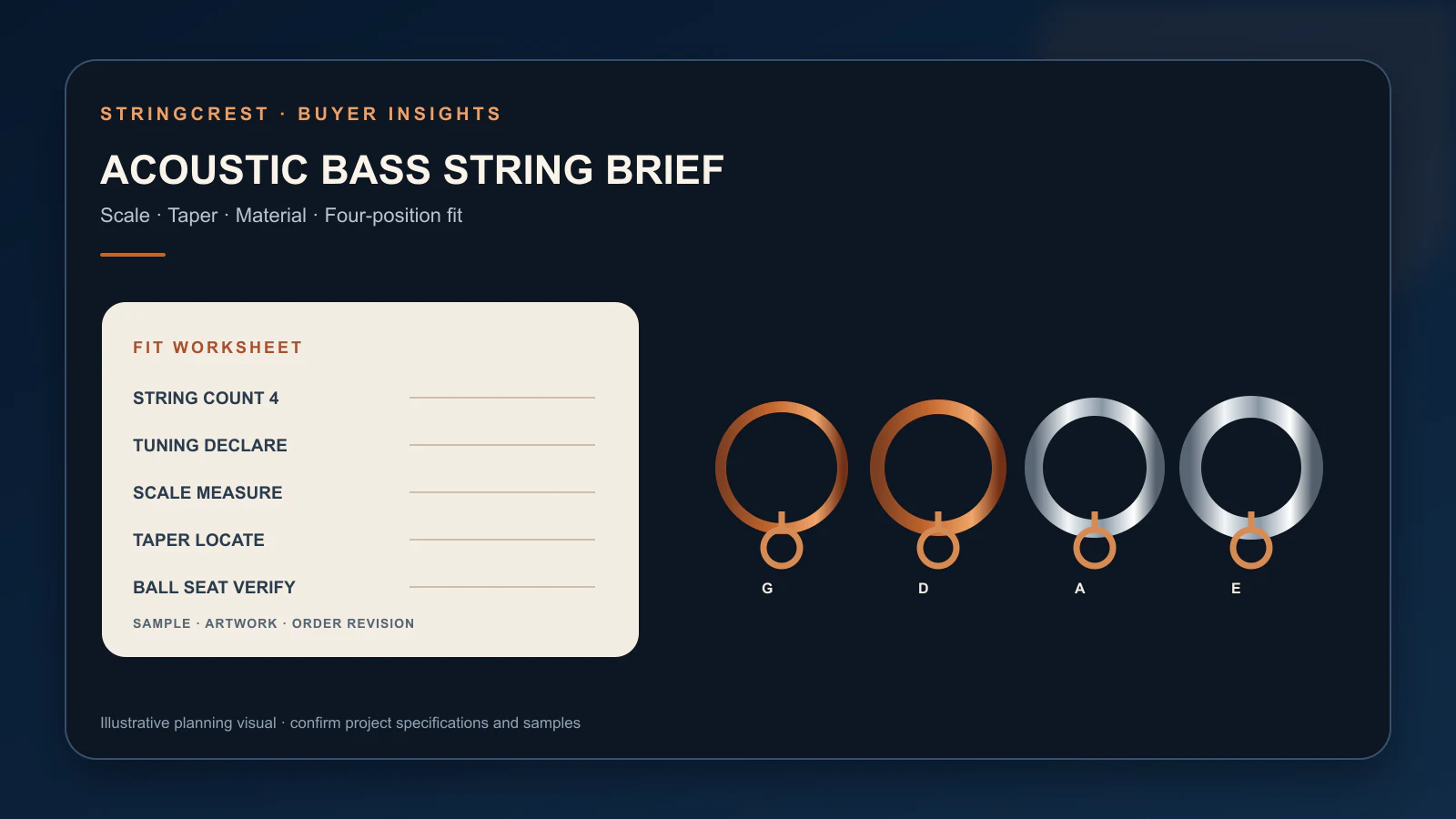
The buyer should begin with the reference instrument: string count, tuning, scale length, ball-end seating, bridge-to-nut path, nut-to-tuner path and target response. Gauge and wrap material come after those facts. Official D’Addario support documentation defines its own bass scale lengths by the distance from the ball-end contact point to the taper, and its acoustic bass products identify scale and construction. That is useful evidence that winding length and taper are controlled dimensions. It is not a universal standard for every supplier.
This guide is for music distributors, instrument makers, repair networks and private-label brands planning acoustic bass sets. It explains how to distinguish the product, measure for fit, structure sample comparisons, and connect packaging to the approved instrument range. It does not claim a StringCrest set, validated gauge, factory test result or universal compatibility. Those facts must come from the project’s proposal, sample and current quotation.
Define what “acoustic bass” means in the project
Instrument category must be explicit
An acoustic bass guitar is not a double bass and is not automatically equivalent to an electric bass. Its body, bridge and acoustic response create a different application. Some instruments are four-string; others add a low B or use different tunings. A buyer who writes only “acoustic bass strings” leaves the supplier to guess the string count, tuning, length and material direction.
Start the RFQ with a plain description of the target instrument and channel. For example: “four-string fretted acoustic bass guitar, standard bass tuning, long-scale reference instrument, ball-end bridge, retail replacement set.” If the project is for an instrument factory, include the exact production model and intended setup. If the set must fit several brands, list the reference models and measurements rather than using a broad compatibility claim.
Clarify whether the range is intended for unplugged acoustic contribution, amplified use with a pickup, or general replacement. These use cases can inform sample questions, but they do not prove one material is best. The approval should record what evaluators heard and felt on the declared instruments without turning preference into a universal fact.
| Project input | Record | Decision supported |
|---|---|---|
| Instrument type | Acoustic bass guitar, fretted or fretless | Separates the category from electric and upright bass |
| String count | Four, five or another defined layout | Controls set architecture |
| Tuning | Position-by-position open notes | Supports tension and gauge review |
| Scale length | Nut to bridge in inches and millimeters | Supports calculation and comparison |
| Complete path | Ball seat through bridge to farthest tuner | Confirms total and wound length |
| Target channel | Retail, repair, instrument factory or private label | Guides SKU and packaging decisions |
Measure scale, winding length and taper separately
Fit depends on more than the nut-to-bridge dimension
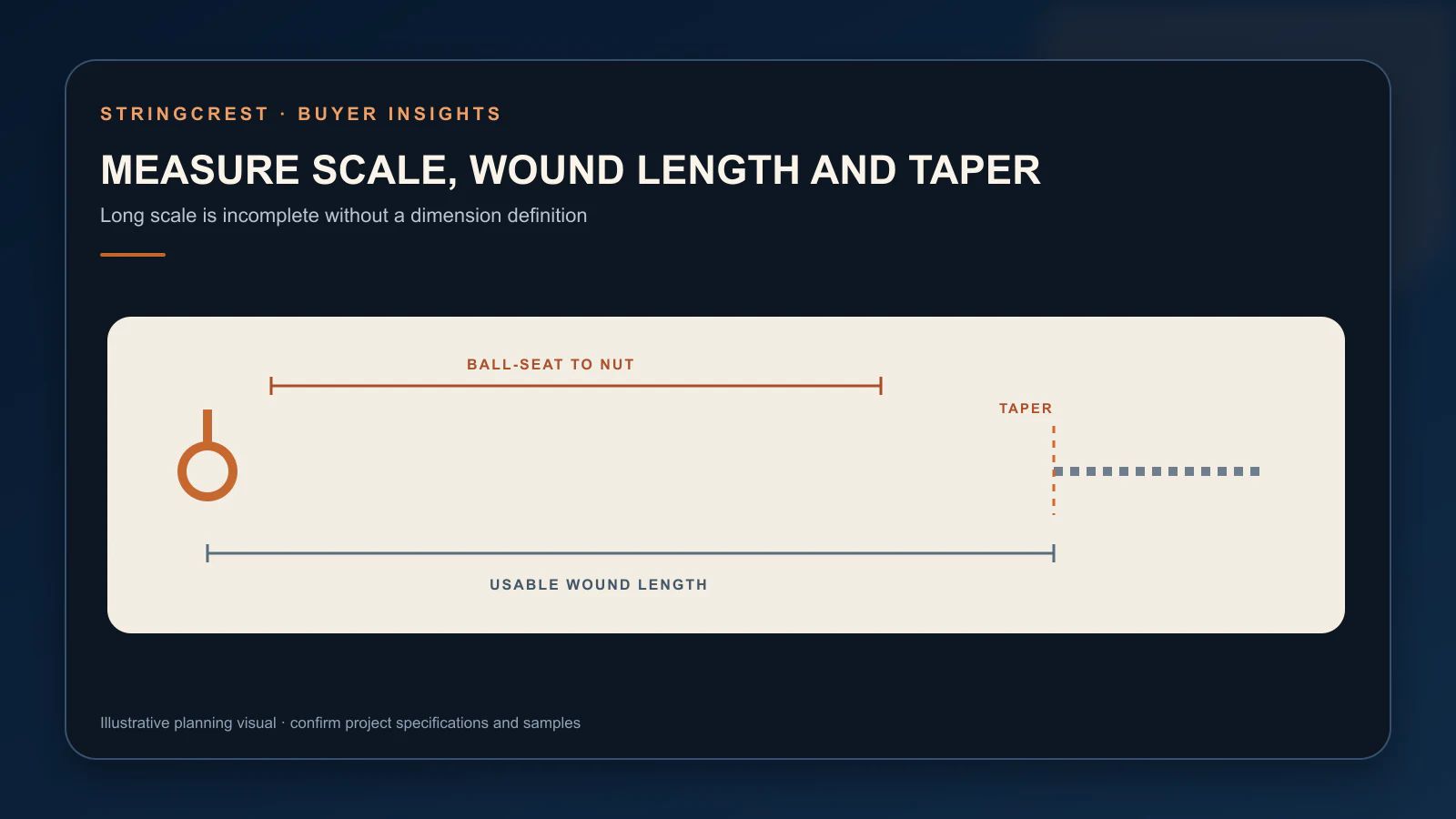
Scale length is the vibrating distance between nut and bridge. String fit also depends on the path behind the bridge or through the body, the distance from nut to tuner, and where the wound section changes to taper or exposed core. A wholesale specification should record these dimensions separately.
D’Addario’s official bass-scale support page provides one manufacturer-specific example. It measures scale category from the point where the string meets the ball end to the taper and publishes different taper locations for short, medium, long and super-long families. Those numbers describe D’Addario products. The general lesson is that “long scale” is incomplete unless the supplier defines the measurement and taper location.
For each reference instrument, measure from the ball-end seating point to the nut and then to the farthest tuner path. Note whether the string passes through a bridge, body or tailpiece arrangement. Record the acceptable location for the taper. The wound section should cover the required playing and nut path, while the thickest winding should not create an unsuitable tuner-post wrap.
Five-string sets require the low position to be checked carefully because its diameter and taper can interact with the nut and tuner. Do not assume that adding one heavy single to a four-string set creates a validated five-string product. The complete progression, winding length and ball-end fit need approval together.
Specify materials as a complete construction
Wrap color is not a technical description
Phosphor bronze appears in commercial acoustic bass sets, and official product pages may describe phosphor-bronze wrap over a steel core. Buyers should still state the complete intended construction rather than ordering by appearance. A meaningful description identifies core family and geometry where declared, wrap material, winding style, surface treatment, end construction and coating status.
Do not import acoustic-guitar claims into the bass category. A material used in both categories can behave differently because gauges, unit weights, scales and instrument bodies differ. Likewise, a bronze-colored string is not proof of a particular alloy. The approved technical sheet should carry the material identity.
If coated and uncoated candidates are being considered, define what the coating claim means and what evidence supports it. A private-label package should not promise a fixed lifespan without a defined test and conditions. Sample evaluators can record surface feel, audible direction, installation and visible condition over an agreed review period, but those observations should not be generalized beyond the test.
Core geometry and core-to-wrap relationship can also influence flexibility and response. A buyer may compare constructions while keeping nominal gauges and scale constant. If the supplier recommends a gauge change with the new construction, document both so the result is not attributed to material alone.
Review gauge as a four- or five-position system
The lowest number on the package is not the complete set
Gauge selection should be position by position. Record the nominal diameter and construction of every string, then evaluate the progression at the declared tuning and scale. The heaviest string attracts attention, but middle-position balance often determines whether the set feels coherent.
D’Addario’s historical tension reference includes an acoustic-bass section and shows the physical relationship among unit weight, pitch and scale. Use such references to understand why two sets with similar outer gauges can still differ. Do not present a calculated value as a StringCrest specification unless the unit weight, construction and scale for the proposed sample are known.
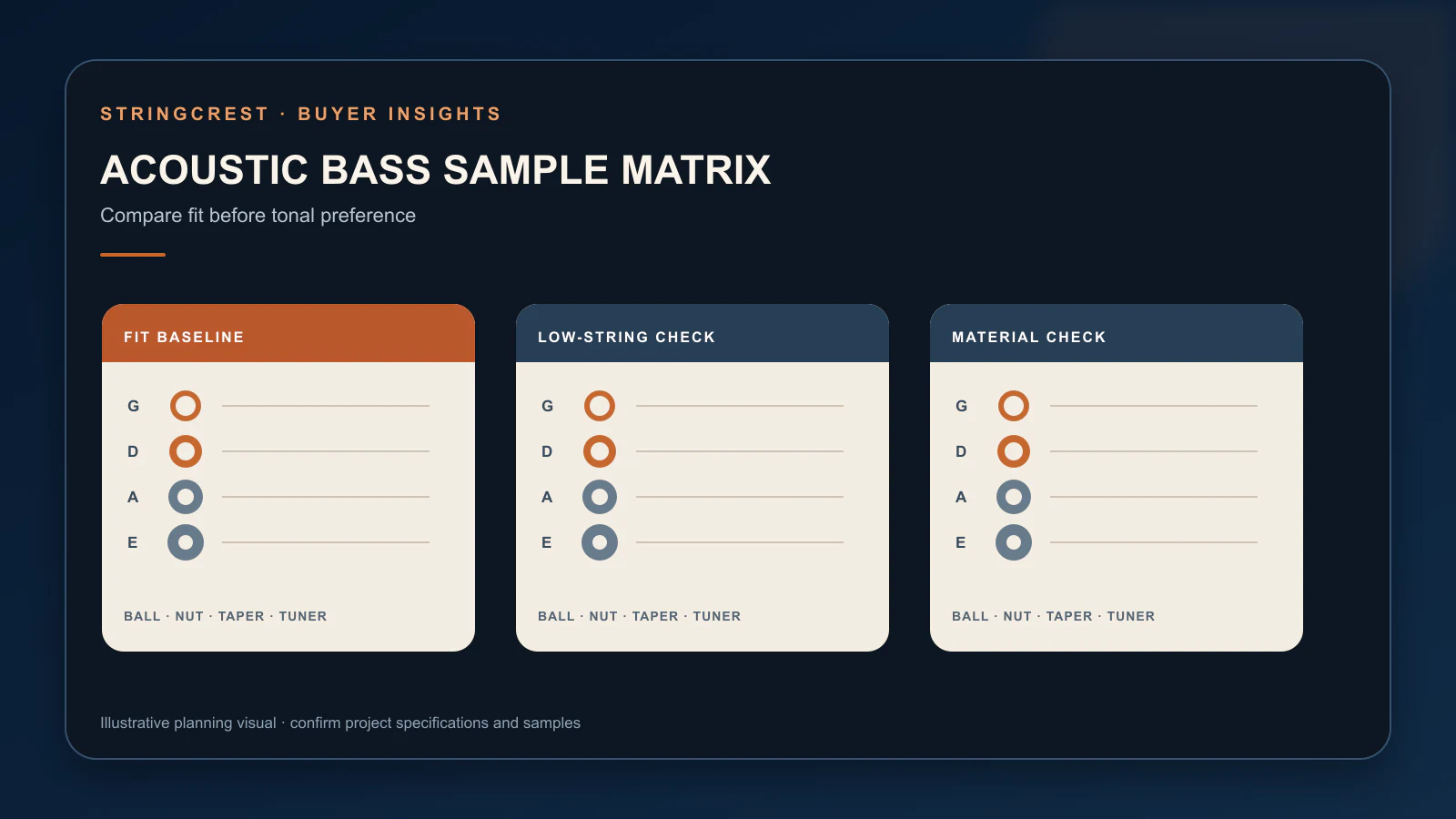
A buyer can prepare two purposeful sample matrices. The first may hold the upper positions constant while comparing the lower-string direction. The second may hold gauges constant while comparing wrap or surface construction. Avoid changing every position and material at once. Controlled variants make evaluator comments and supplier revisions easier to interpret.
Check the bridge, ball end, nut and tuner path
Installation fit is a release gate
Many acoustic bass guitars use ball-end strings, but bridge designs and seating details vary. The ball must seat securely without damaging the bridge or slipping into an opening. The buyer should photograph the target bridge and state any ball geometry or orientation requirement. Category assumptions are not a substitute for installed verification.
At the nut, each string should sit correctly in the slot for the approved setup. A different gauge can require professional adjustment. Do not treat unapproved filing as a normal part of sample installation. If a sample requires modification, record it and decide whether the target product should require that setup service.
At the tuner, confirm that the correct portion of the string reaches and wraps the post. A thick fully wound section can be difficult to wrap on hardware designed for a taper. A taper that begins too early can contact the nut or enter the speaking length. The correct condition depends on the instrument, so the fit sheet should use actual reference points.
Inspect all positions, not only the longest or thickest. Headstock layout changes the path to each tuner. Record total string length, winding continuity, taper location and trimmed allowance. If one set is claimed to fit several instruments, test the shortest and longest relevant paths.
Build an application-based sample procedure
Separate receiving inspection from playing evaluation
On receipt, verify the sample code, revision, position labels, gauge list, material declaration and packaging state. Inspect for visible kinks, damaged winding, loose end attachments or contamination. These observations establish whether the sample is in condition for installation; they do not prove long-term performance.
Install the set on a measured reference instrument. Photograph ball seating, bridge exit, nut area and tuner wraps. Bring the instrument to the declared tuning and allow the normal stabilization procedure. Record any required setup change. For a factory project, use the same instrument model and setup standard that will be applied during production.
The playing review can cover string-to-string balance, left-hand feel, fret or fingerboard behavior, acoustic projection direction, amplified response where relevant and tuning behavior. Use clear questions rather than asking whether the set is simply “good.” If several evaluators participate, keep the instrument and comparison order controlled as far as practical.
After the review, inspect the winding and ends again. Record visible movement, unusual wear or fit changes. A shipment inspection later can confirm codes, quantities, visible condition and packaging revision, but it should not be described as repeating the full application test on every set.
| Stage | Pass question | Evidence retained |
|---|---|---|
| Receiving | Is the sample identified and visibly suitable to install? | Receiving photos and revision log |
| Fit | Do ball, bridge, nut, taper and tuner path match the brief? | Installed-path photos and measurements |
| Tuning | Does the set reach the declared tuning on the reference scale? | Tuning and setup notes |
| Application | Does the complete set meet the chosen response direction? | Structured evaluator form |
| Release | Do sample, specification, artwork and order share a revision? | Signed approval record |
Plan the wholesale range around real channel roles
Fewer distinct SKUs can be clearer than many near-duplicates
An acoustic bass assortment might begin with one four-string long-scale set. Another channel may require five-string coverage, a smaller instrument format or a second material direction. The correct range depends on target instruments, customer requirements and the ability to hold each SKU accurately.
Create a role statement for every proposed set: instrument count, scale group, material system, gauge direction, coating status and target use. If two sets have nearly identical roles, test whether the distinction is useful enough to justify separate forecasting, artwork and inventory.
Singles can support repair and replacement, but they add complexity. Each single needs a stable position or use description, gauge, construction, length, end, barcode and pack quantity. A low string from a five-string set should not be offered as a universal extension for every four-string set without fit and tension review.
For instrument factories, bulk packs may reduce individual retail packaging, yet traceability remains necessary. Inner bundles, lot identification, position separation and receiving counts should be agreed. A “bulk” format should not mean unidentified strings in one carton.
Design packaging around identification and fit
Put the application before marketing adjectives
The package should identify acoustic bass guitar, string count, gauge sequence, scale or winding-length qualification, material construction, end type and coating status where applicable. Use both inch and millimeter information if that improves clarity for the target market. The exact label should follow the approved project definitions.
Avoid phrases such as “fits all acoustic basses.” If the set was approved for a declared ball-seat-to-taper range and reference instruments, state that information or ask customers to compare measurements. If a five-string set uses a particular low-string construction, show the full gauge sequence so buyers do not confuse it with a four-string package.
Tone words should be modest and tied to the approved material direction. Claims about corrosion resistance, longer life or climate protection require evidence for the actual string and packaging system. A material supplier’s generic claim is not automatically evidence for the finished pack.
Artwork version, barcode, pack count, inner envelope codes and carton labels should map to the technical revision. If the gauge sequence changes, the artwork and warehouse transition must change with it. Do not allow an old package to remain visually identical to a new construction during overlapping inventory.
Prepare a comparable RFQ
Ask every supplier to quote the same defined application
The RFQ should list instrument type, string count, tuning, scale, complete path, acceptable taper location, position gauges, materials, coating status, ball-end requirement, packaging format, sample quantity, target market and forecast structure. Mark fields that are open for supplier recommendation and fields that cannot change.
Request a position-by-position response. If the supplier recommends a different gauge, winding length or material, the deviation should be visible. Ask for a drawing or dimension definition when scale labels are used. Current MOQ, price, sample cost and lead time belong in the quotation because packaging and specification choices affect them.
Before production, compare four objects: approved technical sheet, identified installed sample, final artwork and purchase order. They should share a revision. Shipment receiving can then check the ordered SKU, cartons, pack count, codes and visible state against a known baseline.
Common acoustic bass sourcing mistakes
The first mistake is using an electric-bass scale label without confirming how the acoustic bridge and ball-end path affect fit. The second is measuring only nut to bridge and ignoring the taper and tuner. The third is selecting by the lowest gauge while neglecting the progression across the set. The fourth is describing material by color.
Another mistake is adding a fifth string without re-evaluating the complete set and instrument setup. Buyers also create risk when they publish life or corrosion claims before the final packaging and evidence are approved. Finally, a competitor’s published product is a market example, not a substitute for a StringCrest project specification.
FAQ
Are acoustic bass and electric bass strings interchangeable?
They should not be assumed interchangeable. Construction, material, bridge path, taper location and intended acoustic response can differ. Confirm the instrument, scale, complete path and approved product description before ordering.
What does long scale mean for acoustic bass strings?
The phrase depends on the supplier’s measurement method. Ask for the distance from the ball-end seating point to the taper, total length and usable wound length. Compare those dimensions with the reference instrument rather than relying on the label alone.
Why is taper location important?
The wound section needs to cover the required path while the taper should fall in a suitable area beyond the nut and before the tuner wrap or clamp. A taper that starts too early or too late can create fit problems even when scale length appears correct.
Should a wholesale range include four- and five-string sets?
Only when the target channel has a defined need and each set can be sampled, packaged and stocked accurately. A five-string set is not just a four-string set plus any heavy single; its progression and fit should be approved as a complete product.
What should be approved before a bulk order?
Approve the position specification, length and taper definitions, identified samples on reference instruments, packaging artwork, inner codes and purchase-order revision. Confirm current commercial terms directly with the supplier.
Conclusion
Acoustic bass guitar strings become easier to source when buyers separate the vibrating scale from the complete installed path. A clear taper definition, position-by-position construction table and controlled sample procedure reduce the chance that a plausible gauge set will fail at the bridge, nut or tuner.
The same discipline improves range planning. Each four- or five-string SKU can serve a defined instrument group, carry accurate material and fit language, and remain traceable from sample approval to carton receipt. That clarity is more valuable than a long list of unverified compatibility claims.
Explore bass guitar string options · Send your acoustic bass requirements
Sources and interpretation limits
- D’Addario bass string scale-length definitions
- D’Addario acoustic bass product example
- D’Addario string tension reference
These official sources document one manufacturer’s scale definitions, acoustic-bass construction example and tension methodology. They do not establish StringCrest dimensions, gauges, performance, availability or commercial terms. Confirm each project through its own technical proposal, samples and quotation.
FROM GUIDE TO PRODUCT
Connect this guide to Bass Guitar Strings.
Review the relevant range, then bring the instrument, complete specification and open questions into one project brief.
YOUR PRODUCT · YOUR BRAND
Discuss your next string project with Frank.
Share your instrument category, target market, gauge or material direction and private-label packaging requirements.

ABOUT THE AUTHOR
Frank Zou
Frank works directly with musical-instrument brands, importers and distributors on string specifications, product selection and private-label project requirements.
Meet Frank