
Product Selection
Product Selection
Four-String Bass Gauge Matrix: Comparing 40–95, 45–100 and 45–105 for Wholesale
Compare four-string bass gauge sets without guessing the two middle string diameters.
Introduction
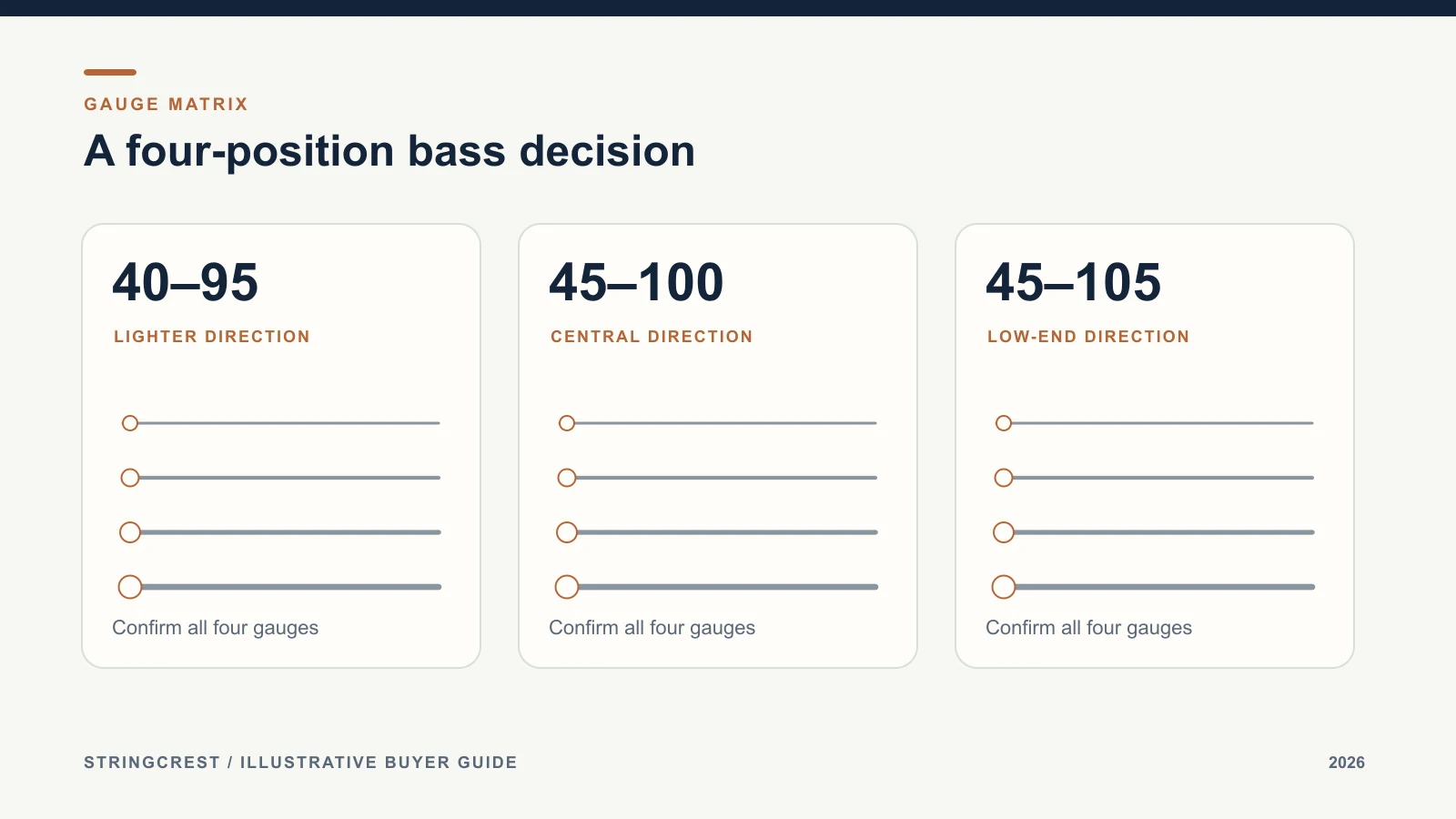
A four-string bass range can become confusing when a buyer treats “40–95,” “45–100” and “45–105” as complete specifications. Those labels identify the outer strings in a set, not the gauges, construction, usable winding length or fit of the two middle strings. For a distributor, the practical decision is which distinct dealer need each candidate serves and whether a repeatable sample trial supports that difference.
This guide builds a four-position comparison rather than claiming a universal winning gauge. It uses published ranges from other makers to explain how gauge naming works, then shows which data to request from the proposed supplier. The StringCrest bass-guitar category shows a four-string nickel-plated-steel concept and several gauge-guide directions. Its final intermediate gauges, dimensions, availability and commercial terms must be confirmed for an actual order.
Start with four positions, not the label on the box
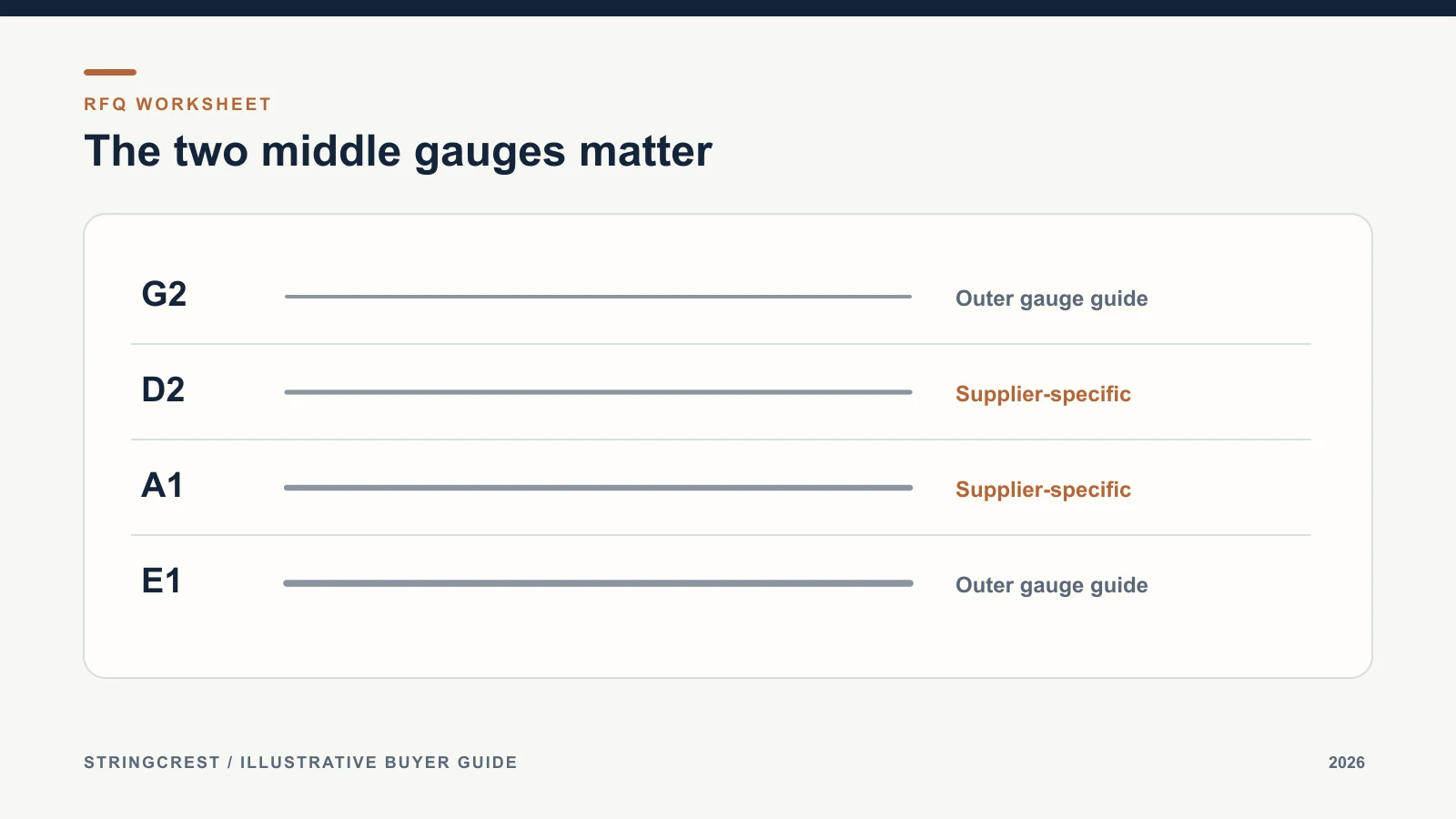
For standard four-string electric bass tuning, the open notes are G2, D2, A1 and E1 from the thinnest to thickest string. A set called 45–105 identifies an outer diameter of approximately .045 inch for G and .105 inch for E, but the D and A positions are not fixed by that name alone. Two brands can publish a similar outer range while choosing different middle gauges, materials, cores or winding dimensions. They should not be treated as identical products.
Ernie Ball's nickel-wound four-string range illustrates the point. Its published examples include 40–95, 45–100 and 45–105, with complete four-number sequences that differ by set. Those are Ernie Ball specifications, not StringCrest specifications or suggested substitutes. The maker also explains gauge notation using its own 45–100 example. A buyer can learn the notation without importing another company's inner gauges into a new quotation.
Write the proposed set as four position-specific rows. Ask for the finished gauge, declared construction, material direction, end format, recommended use, usable winding length and the supplier's measurement method. If any field is still open, leave it explicitly “to confirm.” A comparison table with four unknown middle values is honest; a neatly completed table copied from a competitor's catalog is misleading.
A buyer's working matrix
| Candidate direction | G2 | D2 | A1 | E1 | What must still be confirmed |
|---|---|---|---|---|---|
| Lighter outer range, 40–95 | .040 guide | Supplier data | Supplier data | .095 guide | Complete sequence, material, winding and fit |
| Central outer range, 45–100 | .045 guide | Supplier data | Supplier data | .100 guide | Complete sequence, material, winding and fit |
| Stronger low-end outer range, 45–105 | .045 guide | Supplier data | Supplier data | .105 guide | Complete sequence, material, winding and fit |
The numbers above are planning labels, not confirmation that each set is a current StringCrest SKU. A buyer may ultimately select another range or a different middle-string sequence. What matters is that the final quote, sample pack, artwork and reorder code all refer to the same four-position record.
Define the dealer job of each candidate
A range should be built around customer use, not a belief that more variants always improve conversion. Ask dealers what instruments, styles and customer questions appear in their stores. A player asking for easier left-hand movement, one asking for a firmer low E, and one asking for a particular material may not be asking the same question. Gauge is only one part of the answer; setup, scale, construction and playing approach also affect feel.
Write a short job statement for each candidate. For example: “A lighter four-string replacement direction for standard-tuned basses represented in our dealer network, subject to sample and fit approval.” That sentence defines an application but does not pretend to forecast sell-through or guarantee comfort. Another candidate might aim to retain a familiar G-string feel while exploring a firmer low E. That role is different from uniformly increasing all four gauges.
The buying team should ask which candidate a dealer could explain in one sentence without making an exaggerated performance claim. If two samples produce no reliable distinction on the intended instruments, they may not both deserve separate inventory codes. Conversely, a real fit constraint can justify separate SKUs even when the packaging looks similar. Keep commercial judgment, test evidence and supplier capability in different columns.
Hold material and construction steady during gauge trials
If the goal is to compare gauge patterns, avoid changing wrap material, surface type and core design at the same time unless the supplier offers only complete set alternatives. The StringCrest bass preview uses nickel-plated steel as a material direction. A stainless-steel or flatwound competitor example may help a buyer understand the wider market, but it does not belong in a controlled gauge-only comparison unless explicitly designated a separate product concept.
Record whether the strings are roundwound, any relevant core specification, the end construction and how the proposed manufacturer defines finished diameter. Ask whether the two middle gauges and wrap proportions differ between candidates. A heavier outer E with an unchanged G may be described as a hybrid pattern, but the exact feel cannot be predicted from the label. A measured diameter also does not prove tension without the string's physical construction, pitch and speaking length.
This is why a statement such as “45–105 has 5% more tension than 45–100” would be unsafe. The change from .100 to .105 on the low E does not translate directly into a universal tension percentage, and the remaining positions may differ. If tension figures are requested, obtain product-specific calculations or measurements with the tuning and scale conditions. Otherwise compare the actual samples under controlled conditions and describe only what evaluators observed.
Check fit before playing comparisons
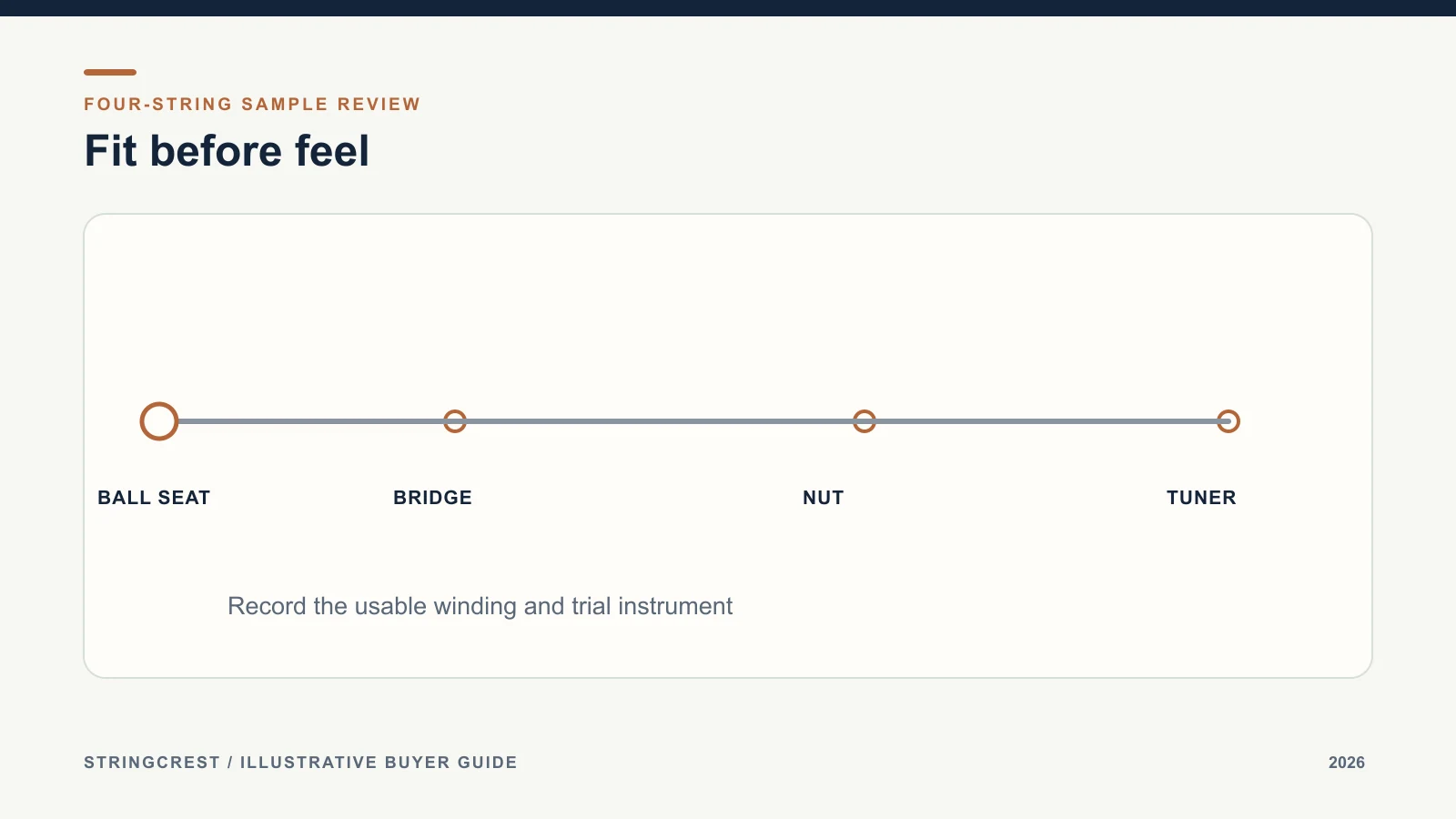
Bass sets must travel from their end anchor, through or over the bridge, across the nut and into the tuning-post area. The required usable winding length is distinct from vibrating scale length. Through-body routing, bridge geometry and a taper can change where the full-diameter winding lands. A four-number gauge label does not establish whether the set fits a particular bass.
For every trial instrument, record the model or identifying description, nut-to-saddle scale, bridge loading path, distance from ball seating point to nut, and where the winding or taper should end. Take a clear measurement photograph with a ruler where possible, but retain the numerical record and reference points in the brief. If the supplier uses a different length convention, agree on the conversion before ordering. The existing bass scale-length buyer guide treats that fit question in more detail; it should be read alongside, not replaced by, a gauge matrix.
If a string would place a full-thickness winding over an unsuitable area or an exposed core in an unexpected location, pause the trial. Fit failure is not evidence that the gauge direction sounds bad. Likewise, do not force a thick string into a nut slot to finish a comparison. The instrument may need competent setup, or the candidate may not suit that instrument. Record which explanation remains open.
Prepare a controlled installation sheet
Use one row per instrument and sample revision. Include bridge path, scale, baseline setup, sample code, installation date, string-count check and the technician or evaluator. Note if a nut adjustment or other setup change occurs. When possible, trial candidates on the same instrument under the same tuning, pickup and amplification conditions. A second bass can reveal application limits, but it should not erase the first bass's context.
Compare feel and response without inventing a ranking
Give evaluators short tasks that represent the target channel: repeated low E notes, a walking line across all four strings, fingerstyle and pick passages if those are relevant, changes between open and fretted notes, and quiet-to-strong attack. Ask them to record physical feel, response, note balance, string noise and any unwanted contact separately. Avoid a single “tone score” that hides why a candidate was preferred.
A useful comment might say, “On Bass A at standard tuning, Sample B felt easier to articulate on G and D but the low E required more right-hand effort.” The statement is scoped to an instrument and sample. It is not a universal promise about all 45–105 sets. A seller could later translate a consistent observation into careful product language, but only after the actual product construction and customer application are approved.
Allow each candidate the same observation schedule. New strings, old strings and setup changes are not comparable conditions. If the team wants to discuss longevity, define a separate durability protocol; a short listening session cannot prove corrosion resistance or service life. Photograph received package identity and visible condition, but do not present staged product illustrations as factory testing or shipment evidence.
Decide which candidate earns an inventory code
After a sample round, compare evidence with the job statements. Did the lighter range answer a distinct customer request? Did the stronger low-end candidate solve an observed need on the intended basses? Were any differences instead caused by a material, setup or length change? Mark each conclusion as observed, inferred or still untested. The aim is to make a purchasing decision that another team member can reconstruct months later.
An opening assortment may use one core four-string set with a second well-supported alternative. That is a planning pattern, not a claim about US sales volume. If a dealer network has its own sell-through and returns data, use those records with their dates, stock-availability context and channel mix. Search-query lists alone do not tell you which gauges customers will buy in a given store.
Every added SKU has work beyond the string set itself: distinct product code, artwork, barcoding supplied by the brand, stock location, replenishment rule, dealer sheet and customer support language. If a 45–100 and a 45–105 pack share nearly identical names, the risk of warehouse or retailer substitution rises. A visible difference in the front label should still match the confirmed technical panel; attractive design cannot repair incorrect numbers.
Before selecting a second SKU, calculate the smallest practical review period for the channel. Ask how many stores will stock it, how they will describe the difference, and what evidence would lead to keeping or withdrawing it. A small pilot order can be useful if the supplier confirms terms, but a proposed pilot is not a promise that one is available. Record units sold beside stock availability and returns; a week with no stock cannot be interpreted as weak customer demand. Keep the decision criteria in the range file so a future buyer does not add a near-duplicate simply because the outer gauges look different.
Make quotation and shipment identity precise
Quote the approved four-position sequence and construction, not just the outer range. The purchasing sheet should identify sample revision, material, surface, end type, usable winding length or fit range, packaging unit, artwork revision and the intended SKU. MOQ, sample charges, lead time, delivery terms and alternate material availability should be requested for the actual confirmed configuration. Do not turn a preliminary discussion into a blanket StringCrest policy.
The first order should reference the approved sample record. For an agreed shipment inspection, useful identity checks include four strings per set, visible end construction, correct G/D/A/E positions, readable product code, correct outer carton and undamaged protective packs. If the agreement includes diameter or length checks, define the measuring instrument, sampling plan, tolerances and record format before goods are ready. A photo of four coiled strings by itself does not verify the middle gauges.
Create a simple change-control rule: a supplier-proposed substitution in any position requires a revised specification and buyer acceptance before the pack keeps the same code. If the distributor later changes a gauge or material, update the customer-facing listing and pack proof as well as the purchase order. Many avoidable returns arise when those records drift apart.
FAQ
Is 45–105 always heavier than 45–100 across the full set?
No. Those names specify only the outer gauges. The two middle positions can vary by maker and by set, and construction can change feel. Request the full four-number sequence and product-specific material and winding details before comparing.
Does a thicker low E always solve a weak low end?
No. Gauge may matter, but instrument setup, scale, tuning, pickup and playing technique can also shape the observation. Record the problem on a reference bass, then compare controlled samples rather than assuming a single diameter change is the cure.
Can another brand's four-gauge sequence be copied into my StringCrest quotation?
No. Published competitor sequences explain the market and notation; they are not StringCrest product data. Ask for the actual proposed sequence and a labeled sample. Confirm any requested custom pattern and its commercial terms before using it in artwork.
Why do I need winding-length data if the pack says “long scale”?
Scale labels can use different conventions and do not capture every bridge path. Measure from the actual seating point through the instrument path to the nut and tuning area, then ask the supplier to state its winding and taper dimensions using clear reference points.
How many gauge SKUs should a new dealer range launch?
There is no universal number. Give each candidate a distinct customer job, validate fit and sample response, and consider artwork, stock and replenishment burden. Use your own channel evidence where available; treat keyword lists as research inputs, not forecasts.
Conclusion
A useful bass gauge comparison records all four positions, keeps material and installation variables controlled, and assigns each candidate a dealer role. The outer range is a signpost, not a completed RFQ. Confirm the actual StringCrest sequence and fit information before approving samples, packaging or the first bulk order.
FROM GUIDE TO PRODUCT
Connect this guide to Bass Guitar Strings.
Review the relevant range, then bring the instrument, complete specification and open questions into one project brief.
YOUR PRODUCT · YOUR BRAND
Discuss your next string project with Frank.
Share your instrument category, target market, gauge or material direction and private-label packaging requirements.

ABOUT THE AUTHOR
Frank Zou
Frank works directly with musical-instrument brands, importers and distributors on string specifications, product selection and private-label project requirements.
Meet Frank