
Product Selection
Product Selection
Tapered vs Untapered Bass Strings: A Wholesale Fit and Range Planning Guide
Compare taper position, bridge and nut fit, scale reference, sample matrices, labeling and inspection for a wholesale bass range.
Introduction
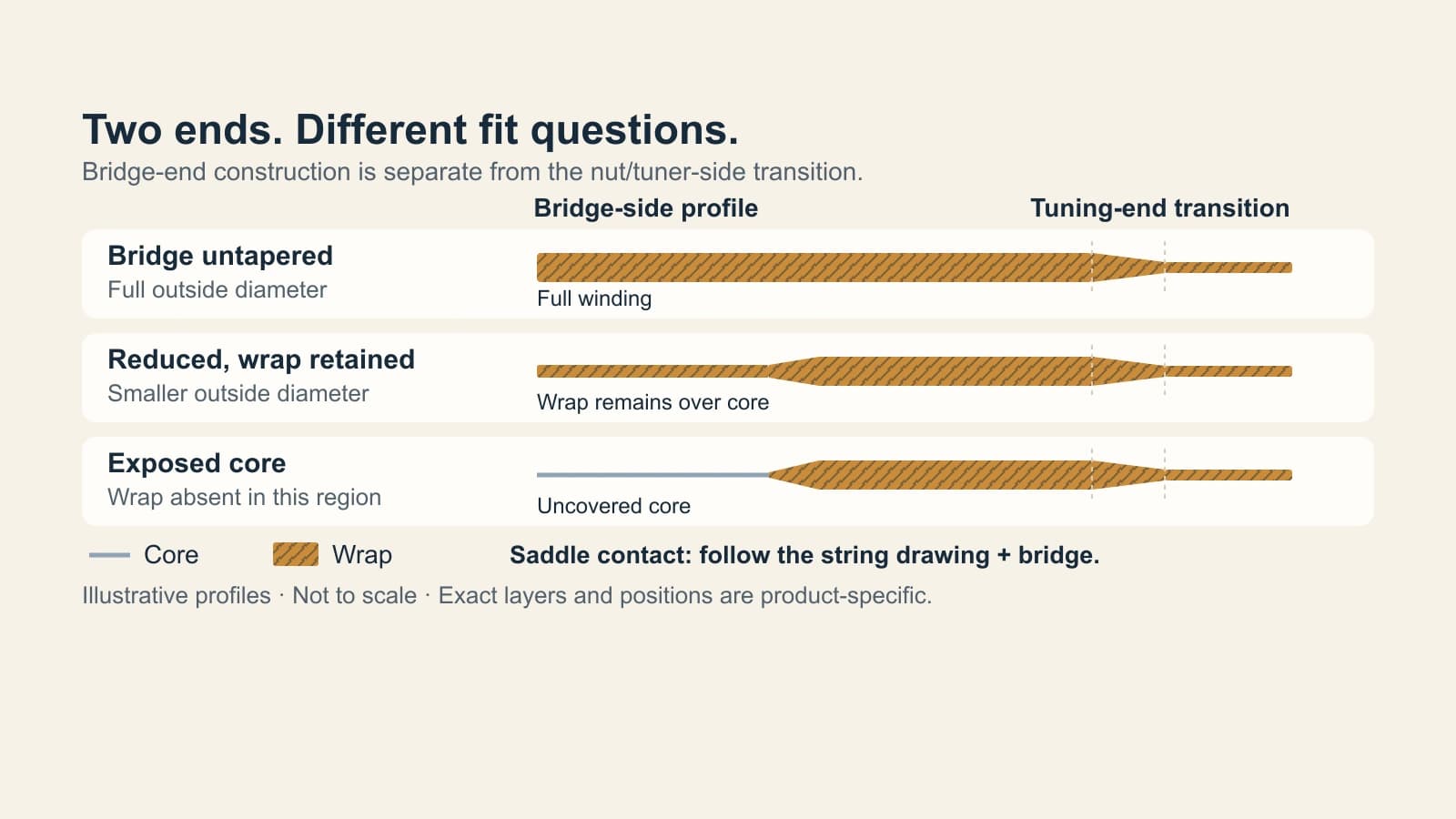
Tapered bass strings have a smaller outside diameter in a specified region. To decide whether a set fits, a buyer needs to know which end is tapered, which strings have it, and what part of the string should contact the hardware. A bridge-end taper and a nut-to-tuner winding transition answer different installation questions. A set described as untapered at the bridge can still have a thinner section at the tuning end.
Neither construction is a universal fit upgrade. The bridge design, string maker's intended contact positions and actual installation path determine the choice. For a brand, importer, distributor or guitar store, the useful comparison is a drawing and a position table for the intended instruments. This guide checks specific bridge, nut and tuner contact positions; the linked custom-bass guide covers the broader complete-set development brief. A “long scale” label or finished gauge alone cannot establish those details.
What changes at the bridge, and what changes near the tuner?
The core is the central wire. Wrap layers surround it in a wound string. The finished gauge is the outside diameter of the completed string at the stated measurement location; it is not the core diameter. A thinner region may retain winding over the core. An exposed-core region has no wrap covering that part of the core. Do not describe every reduced-diameter section as bare core, or infer a smaller core wire simply from a smaller outside diameter.
These distinctions describe geometry. They do not specify how many wrap layers a particular product uses. Ask for a drawing that identifies the core, the wraps that continue through each region and the resulting outside diameter.
| Description in a buying brief | Region to locate | Fit question |
|---|---|---|
| Untapered at the bridge | Full-diameter wound section around the saddle, as specified | Does that section seat correctly on the intended bridge? |
| Bridge-end taper with winding retained | Reduced outside diameter near the ball or anchor | Which part of the reduced section, transition or full winding is intended to contact the saddle? |
| Bridge-end exposed core | Uncovered core near the bridge | Does the hardware support the maker's intended core contact and setup? |
| Nut/tuner-side transition | Change from full winding toward the tuning end | Does the specified winding clear the nut, and does the permitted section reach the tuner? |
A bridge-end taper is intentional in some string families. D'Addario's low-B taper explanation describes a ball-end design for the heavier low B. La Bella explicitly describes its Super Steps line as having exposed core at the bridge. These are examples of the named makers' designs, not StringCrest construction specifications or evidence that every saddle accepts them.
It would therefore be wrong to reject a string solely because its intended bridge taper extends onto the saddle or into a short part of the speaking length. Compare that location with the exact string's instructions and the bridge geometry. Conversely, an intentional design can still be unsuitable for a particular instrument.
Dates also matter when evaluating replacement stock. La Bella's current FAQ says its flatwound low-B strings produced before May 2025 had a ball-end taper, and that it stopped tapering those low-B strings from May 2025. A photograph of an older string cannot establish the construction of a newly supplied set.
Measure from the installed anchor, then mark both transitions
Begin with the reference bass and its intended loading route. Photograph the seated ball end or other anchor, saddle, nut and tuner for each position. Mark the measurement origin O at the point where the string meets the seated ball or anchor, unless the supplier specifies another datum. State whether the ball itself is included. A loose ball's center and the installed string's exit point are different references.
Follow the actual string path from O toward the tuner. Record the hardware locations and the string's construction boundaries separately:
| Record | Meaning and method |
|---|---|
| O to S | Path from the installed anchor reference to that string's saddle contact point |
| O to N | Path to the nut contact point; photograph the endpoint used |
| O to T | Path to the tuner entry or first post contact, with that endpoint identified |
| Speaking length | Nut-to-saddle vibrating span for that position, separate from the anchor-to-nut path |
| Bridge-region start/end | Boundaries of each reduced, exposed-core or transition region near the bridge, measured from O; identify separate regions on the drawing |
| F0 and F1 | Start and end of the full-diameter winding, measured from the same string datum |
| U0 and U1 | Start and end of the nut/tuner-side transition; note any separate silk boundary |
| Overall length L | Uncut string length to its tail, with end-hardware inclusion stated |
| Contact profile | Core, reduced winding, transition or full winding at each relevant hardware contact, plus outside diameter where needed |
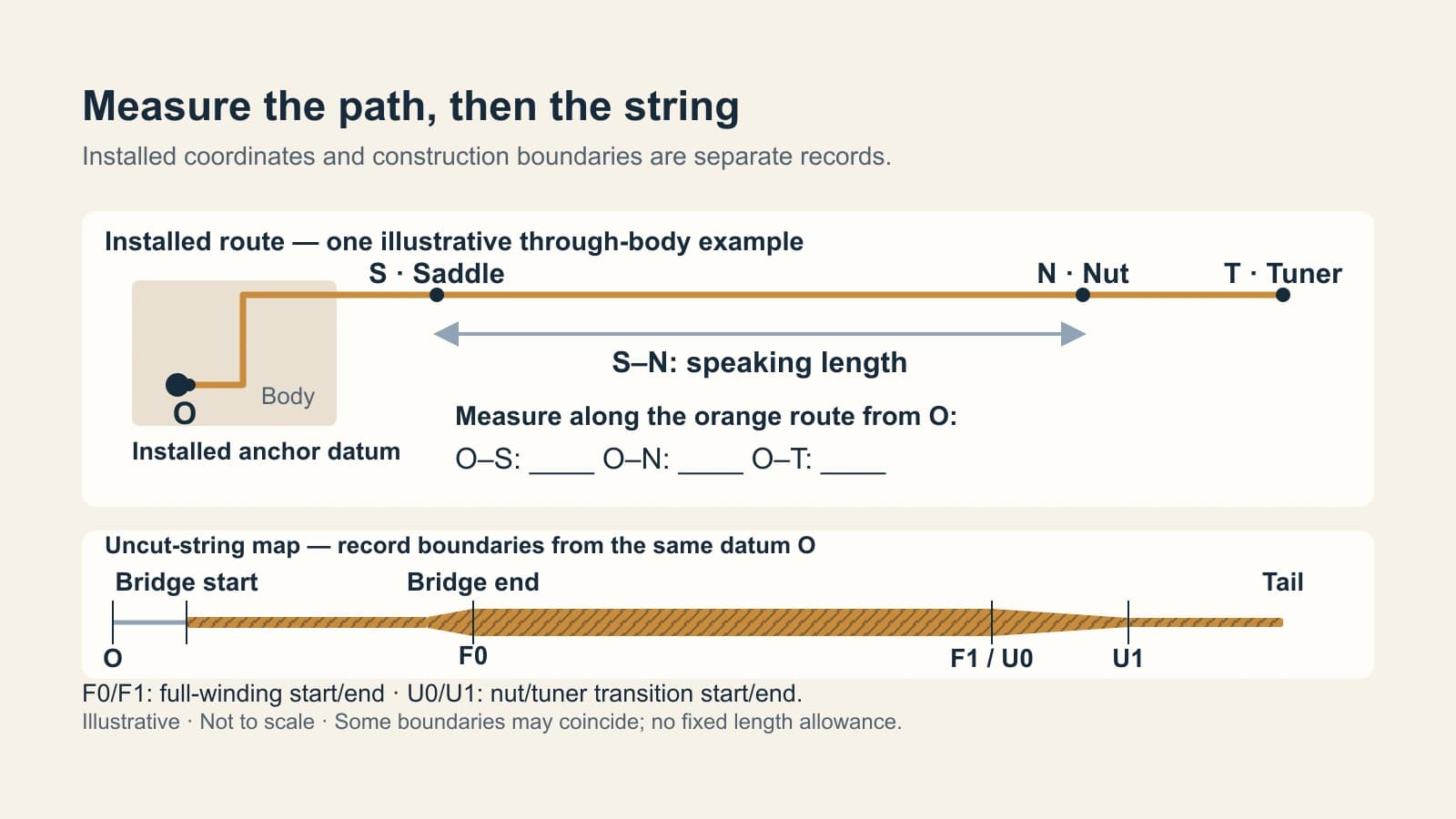
Use one unit throughout the project sheet, such as millimeters. A maker's diagram may give the start of a taper while another gives the end of a full winding or the start of silk. Preserve the endpoint definitions when comparing them. Silk color alone is not a dimensional specification. If a published measurement ends at the “top of the nut,” identify that endpoint on the photograph rather than silently substituting another nut edge.
D'Addario's bass scale-length guide measures its string scale categories from the ball-end junction to the taper and tells buyers to measure from the seated ball end to the nut. In that guidance, the taper being positioned after the nut is the tuning-end transition. It is not a rule forbidding a separate bridge-end taper.
Through-body loading adds a route behind the saddle that an instrument's advertised speaking scale does not describe. Trace and measure that route from the actual anchor, including its bends; do not add a standard allowance. A longer string also needs approval for the bend and loading arrangement. La Bella's FAQ restricts through-body use of its flatwounds to particular families. That restriction belongs to those products, but it illustrates why extra length alone cannot establish compatibility.
Have a reference bass or a proposed dealer range? Send its bridge route, anchor-to-saddle/nut/tuner measurements and close-up photographs. Include the intended saddle contact profile so the inquiry can distinguish a bridge taper from a tuning-end transition.
Use a separate baseline for every string position
The tables below are blank planning worksheets, not measured StringCrest specifications. The direction is low to high pitch. String numbers use the common convention in which the highest-pitched string is string 1. The examples cover ordinary four-string E1–A1–D2–G2 and five-string B0–E1–A1–D2–G2 tuning; write a different pitch sequence explicitly for another configuration.
Fill every blank from the proposed string drawing and reference instrument. “None” means the feature is confirmed absent; an empty field means it has not yet been recorded. Neither means zero length. Enter outside diameters and all length coordinates with units.
Four-string baseline: low to high
| String number | Pitch | Finished gauge / unit | Bridge-region start/end from O; contact profile and diameter | F0 / F1 | U0 / U1 | O–S / O–N / O–T | Overall L |
|---|---|---|---|---|---|---|---|
| 4 | E1 | _____ | _____ | _____ | _____ | _____ | _____ |
| 3 | A1 | _____ | _____ | _____ | _____ | _____ | _____ |
| 2 | D2 | _____ | _____ | _____ | _____ | _____ | _____ |
| 1 | G2 | _____ | _____ | _____ | _____ | _____ | _____ |
Five-string baseline: low to high
| String number | Pitch | Finished gauge / unit | Bridge-region start/end from O; contact profile and diameter | F0 / F1 | U0 / U1 | O–S / O–N / O–T | Overall L |
|---|---|---|---|---|---|---|---|
| 5 | B0 | _____ | _____ | _____ | _____ | _____ | _____ |
| 4 | E1 | _____ | _____ | _____ | _____ | _____ | _____ |
| 3 | A1 | _____ | _____ | _____ | _____ | _____ | _____ |
| 2 | D2 | _____ | _____ | _____ | _____ | _____ | _____ |
| 1 | G2 | _____ | _____ | _____ | _____ | _____ | _____ |
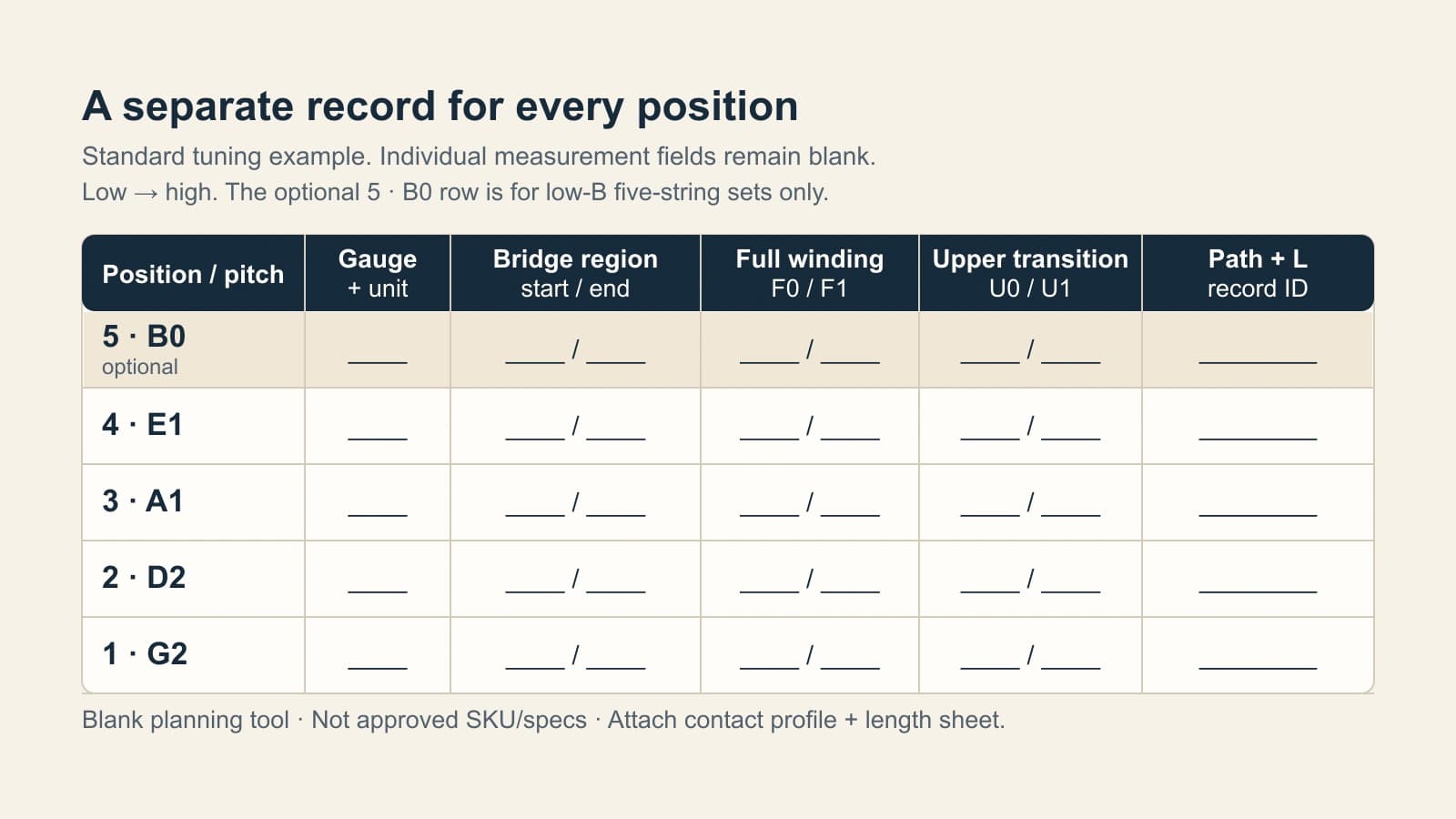
Attach a construction drawing and speaking-length record for each row, along with the reference instrument, loading route and sample revision. Identify which wraps continue in the reduced section; that information cannot be recovered from the finished gauge column. Where a string has no distinct transition, record that confirmed condition rather than inventing U0 and U1. Do not assume the bridge-region boundary coincides with F0; identify any such coincidence explicitly on the drawing.
Do not copy the low B's taper geometry into the other rows. La Bella's bass string guide distinguishes winding endpoints by string position and family. Those product-specific tables demonstrate why a set-level scale name does not replace individual records; their dimensions should not populate a StringCrest worksheet.
Three ways a proposed string can miss the intended fit
The following are hypothetical teaching examples, not customer cases, installation results or product defects. Each assumes the maker's intended construction has already been established.
1. The tuning-end transition arrives before the nut
Assume the reference design requires full-diameter winding over the nut and its ordinary speaking span. The proposed string's full winding ends before the recorded nut contact, placing its tuning-end transition over the nut and toward the first fret.
That proposal fails the stated contact requirement even if its total length reaches the tuner. Check the loading route and the supplier's winding endpoint. Request the appropriate construction or written fit guidance. The problem here is the tuning-end transition; it does not establish that an intentional bridge taper is wrong.
2. Full winding reaches a saddle specified for exposed-core contact
Assume the proposed exposed-core string drawing specifically requires the saddle to contact the uncovered core. On the recorded instrument path, full-diameter winding begins closer to the anchor than the saddle, so the saddle would contact the full winding instead.
The label “exposed core” is accurate but the intended contact is missed on this bridge. Compare O–S with the drawing and consult the maker about suitability. Do not strip winding, move the ball seating point or alter the bridge to make the diagram appear to match. A different bridge-end geometry may be needed.
3. The full-diameter section reaches an incompatible tuner
Assume the full winding continues past the nut and reaches a tuner whose hole or bend arrangement is not approved for that diameter and construction. In this example, F1 and the start of the tuning-end transition U0 lie beyond T: full winding therefore passes both N and T. Nut contact has been satisfied; tuner fit has not.
Record O–T, post and hole details, and the section that would enter and wrap around the post. Ask for the exact product's installation instructions before trimming or tensioning. Stringjoy's FAQ also places the tuning-end taper of its applicable bass strings between the nut and tuning peg. That is a useful attributed example, not a universal cutting rule or a measurement for another maker's strings.
Plan the assortment around documented instrument fit
For a general replacement range, list the actual instruments and loading routes the dealers expect to serve. For a specialist tapered or exposed-core option, state the intended bridge contact and string positions. Add another variant when that documented fit requirement differs, rather than treating tapered and untapered as quality grades.
A five-string program needs its own B0 row and set identity. It should not inherit approval from a four-string sample simply because the E1–G2 gauges look similar. Replacement singles should carry enough identity to match the accepted set's material, gauge and end geometry; a gauge printed by itself cannot establish that match.
The bass guitar category provides the relevant product direction. The nickel-plated steel four-string page is a specification-brief example with scale and individual details to confirm. It is not an approved tapered or exposed-core SKU. For the broader development brief, use the custom bass strings scale, taper and sample guide. Keep this fit worksheet attached to the proposed sample.
FAQ
Does tapered always mean exposed core?
No. A reduced-diameter section can retain winding. Exposed core specifically describes a region without a wrap covering the core. Ask for the section profile and outside diameter instead of treating the two terms as interchangeable.
Is a taper at the saddle automatically a fit error?
No. Some named string families deliberately use a reduced section or exposed core at the bridge. The proposed contact must match that string's design and the instrument's hardware; an intentional bridge taper does not approve every installation.
Does long scale guarantee a string will reach the right contact points?
No. Makers can define string-length categories using different endpoints. Record the seated anchor datum, saddle, nut, tuner entry and construction boundaries for each position. The speaking length alone does not describe a through-body route or the complete winding placement.
Conclusion: confirm fit before installation
Pause before cutting or bringing the string to pitch if the seated anchor reference is uncertain, the bridge contact disagrees with the drawing, the tuning-end transition reaches the nut, or the proposed section will not enter the tuner as instructed. Do the same if through-body compatibility is unconfirmed or the string would require force to seat.
Ask the string maker for product-specific guidance and, where setup work is involved, a qualified technician's assessment. Send the exact product or sample revision, affected position, instrument and loading route, measurements with marked endpoints, and close-up photographs. A universal spare-length allowance, wrap count or cutting instruction cannot resolve an unconfirmed construction. Do not cut the wound portion or modify the hardware while waiting for that guidance.
For a StringCrest project, send the completed four- or five-position brief and your reference-bass photographs. Identify the intended bridge-end construction separately from the nut/tuner transition, and flag every contact that still needs confirmation before a sample is installed.
FROM GUIDE TO PRODUCT
Connect this guide to Bass Guitar Strings.
Review the relevant range, then bring the instrument, complete specification and open questions into one project brief.
YOUR PRODUCT · YOUR BRAND
Discuss your next string project with Frank.
Share your instrument category, target market, gauge or material direction and private-label packaging requirements.

ABOUT THE AUTHOR
Frank Zou
Frank works directly with musical-instrument brands, importers and distributors on string specifications, product selection and private-label project requirements.
Meet Frank