
Product Selection
Private Label
Custom Bass Strings: A Private-Label Scale, Taper and Sample Guide
A B2B method for turning a custom bass-string idea into a position master, installed-fit sample and controlled private-label product.
Introduction
Buying custom bass strings for a private-label range requires more than choosing four or five outside diameters. A usable specification must connect the instrument’s string count, tuning and measured scale with the ball-to-taper geometry of every position. It must also define construction, materials, end details, installed fit, packaging identity and the records that will control later orders.
This matters because “long scale” is not a complete engineering instruction. Manufacturers may define scale families by their own ball-to-taper measurements, and basses with the same nominal scale can use different bridge routes, tuner locations and winding paths. A wound section that is suitable for one reference bass may place a taper too early or wrap a thick full-diameter section around a tuner on another.
The practical solution is a position-by-position brief followed by installed samples. This guide explains how brands, distributors and product managers can build that brief, screen a proposed gauge family, review taper and usable length, approve samples and carry the result into packaging and receiving inspection. It does not state StringCrest MOQ, lead time, capacity, proprietary formulas or compatibility with every bass. Those items require a current quotation and a project-specific sample review.
Define the bass application before discussing gauges
Record string count, tuning and player task
Start by stating whether the range is for four-, five- or six-string bass. List the pitch for every position instead of relying on a general label such as “standard” or “drop.” A five-string project may add a low B, while a six-string project commonly adds both a low and a high position, but the buyer must still write the exact tuning being evaluated.
Then describe the application. A general retail set, lower-tuning set, bright stainless direction, smoother-feel direction and extended-range set answer different product questions. The brief should explain why the custom set is needed and which existing set or player problem is the reference. That context helps the supplier propose a coherent construction rather than treating each gauge as an isolated single.
Avoid declaring that one sequence is “balanced” until the project defines what balanced means. It could refer to calculated tension progression, familiar left-hand feel, controlled output between positions or a player-approved comparison. Each method needs a recorded baseline and consistent test conditions.
Measure the reference bass, not only the catalog scale
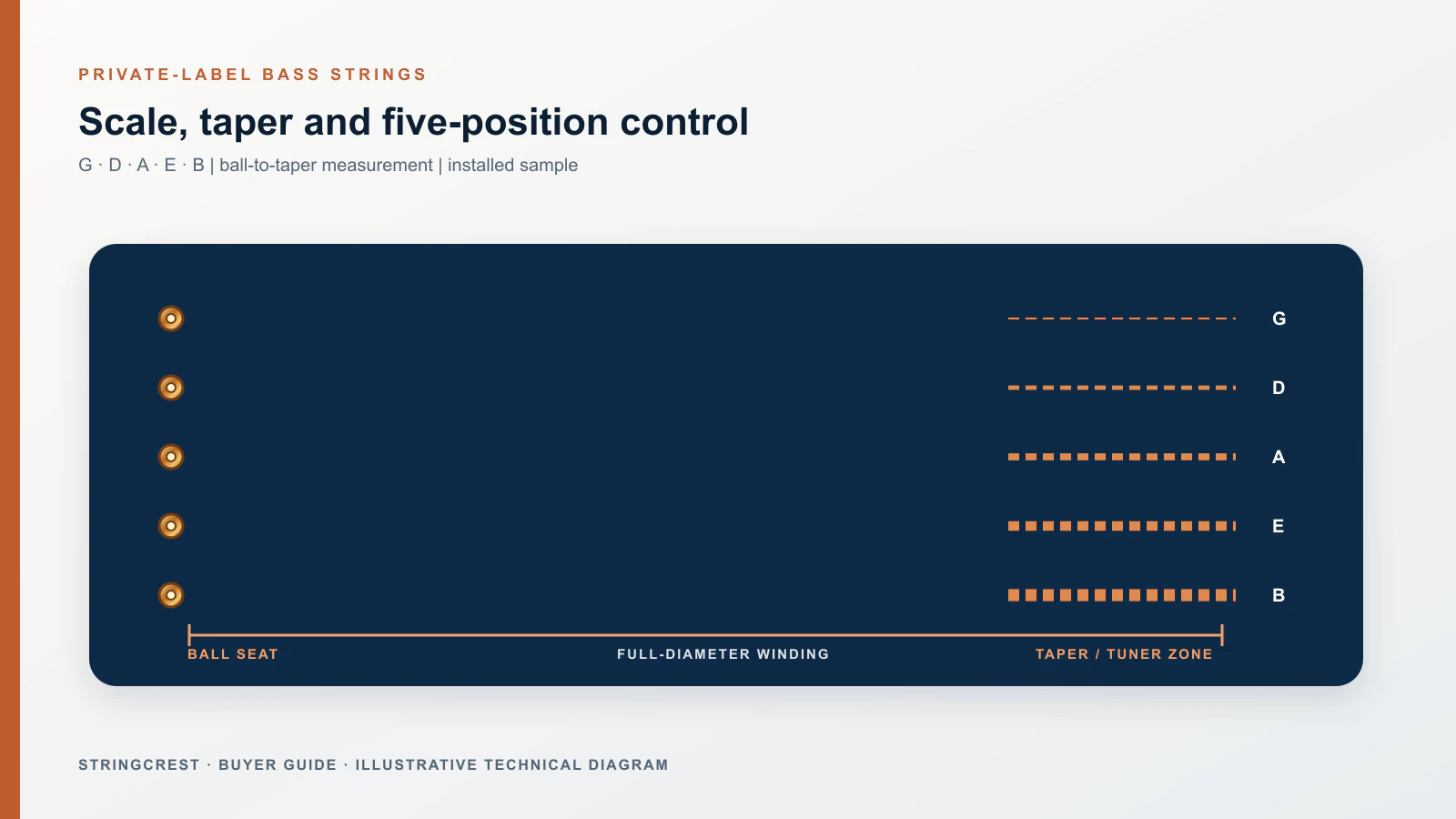
Nominal scale is the speaking length from nut to bridge saddle. It is essential, but it does not describe the complete string path. Record the distance from the ball-end seating point to the saddle, from the ball seat to the nut and from the ball seat to each tuner post. Note whether the bridge is top-load, through-body or uses another route.
Photograph the installed reference set at the bridge, nut and tuner. These images help show where the silk, taper or full-diameter winding begins and ends. They also reveal whether a proposed heavy string will make a sharp turn, enter a narrow tuner hole or require an impractical number of wraps.
| Project input | What to record | Why it changes the decision |
|---|---|---|
| String count | Every intended position | Controls set architecture and replacement singles |
| Tuning | Pitch for every position | Affects tension direction and sample tasks |
| Speaking scale | Nut to saddle | Required for tension comparison |
| Ball-to-taper need | Installed measurement by position | Distinguishes tuner transition from intended bridge taper |
| Ball-to-tuner path | Bridge route to post | Checks whether winding and taper reach correctly |
| Reference bass | Model and setup state | Makes fit comments reproducible |
| Range role | Core, alternate tuning or specialist | Keeps customization tied to a sellable purpose |
Build a complete position specification
Treat each string as its own controlled component
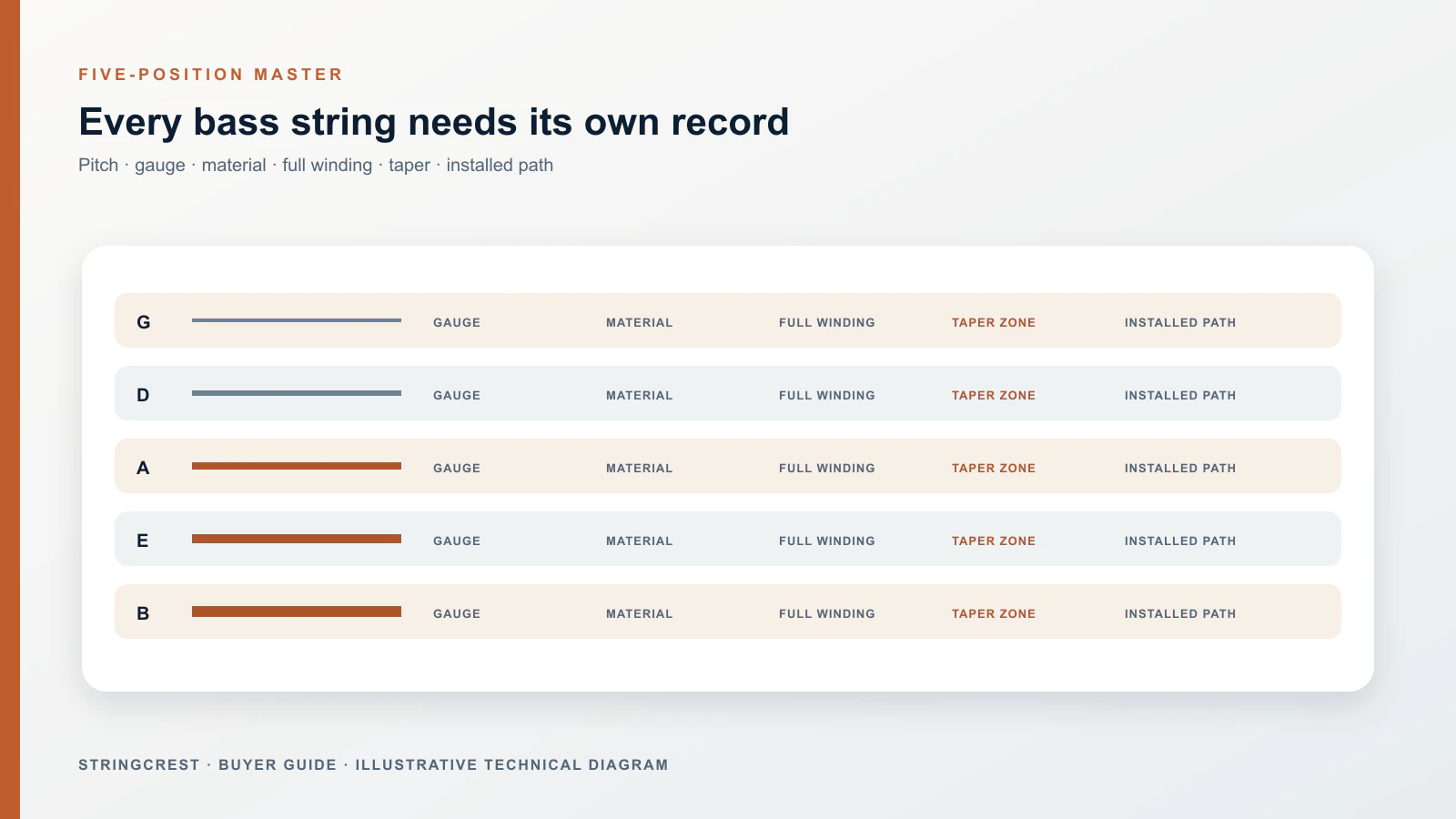
Create one row for G, D, A and E in a four-string set, then add B or C positions explicitly when required. Each row should contain target pitch, finished gauge and unit, plain or wound status, core direction, wrap direction, material, coating or treatment, ball end, overall length, full-diameter winding length and intended taper location.
This table prevents two common errors. First, the supplier does not have to infer middle gauges from the highest and lowest numbers. Second, the buyer can distinguish strings that share an outside diameter but use different internal construction. Finished gauge alone does not define core-to-wrap relationship, flexibility, surface or unit weight.
Use one unit system consistently and show conversions only when they help a market read the pack. Record the allowed precision in the technical document rather than adding decimal places that the production control cannot support.
Connect technical identity to the retail SKU
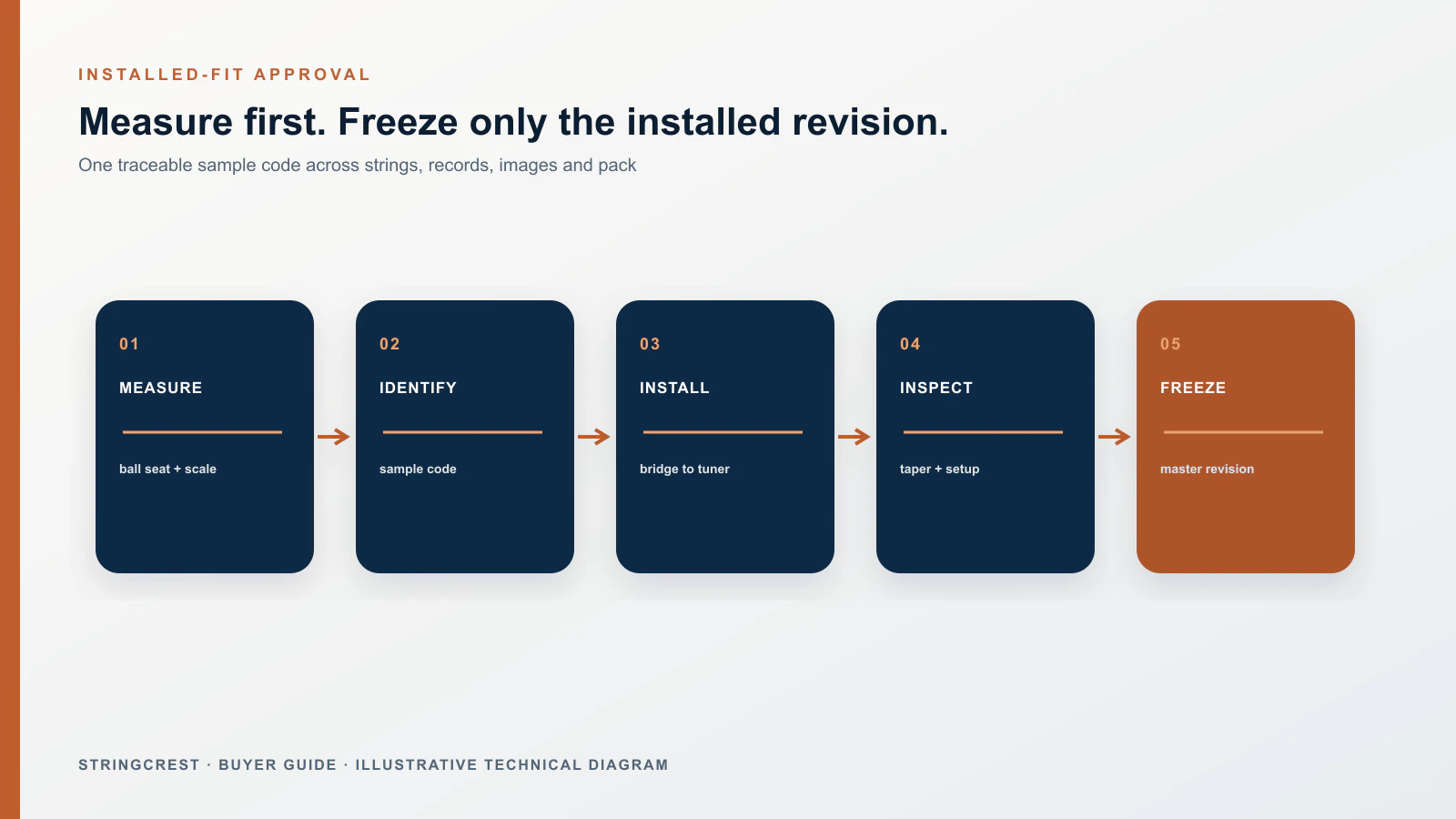
Give every proposed set and sample revision an unambiguous code. The code should appear on the loose-string separator, sample pack, evaluation form and image record. A handwritten note saying “custom 45–130” is not adequate if the middle positions, taper geometry or material can differ.
The retail item code can be assigned later, after the installed sample is approved. Keeping development codes separate prevents an early experimental pack from being mistaken for the final product. When the project reaches approval, link the final position table, sample code, artwork version, barcode and purchase-order revision in the product master.
Understand scale labels and taper geometry
Use supplier-specific measurements carefully
Public bass-string guidance from D’Addario describes its scale families using the distance from the ball end to the taper. That is a useful example of why a buyer must ask how a supplier measures scale, but the exact dimensions belong to that manufacturer’s products. They should not be copied into a StringCrest specification as universal values.
Ask the supplier to state the reference point for each length. “Ball to taper” may mean the contact point of the ball at the bridge, the center of the ball or another controlled point. Define whether the taper begins where the outer wrap changes, where the full-diameter section ends or where a silk section starts. A drawing is clearer than a label alone.
Distinguish tuner transitions from bridge taper designs
On a conventional fully wound bass string, verify the intended full-diameter section at the nut and bridge. The tuner-side transition must suit the nut-to-post path. Bridge-side taper or exposed-core construction is a different design: a reduced section may intentionally contact the saddle. La Bella’s FAQ describes a ball-end taper on its flatwound low-B strings produced before May 2025, and says it stopped tapering those low-B strings from May 2025. This does not establish compatibility for another set or bridge. Record the exact transition, contact point and installed geometry against the string maker’s and instrument maker’s instructions; do not reject all bridge tapers merely because they reach the saddle. A thick wound section must also be suitable for the tuner post.
The correct transition depends on the intended bass and string design. The buyer should provide target zones and let the installed sample confirm them. Do not promise broad compatibility based only on “short,” “medium,” “long” or “super long” wording.
Screen gauge and tension direction without overpromising
Compare every position under the same assumptions
Gauge is one input to tension, not the full calculation. Pitch, vibrating length and unit weight also matter. A heavier outside diameter usually changes the tension direction, but two strings with the same nominal gauge can produce different calculated values when their construction and unit weight differ.
Use verified unit-weight data for the proposed construction when available. If the exact data is unavailable, treat any calculation as a planning estimate. Record the scale and pitch used, review the progression position by position and confirm the result by installing the actual sample.
A set-total number can conceal a large step between adjacent strings. Review transitions from G to D, D to A, A to E and E to low B where applicable. The goal is not necessarily numerical equality. The goal is a documented progression that supports the intended tuning and player task.
Consider the low-B position as a separate engineering decision
The lowest string can be particularly sensitive to scale, construction, taper and tuner fit. A buyer should state whether a low-B position is required, which basses will be used and what reference set defines acceptable feel and response. The supplier may propose a tapered or non-tapered direction, but the proposal remains provisional until it is measured and installed.
Do not borrow a competitor’s published low-B gauge and assume the same result. Even when the outside number matches, differences in core, wrap, taper and unit weight can change the installed behavior. Use competitor specifications only to understand market conventions, never as proof of StringCrest performance.
Choose materials and construction as a system
Keep wrap material separate from scale and gauge changes
Nickel-plated steel, stainless steel and other declared wrap directions should be evaluated as construction choices. If the development question is material, keep gauge, scale and as many other variables as practical constant between samples. If material, core, gauge and taper all change together, the evaluation cannot identify which variable produced the observed difference.
The same rule applies to roundwound, flatwound and tapewound directions. These are distinct product architectures, not surface labels that can be switched without reconsidering gauge, installed length and range role. Begin a separate sample ladder when the construction family changes materially.
Define coating or treatment claims conservatively
If a coating or surface treatment is proposed, specify which strings receive it and how the pack will describe it. Do not publish a fixed-life multiplier or corrosion guarantee without suitable evidence for the final construction and conditions. A safer early claim identifies the treatment accurately and directs buyers to the approved specification.
Packaging copy should never outrun the sample record. Terms such as “maximum sustain,” “perfect balance” or “universal fit” require evidence that a private-label development brief normally does not provide.
Design a sample plan that isolates decisions
Begin with an identified baseline
Sample A should be a documented baseline. Sample B should change the main variable being investigated, such as the low-string gauge or taper zone. Sample C may refine the most promising direction. This sequence creates useful evidence because the team can connect feedback to a known difference.
For every sample, record the exact set table, production or sample date, installed bass, scale, bridge route, tuner type and setup state. Keep photographs of ball seating, saddle path, nut contact, taper location and tuner wraps. Comments such as “feels better” should be accompanied by the musical task and the comparison set.
Evaluate fit before preference
First check whether each string seats correctly and reaches the tuner with the intended winding section. Check the nut-side transition separately from any bridge taper or exposed-core section. Confirm that the intended section seats on the saddle for this design and that the tuner receives a suitable section. Note any nut, saddle, intonation or neck adjustment required.
Then evaluate the musical use case: attack, articulation, left-hand resistance, transition between strings, low-position response and stability after installation. These observations are comparative sample notes, not universal performance claims. Different instruments, players and setups can produce different results.
Plan the range, singles and packaging together
Decide whether the custom set stands alone
A custom five-string set may need a matching four-string core set, a six-string extension or replacement singles. Decide the architecture before assigning SKUs. Otherwise the brand can launch one appealing set while leaving dealers unable to replace a low B or explain the relation between related packs.
Use a matrix showing string count, complete gauge sequence, material, scale family and taper type. Mark which components are shared and which are unique. This supports clearer inventory planning without assuming that every niche variation should be stocked.
Put decision-critical facts on the pack
The front and back of the package should make the product identifiable: instrument, string count, complete gauges, declared material or construction, scale/fit wording approved for the project and a revision-controlled item code. If the set targets an alternate tuning, use wording supported by the installed sample and state setup limitations where relevant.
Inner separators or envelopes should identify position and gauge clearly. For a set with a low B or high C, position labeling reduces packing and customer-selection errors. Packaging inspection should verify that the printed sequence matches the actual set master.
Establish receiving and reorder controls
Development testing and shipment inspection have different purposes
Development testing selects a specification. Receiving inspection checks whether a shipment conforms to the approved identity. A receiving plan can review item and lot codes, set count, pack condition, position labels, gauge sequence, ball-end appearance, selected dimensions and installed fit points agreed for the project.
Visual inspection does not prove alloy composition, internal core ratio or every process attribute. Critical material or construction claims require supplier documentation or an appropriate verification method. Shipment photos should be described as packing or condition evidence, not laboratory proof.
Freeze a change-control rule
The technical agreement should require notice before changing an approved gauge, core, wrap, treatment, ball end, taper geometry, length or package component. The buyer can then decide whether document review, dimensional checks or a new installed sample is necessary.
Use the same revision on the quotation, purchase order, product master and artwork. A familiar SKU name is not enough to show that the underlying construction is unchanged.
Prepare a useful custom-bass RFQ
Include the following information in the request:
- four-, five- or six-string architecture and the role of each SKU;
- pitch and tuning for every position;
- complete proposed gauge sequence with units;
- scale, ball-seat-to-saddle and ball-seat-to-tuner measurements;
- bridge route, tuner constraints and reference basses;
- material, round/flat/tape construction, coating and ball-end direction;
- target full-diameter winding and taper zones by position;
- baseline product, sample ladder and installed evaluation tasks;
- packaging, barcode, position labeling, case pack and traceability needs;
- commercial request for current sample terms, MOQ, quotation validity and lead time.
Unknown fields can be marked as requests for proposal. Keep supplier proposals visibly separate from confirmed requirements until a sample and document review approve them.
FAQ
Is “long scale” enough information for a custom bass set?
No. Confirm how the supplier measures the scale family, then provide the reference bass, bridge route and ball-to-taper or ball-to-tuner measurements needed for installed fit.
Can I specify only the highest and lowest gauges?
No. Every string needs a gauge, pitch, construction and length identity. The middle positions determine progression and must not be left to assumption.
Does a thicker low B guarantee a better result?
No. Gauge changes tension direction, but scale, tuning, unit weight, taper, construction and setup also matter. Compare calculated direction cautiously and approve the actual installed sample.
Should taper start at the same distance on every position?
Not automatically. Position, gauge, bridge route and tuner location can differ. Define the measurement method and approve each position against the intended instruments.
How many sample revisions are required?
There is no universal number. Use enough controlled revisions to answer the fit, progression and application questions. Approve only when the exact revision is documented.
Can one custom set be labeled compatible with all basses of the same nominal scale?
That claim is too broad without evidence. Basses can differ in bridge and tuner geometry. State the verified fit basis and ask buyers to confirm critical measurements.
Conclusion
A reliable custom bass-string range begins with an instrument and commercial problem, then translates it into a position master. Scale, gauge, material and taper must be considered together, yet changed systematically enough that sample feedback remains interpretable.
Brands that measure the installed path, isolate sample variables and connect the approved strings to packaging and reorder records can discuss private-label development with less ambiguity. They also give dealers better information than a simple first-to-last gauge label.
Explore StringCrest bass guitar strings · Send your custom bass-string specification
Sources and interpretation limits
- D’Addario: bass-string scale-length definitions
- D’Addario: bass-guitar single strings and available specification examples
- D’Addario string-tension specifications reference
These sources explain general string relationships and one manufacturer’s scale definitions or product examples. They do not confirm StringCrest dimensions, formulas, availability, compatibility, sample results, MOQ, capacity or delivery time. Final requirements must be established through the current specification, quotation and approved sample.
FROM GUIDE TO PRODUCT
Connect this guide to Bass Guitar Strings.
Review the relevant range, then bring the instrument, complete specification and open questions into one project brief.
YOUR PRODUCT · YOUR BRAND
Discuss your next string project with Frank.
Share your instrument category, target market, gauge or material direction and private-label packaging requirements.

ABOUT THE AUTHOR
Frank Zou
Frank works directly with musical-instrument brands, importers and distributors on string specifications, product selection and private-label project requirements.
Meet Frank