
Buying Guides
Wholesale Planning
Piccolo Bass Strings: An Octave Register and Fit Guide for Dealers
Separate an octave-up piccolo request from short-scale or high-C bass strings, then record the proposed components, actual bass fit and setup questions.
Introduction
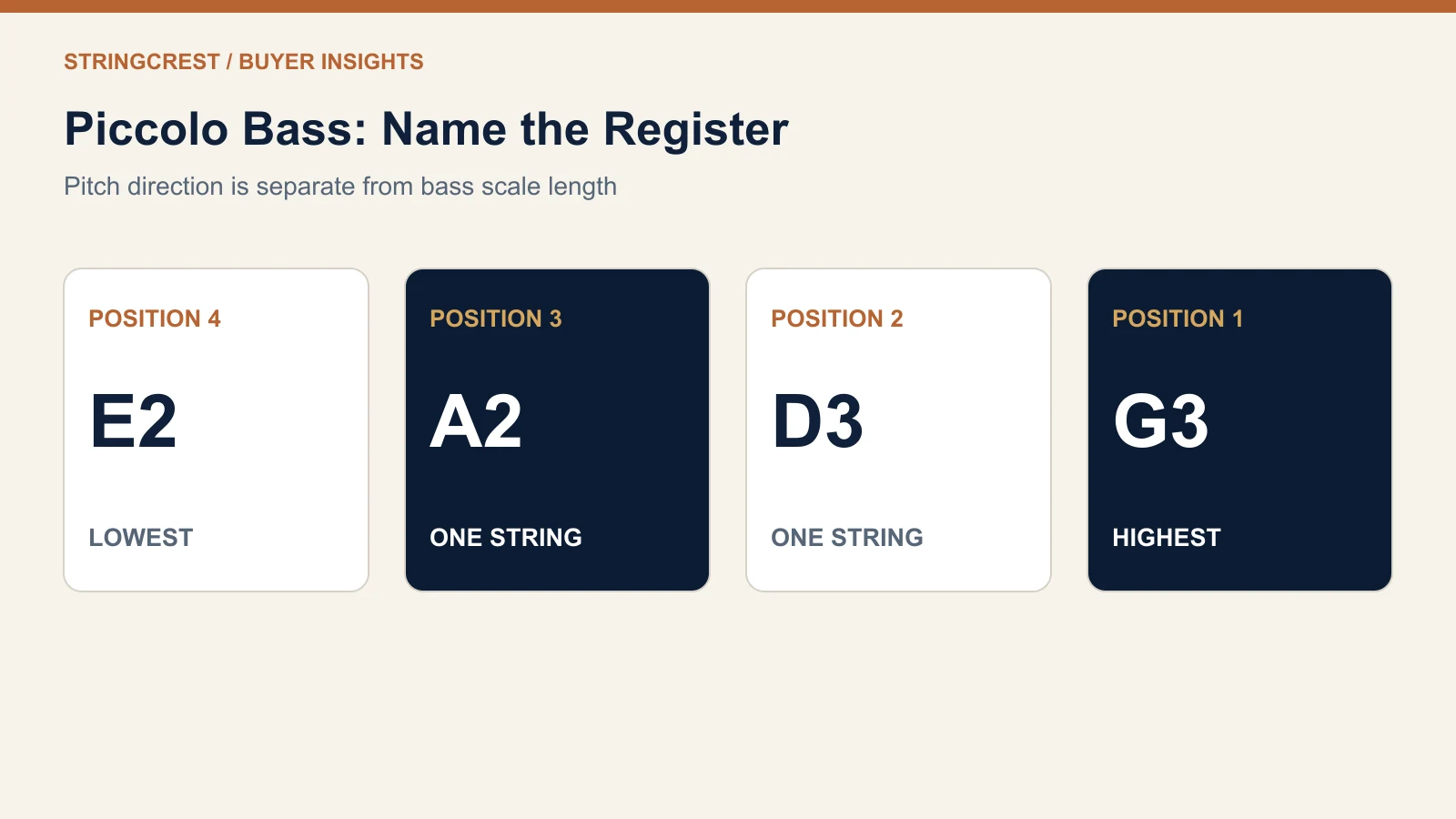
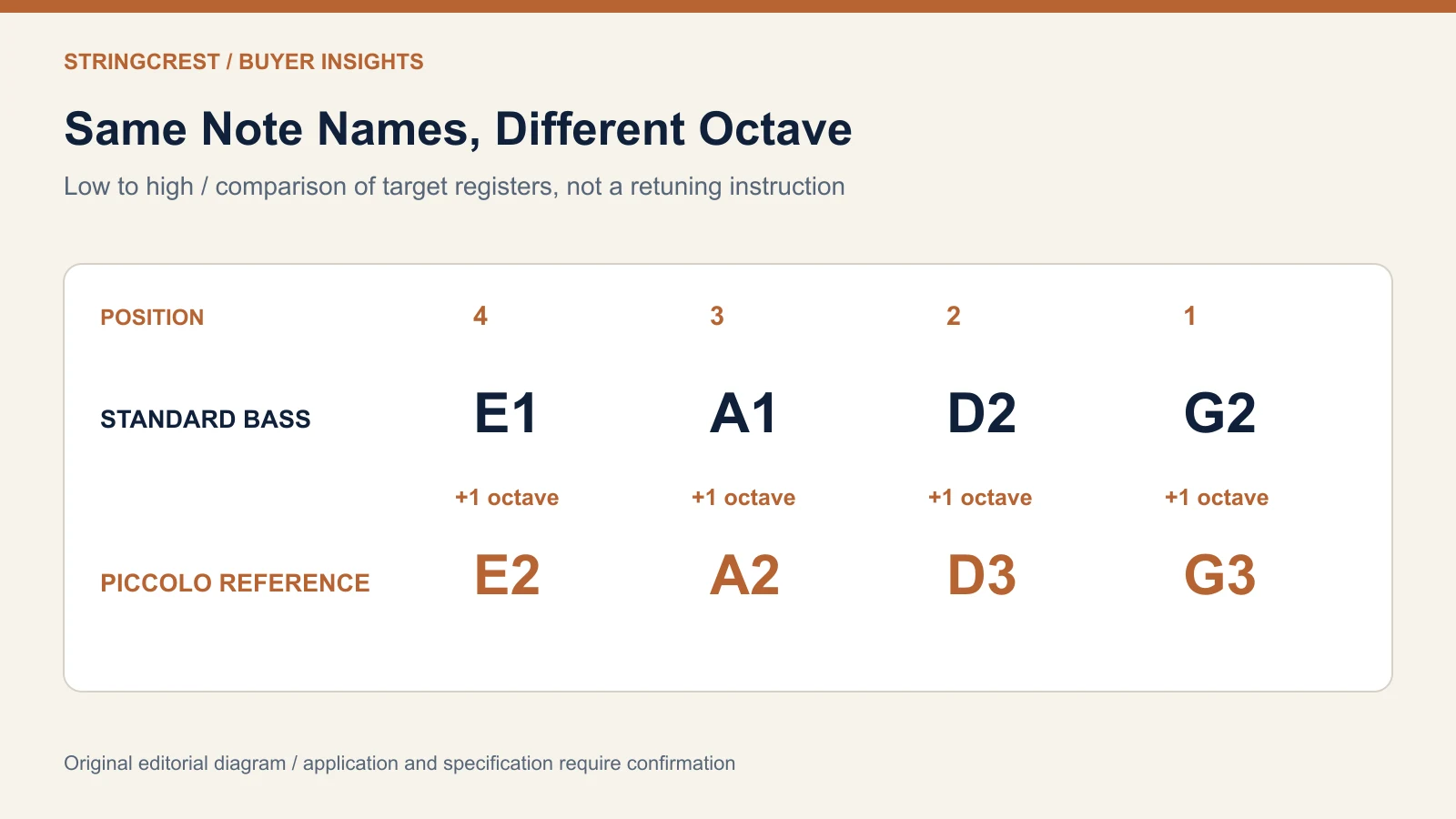
Piccolo bass strings are intended for an octave-higher register on a bass guitar. In the four-string configuration covered here, the open pitches are E2–A2–D3–G3, from lowest to highest. A conventional four-string bass uses E1–A1–D2–G2. The letter names stay the same; the octave changes at every position.
For a dealer or importer, that distinction should come before a gauge recommendation. “Piccolo” identifies the intended register in this discussion. It does not specify a short-scale instrument, prove that a set fits a customer's bass, or authorize tuning an ordinary bass set up an octave. Identify the intended strings and actual instrument, resolve their fit, then evaluate the setup and playing result.
Put the octave on every position
Use the common numbering convention in which physical string 1 is the highest-pitched string. The table reads low to high pitch, so string 4 appears first. These are open-string pitches, not transposed staff notation.
| Physical string | Conventional four-string bass | Piccolo configuration here |
|---|---|---|
| 4 — lowest | E1 | E2 |
| 3 | A1 | A2 |
| 2 | D2 | D3 |
| 1 — highest | G2 | G3 |
D’Addario provides a specific current example: its EXL280 piccolo set is described for an octave above ordinary bass, and its chart lists G3, D3, A2 and E2. The manufacturer's EXL170 chart supplies the conventional G2, D2, A1 and E1 comparison. Reversing the chart order produces the low-to-high map above.
Those named products establish useful register references. Their gauges, construction, tension figures and length designations belong to those products. A different proposed piccolo set still needs its own complete specification.
On a dealer record, write “4 / E2” rather than just “E.” Carry that identity through a loose-string label, replacement request and service note. If a tuner displays the note letter without an octave, that display alone does not establish which register has been reached. Use a suitable pitch reference and the product's stated tuning.
Separate piccolo, short scale and high C
Three requests can sound similar at the counter while requiring different products:
- Piccolo register: the four positions above move to E2–A2–D3–G3. The actual bass still needs an individual fit assessment.
- Short-scale replacement: the request concerns instrument and installed-string length. It does not establish an octave change. Ask for both the bass model and its intended tuning.
- Extended-range high C: a conventional six-string configuration can run B0–E1–A1–D2–G2–C3. It extends the range at both ends rather than moving the four-string configuration up an octave.
D’Addario's EXL165-6 chart is a named example of that six-string register. The five- and six-string range guide also separates the low-B five, standard six and high-C five alternatives.
The EXL280 example is labeled long scale, which also shows why the word piccolo should not be used as a synonym for short scale. Its label does not establish fit on every long-scale bass. A customer's request for a “higher bass sound” needs a follow-up about the actual open pitches, string count and instrument before a replacement can be identified.
Check the actual bass before selecting a replacement
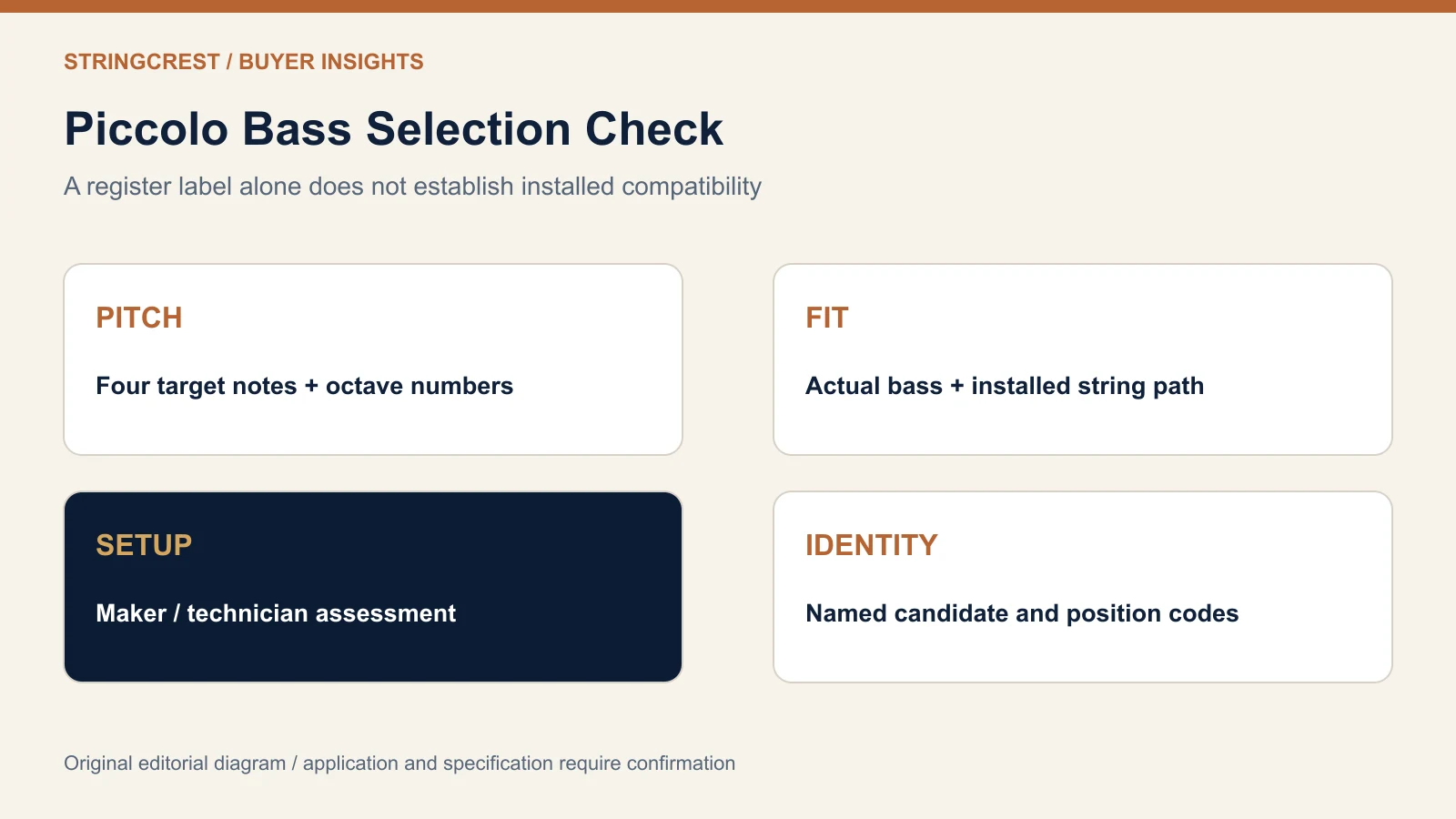
Start with the bass make and model, any hardware changes, and its current tuning. Identify the proposed string maker, exact set or component and revision where available. Keep the customer's existing set as a reference identity; do not assume it is suitable for the proposed register.
Record the speaking length between the effective nut and saddle contacts for each position. Separately record the installed path from a stated seated anchor reference to the saddle, nut and tuner. Include the real bridge route. Through-body loading can add a path behind the saddle that the speaking length does not describe; measure that route rather than adding a standard allowance.
D’Addario's bass-length guidance uses a ball-to-taper definition for its own categories and a seated-ball-to-nut measurement when selecting them. That is a manufacturer-specific measurement system. Preserve its endpoint definitions when checking those strings, and obtain the corresponding definitions for another proposal.
The bass scale-length guide explains the broader length vocabulary. For the contact details, use the taper and winding-transition guide. A bridge-end reduced section and a tuning-end transition are separate features. The correct contact depends on the exact string design and hardware; an intentional bridge taper is not automatically an installation error.
For piccolo, the immediate decision is whether the identified string has the correct endpoints, usable sections and contact profile for this bass. Reaching the tuner answers only one part of that question. Do not cut or force a string into place while those details remain unresolved.
Complete a four-position application record
Use a separate record for each proposed set and bass. The reference pitches are supplied below; all product and evaluation fields are deliberately blank. This is a planning worksheet, not an approved StringCrest SKU or a completed fit test.
Reference bass and hardware revision: ______
Current set/tuning: ______
Proposed set/revision and specification source: ______
Installed-path drawing ID, datum and units: ______
| Physical position, low to high | Target pitch | Proposed component/revision | Gauge and unit | Plain/wound; core/wrap; treatment or finish | Position fit-record ID |
|---|---|---|---|---|---|
| 4 | E2 | ______ | ______ | ______ | ______ |
| 3 | A2 | ______ | ______ | ______ | ______ |
| 2 | D3 | ______ | ______ | ______ | ______ |
| 1 | G3 | ______ | ______ | ______ | ______ |
Each position's linked fit record should contain its speaking length, anchor-to-hardware path measurements, end interface, overall length and applicable winding or transition boundaries. Record the intended section at the saddle, nut and tuner. A plain string has no winding boundaries to measure; mark those fields “not applicable” after confirming its construction.
Use “unknown” for information not established and “not checked” for an inspection not performed. “None” means a feature has been confirmed absent. None of these states means a measurement of zero or a passed check. Keep the source document or written manufacturer answer with the relevant field.
The construction column matters even when the intended pitch is known. “Piccolo” does not declare the core, wrap or plain-string material at every position. Nor does a matching printed diameter establish an identical replacement component.
Reassess setup and record the playing result separately
A register change calls for a fresh setup assessment on the actual bass. Have a qualified technician assess nut support, neck relief, action, saddle adjustment and intonation as appropriate to the instrument and proposed strings. The necessary work and available adjustment range are instrument-specific. No universal truss-rod turn, nut modification or saddle distance follows from the word piccolo.
Installation and tuning should follow the applicable string and instrument guidance. An ordinary bass set should not be selected for an octave-up attempt simply because its four note letters match the target. If product identity, intended tuning or hardware fit is uncertain, pause and obtain guidance before tensioning or making irreversible changes.
Once installation is suitable, record a small number of relevant playing tasks: open and fretted notes, the range the customer will use, transitions between positions, and the intended attack. Keep technical observations distinct from preference. A string can fit the documented contacts while the player prefers a different response; a pleasing recording cannot resolve an unconfirmed fit.
| Evaluation field | Entry to complete |
|---|---|
| Bass, proposed set/revision, date and evaluator | ______ |
| Setup before/after; changes and responsible technician | ______ |
| Position and confirmed open pitch | ______ |
| Task, attack and fretted-note/intonation check method | ______ |
| Pickup selection, controls, signal path and recording gain | ______ |
| Observations; fit/setup decision; remaining question | ______ |
| Player preference and the task it concerns | ______ |
When recordings are used, retain the raw fixed-gain version for output comparisons. A separately level-matched copy can support a tonal-preference comparison, with that processing identified. If samples differ in several construction fields, describe them as complete-product comparisons. The record cannot attribute every difference to the octave register or one material.
Give stock and return inquiries a clear identity
Keep piccolo requests distinct from conventional four-string replenishment, short-scale requests and extended-range sets. Use the complete register on the internal item description and dealer reference. Supplier-confirmed gauges, length information and component identities can then be added without letting the word piccolo stand in for them.
For a return inquiry, first separate three questions: was the requested register identified correctly; does the exact supplied product match the bass's path and contacts; and what did the setup and playing assessment find? The answer can remain unresolved until evidence arrives. An unusual feel alone does not identify a manufacturing fault, and a fit problem should not be dismissed as preference.
For example, suppose a customer ordered for E2–A2–D3–G3 but the dealer record contains only “EADG, short scale.” That is a hypothetical identification gap, not a reported StringCrest case. Establish the original request and exact product before proposing an exchange. Do not resolve the ambiguity by advising the customer to retune the unidentified set.
The bass guitar strings category provides category context. The custom-bass guide covers the broader development and sample-approval brief. Neither link confirms a StringCrest piccolo SKU, availability or compatibility. Confirm the proposed product and project scope before creating an orderable item or promising a replacement.
FAQ
Can a piccolo set supply replacement singles for an ordinary bass set?
A shared note letter is insufficient. Compare the intended octave, component identity, construction and installed fit. E2 in the piccolo configuration and E1 in an ordinary set are different target pitches. Any proposed shared use needs the maker's confirmation for that application.
Can a dealer promise a reversible swap with no setup work?
That promise needs an assessment of the actual bass and both string configurations. Record any changes made during the conversion, especially changes to hardware or nut support. Ask the technician what returning to the original configuration would require before describing the swap as reversible.
Conclusion
A useful piccolo-bass recommendation starts with four explicit pitches and one identified bass. Complete the position record, resolve the actual installation, and give setup findings and playing preferences their own entries. That gives dealers a sound basis for a stocking or replacement decision while keeping unconfirmed compatibility open.
FROM GUIDE TO PRODUCT
Connect this guide to Bass Guitar Strings.
Review the relevant range, then bring the instrument, complete specification and open questions into one project brief.
YOUR PRODUCT · YOUR BRAND
Discuss your next string project with Frank.
Share your instrument category, target market, gauge or material direction and private-label packaging requirements.

ABOUT THE AUTHOR
Frank Zou
Frank works directly with musical-instrument brands, importers and distributors on string specifications, product selection and private-label project requirements.
Meet Frank