
Wholesale Planning
Buying Guides
8-String Bass Strings: An Octave-Course Buying Guide
Four bass courses need eight distinct component identities. Separate fundamentals from octave companions, then check each member’s pitch, usable path and replacement reference.
Introduction
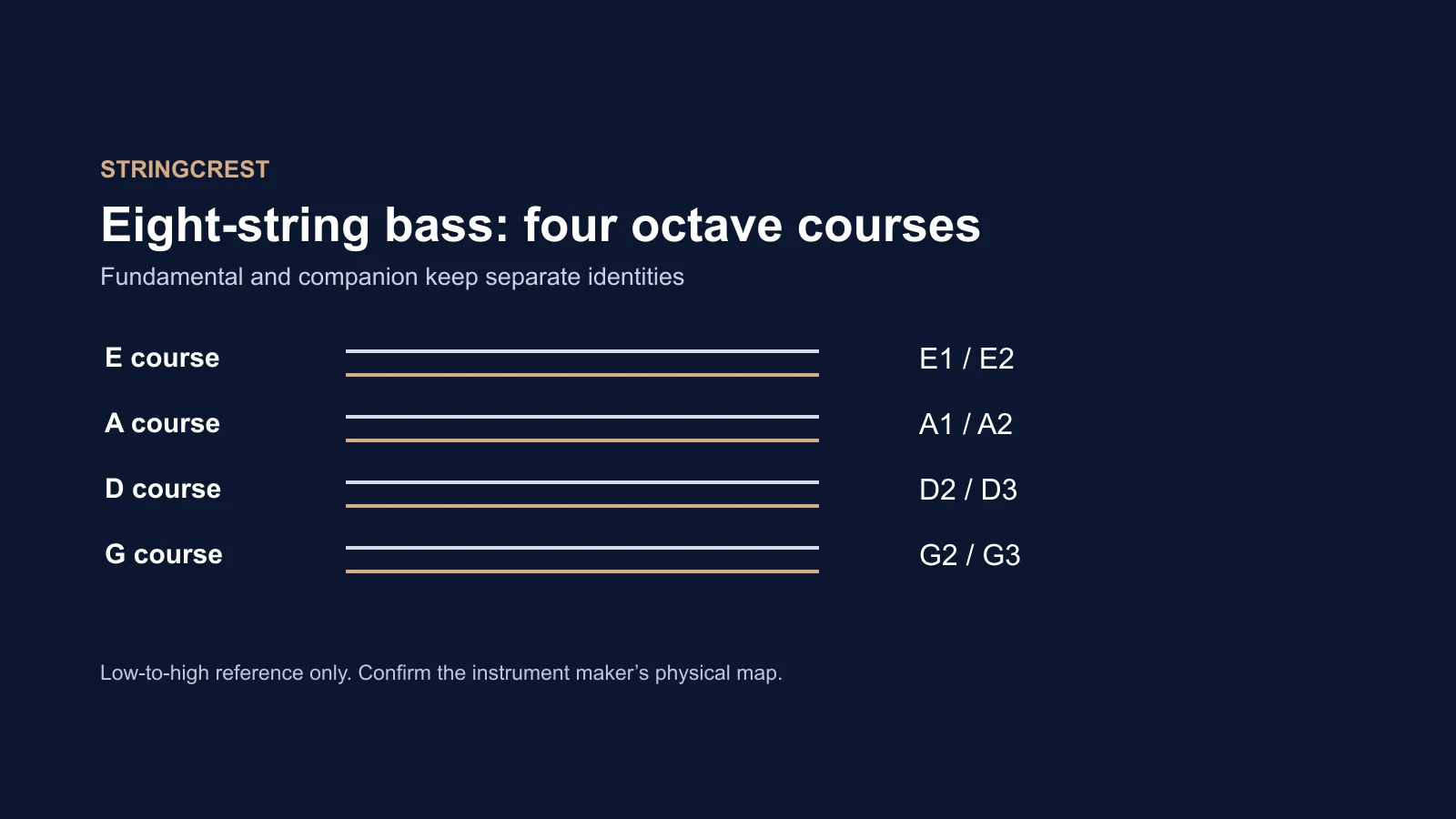
For an octave-course bass, 8 string bass strings form four pairs: each familiar bass position has a companion one octave higher. Identify the instrument and its pairing map before buying a replacement. Eight physical strings do not by themselves tell a dealer whether the customer needs four paired courses, eight separate playing positions or strings for an eight-string electric guitar.
This guide addresses the four-course bass application. It gives dealers and importers a way to distinguish the fundamental from its octave companion, check their separate fit requirements and identify the contents of a complete pack. A reference pitch map explains the configuration; the blank buying record leaves actual gauges, lengths and component proposals to the application being discussed.
Confirm four courses before choosing a set
Start with the bass maker and model, a clear view of the string arrangement and the maker’s recommended tuning. Count the playing courses as well as the strings. In the configuration covered here, a player sounds two strings together at each of four musical positions.
D’Addario’s EXL170-8 product page describes adding octave strings to its bass selection. Its eight-row chart identifies the pairs shown below. The table rearranges that named chart into low-to-high course order; it does not prescribe where either member sits on every instrument.
| Course, low to high | Fundamental member | Octave companion |
|---|---|---|
| E | E1 | E2 |
| A | A1 | A2 |
| D | D2 | D3 |
| G | G2 | G3 |
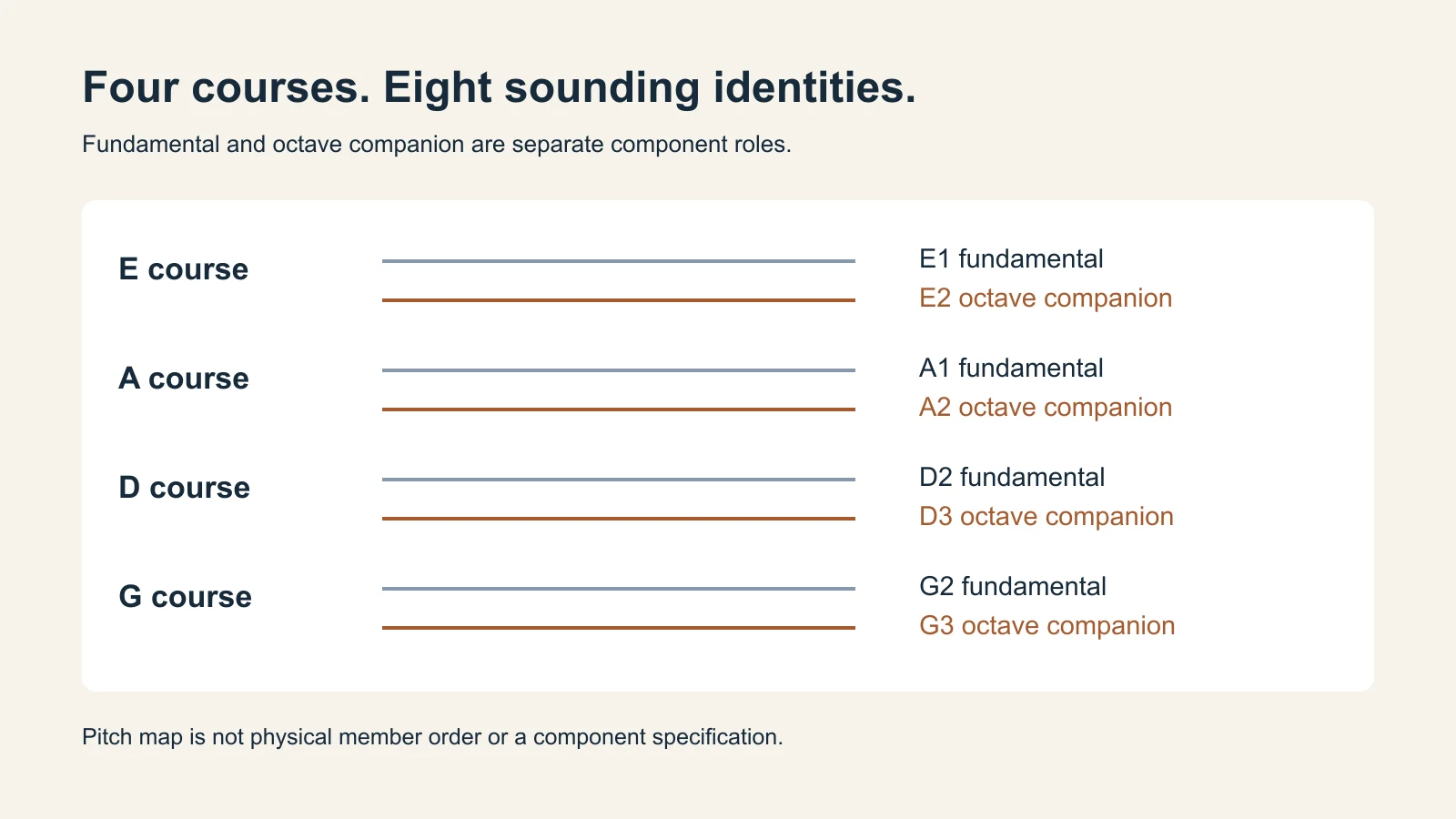
These are sounding open pitches, including octave numbers. The two E members share a note letter but occupy different registers. Neither an unlabeled E packet nor a tuner showing only the letter E fully identifies the intended component.
For an instrument with eight independently played positions, obtain that instrument’s complete map instead. The five- and six-string bass range guide addresses added independent positions; its range logic should not be used to infer this paired configuration. The extended-range electric guitar guide concerns another instrument family altogether.
Keep physical order separate from this reference table
Write which side of the neck and which viewing direction a diagram uses. Within each course, identify the fundamental and companion by role and target pitch. Do not assume that “first string” always means the highest sounding component on an unfamiliar eight-string bass.
Hagstrom’s H8-II instrument sheet provides a model-specific custom string setup with numbered G, D, A and E pairs, marking one member of each as an octave. That is a useful example of a maker supplying the missing physical identities. Its numbering and component choices belong to that model; they do not approve another bass or replacement set.
Specify each member’s fit independently
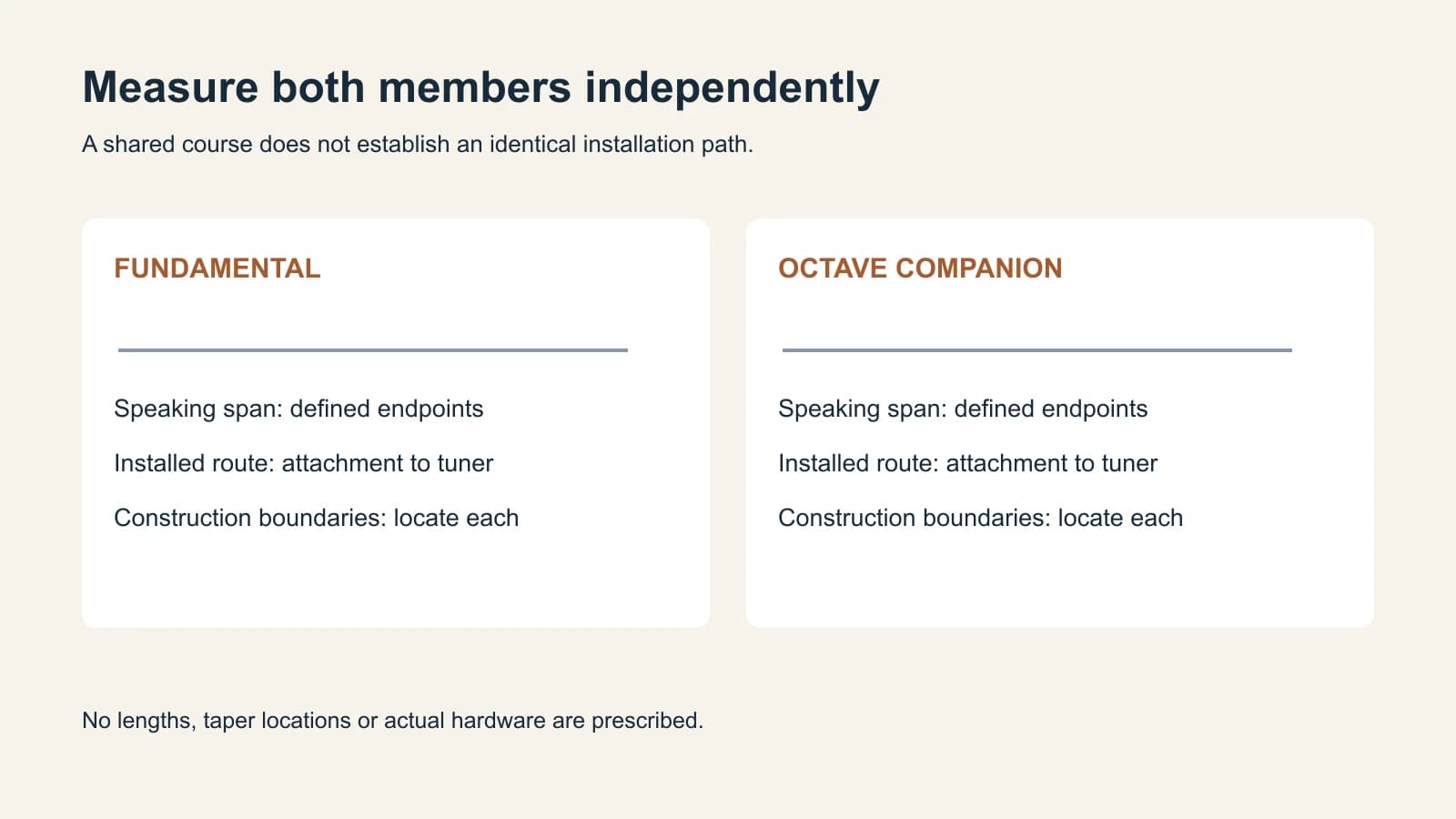
A companion shares a musical course with its fundamental, but it still travels through its own attachment and tuning path. Record the required speaking length, installed route and relevant construction boundaries for each component. A thinner appearance does not establish enough usable length or compatible end construction.
Separate the vibrating span from the full route between the retained end and the tuning post. Where the bass strings through the body, include that route in the application record. Where a component changes diameter or construction near an end, identify the transition relative to the actual contact points. Do not copy a dimension from the fundamental into the companion’s row without checking it.
The bass string scale and length guide explains those measurement distinctions. For this project, apply the method to all eight members rather than measuring one and treating the other seven as established. Ask the supplier to state which endpoints its supplied-length and wound-length descriptions use.
Construction also needs a per-member description. Record plain or wound, core and wrap where applicable, finished diameter with units, end construction and supplier component identity. A set-level family label may not describe every individual member in enough detail to order a single correctly.
Turn a replacement request into an identifiable component
A request for “the thin A string” is incomplete. Ask whether the customer means the octave companion in the A course, then confirm the intended A2 pitch against the actual instrument map. Retain the identity of the fundamental that will remain installed. If that fundamental is already an unknown replacement, the original pack label may no longer describe the complete pair.
Consider a hypothetical service request in which the original octave A member has broken. The customer provides an old complete-set packet but no component label. The useful next step is to connect the marked instrument position, target pitch, companion identity and known set revision. Selecting a visually similar guitar string would skip the fit and construction questions that are still unresolved.
A replacement may be proposed as one member or as a defined pair. State which case is being quoted and which other components stay installed. A dealer can then distinguish a single-string proposal from a complete eight-member revision without silently changing the customer’s existing configuration.
Use an eight-member buying record
The original worksheet below separates the musical role from the supplier item. Enter the requested pitch, construction, diameter and fit information in the component record. The supplier proposal and accepted reference remain separate so a proposed substitution is visible.
| Course | Member role | Requested component record | Supplier proposal | Accepted reference |
|---|---|---|---|---|
| E | Fundamental | |||
| E | Octave companion | |||
| A | Fundamental | |||
| A | Octave companion | |||
| D | Fundamental | |||
| D | Octave companion | |||
| G | Fundamental | |||
| G | Octave companion |
Add the instrument model, viewing direction and drawing or photograph reference above the table. If the customer uses a different tuning, replace the course labels and targets before discussing construction. Empty fields mean information is still needed; they do not mean zero length, zero tension or permission to reuse another maker’s specification.
Where numerical tension data are provided, keep their pitch, length, units and component conditions attached. An octave relationship describes two pitches. It does not prove a particular diameter ratio, equal tension between the members or balanced feel across the complete instrument.
The piccolo bass guide describes moving a four-string configuration to a higher register. An octave-course bass retains fundamentals and adds companions. A shared octave concept does not establish interchangeable sets or individual components.
Check pack identity before evaluating the instrument
A complete sample pack should account for eight identified components and four declared pair relationships. Confirm the set revision and connect each tag, envelope or other supplier identifier to the returned map. Count alone cannot establish that the pack contains the intended fundamental and companion at every course.
Keep the component code, role and target pitch understandable if the dealer also stocks singles. A label that names only the course can leave staff unable to distinguish the two members. If one envelope contains a pair, ask how the installer distinguishes its contents before fitting them.
A competent installer should then assess the proposed candidate on the intended bass using the applicable instructions. Check the physical assignment, route and contact points before tuning. An uncertain bridge, nut or tuner fit belongs with the instrument maker or a qualified technician. This article does not authorize conversion of an ordinary four-string bass.
Record installation changes separately from observations about the strings. Playing notes can address the pair’s response and balance on that bass, but a single session does not establish service life or a universal tonal advantage. Keep any accepted set or replacement tied to its actual component revision.
FAQ
Can two ordinary four-string bass sets make this eight-string set?
They provide eight components, but they do not establish the required octave-companion construction, pitch or fit. Obtain the actual eight-member proposal rather than treating quantity as compatibility.
Is an octave companion simply half the fundamental’s diameter?
Pitch relationship alone does not determine finished diameter. Construction, intended length and the supplier’s applicable design also matter. Use the proposed component specification rather than a guessed diameter rule.
Conclusion
An octave-course bass request becomes useful when four course names resolve into eight distinct components. Retain the fundamental/companion relationship while checking each member’s pitch, construction, fit and reorder identity.
Start a discussion through the bass guitar string category. Send Your Eight-Member Bass Brief with the maker’s map and unresolved fit questions. Confirm any offered configuration and commercial terms for the actual application; the reference diagram is not a StringCrest stock specification.
FROM GUIDE TO PRODUCT
Connect this guide to Bass Guitar Strings.
Review the relevant range, then bring the instrument, complete specification and open questions into one project brief.
YOUR PRODUCT · YOUR BRAND
Discuss your next string project with Frank.
Share your instrument category, target market, gauge or material direction and private-label packaging requirements.

ABOUT THE AUTHOR
Frank Zou
Frank works directly with musical-instrument brands, importers and distributors on string specifications, product selection and private-label project requirements.
Meet Frank