
Private Label
Product Selection
Bass String Scale Length: A Wholesale Guide to Short, Medium, Long and Super-Long Sets
A fit-first guide to vibrating scale, bridge path, wound length, taper, total length, string count and wholesale assortment planning.
Introduction
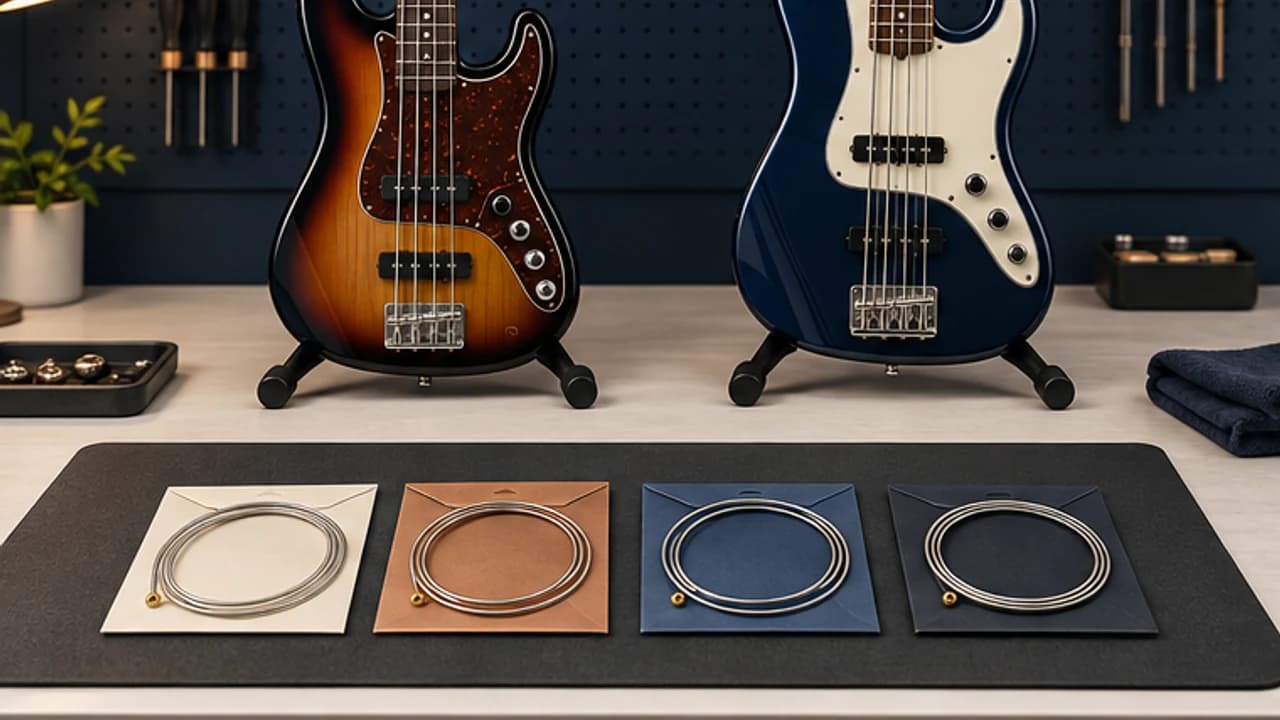
A bass string scale-length inquiry cannot be resolved by writing “34-inch bass” on a quotation. The vibrating scale is measured from nut to bridge saddle, but string fit also depends on the ball-seat-to-nut path, bridge design, through-body routing, wound length, taper location and tuner layout. Two instruments with the same nominal scale can require different string lengths. For a wholesaler or private-label brand, using only the words short, medium or long can therefore produce a set that reaches the tuner but puts full-diameter winding in the wrong place.
D’Addario’s published support guide illustrates the distinction by defining its own scale categories according to the distance from ball-end seat to taper. La Bella similarly advises buyers to determine required wound length, not scale label alone. Those dimensions apply to the named manufacturers’ products. They demonstrate which measurements a buyer needs; they must not be copied as unverified StringCrest specifications.
The practical solution is a fit drawing for each target instrument family. It should record vibrating scale, ball path, wound length, taper and total length, then connect those measurements to the exact four-, five- or six-string gauge matrix. This guide explains how to build that brief, test samples and avoid ambiguous scale claims.
Separate four different length measurements
Buyers often use “scale length” for several different dimensions. Keep them separate in the RFQ:
- Vibrating scale: saddle contact point to nut contact point.
- Ball-to-nut path: ball-end seat to the nut, including any non-speaking bridge route.
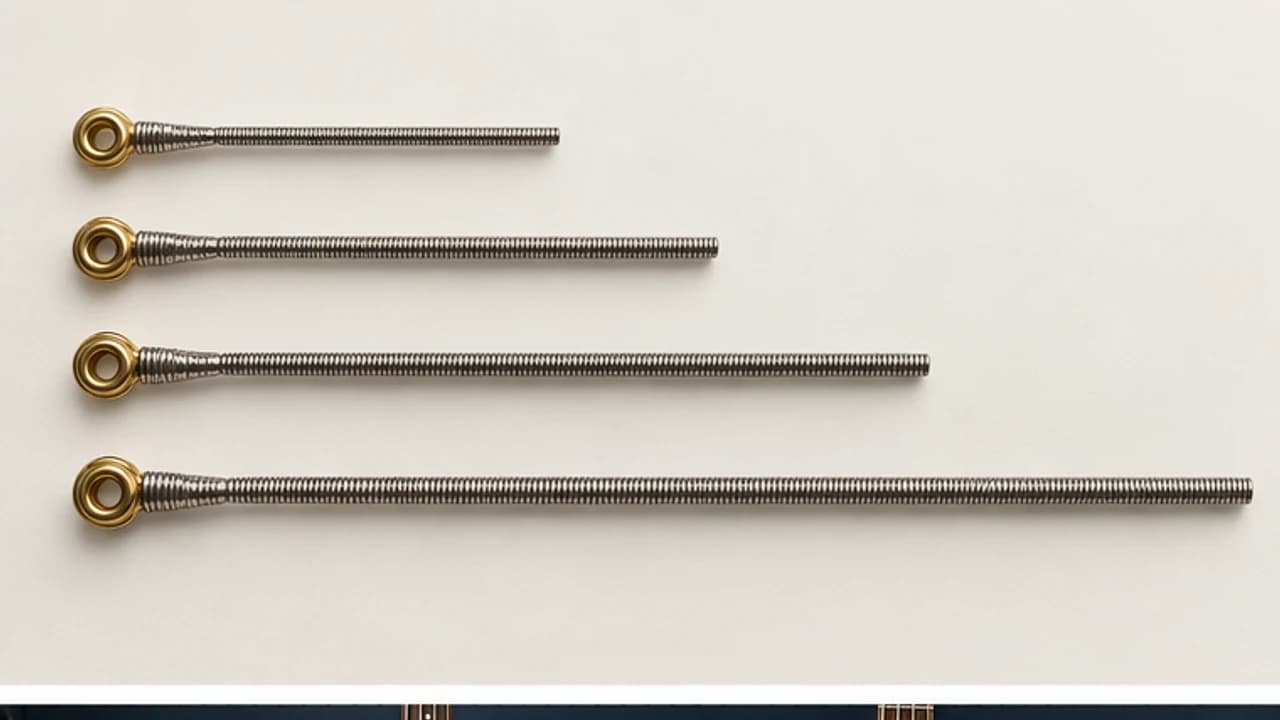
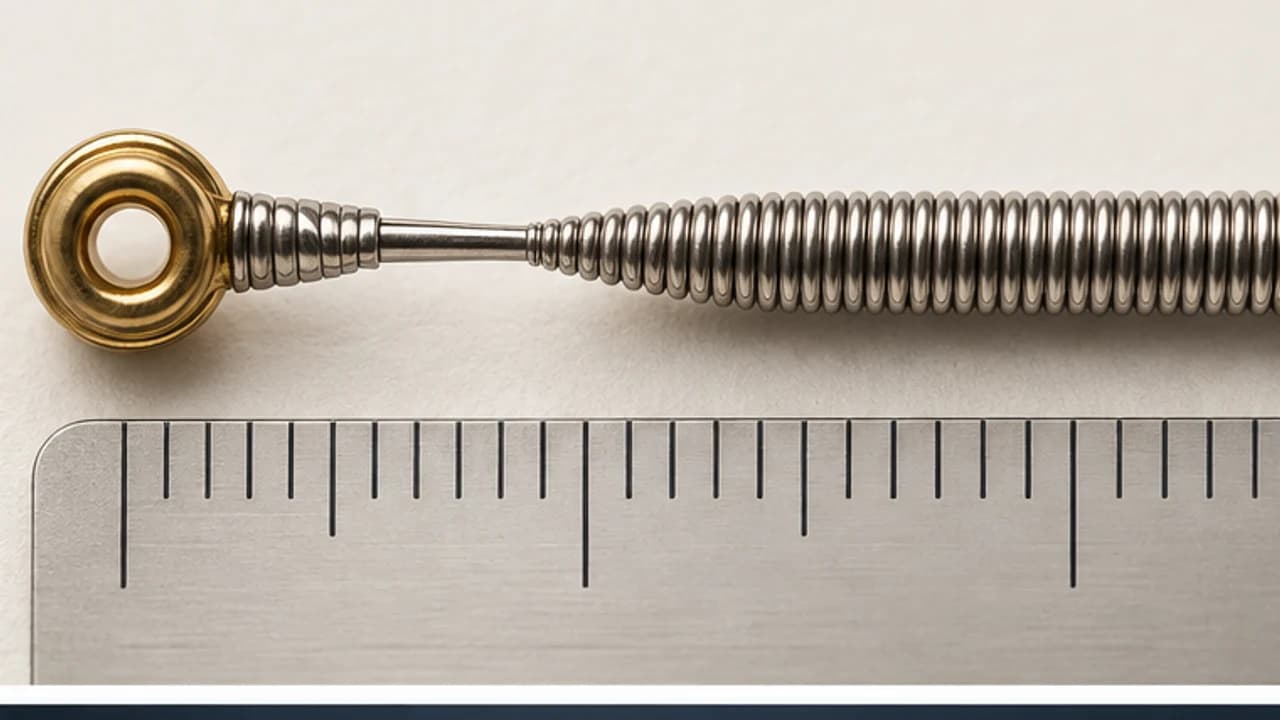
- Wound length: ball end to the point where full winding ends or taper begins.
- Overall length: end-to-end length available for the complete installation path.
For a conventional top-loading bridge, vibrating scale and ball-to-nut path may be close but are not identical. A string-through-body bridge adds a longer route before the saddle. Some headstocks place tuners at different distances beyond the nut. The lowest string may use a taper that must sit after the nut but before excessive wraps reach the tuner.
Why category names are not universal dimensions
Short, medium, long and super-long are useful shopping labels, but each supplier may define them through its own wound-length system. Record the offered numeric measurements with the product revision. If a quote says “long scale,” ask where the full winding ends and what ball-to-taper distance applies.
| Measurement | Instrument reference | Supplier confirmation |
|---|---|---|
| Vibrating scale | Saddle contact to nut contact | Intended application |
| Ball path | Ball seat through bridge to nut | Fit context |
| Full wound length | Ball seat to taper start | Product-specific value |
| Total length | Ball seat to string end | Reaches the farthest tuner |
| Taper position | Relative to nut and tuner | Avoids incorrect contact |
Map the instruments before building the assortment
Start with the instruments already sold by the buyer’s dealers or targeted by the new product line. Record brand and model internally when available, but build the technical brief from measurements rather than assuming that every model carrying the same marketing label has the same route.
For each representative instrument, note string count, vibrating scale, bridge loading method, ball-seat-to-nut distance, saddle position, nut width, tuner location and any taper requirement for the lowest string. Photograph the measuring points. If the line must cover instruments that vary, state the tested application range and identify exceptions.
Do not use an instrument list as an unsupported compatibility claim. A sample that fits one representative model does not prove fit on every bass described as short scale or long scale. Keep the public wording within the scope actually measured and evaluated.
Connect length to string count and gauge
A four-string set, five-string set and six-string set are different products, even when they share the same scale category. The low B in a five-string set and high C in a six-string set add construction and balance questions. List every position, tuning and gauge. Confirm whether any lowest string is tapered and where that taper should sit on each instrument path.
A common 4-string retail direction may use gauges such as 45–100 or 45–105, and published ranges show 5-string directions around 45–125 or 45–130. These are market examples, not automatically suitable matrices. Gauge labels do not establish tension without material, core, winding and scale context. The buyer should compare complete proposed revisions.
Create a separate line for replacement singles if the channel needs them. A single low B or E must use the same length vocabulary and product identity as the corresponding set. Otherwise, a dealer may select the right nominal gauge but the wrong taper. Record whether a single belongs to a short-, medium-, long-, super-long- or multiscale family, and link it to the supported fit drawing rather than describing it only by diameter.
Treat through-body and multiscale applications separately
Through-body routing can require more wound length even when the vibrating scale is unchanged. Multiscale basses add position-specific vibrating lengths and hardware paths. For a multiscale product, provide measurements for every string, not one average scale. Confirm taper and tuner fit on the lowest string at minimum, then inspect all positions.
If one set is offered for both top-load and through-body installation, document the tested range and verify that winding and taper land correctly in both routes. Do not infer universal compatibility from overall length alone.
Understand what goes wrong when length is incorrect
If a bass string is too short, the full wound section or taper may stop before it passes the nut correctly, or the string may not reach the tuner. If it is too long, thick winding can wrap around a tuner post that was not designed for it. The string may also place a taper in the speaking length or create an untidy installation.
Cutting a wound bass string at the wrong point can allow winding to loosen. Installation guidance should follow the offered construction and supplier instructions. A product page should not casually tell customers to shorten any bass string without explaining how the winding is secured.
Fit problems can be misdiagnosed as feel or tone problems. When a sample is evaluated, record where the taper, silk and full winding sit relative to saddle, nut and tuner. Only after fit is correct should the team compare feel, response and balance.
Choose material and winding as separate decisions
Nickel-plated steel, stainless steel, pure nickel, flatwound and other descriptions organize bass-string ranges, but they do not replace a full specification. Roundwound or flatwound surface, core construction, wrap material, gauge, taper and scale work together. A buyer who changes both material and length at once cannot easily identify which change caused an evaluation result.
Create controlled sample pairs. Keep length, gauges, tuning and instruments constant when comparing material directions. Keep material constant when comparing gauge or scale revisions. Record observations as sample-specific results: attack, finger noise, perceived stiffness, balance, tuning stability during the test and visible condition.
Avoid absolute phrases such as “stainless is always brighter” or “short scale is always easier.” Published descriptions can guide evaluation questions, but actual response depends on the complete string and instrument. Public claims should reflect the approved revision and evidence available.
Run a fit-first sample evaluation
Give every sample a code, scale designation, numeric wound-length record and full position matrix. Before installation, check package identity, string count, gauges, ends, visible surface and total length. Photograph each string beside a neutral reference without presenting the photo as a certified measurement result.
Measure the instrument path from ball seat to nut and locate the farthest tuner. Install the set according to the intended bridge route. Confirm that each string seats correctly at the bridge, crosses the saddle and nut as intended, and reaches its tuner with a suitable winding area. Record taper location and number of wraps as observations, not universal instructions.
After fit is accepted, tune to the intended pitches and use repeatable playing tasks. Check open strings, notes across the neck, common attack strengths, string-to-string balance and any application-specific tuning. If the set is intended for drop tuning, test that revision separately and record the exact tuning.
Plan a wholesale scale assortment
Do not launch short, medium, long and super-long variants simply to make the catalog look complete. Each variant adds artwork, barcodes, inventory positions, forecasts, inspection lines and customer-service questions. Begin with the measured instrument population and demand evidence available to the buyer.
A distributor whose dealers mainly sell standard 34-inch top-load basses may start with a controlled long-scale range and add other lengths only where instrument data supports them. A retailer serving vintage-style short-scale models may need a distinct short-scale option with clear wound-length guidance. These are examples of assortment logic, not market-share claims.
For each SKU, record target instruments, string count, material family, gauge matrix, scale measurements, packaging identity and reason for inclusion. Define which products are core stock, which are test items and which are special inquiry directions. This makes replenishment decisions clearer.
Make packaging state the fit information clearly
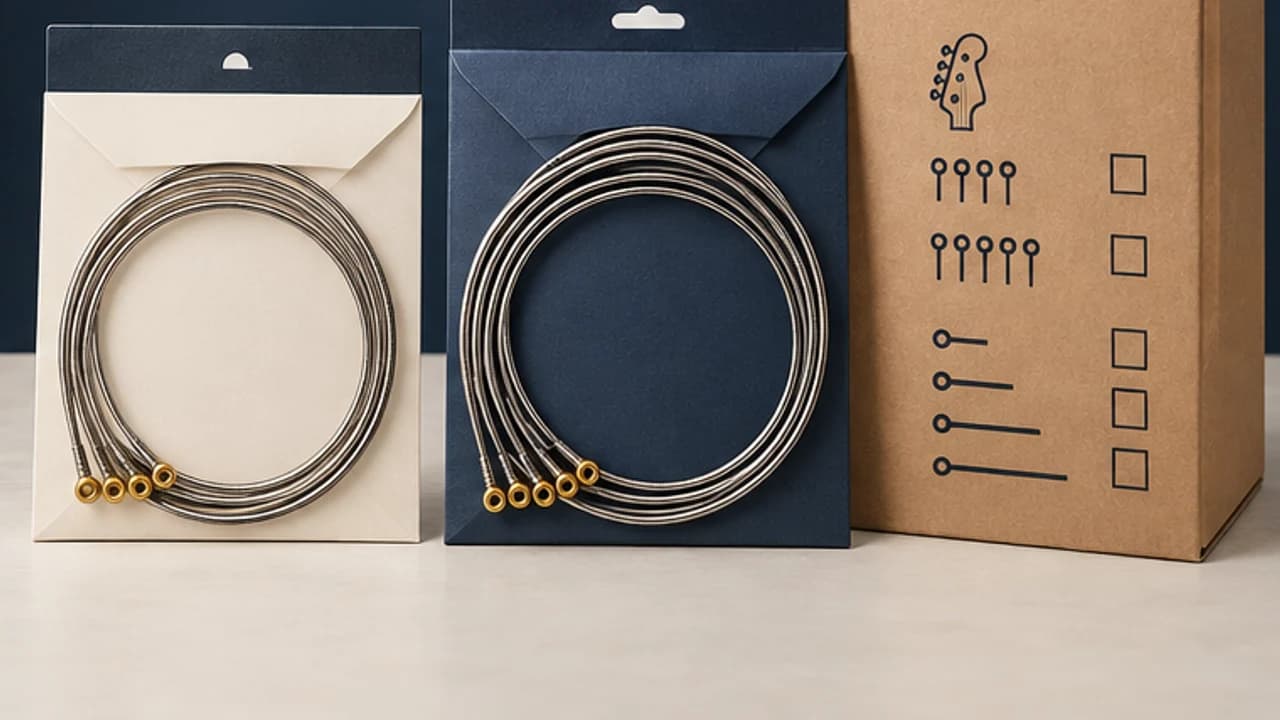
The front of the pack should identify bass string count, scale category, material or winding family where applicable, and complete gauge sequence. The technical panel should provide the numeric fit information that the supplier can support, explain how the length is measured and highlight through-body or multiscale limitations.
Use diagrams instead of relying on the phrase “fits most.” A simple ball-seat-to-taper illustration can show the buyer what to measure. Keep measurement wording consistent across pack, website, dealer sheet and customer-service response. If a revision changes the taper or wound length, update every channel.
Compare quotes and commercial terms accurately
Provide each supplier with the same matrix: string count, tuning, gauges, core and winding direction, ball end, wound length, taper, total length, packaging, quantity scenarios, destination and trade term. Ask for product and packaging costs to be identified clearly where possible.
MOQ can depend on wire sizes, scale-specific construction, number of SKUs, inner packs, print method and order mix. Sample time and production lead time also depend on how many fit revisions are required. Treat early figures as planning ranges until the technical matrix and artwork are fixed.
A cheaper quote may omit scale-specific construction or individual identification. Compare what is included, which measurements are guaranteed, which fields remain open and how a confirmed sample will be referenced in production.
Inspect production and shipment identity
Inspection should verify product code, revision, scale label, string count, tuning, gauge sequence, ball ends, visible winding and pack condition. Where wound length, taper or gauge is checked, define the measurement point, equipment, tolerance, sampling plan and decision rule in advance.
Connect retail packs, inner cartons and outer cartons to the same SKU and revision. Separate short, medium and long variants physically and through readable labels. Verify quantities and mixed-carton rules against an approved packing diagram. Retain a traceable sample record for the shipment.
Do not describe a photograph of a caliper or ruler as proof that a lot passed. A credible inspection record states what was checked, under which method, for which lot or order, and what decision rule applied.
FAQ
Is bass scale length the same as string wound length?
No. Instrument scale is the vibrating distance from saddle to nut. Wound length is a product measurement from the ball-end region to the taper or end of full winding. Bridge routing means the required wound length can exceed the vibrating scale.
Are short, medium and long scale labels standardized?
Do not assume so. Suppliers may use different category boundaries and measurement methods. Obtain numeric ball-to-taper, total-length and application information for the exact offered revision.
Can a long-scale string be used on a short-scale bass?
Fit depends on winding and taper location, tuner design and installation guidance. Excess full winding at the post can be unsuitable. Use a product designed and confirmed for the intended path instead of relying on the label alone.
What changes for a through-body bridge?
The string travels farther before reaching the saddle and nut. Measure from the actual ball seat through the body to the nut and confirm wound and total length. Test the proposed set on the intended hardware.
How should multiscale bass strings be specified?
Provide the vibrating length and hardware path for each position, plus tuning, gauge and taper requirements. Do not describe the instrument with one average scale measurement.
What should appear on a bass-string package?
State string count, complete gauges, material or winding family, scale category, supported numeric fit information and any bridge-route limitation. Use the same revision and measurement wording on every sales channel.
Conclusion
A reliable bass-string scale specification begins with measurements, not category labels. Separate vibrating scale, ball path, wound length, taper and overall length. Connect them to the complete four-, five- or six-string matrix and the actual bridge route.
Fit the sample first, then evaluate feel and response. Carry the approved numeric identity through packaging, quotation, inspection and shipment records. This reduces returns, makes supplier offers comparable and gives dealers a clear way to help customers select the correct set.
FROM GUIDE TO PRODUCT
Connect this guide to Bass Guitar Strings.
Review the relevant range, then bring the instrument, complete specification and open questions into one project brief.
YOUR PRODUCT · YOUR BRAND
Discuss your next string project with Frank.
Share your instrument category, target market, gauge or material direction and private-label packaging requirements.

ABOUT THE AUTHOR
Frank Zou
Frank works directly with musical-instrument brands, importers and distributors on string specifications, product selection and private-label project requirements.
Meet Frank