
Product Selection
Wholesale Planning
5- and 6-String Bass Strings: A Wholesale Range Planning Guide
Plan five- and six-string bass ranges by tuning, low-B and high-C position, scale, winding length, taper, gauge matrix, sample fit, SKU and receiving controls.
Introduction
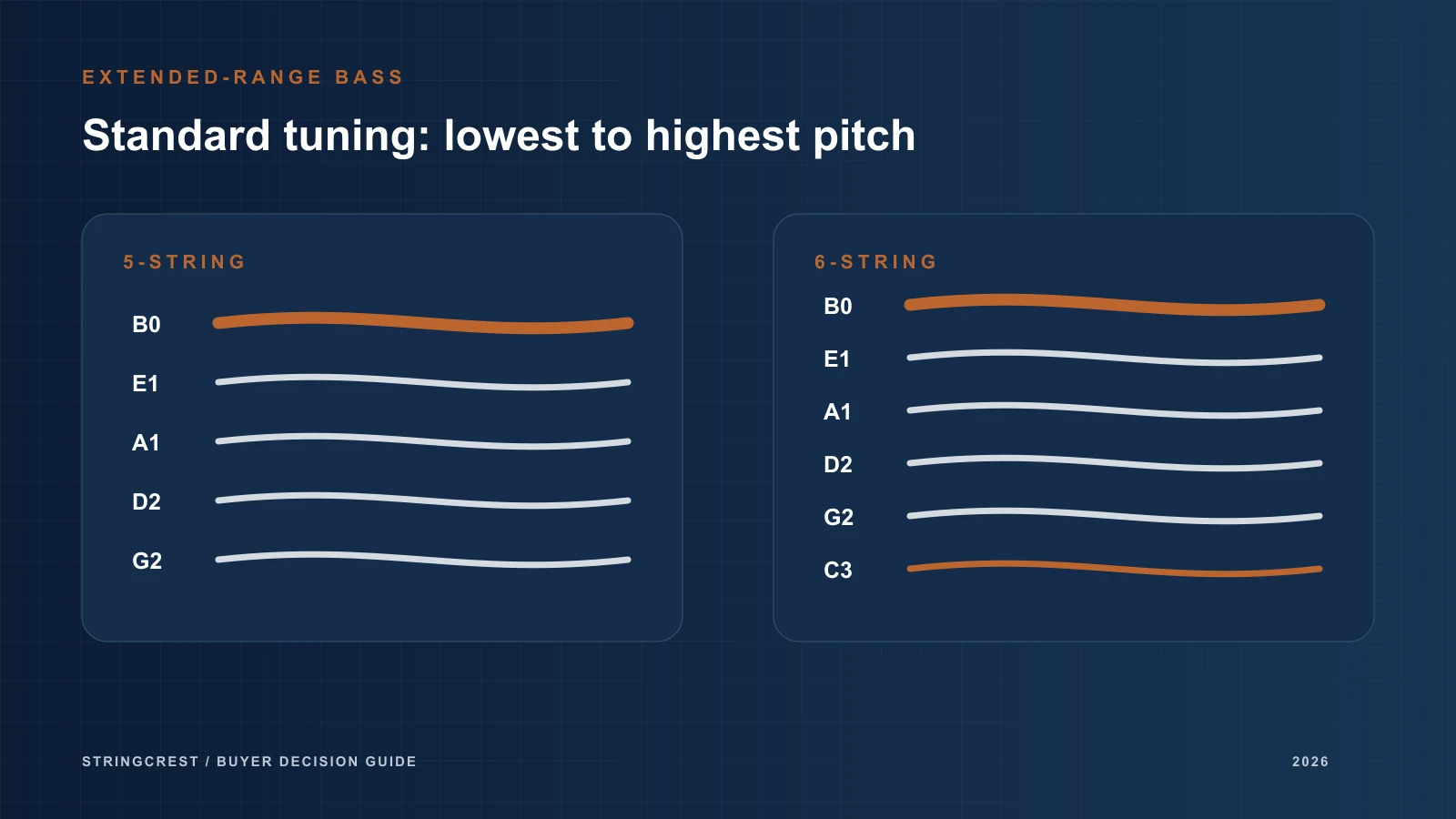
A standard low-B five-string bass runs B0–E1–A1–D2–G2, from lowest to highest pitch. A standard six-string adds a high C: B0–E1–A1–D2–G2–C3. A high-C five-string uses E1–A1–D2–G2–C3 instead. It has no low B. For a brand, importer or dealer planning an extended-range assortment, those are three distinct configurations, even though two contain five strings.
Start by naming the configuration and every physical position. Then ask two different questions: will the low B fit the intended bass and respond acceptably under the player's attack, and does the high C have the construction and playing response intended for the upper register? A gauge range or a “long scale” label cannot answer either question alone.
The tables below are planning tools. Their pitch references are defined; the proposed construction and sample results remain blank until a supplier and buyer confirm them. They do not describe approved StringCrest five- or six-string SKUs.
Match the configuration before matching a string number
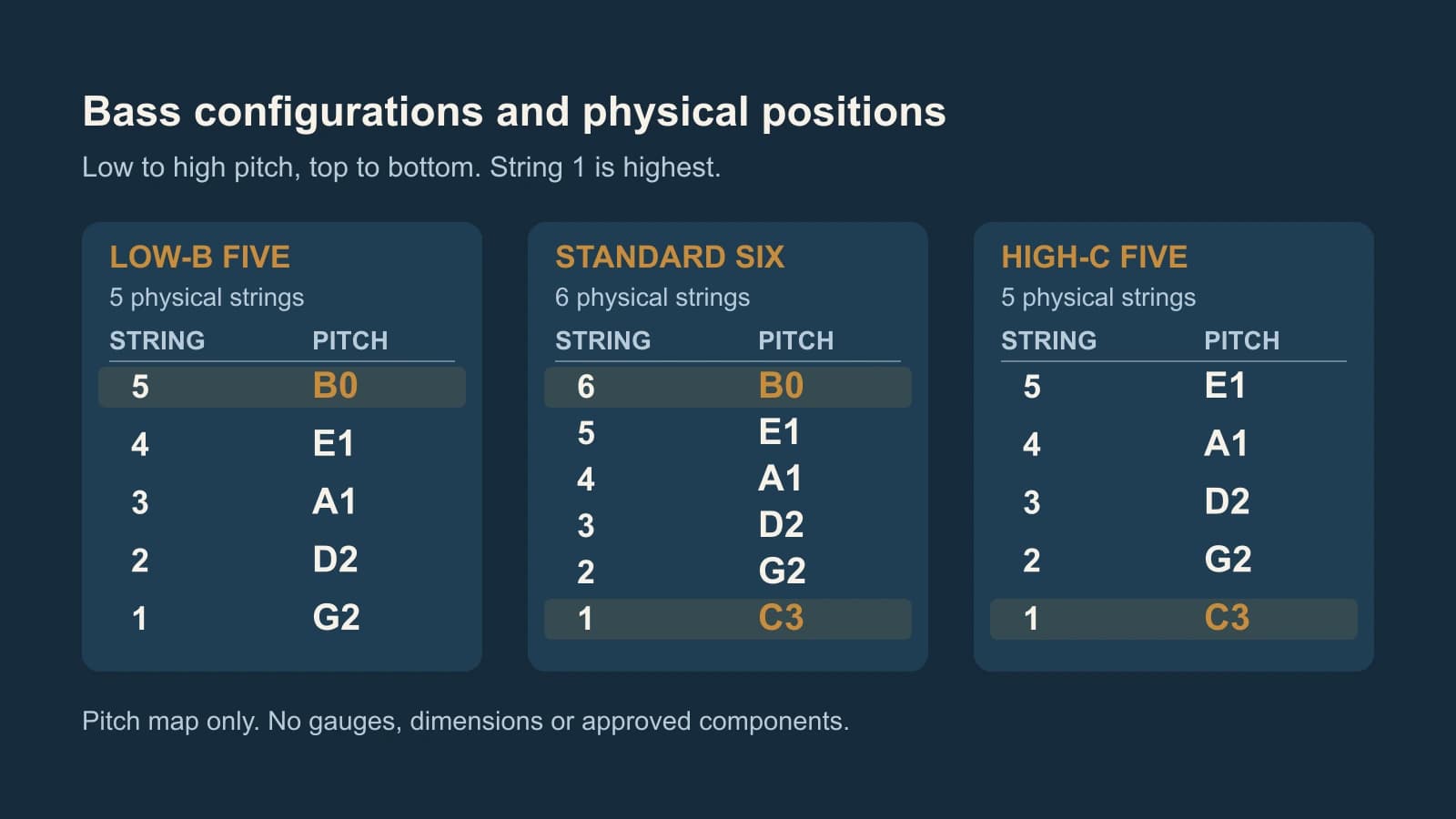
Here, string 1 means the highest-pitched physical string in the stated configuration. Each column reads from lowest to highest pitch down the table, skipping the position that does not exist. This numbering convention belongs to this planning table; a manufacturer's component names may follow a different convention.
| Physical string number | Standard low-B five-string | Standard six-string | High-C five-string alternative |
|---|---|---|---|
| 6 | Not present | B0 — lowest | Not present |
| 5 | B0 — lowest | E1 | E1 — lowest |
| 4 | E1 | A1 | A1 |
| 3 | A1 | D2 | D2 |
| 2 | D2 | G2 | G2 |
| 1 | G2 — highest | C3 — highest | C3 — highest |
D’Addario's official EXL170-5 chart lists G2 through B0, while its ENR71-6 chart lists C3 through B0. Read in the opposite direction, they support the standard low-to-high registers above. These are named product examples, not gauge or construction specifications for StringCrest.
A high-C five-string is a real alternative range format: GHS lists its 5M-C-DYB set with a high C plus G, D, A and E components. Its published component labels should not be copied into another supplier's physical-position system. Define the intended E1–A1–D2–G2–C3 configuration explicitly in your own brief.
This matters when ordering replacements. “String 5” means B0 in the standard low-B five-string column and E1 in the six-string column. Even a matching pitch does not establish an identical component: construction, diameter, length and end profile may differ between sets. Use the approved component identity and revision alongside the pitch and physical position.
Give the low B its own fit and response questions
The low B is not approved simply because the string reaches its tuner and tunes to B0. Check where the string's different regions sit on the actual installation path.
Keep speaking length—the distance between the effective bridge and nut contacts—separate from the path from the seated ball or anchor to the bridge, nut and tuner. Record the measurement datum and route for that particular bass. A through-body route can add path beyond the bridge, and a multiscale bass requires the length for the relevant position. Neither is resolved by adding an assumed allowance to a scale label.
For each proposed low B, obtain the full-diameter winding boundaries and any bridge-end reduced section or upper winding transition. A bridge-end taper can retain winding; it need not be bare core. An exposed-core design is a separate construction. Ask which part should contact that bridge's saddle and compare the actual location with the string maker's instructions.
D’Addario's low-B taper FAQ describes a bridge-end taper as one design used to position a heavier low B at the bridge. It does not make taper mandatory for every low B. Its separate bass scale-length guide uses a ball-to-taper measurement and discusses a transition beyond the nut. Those two regions must not be treated as one universal taper rule.
Use the tapered versus untapered bass-string guide for the detailed anchor-to-saddle/nut/tuner record. This range decision needs the resulting fit record for the low-B position, rather than a second copy of that measurement procedure. If the contact profile or required bend is unclear, pause installation and seek guidance before cutting or forcing the string into place.
Once fit is established, define what “usable low B” means for the proposed range. A player can compare note onset, open and fretted notes, unwanted buzz under the intended attack, muting and transitions to E1. Record the bass, setup and task. “Clear on this bass under this attack” is an observation; it is not proof that one diameter or construction will produce the same result on every bass.
Ask the high C about construction and upper-register use
The C3 in this configuration is the highest open string. Specify its actual construction rather than treating “high C” as a material or gauge category. Obtain separate fields for plain or wound construction, core, wrap where present, surface treatment and finished diameter. Do not assume it shares every material or internal dimension with the adjacent G2.
The sample question also changes. A buyer considering the high-C format may want an upper-register line, a chord voicing, a slide or a transition between G2 and C3 to feel and sound appropriate. Select the tasks that represent the intended customers. Check the high C's own nut, bridge and tuner fit before using a playing preference to approve it.
A small finished diameter does not identify the core of a wound string, and equal finished diameters do not establish equal tension or feel. D’Addario's tension explanation identifies unit weight, vibrating length and frequency as the inputs for a tension calculation. Ask for the proposed build and the basis of any tension information. Do not fill missing data with another maker's chart or infer a numerical result from a gauge label.
For an amplified comparison, keep pickup selection, control settings, signal path and recording gain fixed. Preserve that raw recording when judging output balance across C3, G2 and the other strings. A separately level-matched copy can help compare tonal preference, but it cannot establish the original output balance. Surface feel and playing comfort need their own written observations.
If two samples also change core, wrap, gauge or treatment, describe the result as a comparison of the complete samples. A comparison between two different basses has further instrument and setup differences. It cannot isolate the effect of adding C3 or changing one construction field.
For the separate wrap-material decision, see the bass-string material comparison. Keep that choice distinct from whether the range includes low B, high C or both.
If you are defining one of these configurations, discuss the pitch sequence, reference bass and unresolved low-B or high-C requirements.
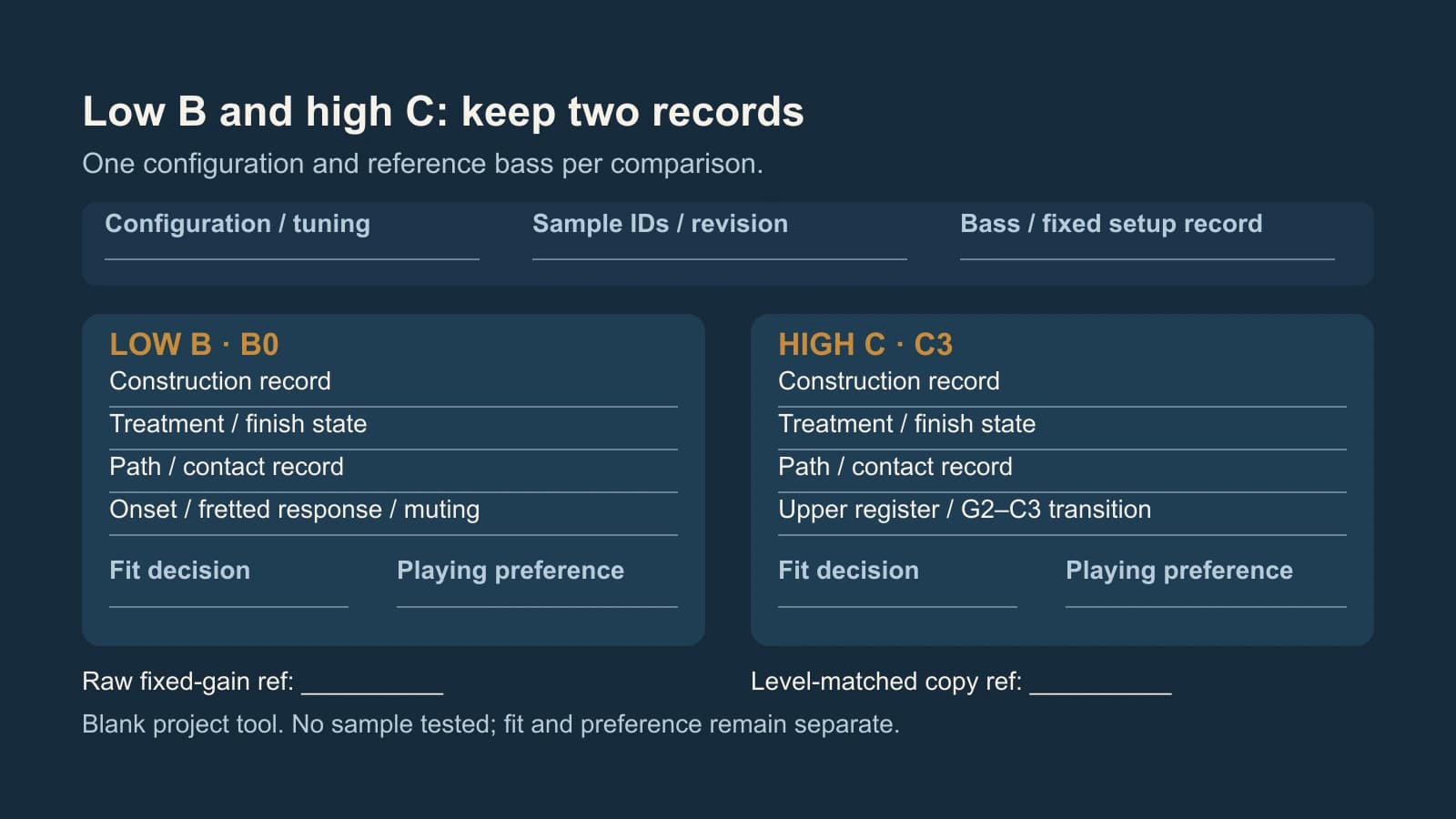
Use one blank position record for each configuration
Create a separate record for the standard low-B five, the six, or the high-C five. Copy the appropriate reference pitches from the first table, then confirm the actual intended tuning. Do not add a “high C, optional” row to a low-B five-string specification without changing its string count or removing the low B.
Configuration name/code: ______ Reference bass and setup record: ______ Supplier proposal/sample revision: ______ Intended tuning: ______
| Physical position, low to high pitch | Actual pitch | Finished gauge and unit | Plain/wound; core/wrap; treatment/finish record | Installed-path/contact record ID | Proposed component ID/revision |
|---|---|---|---|---|---|
| 6 — six-string only | ______ | ______ | ______ | ______ | ______ |
| 5 | ______ | ______ | ______ | ______ | ______ |
| 4 | ______ | ______ | ______ | ______ | ______ |
| 3 | ______ | ______ | ______ | ______ | ______ |
| 2 | ______ | ______ | ______ | ______ | ______ |
| 1 — highest | ______ | ______ | ______ | ______ | ______ |
For either five-string format, mark position 6 “not applicable.” Keep unresolved fields “unknown”; use “none” only when the absence of a feature has been confirmed. A blank taper field is not confirmation of an untapered string.
The installed-path record should identify the seated anchor datum, speaking length, actual route to the tuner, winding boundaries and contact conditions. Each position needs its own identity even when several measured fields eventually match. An E1 used in two formats can share a component only after the supplier confirms the same construction, fit specification and revision for both.
Keep fit findings separate from playing preference
Use the same reference bass when comparing sample revisions for one configuration. Record any necessary setup change; do not quietly adjust one sample and call the conditions identical. Comparing a five-string bass with a six-string bass can inform an assortment decision, but it is a comparison between complete instruments and string configurations.
This short card leaves the result open. Repeat it for each relevant sample and position; it is not a completed test or approval.
| Observation field | Record to complete |
|---|---|
| Configuration, physical position and pitch | ______ |
| Sample A/B identities and declared construction differences or unknowns | ______ |
| Reference bass; speaking length and installed-fit record | ______ |
| Fixed setup, player/task, pickup and signal-path conditions | ______ |
| Low B, if present: contact fit; note onset, fretted response and muting observations | ______ |
| High C, if present: contact fit; upper-register task and G2-to-C3 transition observations | ______ |
| Recording versions: raw fixed-gain file; separately level-matched copy, if used | ______ |
| Necessary setup changes; limits on comparison | ______ |
| Fit decision; playing preference; unresolved question and responsible reviewer | ______ |
Use the completed records to decide whether a low-B five and a six serve distinct customers, and whether there is a defined need for a separate high-C five. Dealer requests should name the configuration rather than merely “five-string.” Sales or reorder evidence, when available, should remain separate for those two five-string formats.
The custom-bass scale, taper and sample guide covers the broader development and approval process. The bass-string category provides product context; it does not confirm a particular extended-range build. Confirm supply, component identities and the final proposed specification for the project before assigning an orderable SKU.
FAQ
Can a standard low-B five-string set be retuned into a high-C five-string set?
Do not assume the existing five strings are suitable simply because the instrument has five positions. The target pitches change from B0–E1–A1–D2–G2 to E1–A1–D2–G2–C3. Obtain strings specified for the intended pitches, lengths and setup, and seek the string and instrument makers' guidance before changing the configuration.
Can a distributor use one replacement E1 for the five- and six-string ranges?
Only if the proposed component is confirmed for both. E1 is physical string 4 in the standard low-B five-string configuration and string 5 in the six-string configuration used here. Pitch and equal printed gauge alone do not confirm the same core, winding, installed length, end profile or revision. Keep the replacement mapping explicit.
Conclusion
Name the pitch architecture first, then resolve the questions that distinguish the added positions. The low B needs an approved installation and a useful response on the reference bass; the high C needs a declared construction and a relevant upper-register evaluation. Keep both tied to their physical positions and sample revisions.
FROM GUIDE TO PRODUCT
Connect this guide to Bass Guitar Strings.
Review the relevant range, then bring the instrument, complete specification and open questions into one project brief.
YOUR PRODUCT · YOUR BRAND
Discuss your next string project with Frank.
Share your instrument category, target market, gauge or material direction and private-label packaging requirements.

ABOUT THE AUTHOR
Frank Zou
Frank works directly with musical-instrument brands, importers and distributors on string specifications, product selection and private-label project requirements.
Meet Frank