
Buying Guides
Buying Guides
Slide Guitar Strings: Choosing Gauges for Fretted and Slide Playing
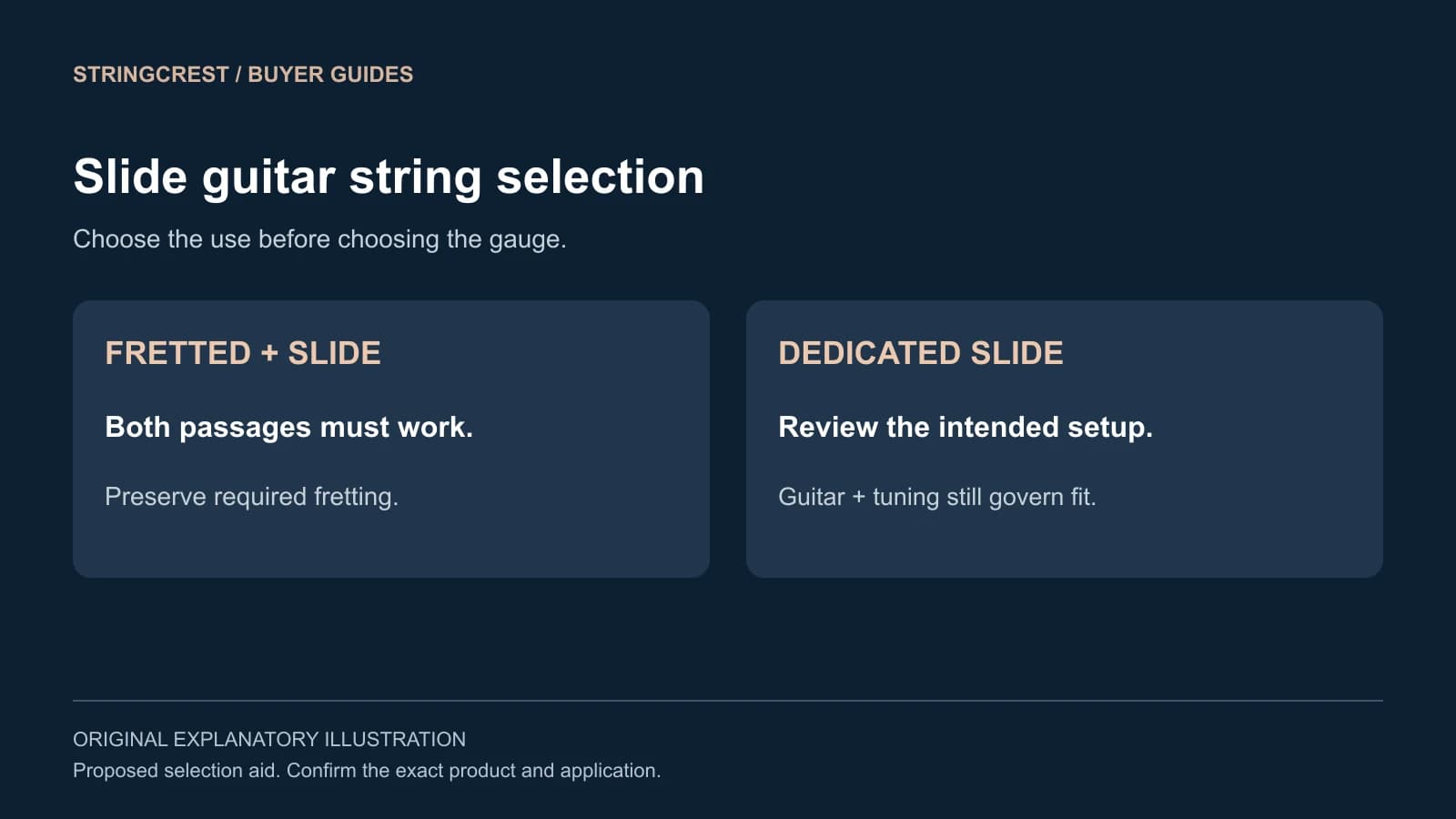
Separate mixed fretted-and-slide playing from a dedicated setup before choosing a heavier set or changing the guitar.
Introduction
Choose slide guitar strings around the actual guitar, target tuning and whether the player will still fret notes. A heavier set is not an automatic solution to slide noise or poor control. String gauges, setup, slide weight and the player's contact all belong in the decision.
For a dealer, the useful starting question is whether the customer wants occasional bottleneck passages on a normally fretted guitar or a dedicated slide setup. Those uses can lead to different compromises. This guide concerns conventional six-string steel-string acoustic and electric guitars played with a finger slide. Lap steel and dedicated square-neck instruments need their own specifications.
Separate mixed playing from a dedicated setup
A player alternating fretted chords and slide passages still needs a workable fretted action and response. Before proposing a change, ask the player to demonstrate or describe both tasks. Record what works with the current set and what specifically does not.
For a dedicated slide application, the player may accept a different setup. That is an instrument decision as well as a string purchase. Do not promise that a packet marked “heavy” turns the existing guitar into a suitable dedicated slide instrument.
Fender's slide introduction discusses slide weight in relation to string gauges and identifies action as part of the setup. It also directs players who cannot perform setup work to a music store. That supports reviewing the interaction; it does not provide one gauge or action measurement for every guitar.
Use the resonator instrument guide if the customer's description turns out to involve a resonator's neck and playing configuration. For a non-pedal lap steel, use the six-string lap-steel guide instead of extending this finger-slide discussion to that instrument.
Record the target tuning before changing gauges
Slide is a playing technique, not a tuning specification. Keep the current tuning and proposed tuning separate. If the player requests an open tuning, record all six notes with registers and a clear direction before selecting a candidate set.
For reference, conventional six-string standard tuning from sixth string to first is E2, A2, D3, G3, B3 and E4. This is a reference map, not a proposed slide tuning. Do not infer a complete alternative from “open,” “blues” or a slide accessory's product name.
A tuning change can alter the conditions under which a set is used. Have the intended guitar and complete tuning reviewed rather than assuming that a familiar gauge range is approved. A lower pitch request and a higher pitch request should not be grouped together as the same change.
Use two playing tasks to compare the compromise
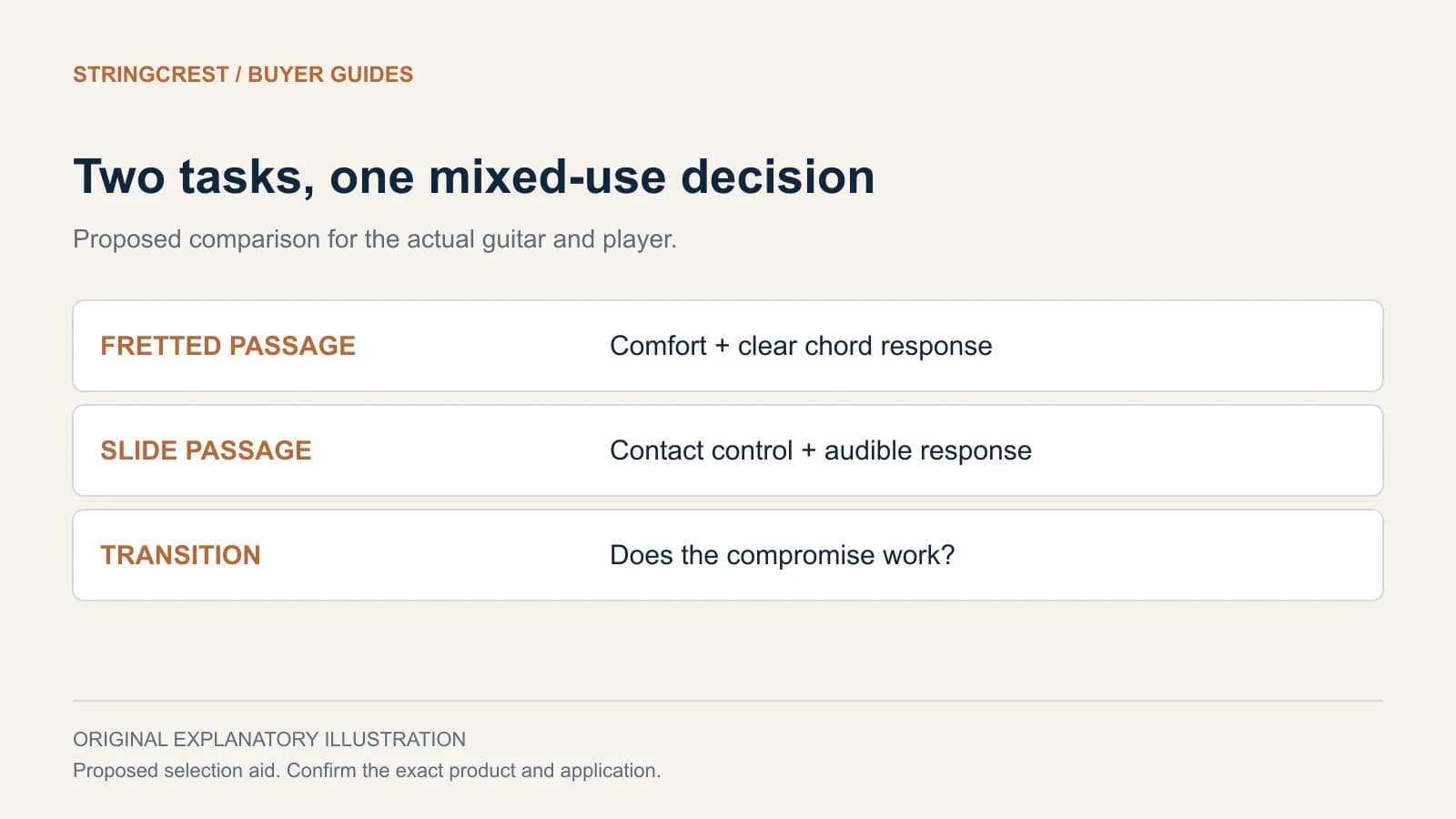
A short dealer worksheet can keep the decision focused:
| Playing task | What to observe | What the observation cannot establish alone |
|---|---|---|
| The customer's fretted passage | Comfort, clear notes and usable chord response | Approval for an unreviewed tuning or setup change |
| The intended slide passage | Contact control, unwanted fret contact and audible response | That gauge is the only cause of a problem |
| Transition between the two | Whether the compromise works during the actual part | A universal best set for all slide players |
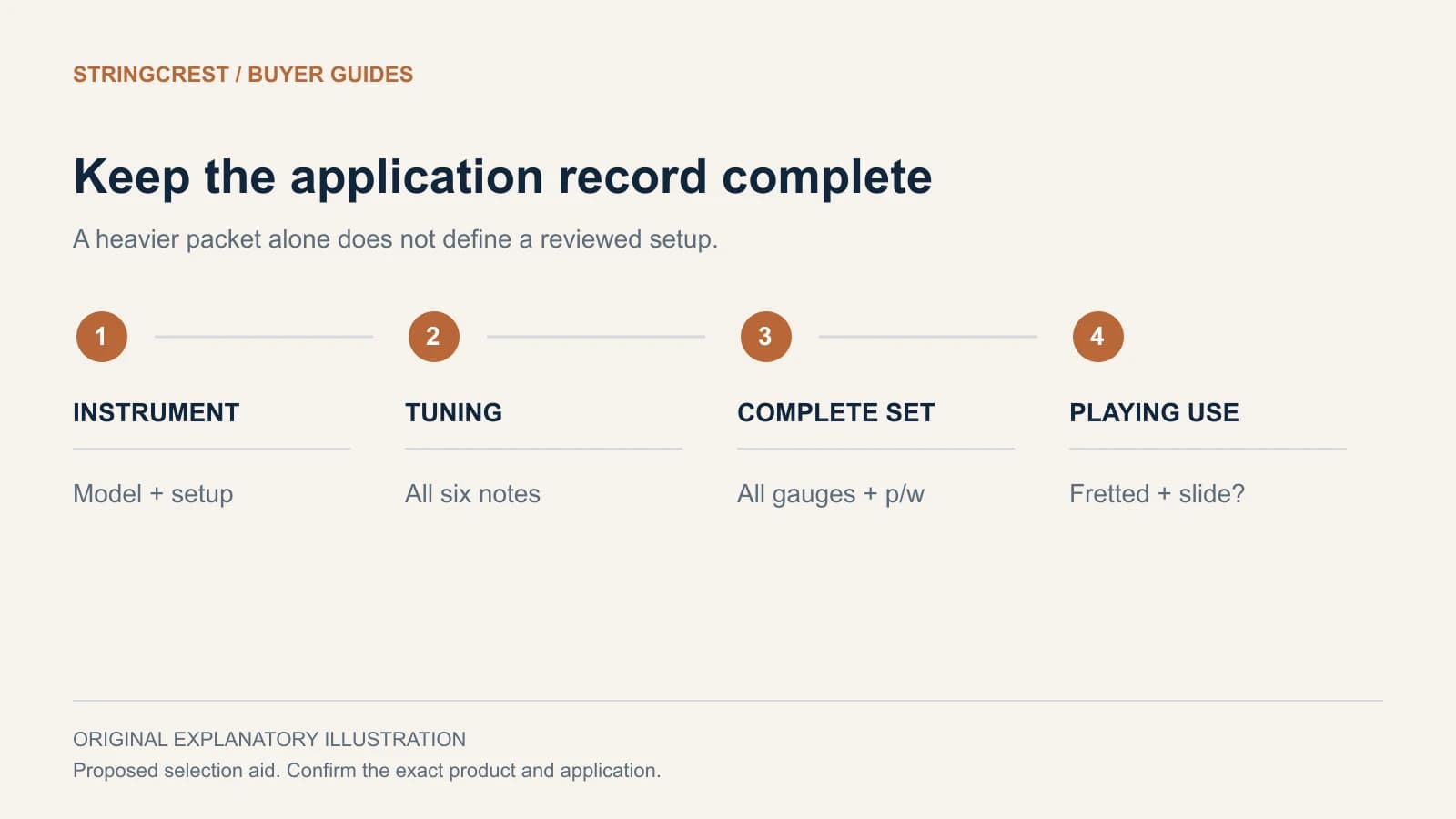
Record the current set, guitar, tuning, slide identity and relevant setup alongside the observations. The worksheet is a proposed method, not a completed performance test or a numeric acceptance standard.
Discuss your slide-string application. Send the guitar model, current gauges, intended tuning and whether normal fretting must remain part of the setup.
Change one defined variable where practical
If a candidate changes every gauge, the tuning and the setup, any result describes that complete configuration. It does not isolate a string-material or gauge effect. Keep the proposed changes visible in the record rather than attributing the outcome to whichever feature is easiest to market.
For a useful initial comparison, identify the current configuration and the specific change being considered. If the player reports the slide pressing strings into the frets, review that contact with the actual instrument; buying a heavier set alone may leave the original question unanswered. A technician can review the guitar while an instructor can help separate technique from equipment concerns.
Fender discusses lighter slides with lighter strings and heavier slides with thicker strings as possible choices. Treat that as a starting relationship to assess, not a mandatory pairing or a substitute for the player's actual passage. Slide material alone does not establish its mass or how much pressure the player applies.
Compare the whole set, including the third string
List every gauge and the plain or wound identity of the positions involved. A packet's first-and-sixth range is not a complete specification. Two nominally similar sets can differ in middle gauges or construction, and a plain-to-wound third-string change deserves its own review.
Use the plain versus wound G guide when that is part of an electric-guitar proposal. Keep any resulting setup or intonation assessment attached to the candidate. Do not describe the revised third string as a direct equivalent solely because it targets the same note.
For a steel-string acoustic guitar, retain the maker's permitted string and tuning requirements. This article does not authorize a heavier gauge on a particular instrument or a conversion of a nylon-string guitar to steel strings.
Give the customer a clear next step
Separate three possible outcomes. The current setup may merit a technique or contact review before any string purchase. A defined alternative set may be suitable for a supervised comparison. Or the intended dedicated setup may require instrument work before a new string specification can be approved.
Describe the outcome with its conditions. “Candidate selected for a trial on this guitar in the recorded tuning” is useful. “Heavy strings fix slide buzz” is not supported by that decision.
If a new set creates a noise or response issue, use the string-buzz after-change guide for the broader investigation. Keep a recurring instrument problem separate from a product-family preference.
FAQ
Is there one best gauge range for slide guitar?
No universal range follows from the technique name. The guitar, complete tuning, setup, slide interaction and need for normal fretting determine what should be assessed.
Does playing slide require an open tuning?
No. Fender's introduction discusses standard and alternative tunings. Confirm the actual target notes instead of assuming every slide request means an open tuning.
Should a dealer raise the action as part of every string sale?
No. Establish the customer's intended use and have any setup change assessed for that instrument. Mixed fretted and slide playing may need a different compromise from a dedicated setup.
Conclusion
Choose a slide-string candidate for an identified configuration and a specific playing task. Preserve normal fretting as an explicit requirement when the customer needs it. Start a range enquiry through the electric guitar string category, or identify the steel-string acoustic application in the brief.
Send your slide-string and setup requirements, including the current set, full tuning and the problem you want to resolve. The proposed construction and application require confirmation before ordering.
Sources and interpretation limits
Fender's slide introduction was checked on 26 October 2026. Its setup, slide-weight and tuning discussion supports the attributed points. The task worksheet and decision routes are original proposals, not reported tests, a prescribed action measurement or approval of any heavier gauge for a particular guitar.
FROM GUIDE TO PRODUCT
Connect this guide to StringCrest product ranges.
Review the relevant range, then bring the instrument, complete specification and open questions into one project brief.
YOUR PRODUCT · YOUR BRAND
Discuss your next string project with Frank.
Share your instrument category, target market, gauge or material direction and private-label packaging requirements.

ABOUT THE AUTHOR
Frank Zou
Frank works directly with musical-instrument brands, importers and distributors on string specifications, product selection and private-label project requirements.
Meet Frank