
Classical Guitar Strings
Buying Guides
Monel Guitar Strings: Material Identification and Acoustic Set Selection
Separate nickel/copper alloy wrap from nickel plating, then compare the complete acoustic set and the actual listening task.
Introduction
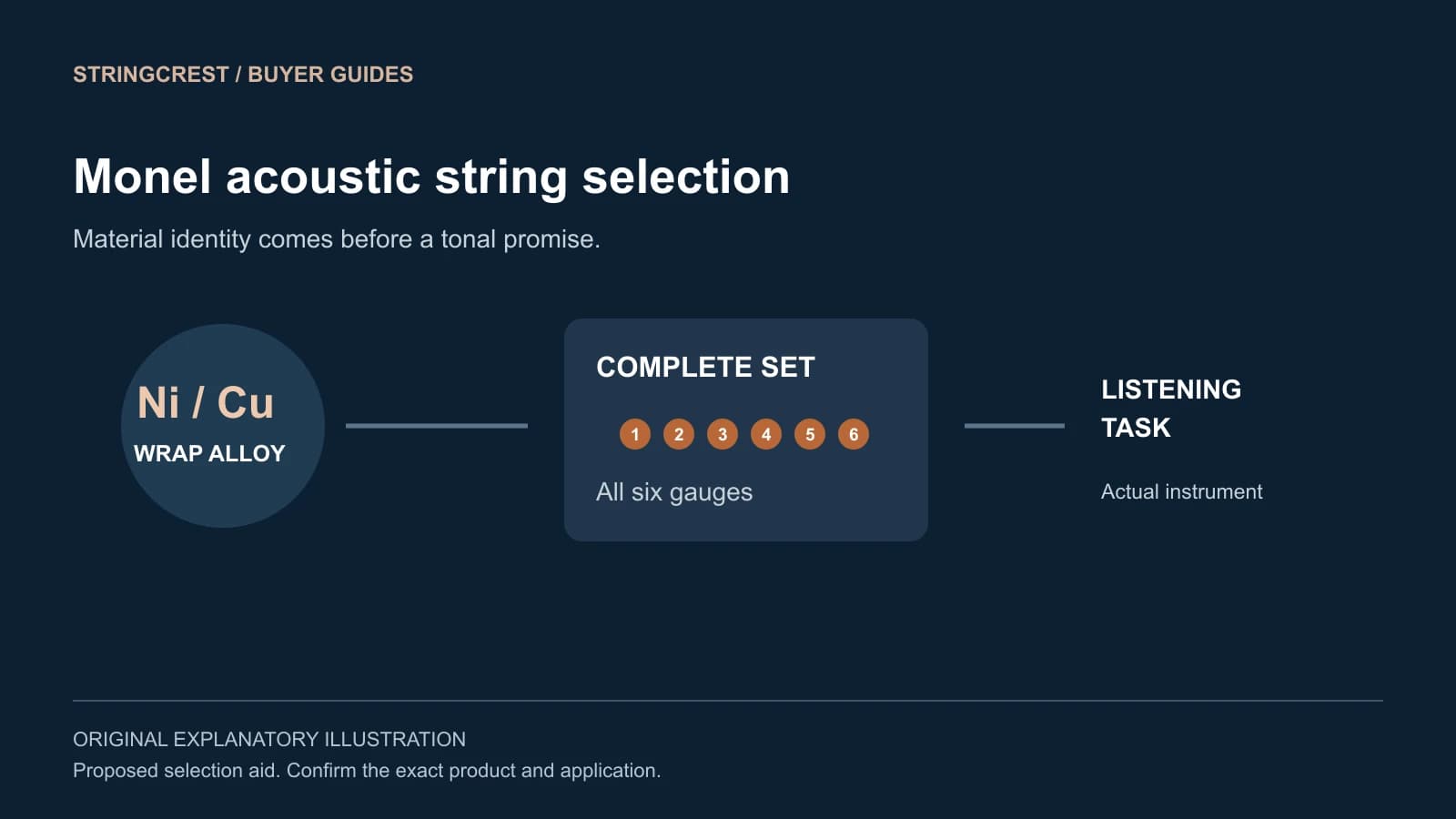
For an acoustic-string enquiry, Monel identifies a nickel/copper alloy direction used for wrap wire; it does not specify the whole set or guarantee a particular sound. Start with the named product and its declared construction. Then check the complete gauges and intended instrument before comparing it with the customer's current strings.
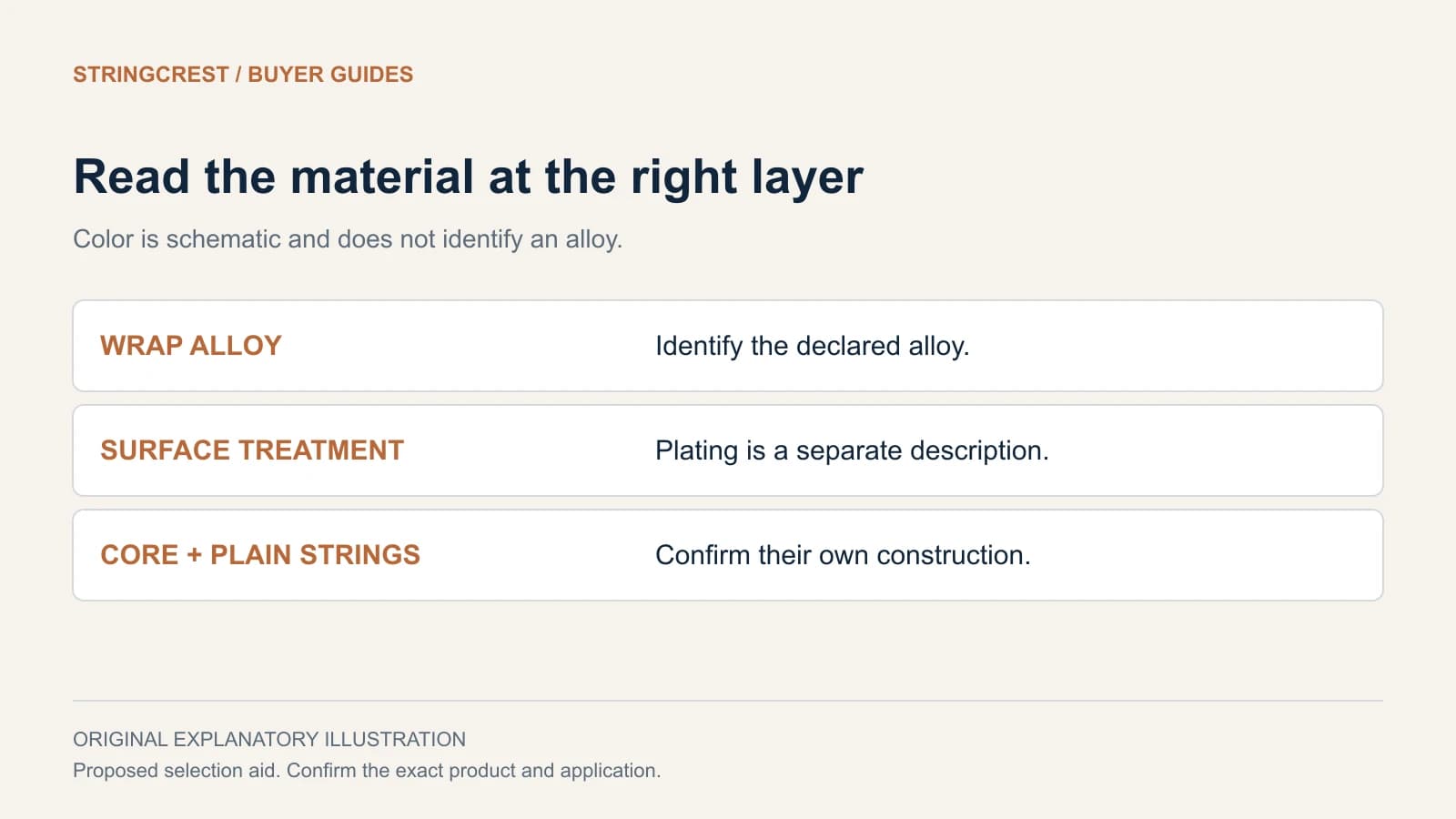
A dealer may hear “nickel strings” used for several different constructions. Resolving that phrase is the first useful step. A solid nickel/copper alloy wrap, nickel plating on another wrap material, and the string's core belong in separate fields. A similar color or a shared word on a packet cannot establish equivalence.
Read the material at the correct layer
Martin's Retro acoustic-string page describes its proprietary Monel wrap as a solid nickel/copper alloy blend. That identifies the wrap in the named family. It does not mean that every wire in the packet is solid Monel or that the term supplies the core, coating and end specification.
A useful contrast is D'Addario's acoustic-alloy explanation, which describes its Nickel Bronze wrap as nickel-plated phosphor bronze. Nickel in an alloy and nickel applied as plating are different material descriptions. The product names should therefore stay attached to their manufacturers' actual definitions.
For a proposed private-label string, ask what the supplier is prepared to declare for the offered revision. Keep a proposed generic nickel/copper description distinct from another maker's proprietary product identity. If exact composition is required for a purchasing specification, obtain applicable documentation rather than inferring a percentage from a familiar material name.
Decide what the alternative must improve
Ask the customer to describe the current problem in playing terms. Is the initial attack too prominent for the intended part? Is the balance between plain and wound strings unsatisfactory? Is the enquiry about a different surface feel, or simply curiosity about a material label?
These questions lead to different comparisons. Record the current set and the passage in which the problem is heard. A broad request for a “vintage” sound leaves the buyer unable to decide whether a candidate has met the requirement.
Separate the listening route as well. An unamplified guitar, a microphone recording and a particular pickup system are different evaluation conditions. A favorable unplugged impression does not settle a pickup-balance question. Keep the actual signal chain attached to any recorded observation instead of promising that a wrap material suits every amplification system.
For the wider bronze-range decision, use the phosphor bronze versus 80/20 planning guide. A Monel enquiry needs its own identified candidate rather than a third box added to a good/better/best ranking.
Compare complete sets before discussing gauge labels
Martin's published Retro table provides a useful example. From first string to sixth string, its MM12 entry lists .012, .015, .025, .031, .041 and .054 inches. That sequence is product data for MM12, not a StringCrest gauge proposal.
A packet's endpoint range does not identify the middle strings. Likewise, “light” is a family designation rather than a universal specification. Compare the customer's actual current sequence with the candidate's complete sequence before describing the change as an alloy-only comparison.
| Question | Required comparison | Decision consequence |
|---|---|---|
| Is this the requested material? | Exact declared wrap and treatment | Clarify the material before selecting the set |
| Are all six gauges comparable? | First-to-sixth sequence in the same units | Record a whole-set change if gauges differ |
| Is the application unchanged? | Instrument, tuning and installation fit | Seek an instrument review where needed |
| What will the player judge? | Named passage and listening route | Use observations from that task, not a generic tone ranking |
The table is a proposed comparison aid. Leave unknown fields open until confirmed. Use the inch and millimeter gauge guide if source documents use different units; a measurement alone still cannot identify the alloy or core.
Discuss a defined acoustic-string material requirement. Send the reference product, full gauge sequence, instrument and the playing result you want to compare.
Make a small trial answer one question
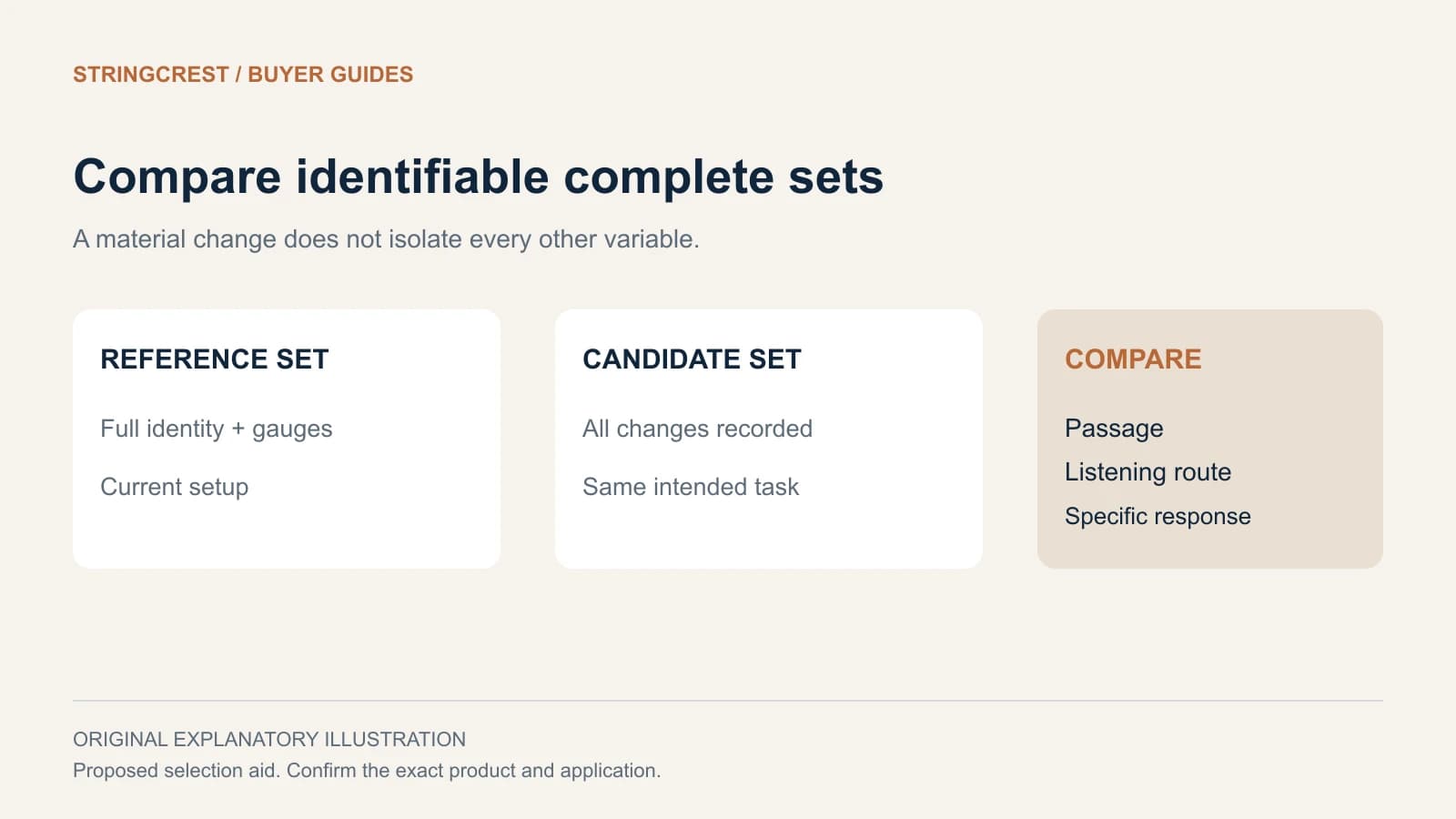
Choose an identifiable reference set and candidate, then keep the instrument and relevant playing conditions consistent where practical. If the setup needs adjustment, record it. Describe the result as a complete-set comparison whenever other construction variables change alongside the wrap.
Use the same passage for the intended decision. A dealer comparing accompaniment may ask whether the attack and chord balance work for that part. A player recording a lead line may prioritize a different response. Neither observation establishes a universal winner.
A short note can record the set identities, installation dates, passage, listening route, setup changes and the player's specific comments. Write those comments before settling on promotional wording. This is a proposed method; it does not supply a tested preference or a StringCrest performance result.
Keep the dealer description within the evidence
Describe an offered material and configuration only after they have been confirmed. Avoid turning a material name into a promise of immunity to corrosion, a fixed service life or compatibility with every acoustic guitar. Another maker's durability or tone language does not establish those properties for a proposed private-label construction.
Keep alloy, protection and package condition distinct in the purchasing record. A material choice does not establish a coating, and a sealed package does not establish installed service life. Where a project needs a performance claim, agree the actual product, evaluation method and evidence before approving that wording.
For a range decision, a documented reason to retain one candidate is more useful than several nearly identical variants with unclear purposes. Broader sample and inspection requirements can follow once the intended material and set have been resolved.
FAQ
Does “nickel” on two packets mean their wrap materials are equivalent?
No. The cited examples distinguish a nickel/copper alloy wrap from nickel-plated phosphor bronze. Read the complete construction description for the actual product.
Does the Monel label identify the plain strings too?
It does not establish their construction. Confirm the plain positions separately instead of extending the wound-string wrap description to every wire in the set.
Can a dealer promise a fixed tonal result from the material name?
No. Evaluate the identified complete set on the intended instrument and listening route. Keep the description proportionate to the observations actually obtained.
Conclusion
Resolve the wrap identity, complete gauges and intended playing question before selecting an acoustic alternative. The acoustic guitar string category is the starting point for a broader range discussion.
Send your acoustic material and set requirements, including the current product and the comparison you need. The proposed construction and availability require confirmation for the project.
Sources and interpretation limits
Martin's Retro product table and D'Addario's acoustic-alloy explanation were checked on 26 October 2026. Named examples belong to those manufacturers. Original diagrams and comparison records are explanatory aids, not completed tests, chemical analyses or new StringCrest specifications.
FROM GUIDE TO PRODUCT
Connect this guide to Acoustic Guitar Strings.
Review the relevant range, then bring the instrument, complete specification and open questions into one project brief.
YOUR PRODUCT · YOUR BRAND
Discuss your next string project with Frank.
Share your instrument category, target market, gauge or material direction and private-label packaging requirements.

ABOUT THE AUTHOR
Frank Zou
Frank works directly with musical-instrument brands, importers and distributors on string specifications, product selection and private-label project requirements.
Meet Frank