
Buying Guides
Buying Guides
Coated Guitar String Wear: How Dealers Can Assess Surface Complaints
Separate a surface observation from wire damage or a playing symptom before deciding how to handle a coated-string complaint.
Introduction
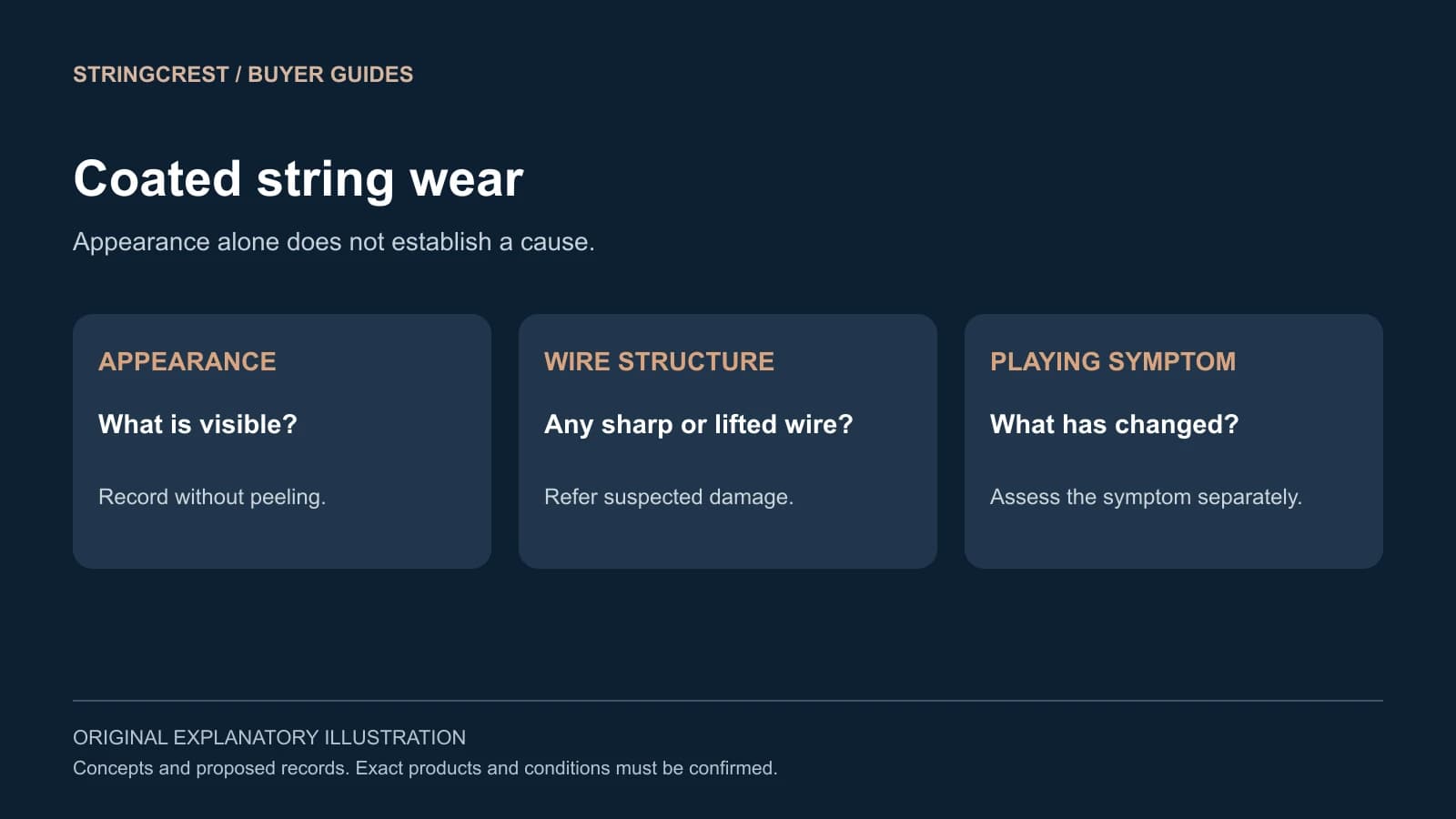
Visible wear on a coated guitar string does not, by itself, identify a broken winding or prove that the string is fit to keep playing. Start with the exact product, the affected position and what has changed. A photograph of a pale fiber needs a different follow-up from a report of a sharp wire end, a separated wrap or a string that will no longer hold pitch.
For a dealer, the immediate decision is whether to request better information, arrange a replacement or refer the instrument for inspection. This guide provides a proposed complaint-routing method. It does not diagnose a customer's string from an image or set a universal acceptable amount of coating wear. Use the identified product's care instructions and applicable return terms.
Identify the surface before naming the fault
Coating, plating, wrap wire and the load-bearing core describe different parts of a string. A wound string has a separate wrap around its core; a plain string has no such wrap. Protection used on one part of a set should not automatically be attributed to every position.
For example, the Elixir FAQ distinguishes the coating on its wound strings from the Anti-Rust plating on its plain steel strings. That is a named manufacturer's construction description. It is not evidence that an unidentified pale mark is coating, nor that another brand uses the same protection.
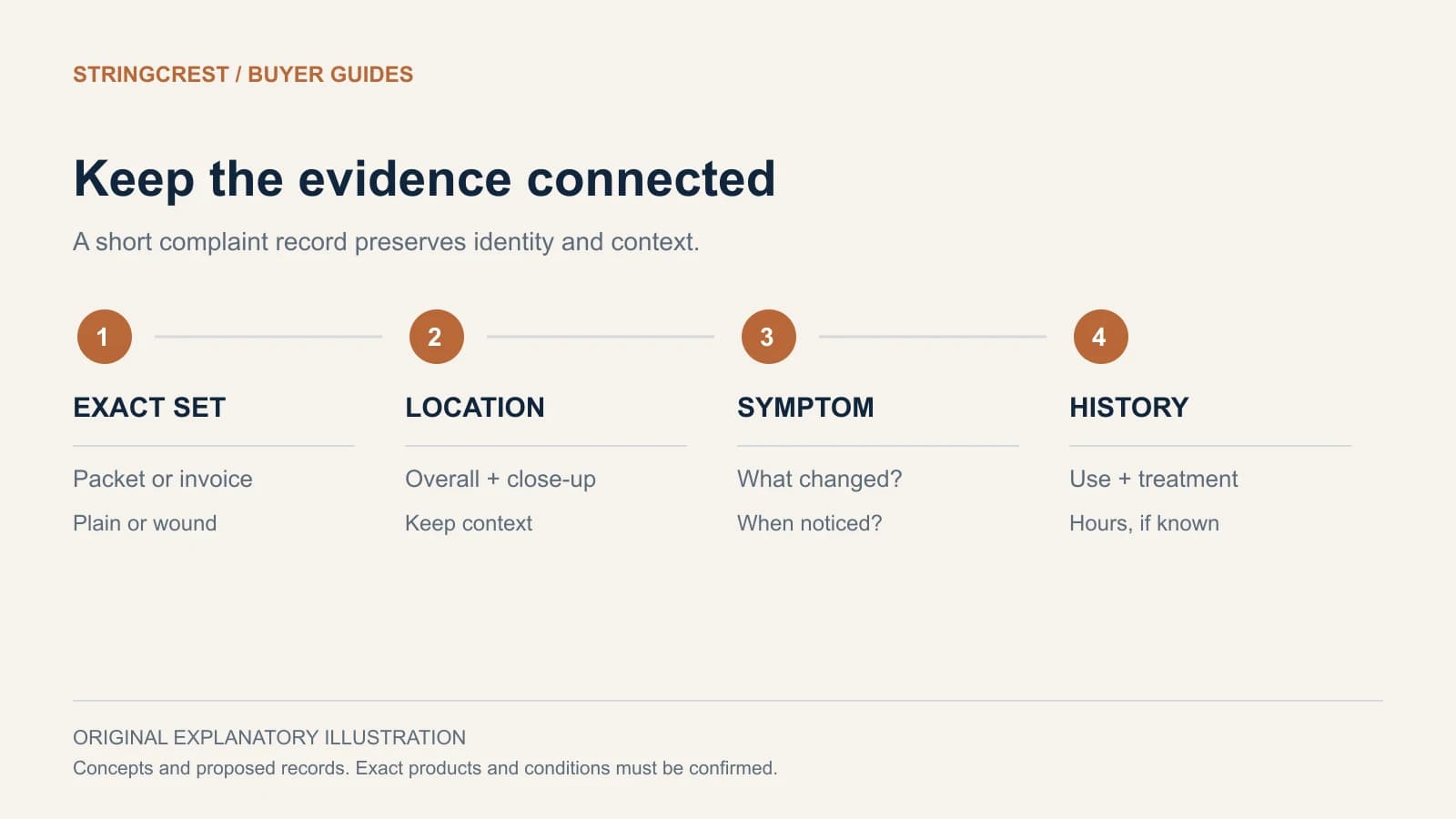
Record the packet name and complete set code before discussing the surface. If the packet is missing, use the purchase record rather than guessing from winding color. Ask which physical string is affected, whether it is plain or wound, and where the mark lies relative to the fretted area, picking area, nut and bridge.
Our coated versus uncoated range guide covers choosing a product family. Here the question is narrower: how should an already-used string complaint be handled?
Separate observation from a suggested cause
Ask the customer to describe what they can see without pulling, scraping or cutting the surface. A useful report says “a pale strand beside the fourth string over the picking area.” “The coating has failed” is already an interpretation.
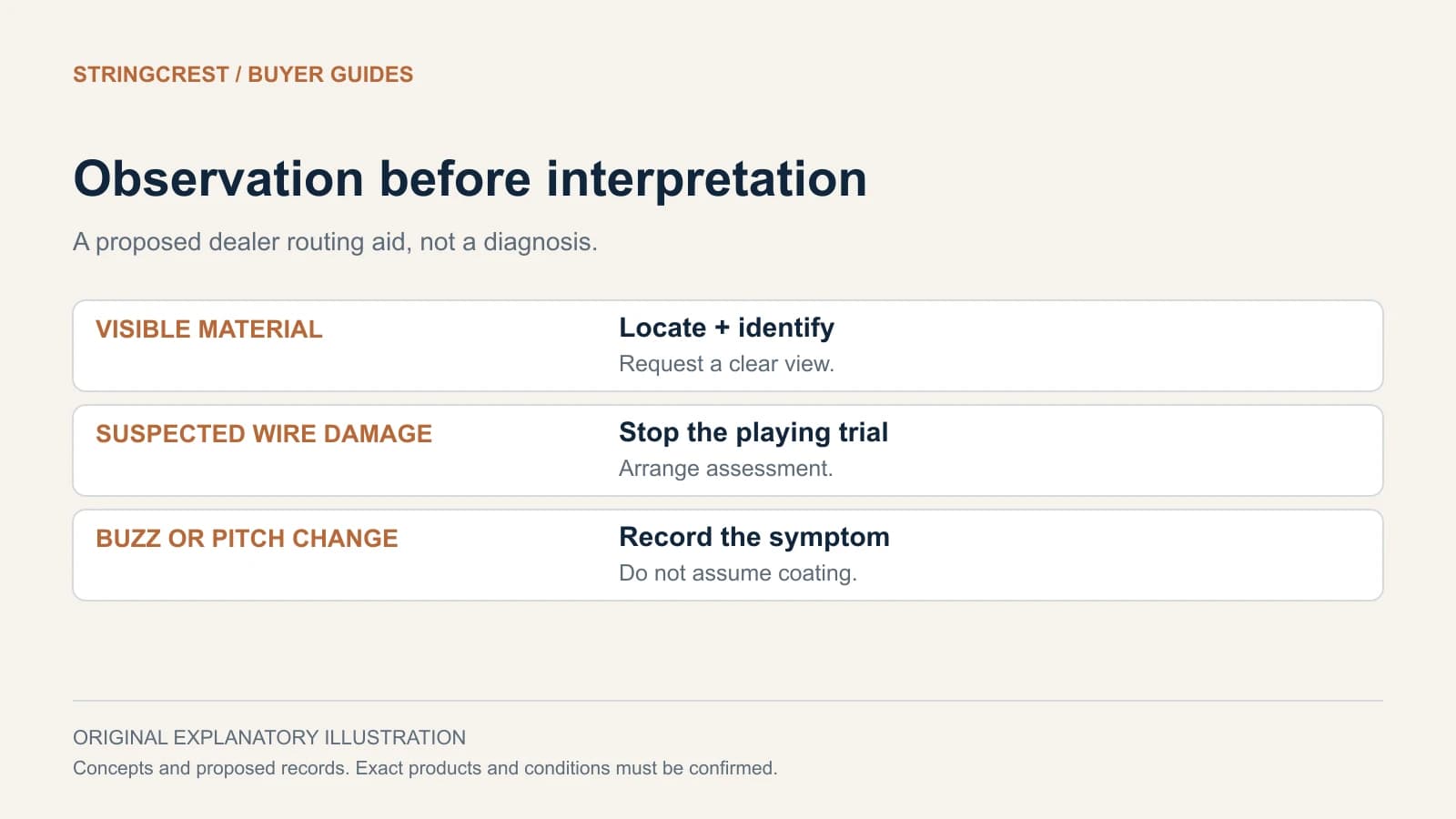
| Reported observation | Information still needed | Dealer's next step |
|---|---|---|
| Pale or fuzzy material beside an otherwise continuous wrap | Clear close-up, location, product identity, any change in feel | Request evidence; do not call it harmless wear from the photo alone |
| Dark patch or uneven color | Whether it is on plain or wound wire, handling and cleaning history | Follow the identified product's care guidance; avoid diagnosing corrosion by color alone |
| Sharp wire, lifted wrap or a visible break | Affected position, location and whether the string remains under tension | Stop the playing trial and arrange replacement or qualified assessment |
| Buzz, pitch instability or changed feel | When it started, installation history and whether a visible change coincides | Assess the symptom separately; do not attribute every setup problem to coating |
This table is a proposed routing aid, not a warranty decision or pass/fail standard. When a sharp or damaged component is suspected, avoid asking the customer to test it repeatedly with a finger. A technician can assess the string and its contact points without turning the enquiry into a home repair experiment.
Keep the evidence useful and the handling conservative
Request one overall photograph that locates the affected section and one sharp close-up under ordinary light. The overall view prevents an isolated detail from being mistaken for a different part of the string. Avoid filters that alter color or aggressive sharpening that makes a surface strand look like a metal edge.
Ask when the set was installed and when the condition was first noticed. Approximate playing time is useful context when the customer knows it; an invented hour count is not. Record whether a cloth, pick or other item contacted the area and whether any cleaner or lubricant was used. These are investigation questions, not automatic reasons to reject a claim.
If the string has already been removed, retain its position label and the relevant packaging where practical. Do not request a loose sharp string in ordinary mail. Agree any return method with the supplier before sending it. Photographing the condition before further handling preserves more useful evidence than trying to make it look new.
Send the product identity, affected position and photographs with your enquiry. Include the symptom and treatment history so the discussion can start with the actual condition.
Do not use cleaning as a diagnostic test
A customer asking about wear may be offered a cleaner before anyone has identified the string. That can create a second uncertainty: the condition after treatment may differ from the condition first reported.
Elixir's current care FAQ recommends a dry cloth for accessible moisture and loose debris on its electric strings and advises against cleaners or lubricants for those products. Follow that product-specific scope. It does not establish a universal cleaning rule for every coated construction.
Do not recommend solvents, abrasive polishing, peeling a film, burning material away or deliberately removing protection to discover what lies underneath. These actions are not needed for the initial report. Where ordinary care is appropriate, the retailer string-cleaning guide explains how to keep care instructions tied to the actual product.
Choose a response that matches the uncertainty
Information request
Use this when identity or image quality is inadequate and no immediate damage concern has been resolved. State exactly what is missing. “Please send the set code and a close-up of the marked area” is more useful than asking for every possible installation measurement.
Replacement and review
If the string is visibly damaged, uncomfortable or no longer meets the customer's playing needs, discuss replacement rather than promising that a coating treatment will restore it. The commercial remedy still depends on the applicable terms and evidence. Replacing a string does not itself establish the original cause.
Instrument assessment
A repeated problem at the same contact point deserves a separate inspection of the installation and instrument. Use the string-breakage review guide for that broader investigation. Do not label a saddle, nut or player technique as the cause without examining it.
Keep these response routes distinct in dealer notes. Otherwise a later summary may turn “replacement arranged while cause remained unresolved” into “confirmed manufacturing failure.”
FAQ
Does visible coating wear mean the string has reached a fixed expiry date?
No universal replacement interval follows from its appearance. Product identity, physical condition, symptoms and the player's requirements remain relevant. Do not promise a number of remaining sessions from a photograph.
Can a dealer call every pale strand normal coating wear?
No. A strand could be misidentified, and a photo may not show the wire beneath it. Describe the observation, obtain the missing evidence and refer uncertain or sharp conditions for assessment.
Should the same response be applied to a plain string and a wound string?
No. Their construction differs, and a maker may use different protection on each. Establish the position and product before choosing the care or after-sales response.
Conclusion
Start a surface complaint with a clear observation and the exact string identity. Then choose the smallest useful next step: better evidence, replacement review or instrument assessment. Browse the electric guitar string category when discussing a new range; keep a used-string complaint attached to its original product and history.
Discuss your coated-string application or dealer support requirements. Send the intended instrument, current construction and the specific question you need resolved.
Sources and interpretation limits
Elixir's global construction FAQ and current care FAQ were checked on 25 October 2026. Their statements concern Elixir products. The routing table and evidence record are original editorial aids, not inspection results, a lifespan claim or an acceptance standard for StringCrest products.
FROM GUIDE TO PRODUCT
Connect this guide to StringCrest product ranges.
Review the relevant range, then bring the instrument, complete specification and open questions into one project brief.
YOUR PRODUCT · YOUR BRAND
Discuss your next string project with Frank.
Share your instrument category, target market, gauge or material direction and private-label packaging requirements.

ABOUT THE AUTHOR
Frank Zou
Frank works directly with musical-instrument brands, importers and distributors on string specifications, product selection and private-label project requirements.
Meet Frank