
Buying Guides
Buying Guides
Bass VI Strings: Tuning, Length and Replacement-Set Selection
Distinguish the E1-to-E3 Bass VI configuration, then check end seating, usable winding and tuning-post transitions on the actual instrument.
Introduction
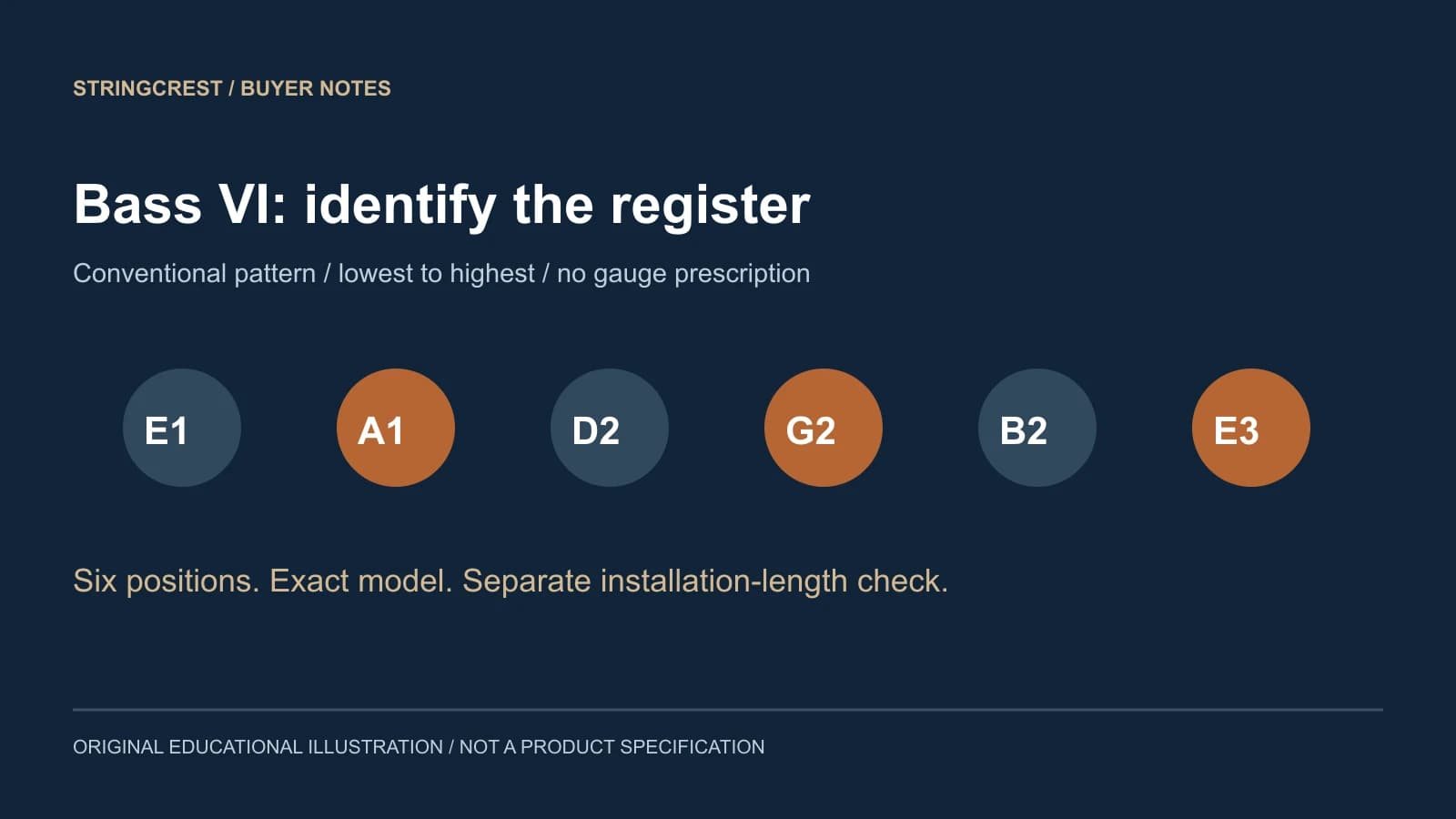
Bass VI strings need to match a six-position, guitar-pattern tuning in a bass register and the installation path of the exact instrument. A conventional six-string bass set is a different configuration. A dealer should establish the pitch map and model before comparing gauges or accepting “six-string bass” as a complete order description.
This guide uses the conventional Bass VI pattern, from lowest to highest: E1, A1, D2, G2, B2 and E3. Alternate tunings need a separate assessment. The proposed checks below help dealers distinguish the requested application without presenting an untested gauge set as a recommendation.
Resolve the register before opening a set
Fender's explanation of the Bass VI describes its Fender and Squier examples as 30-inch-scale bass instruments tuned E–A–D–G–B–E one octave below a standard guitar. Keep that dimensional statement attached to those models; measure or obtain documentation for the actual instrument being serviced.
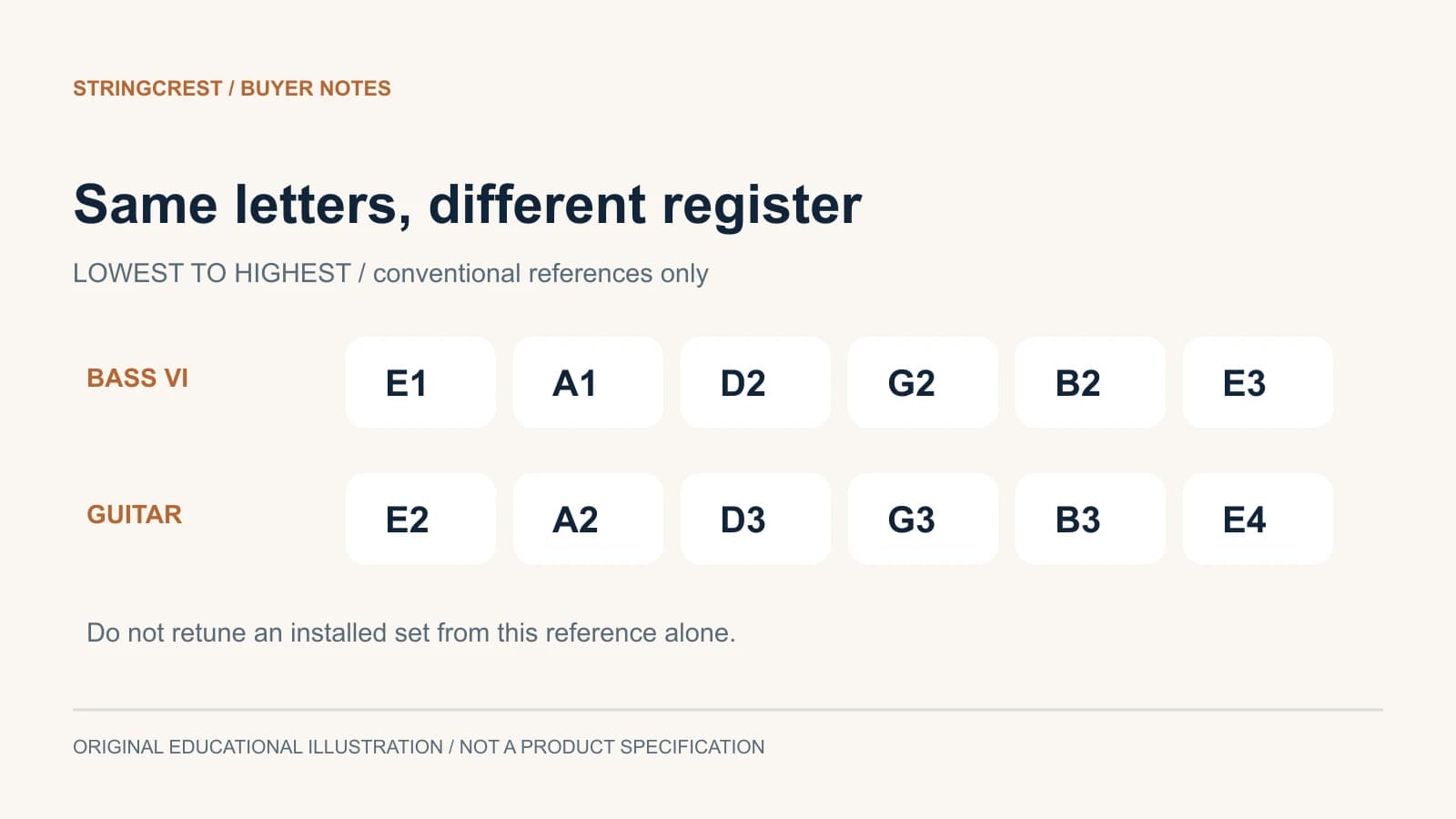
The note letters can look familiar while the pitches are different. The octave number makes the intended register explicit. It also prevents a conventional six-string bass enquiry, commonly low B through high C, from being treated as the same six-part set.
| Application reference | Low-to-high open pitches | What the dealer must distinguish |
|---|---|---|
| Standard six-string guitar | E2, A2, D3, G3, B3, E4 | An octave above the conventional Bass VI pattern |
| Conventional Bass VI pattern | E1, A1, D2, G2, B2, E3 | Guitar-like intervals in the lower register |
| Conventional six-string bass | B0, E1, A1, D2, G2, C3 | Different endpoints and an all-fourths pattern |
These are configuration references, not instructions to retune an installed set. A change of register, tuning or string construction requires suitable strings and an instrument-specific setup review. Do not tune a Bass VI string an octave higher merely because a guitar tuner displays the same note letter.
The five- and six-string bass guide covers the low-B/high-C range question. The baritone guitar guide covers another application. Neither label is a substitute for the actual pitch map here.
A 30-inch scale does not specify the entire string
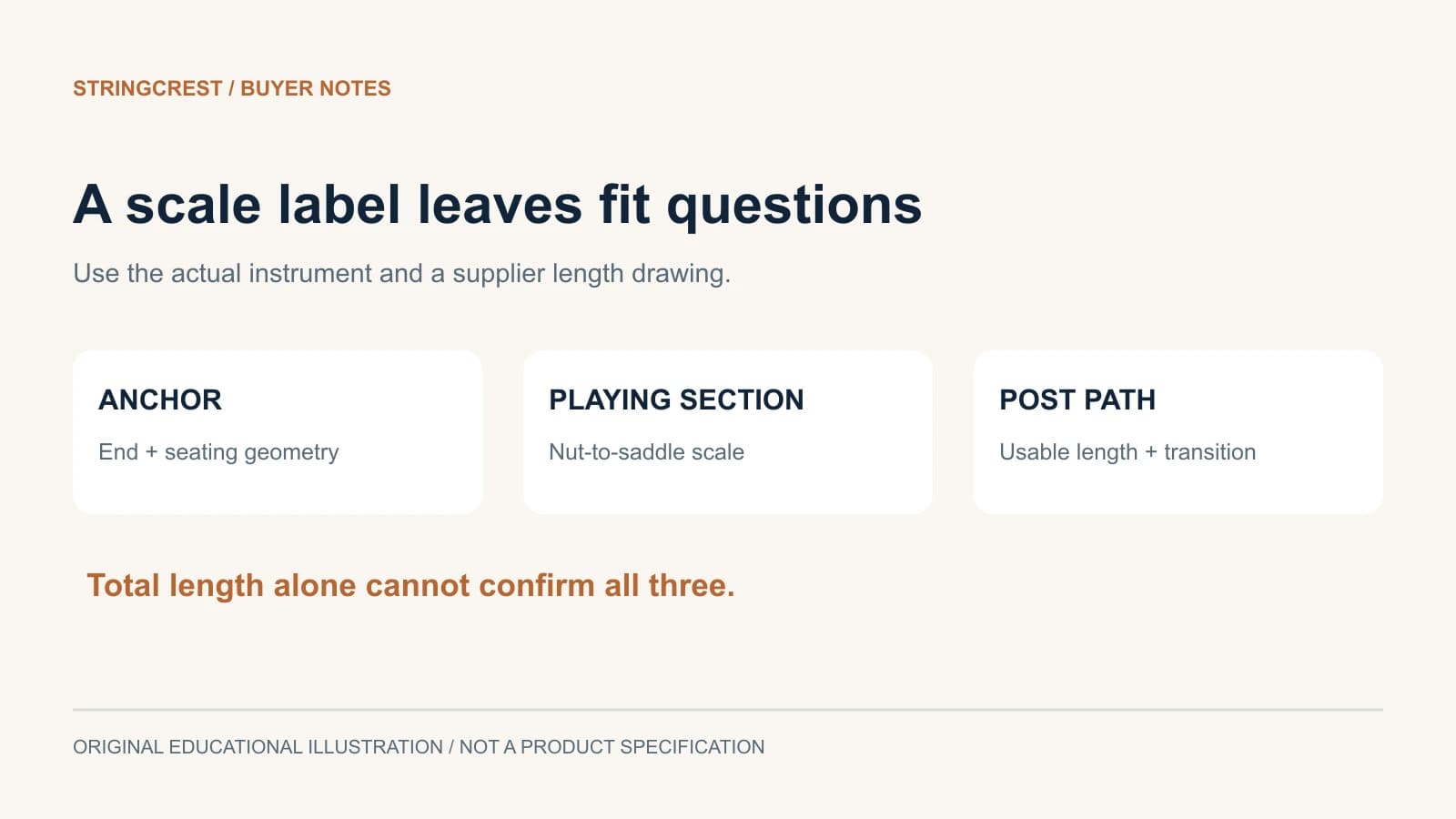
Measure effective vibrating length between nut and saddle, then consider the rest of the installed path. The distance from the end seating point to the bridge and the route beyond the nut also matter. Two instruments can share a scale length while placing their anchors or tuners differently.
Keep four questions separate: will the end seat, will full-diameter winding cover the intended playing section, where will the transition fall, and can the intended section enter the tuning post? A long enough loose string does not answer all four.
La Bella's Bass VI product description specifically discusses smaller ball ends and slimmer tuning-post sections for its stated application. This is a useful manufacturer example of why a generic bass-string length label can miss an important fit detail. It is not a dimensional specification for every Bass VI-style instrument.
Obtain the instrument maker's requirements and the candidate supplier's length drawing when fit is uncertain. Do not enlarge a tuner hole, alter the nut or trim a construction-sensitive winding to make an unconfirmed substitute work. For the general length distinctions, use the bass scale and winding-length guide.
Specify six complete positions
A top-to-bottom gauge range does not identify the four middle strings, the construction at each position or the intended register. Write all six gauges and units alongside their pitches. If one document runs first-to-sixth and another runs lowest-to-highest, reverse the sequence explicitly before comparing.
Use one position identifier consistently within the record. A practical option is to name each row by its intended pitch rather than writing “first” without a direction. Mark whether the string is wound and record the declared core, wrap and surface where relevant.
Do not estimate tension from diameter alone when the construction differs. Unit mass, scale and target pitch are part of a tension calculation. Without dependable inputs, a published gauge can be a candidate reference but cannot be converted into a claimed force or a guaranteed feel.
Discuss a Bass VI replacement requirement. Send the exact model, low-to-high tuning, current set identity and photos of the bridge and tuning-post path.
Separate fit, setup and the low-string playing complaint
If the customer's complaint is a loose-feeling low E, identify when it occurs. An open note struck hard, a lightly picked line and a fretted chord create different assessment tasks. “Needs a thicker string” is a possible proposal after investigation, not a diagnosis.
A proposed dealer comparison can use the current approved set as the reference. Record the action, tuning and normal playing attack before assessing a properly fitting candidate. Then listen to the low E open and fretted, and compare the response in the actual passage the customer uses.
Keep mechanical symptoms separate from preference. A string that moves out of its intended saddle position, a transition sitting in the wrong place or an unresolved buzzing complaint calls for an instrument review. Increasing diameter cannot establish that an unsuitable attachment or setup has been corrected.
Intonation should be checked after an appropriate string change and setup. A tuner reading on the open string does not establish that the fretted instrument is ready. The post-change intonation guide explains how to frame that diagnostic discussion without claiming that every discrepancy is caused by the string.
Keep the purchasing unit and compatibility claim narrow
For a full-set order, specify all six positions and the exact intended application. For a low-E replacement, retain the individual part identity and how it relates to the existing set. Do not describe a single replacement as a complete six-string solution.
For a proposed dealer range, separate the model-fit decision from the surface preference. Flatwound or roundwound describes a construction choice; it does not establish the right end, usable length or transition. A model-specific family can be useful only within its maker's stated compatibility.
The proposed handoff below lets a buyer stop an ambiguous order before packaging or quantity commitments are attached to it.
| Purchasing question | Minimum evidence | Unresolved outcome |
|---|---|---|
| Which six-string application? | Model and six pitches with octave numbers | Ask for instrument identification |
| Does the candidate install correctly? | End and length/transition requirements | Seek supplier and instrument confirmation |
| What is being changed? | Full current and candidate set identities | Record a whole-set comparison |
| Is the requested unit a set or single? | Position and quantity basis | Clarify the order unit |
FAQ
Can a short-scale bass set be treated as a Bass VI set?
No. A shared scale category does not establish the six pitches, all gauges, attachment or usable winding path. Obtain an application-specific candidate rather than assembling a replacement from the label alone.
Does a heavier low E guarantee better intonation?
No. A different gauge may be worth assessing for the player's attack, but fit, setup and available adjustment also matter. Have the instrument evaluated if the complaint remains; do not promise an intonation result from one gauge number.
Conclusion
Resolve the register first, confirm the installation path second and compare complete candidates third. This prevents a familiar six-string label from hiding a different set architecture or an unsuitable end transition.
Send your Bass VI string-selection brief with the instrument model, six pitches, current reference and fit question. StringCrest can review the application; confirm the proposed construction, dimensions and supply terms before approving an order.
FROM GUIDE TO PRODUCT
Connect this guide to Bass Guitar Strings.
Review the relevant range, then bring the instrument, complete specification and open questions into one project brief.
YOUR PRODUCT · YOUR BRAND
Discuss your next string project with Frank.
Share your instrument category, target market, gauge or material direction and private-label packaging requirements.

ABOUT THE AUTHOR
Frank Zou
Frank works directly with musical-instrument brands, importers and distributors on string specifications, product selection and private-label project requirements.
Meet Frank