
Buying Guides
Product Selection
Baritone Guitar Strings Wholesale: A Specification Guide for Brands and Distributors
A buyer-focused method for defining baritone tuning, scale, gauges, usable winding length and sample controls before approving a wholesale string range.
Introduction
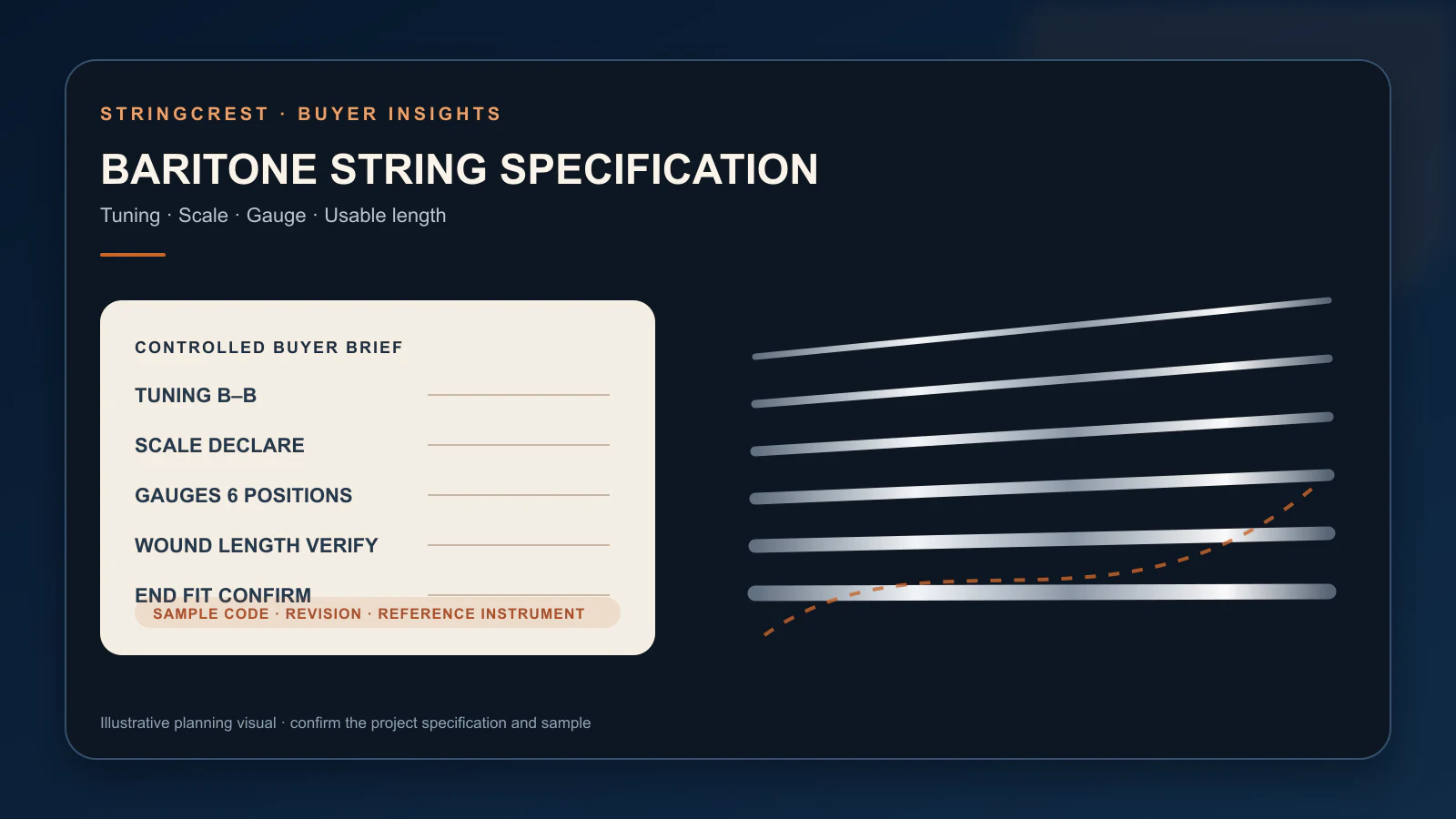
Buying baritone guitar strings for a wholesale or private-label range starts with the instrument, not with a gauge number. A workable brief identifies the intended tuning, vibrating scale length, bridge type, headstock layout, number of strings, target feel and the usable wound length required by the instrument. Only after those facts are fixed should a buyer compare gauges, materials or packaging.
That order matters because the label “baritone” covers more than one use case. Some instruments are six-string electrics tuned below standard guitar; some use longer scales; some players want a firm response while others deliberately choose a more flexible set. A gauge set that appears plausible on a spreadsheet can still fail if the wound portion ends before the nut, continues too far onto a tuner post, or produces an unsuitable feel at the buyer’s target pitch.
This guide gives brand managers, importers, distributors and music retailers a controlled way to prepare a baritone-string request. It does not prescribe one universal set or claim that a particular gauge fits every instrument. Instead, it turns the variables that affect fit and assortment planning into questions a supplier can answer and samples a buyer can evaluate.
Start with the instrument and tuning
Record the complete use case before discussing gauges
The first line of the request should state whether the range is for electric baritone guitar, acoustic baritone guitar or another long-scale instrument. These are not interchangeable categories. The buyer should then provide the number of strings, the lowest-to-highest tuning, scale length, bridge or tailpiece arrangement and headstock configuration.
A phrase such as “baritone set, medium” is incomplete. “Six-string electric baritone, 27-inch scale, B-to-B tuning, string-through-body bridge, inline tuners” is a useful starting point. If several instruments are important to the sales channel, list each reference instrument separately. Do not combine them into an undefined idea of “standard baritone.”
Tuning belongs in the brief because pitch changes tension. Scale belongs there because a longer vibrating length also changes tension. The D’Addario tension chart expresses string tension as a relationship among unit weight, scale length and frequency. That relationship explains why gauge alone cannot describe feel across different instruments. It also explains why a sample approved at one tuning and scale should not automatically be presented as validated at another.
| Required input | Example format | Why the supplier needs it |
|---|---|---|
| Instrument | Six-string electric baritone | Defines the basic construction context |
| Tuning | B1–E2–A2–D3–F#3–B3 | Establishes the pitch target for every position |
| Scale length | 27 in / 686 mm | Affects calculated tension and physical fit |
| Bridge path | String-through body | Affects total and usable length |
| Headstock | Six inline or 3+3 | Changes the longest tuner path |
| Target feel | Flexible, balanced or firm | Guides sample comparison without pretending feel is a universal number |
Treat gauge as a position-by-position system
A six-number set is more useful than one marketing label
Terms such as light, regular and heavy can help shoppers compare packs within one product family, but they are not a reliable cross-supplier specification. A buyer’s worksheet should list the nominal diameter of every string position. It should also identify which positions are plain and which are wound, and whether any transition is intentional.
The lowest string usually receives the most attention, yet the middle of the set often determines whether the set feels coherent. Large jumps can make adjacent positions feel unrelated; very small jumps may not deliver the progression the buyer expects. The upper strings also need review because a set built for lower tuning must still bend, fret and intonate in a way that suits its intended players.
One branded market example illustrates the need to treat a published set as brand-specific evidence rather than a universal rule. Ernie Ball lists a six-string 13–72 baritone set for A-to-A or B-to-B tuning and also publishes set-length and taper information. Those figures describe that product. They do not establish a StringCrest specification and should not be copied into a new line without instrument testing.
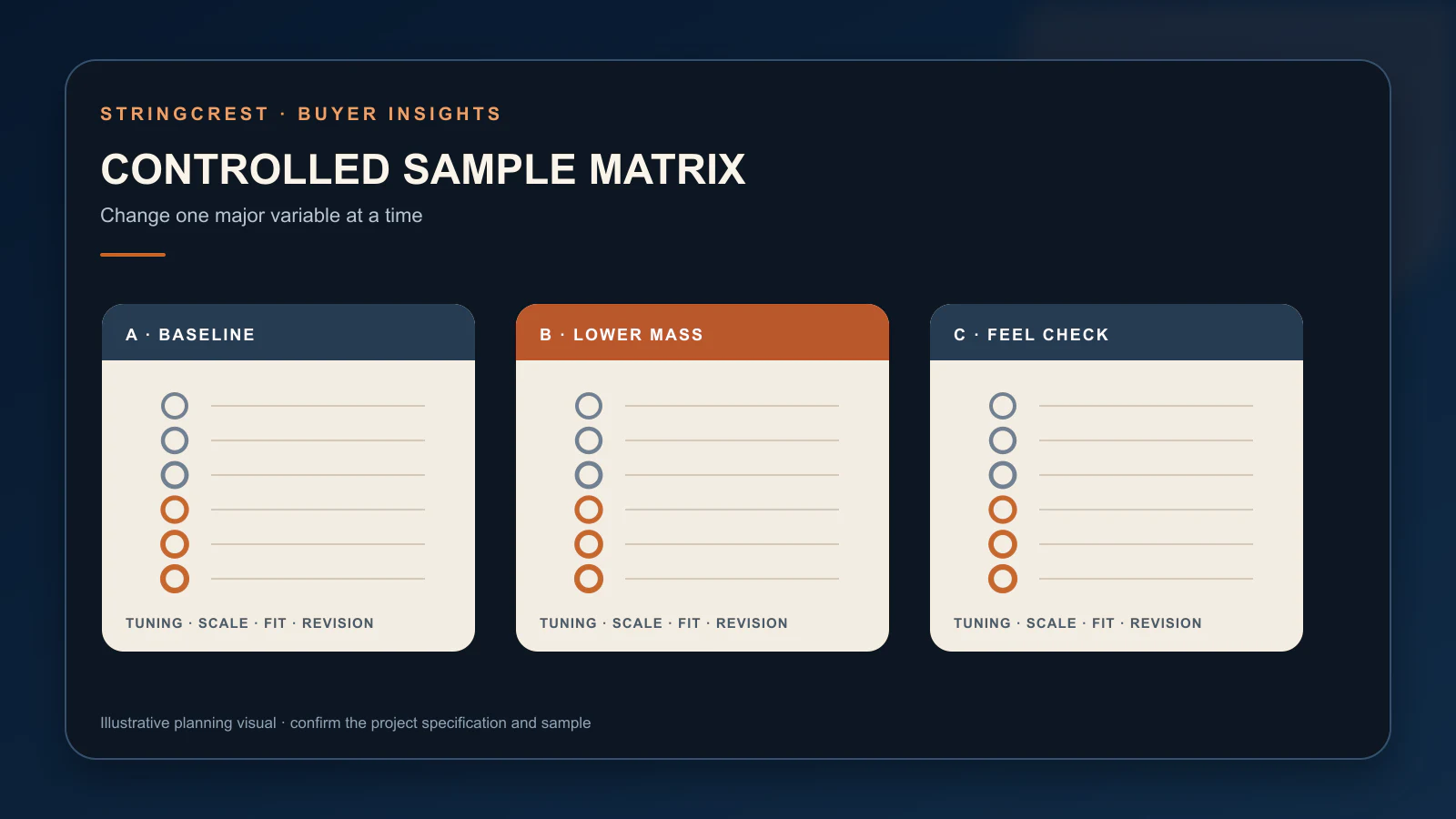
For a new assortment, request at least two logically different sample matrices rather than making several random gauge substitutions. One matrix can hold the top strings constant while comparing lower-string mass; another can hold the lower positions constant while comparing the transition through the middle. A controlled change makes feedback easier to interpret.
Specify total length, wound length and taper
Fit failures often occur outside the playing area
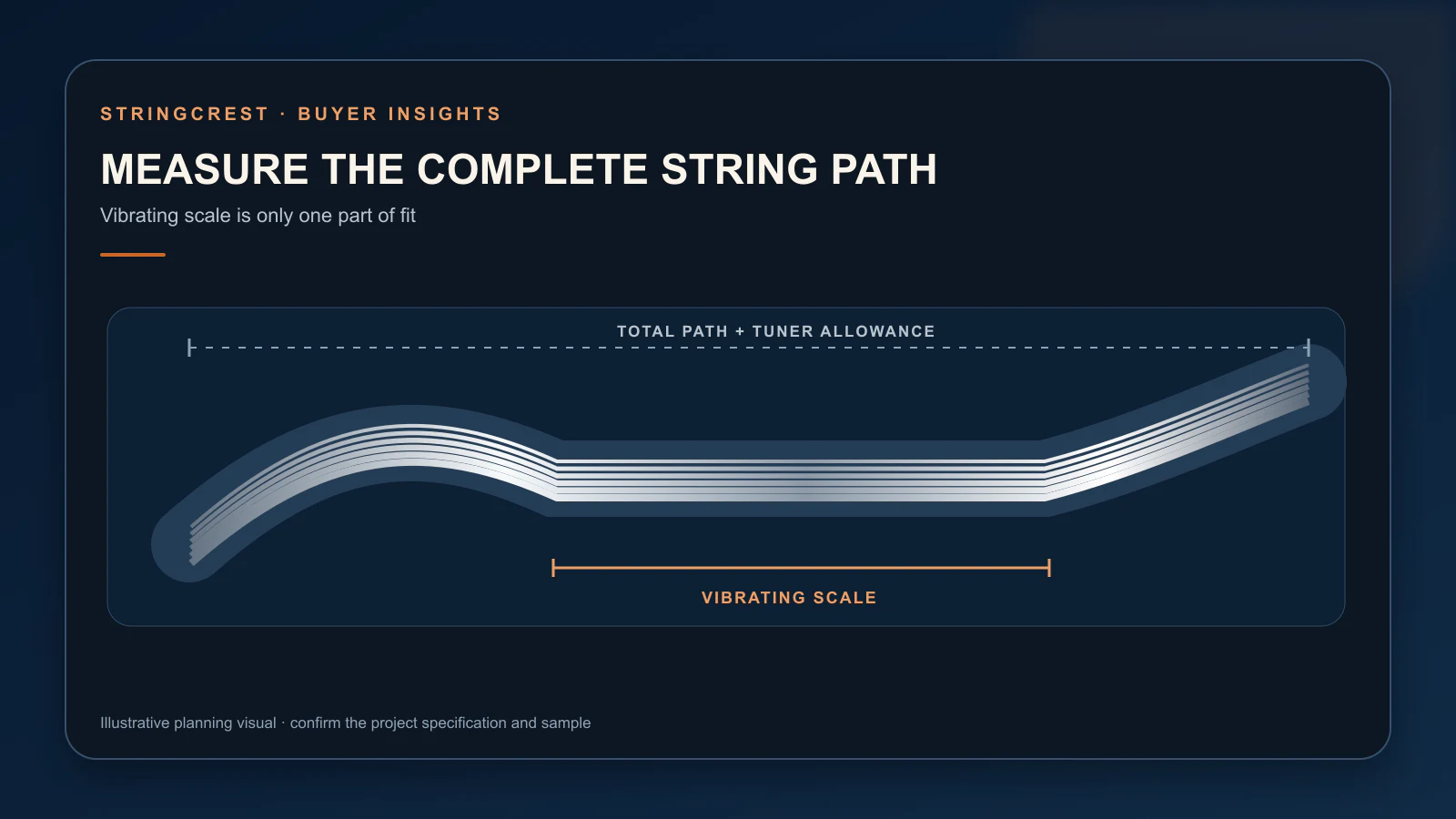
Scale length is only the vibrating part of the string. The complete path can also include the bridge or tailpiece, body passage, distance behind the nut and travel to the farthest tuner. Wholesale briefs should therefore include a measured string-path drawing or a set of minimum length requirements.
For wound strings, three dimensions may matter: total string length, usable wound length and the location of any taper or transition. If the wound section is too short, a plain core or taper can reach the nut or speaking length. If it is too long, a thick wound section may wrap around a tuner post that was not designed for it. Reverse or extended headstocks can increase the path for particular positions.
Measure the longest path on the actual reference instrument. Add the bridge path and tuner-post allowance instead of estimating from scale length alone. When a line is intended for more than one instrument, record the maximum and minimum acceptable positions for the wound-to-plain transition. A supplier can then confirm whether one construction covers the range or whether separate sets are more responsible.
This is also the point to specify the anchoring end. Electric baritone sets commonly use a ball end, but the buyer should still state the required end and bridge fit. Do not infer it from a product photo. Confirm ball geometry, string-through compatibility and any special tailpiece requirement in the sample review.
Select material and construction as test variables
Separate tonal language from the measurable build
Material descriptions are useful when they identify the core, wrap and surface treatment. Broad promises such as “powerful,” “warm” or “long lasting” are not a substitute for those facts. For a metal-wound electric set, a buyer might compare wrap choices, core geometry and winding approach. For an acoustic application, the material system and corrosion considerations may differ. The product category should therefore be decided before one material brief is sent to multiple suppliers.
The core-to-wrap relationship influences mass, flexibility and response, but buyers do not need to publish confidential production details to control a project. A practical approval sheet can record the declared construction, nominal gauges, winding continuity, surface appearance, end construction and measured fit on the reference instrument. If a coating or treatment is proposed, ask what the claim actually means and how it should be described on packaging. Avoid creating a durability promise without a defined test method and evidence.
Round-core and hex-core descriptions also need controlled handling. They describe a construction choice, not an automatic guarantee of a particular tone or lifespan. If the buyer wants to compare them, keep gauges, tuning, scale, installation and evaluation questions as consistent as possible. Record differences as sample observations, not as universal laws.
Build a sample matrix buyers can evaluate
Change one major variable at a time
A disciplined sample plan is more valuable than a large box of unidentified sets. Give every candidate a code. The code should map to a revision-controlled worksheet containing position gauges, materials, end type, length, winding transition and packaging status. The player evaluating the set should be able to report on the code without seeing persuasive marketing language.
Use at least one reference instrument that represents the intended market. Record its scale, tuning and setup before installation. During installation, check that each string reaches its tuner, that wound sections sit where expected and that the anchoring ends seat correctly. After tuning and stabilization, evaluate feel across positions, fretting response, bending requirements, tuning behavior and any setup changes that become necessary.
Do not use a single player’s preference as the entire approval. A product manager can collect structured observations from several relevant players or technicians, but the goal is not to manufacture a false statistical study. It is to identify repeatable fit problems, inconsistent positions and unclear product claims before bulk packaging is approved.
| Sample check | Pass question | Evidence to retain |
|---|---|---|
| Identification | Does the sample code match the worksheet? | Pack label and receiving photo |
| Physical fit | Do all strings reach and seat correctly? | Installed-string photos and notes |
| Winding position | Are transitions clear of the speaking length and suitable for tuners? | Measured reference points |
| Playing review | Does the set meet the chosen feel direction at the declared tuning? | Structured evaluator form |
| Revision control | Can the approved set be distinguished from earlier trials? | Signed or dated approval record |
Plan the range and packaging together
The package must communicate the approved use case
Once a set is approved, the package should help a buyer or player identify what it is for. At minimum, consider the instrument category, string count, gauge sequence, intended tuning guidance, material description, end construction and any important scale or fit qualification. The wording should match the approved specification and should not imply universal compatibility.
A distributor may choose one focused baritone set rather than several near-duplicates. Another may need distinct options for different tunings or instrument types. The correct range depends on customer requirements, channel knowledge and the ability to hold each SKU consistently. Search demand can identify a topic, but it does not prove how many SKUs a particular distributor should stock.
Packaging control also includes artwork version, barcode assignment, inner protection, pack count and carton identification. Confirm these separately from string performance. A string sample can pass while its artwork remains unapproved, and approved artwork can still be paired with the wrong physical revision if codes are weak.
For distributors serving several countries, keep the technical identity stable while reviewing market-facing language separately. Gauge units, tuning notation and material names must remain unambiguous across catalogs, cartons and digital listings. A translated label should never change the underlying construction. If a marketplace limits title length, preserve the instrument and gauge information first and move secondary language to the description.
Prepare an RFQ that produces comparable quotations
Ask every supplier to answer the same specification
A useful request for quotation contains a frozen table rather than a collection of chat messages. Include the instrument, tuning, scale, gauge positions, materials, string ends, length requirements, target markets, packaging format and requested sample quantity. Mark any field that is still open for supplier recommendation.
Ask the supplier to identify deviations instead of silently substituting. If a proposed construction requires a different gauge or taper, the quotation should make that visible. Request a revision number and date on both the technical sheet and artwork proof. Commercial details such as MOQ, lead time and price should be confirmed in the current quotation; they should not be copied from an old project or assumed from an article.
Before approving volume production, reconcile four items: the signed specification, approved physical sample, final artwork and purchase order. If any one of them refers to a different revision, stop and clarify. This simple document check prevents many avoidable disputes.
Common buying mistakes
Avoid assumptions that create fit or claim problems
The first mistake is choosing by the lowest-string gauge alone. The full progression matters. The second is treating “baritone” as a single standardized scale and tuning. The third is measuring only the scale while ignoring bridge and tuner travel. The fourth is changing gauge, material and construction at the same time, which makes sample feedback hard to interpret.
Another common mistake is writing packaging claims before the product is approved. Descriptive language should follow verified construction and controlled evaluation. Finally, do not present a competitor’s published specification as a hidden StringCrest specification. Competitor data can show which variables the market communicates; your own product still requires its own brief, sample and quotation.
FAQ
What gauge is best for a baritone guitar?
There is no universal best gauge. The suitable set depends on tuning, scale length, instrument construction and the player’s target feel. Compare complete position-by-position sample sets on a declared reference instrument rather than selecting only by the lowest string.
Can one baritone set cover both A-to-A and B-to-B tuning?
Some commercial products are marketed for more than one tuning, but the resulting feel changes with pitch and scale. A buyer should validate each claimed tuning on relevant instruments and phrase compatibility narrowly.
Why does wound length need a separate specification?
The speaking length is not the complete string path. A wound section must cover the required path without placing an unsuitable transition on the nut, speaking length or tuner. Long, reverse or unusual headstocks make this check especially important.
Should a baritone range use ball ends?
The end construction must match the intended bridge or tailpiece. Many electric baritone guitars use ball-end strings, but the buyer should state and test the required fit instead of relying on category assumptions.
What should be approved before a wholesale order?
Approve the technical specification, identified sample, packaging artwork, pack configuration and purchase-order revision. Record any exceptions in writing and confirm current commercial terms directly with the supplier.
Conclusion
Baritone guitar strings are easier to source when the brief begins with tuning, scale and the complete instrument path. A position-by-position gauge table, usable wound-length requirement and controlled sample matrix turn a vague “baritone set” into an auditable product decision. The result is a clearer quotation, a more useful sample review and packaging that states the intended application without promising universal fit.
Explore electric guitar string options · Send your baritone string requirements
Sources and interpretation limits
These official sources explain industry variables and one brand-specific market example. They do not establish StringCrest specifications, availability, performance, testing or commercial terms. Confirm the proposal, sample and quotation for each project.
FROM GUIDE TO PRODUCT
Connect this guide to StringCrest product ranges.
Review the relevant range, then bring the instrument, complete specification and open questions into one project brief.
YOUR PRODUCT · YOUR BRAND
Discuss your next string project with Frank.
Share your instrument category, target market, gauge or material direction and private-label packaging requirements.

ABOUT THE AUTHOR
Frank Zou
Frank works directly with musical-instrument brands, importers and distributors on string specifications, product selection and private-label project requirements.
Meet Frank