
Product Selection
Buying Guides
Rubber Bass Strings: A Dealer Guide to Material and Model Fit
Separate a soft black appearance from actual string construction, then check the exact compact-bass model and approved replacement family.
Introduction
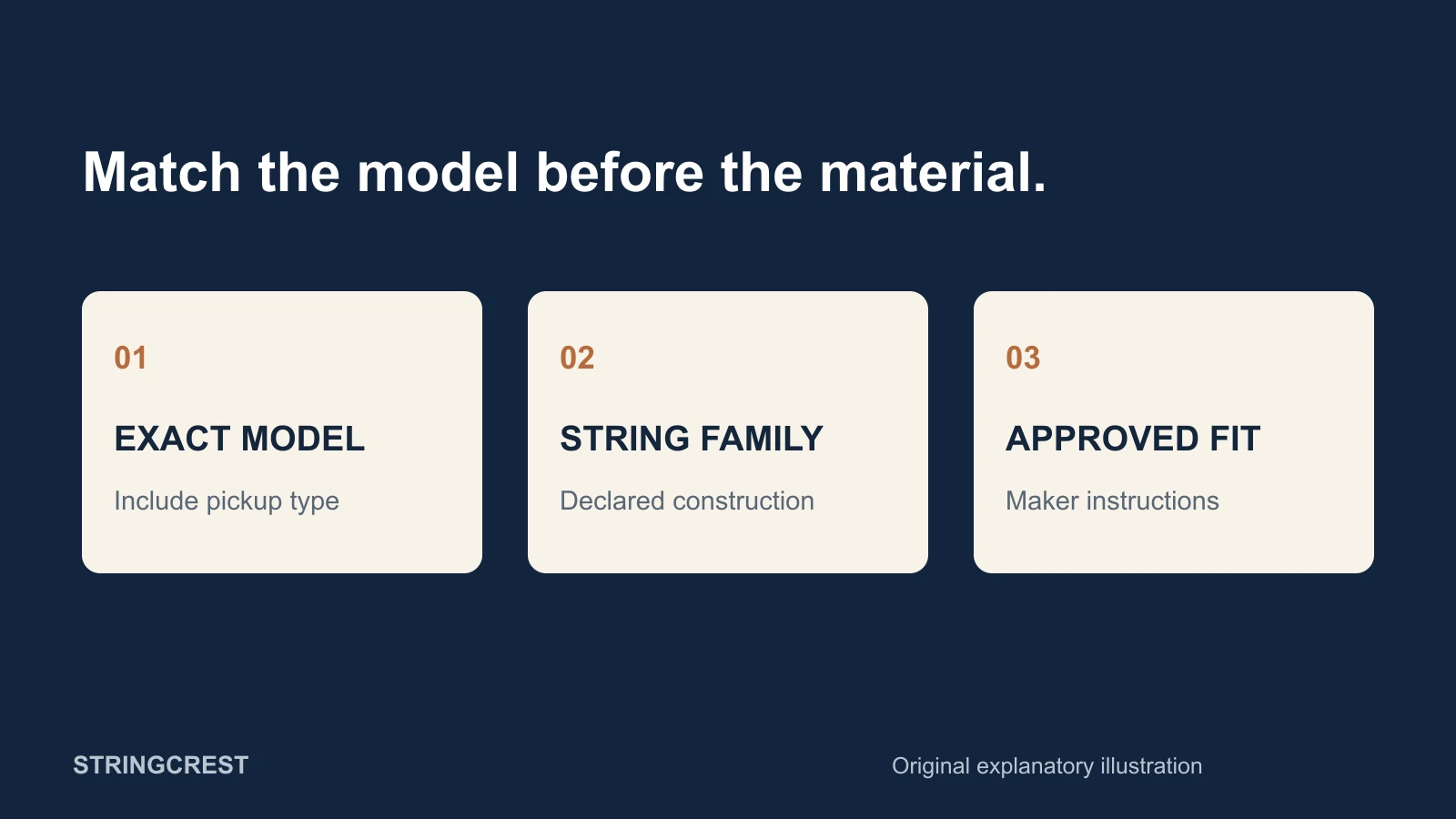
Before supplying rubber bass strings, identify the exact instrument and replacement-string family. Rubber is a description customers use for feel and appearance; it does not establish one material, one attachment method or compatibility with every compact bass. A dark string can also have a wound construction that belongs to a different product family.
For a US retailer, this is a model-matching decision before it is a tone comparison. Establish what the instrument maker approves, what is currently installed and whether the request is a like-for-like replacement or a conversion. The term U•BASS is used below only for Kala's named products and examples.
Translate the customer's description into a product identity
Ask for the instrument model, photographs and the current string packet or product code. Record whether the bass is acoustic-electric or a solid-body design and identify its pickup system from the maker's information. Similar body size and the same four tuning letters do not prove that two instruments use the same strings.
Kala describes its Road Toad Pahoehoe set as a proprietary polyurethane blend, using black rubber as a descriptive term. Its product page gives a defined scale range, rubber-stringed model scope and exclusions. That is a useful manufacturer-specific example of why material and application need separate fields.
Do not expand this example into a statement that every string sold as rubber is polyurethane. Keep a supplier's actual material declaration. Equally, do not replace a missing material name with nylon simply because a customer associates small instruments with ukuleles.
| Customer's description | What it helps identify | What still needs confirmation |
|---|---|---|
| Black and soft | An appearance and handling reference | Material, product code and model compatibility |
| Rubber bass strings | A likely replacement family to investigate | The maker's actual construction and application |
| Four-string compact bass | String count and a broad instrument description | Scale, pickup, hardware and exact model |
| Same tuning as another bass | A pitch relationship to check | Physical fit and approved string family |
Separate three constructions that can look similar
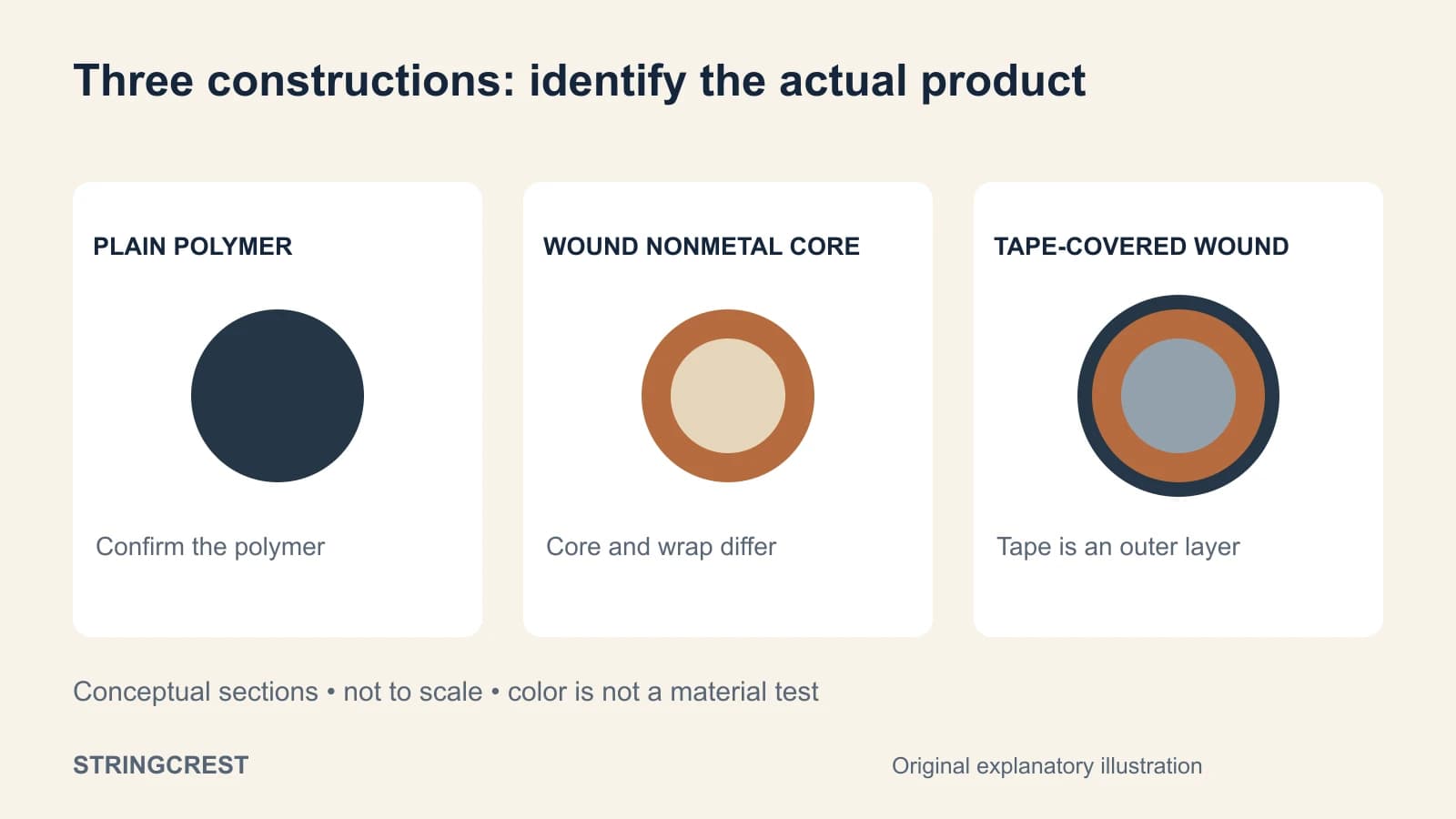
A plain polymer string is different from a metal-wound string with a nonmetal core. Both are different from a conventional metal-core string with an outer tape. The outer color is insufficient to choose among them.
Kala's KA-BASS-4-SC product page, for example, specifies a steel core and nickel outer winding for a particular solid-body magnetic-pickup application. The page excludes its California models. This statement belongs to that named set; it is not a rule that every solid-body compact bass accepts the same construction.
For tape-covered products, use the tapewound construction guide. A black tape surface should not become a substitute description for a plain polyurethane string. If a quoted alternative has a different core or winding, the difference needs review even when a photograph looks close.
Treat a conversion as a separate service decision
A like-for-like replacement should match the instrument maker's application and installation guidance. A change from a wound-string setup to a thick polymer string is a different request. Hardware clearance and the intended pickup system must be checked before a candidate is ordered as a direct replacement.
The Pahoehoe page specifically calls for a compatible replacement nut when those strings are used on round-wound U•BASS setups, with the work performed by an experienced technician. It also excludes Kala's solid-body magnetic-pickup models. Do not turn that model-specific instruction into permission to widen a nut on an unrelated bass.
A counter recommendation can therefore end in one of three useful outcomes: identify the approved replacement, ask the manufacturer about an undocumented combination, or refer a conversion for qualified assessment. A customer should know which outcome the dealer is offering before any strings are cut or hardware is altered.
Send your compact-bass application and replacement requirements to StringCrest. Provide the model, current string reference, pickup description and photographs. Any proposed construction or supply option needs confirmation for that project.
Record fit without guessing from the scale label
Measure the speaking scale using the instrument maker's contact points. Then examine the actual attachment path and tuner arrangement. For any dimensional discussion, identify where a measurement starts and ends; a model's overall body length is not its string scale.
A thick flexible string needs an attachment method suitable for that exact product and hardware. Follow the applicable instructions for knots, clamps, bridge fittings or tuner preparation rather than borrowing a familiar metal-string winding method. If the correct instructions are unavailable, obtain them before proceeding.
The bass scale and installation-length guide explains why a named scale category alone does not define usable string length. Apply that measurement discipline while retaining the compact instrument's own installation method.
Keep the packet with the installed set until the dealer has resolved any fit question. If a string has already been shortened or modified, record that fact before comparing it with a new sample. An altered component cannot establish the supplied length of an untouched set.
Give the customer a model-specific handover
Explain the chosen product using the maker's construction and application description. Leave tone promises within the evidence available for that product. The named Pahoehoe example does not establish a universal settling time, service life or upright-bass sound for every polymer string and instrument.
Ask the customer to follow the applicable tuning and installation instructions. A repeated need to retune should be recorded with the installation condition, rather than answered by an unverified universal stretching routine. The dealer should avoid improvising a forceful pulling method for an unfamiliar material.
Care advice also needs to match the actual product. A cleaning fluid approved for one metal string is not automatically suitable for a proprietary polymer or for the instrument's finish. Use the relevant maker's care instructions and keep the material identity visible in the after-sales record.
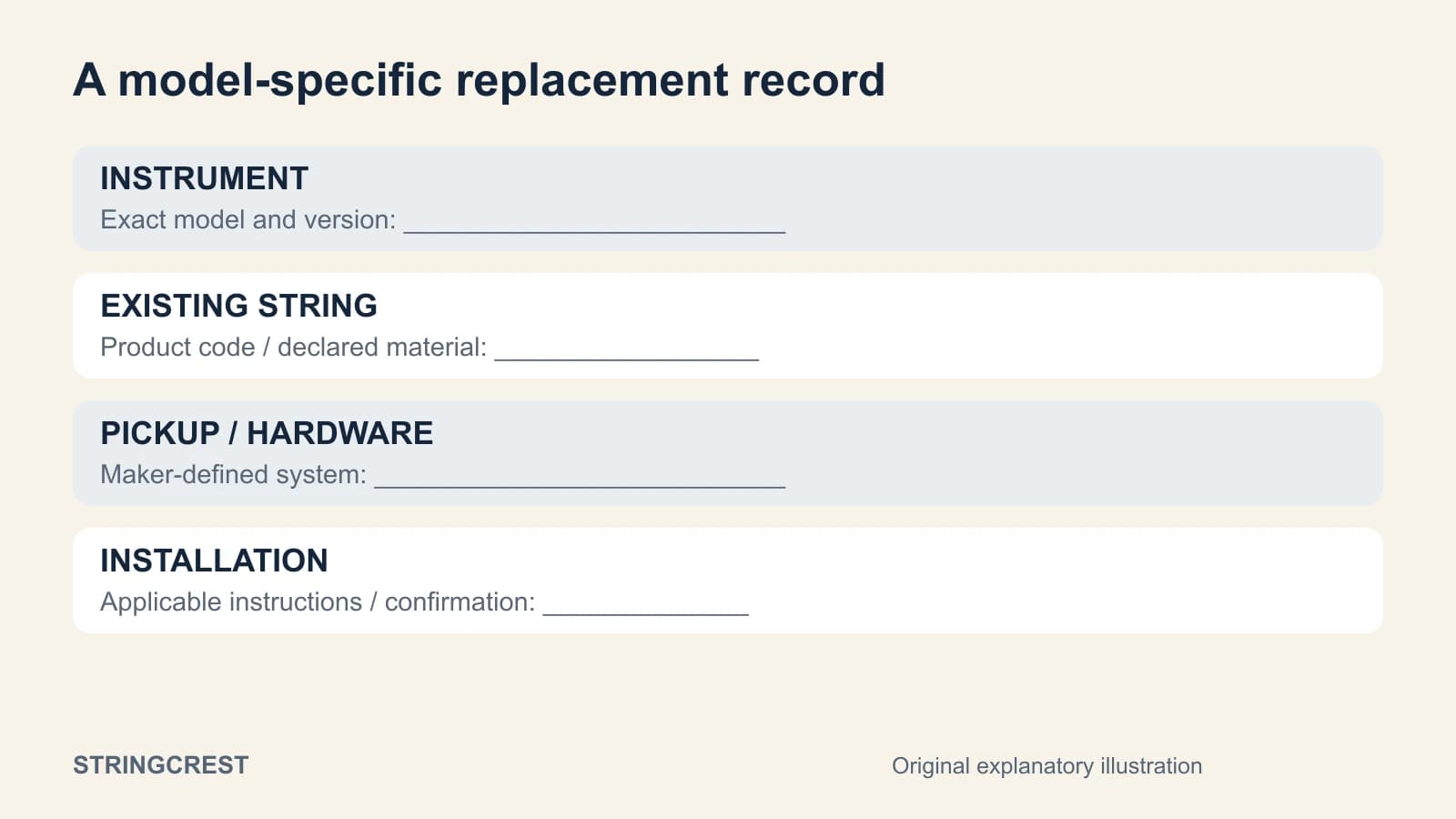
For wholesale inquiries, separate established model replacements from exploratory alternatives. The same carton description should not cover different strings merely because all are dark colored. Preserve the confirmed product family, number of strings, application and package reference through ordering and receiving.
FAQ
Can rubber strings replace metal strings on a full-size bass?
The description alone cannot establish that conversion. Use the actual instrument and string maker's application guidance. Physical dimensions, attachment and pickup compatibility must be resolved; shortening an unsuitable string does not create an approved replacement.
Are rubber bass strings the same as black nylon tapewounds?
No. Those names can describe different structures. A tape-covered wound string and a plain polymer string should be identified separately. Confirm the actual core, winding or polymer declaration instead of deciding from color.
What if the customer no longer has the original packet?
Use the instrument's complete model identity and the manufacturer's current replacement guidance. Photographs and any prior service record can help. If they do not resolve the string family, keep the recommendation conditional while obtaining confirmation.
Conclusion
A reliable rubber-string replacement starts with the instrument model and its approved string family. Material, hardware and pickup information then clarify whether the request is a direct replacement, an unanswered compatibility question or a conversion requiring specialist work.
Discuss your bass-string requirements with StringCrest using the identified model and product references. Browse the bass string category for broader project context, and use the maker's model-specific information when defining a compact-bass replacement.
FROM GUIDE TO PRODUCT
Connect this guide to Bass Guitar Strings.
Review the relevant range, then bring the instrument, complete specification and open questions into one project brief.
YOUR PRODUCT · YOUR BRAND
Discuss your next string project with Frank.
Share your instrument category, target market, gauge or material direction and private-label packaging requirements.

ABOUT THE AUTHOR
Frank Zou
Frank works directly with musical-instrument brands, importers and distributors on string specifications, product selection and private-label project requirements.
Meet Frank