
Buying Guides
Buying Guides
Gypsy Jazz Guitar Strings: Material, End Fit and Dealer Selection
Resolve silver-plated wrap, core construction and ball-versus-loop attachment before comparing a Gypsy Jazz replacement set.
Introduction
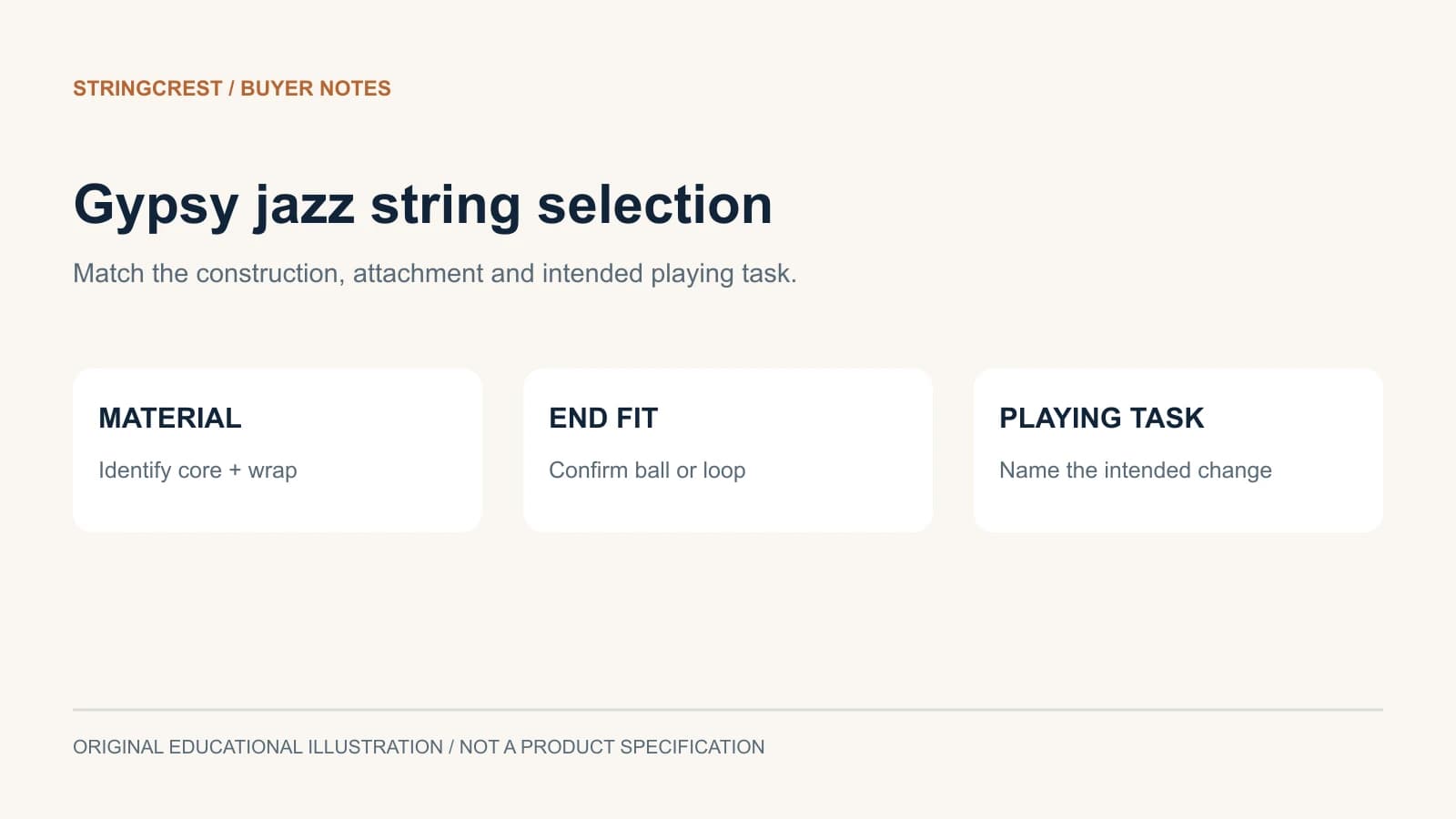
Gypsy jazz guitar strings should be selected by their declared construction, complete gauge sequence and attachment to the actual guitar. The name describes an application; it does not guarantee that every set uses the same core, wrap or end. A dealer handling a Manouche-style guitar needs to resolve those differences before recommending a replacement or preparing a private-label brief.
Begin with the player's current set and the change they want to hear or feel. A request for a stronger rhythm attack is different from a broken-string replacement. Neither request establishes that an ordinary bronze acoustic set is an equivalent substitute.
Identify the wrap and core separately
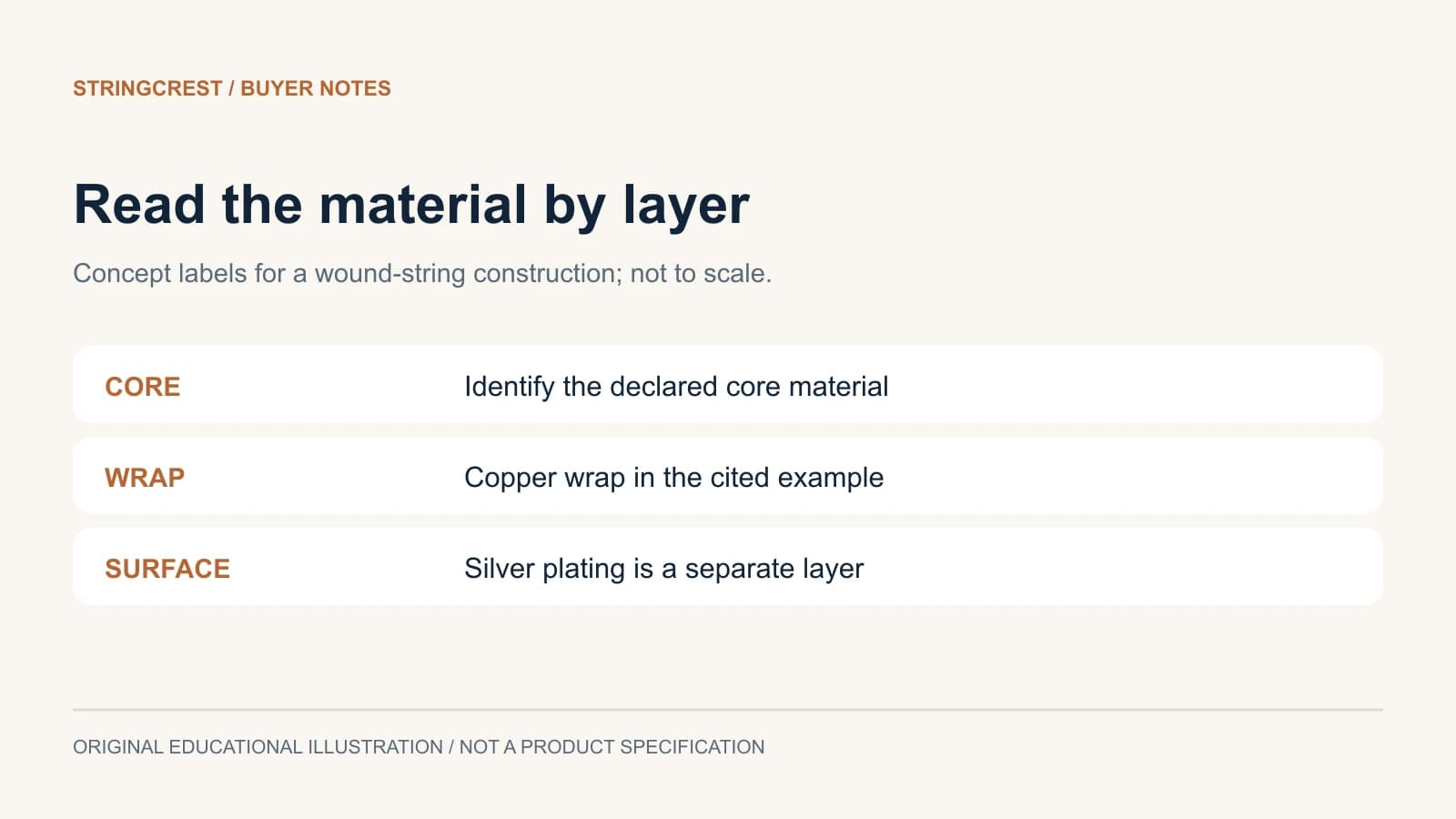
D'Addario's Gypsy Jazz family includes ball-end and loop-end versions. The maker's EJ84L description identifies a high-carbon steel core and silver-plated copper wrap. This is a named construction example, not a specification for every string sold under the Gypsy Jazz label.
Silver-plated copper means copper wrap wire with a silver surface treatment. It does not mean solid silver wire, a silver core or a nylon-core classical bass. A classical wound string may also have a silver-colored wrap, so appearance alone cannot identify the underlying string system. Keep a reference to the maker's exact product description rather than identifying material from a photograph.
For an unfamiliar candidate, ask which positions are plain and which are wound, what the core is, and how the maker describes the wrap. Coating, if any, belongs in a separate field. Do not add a protective-coating claim simply because the wrap is plated.
The broader acoustic-alloy guide compares phosphor bronze and 80/20 bronze. Use it for that range decision; a silver-plated copper enquiry needs its own construction record.
Check the tailpiece before choosing the packet
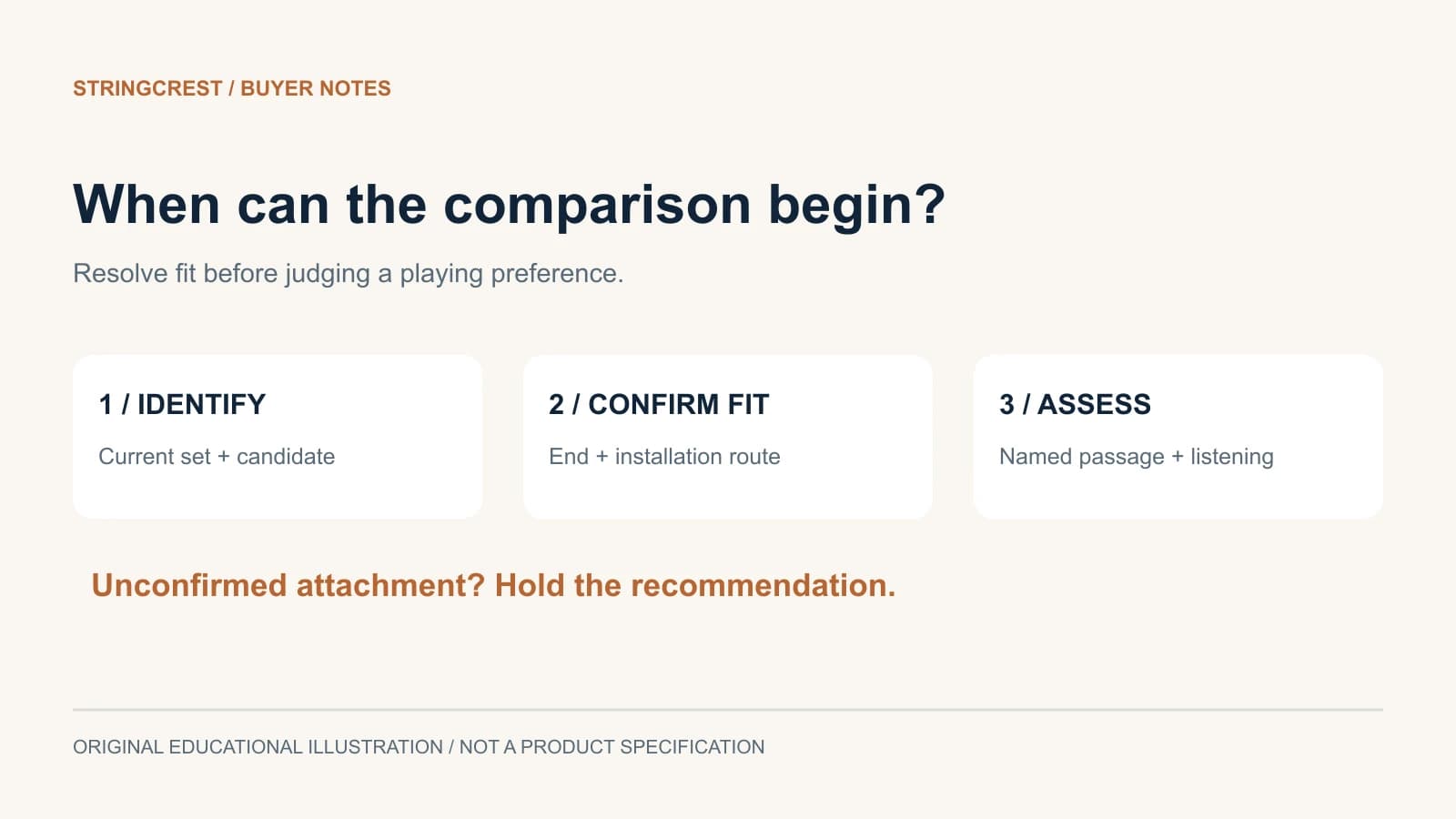
A guitar's style name does not establish whether it accepts a ball end or a formed loop. Look at the actual retaining feature and obtain the instrument maker's instructions. If an old string remains installed, photograph how it sits before removal. An obscured tailpiece cover is a reason to obtain clearer evidence rather than guess.
Ball and loop versions exist within the same published Gypsy Jazz family. That makes the end designation a separate selection field, even when the gauge range on two packets looks similar. Do not remove a ball, reshape a loop or improvise an adaptor as part of a routine string recommendation. Those changes need instrument-specific approval.
Record the string's route from its seating point to the bridge, nut and tuning post. Effective vibrating length runs between nut and saddle; the full installation route extends beyond it. A set that spans the scale can still have insufficient usable length or an unsuitable transition near the tuner.
Use the acoustic end-fit guide for the general distinction between attachment and playing length. For a tailpiece instrument, retain the actual seating point and hardware identity in the notes rather than assuming bridge-pin geometry.
Compare the whole set, then define the playing question
Write down all six gauges in the same direction and units. “10–44” supplies two endpoints; it does not establish the four middle strings. Likewise, a family's “light” label cannot prove equivalence with another maker's light set. Mark plain and wound positions where the published specification provides them.
Changing material and several gauges together is a whole-set comparison. That can be a useful buying decision, but it cannot isolate what caused a particular playing difference. If the dealer's purpose is to compare a material, start with the closest properly fitting construction and record any remaining differences.
Choose a short task that represents the customer's actual use. For rhythm, this might be a repeated chord pattern with the player's normal attack. For a lead complaint, retain the passage and position where the issue is heard. Keep the player, instrument and listening route consistent enough for the observation to mean something.
Do not turn descriptors such as “dry,” “warm” or “projecting” into universal material rankings. Ask what the listener means: a sharper first attack, a shorter perceived decay, better separation within a chord or a different resistance under the pick. These are observations to make, not results supplied by the word “Gypsy.”
Discuss a Gypsy Jazz string requirement. Send the instrument model, existing packet, end photographs and the specific playing change you want to assess.
Use a selection record that can reject the wrong substitute
The following is a proposed dealer worksheet, not a completed inspection. Fill it from the actual reference and candidate before making a recommendation.
| Decision | Record | Hold the recommendation when |
|---|---|---|
| Correct string system | Core, wrap and plain/wound positions | A silver-colored string is the only material evidence |
| Correct attachment | Required end and actual retaining hardware | Ball versus loop remains uncertain |
| Complete set identity | All six gauges, units and position order | Only the endpoint range is known |
| Installation fit | Scale and usable route to the posts | Length or transition placement is unconfirmed |
| Useful playing comparison | Named passage, attack and listening route | The intended improvement has no observable meaning |
A failed fit check stops the installation comparison. A difference in gauge does not automatically reject a candidate, but the dealer should explain it rather than calling the two sets identical. If the customer wants an exact replacement, that distinction matters more than a speculative tonal improvement.
Keep amplified observations separate
An unplugged impression and an amplified result answer different questions. Record whether the guitar is heard acoustically, through a microphone or through a named pickup. A wrap substitution may require a fresh amplified comparison even when the unplugged result is acceptable.
Do not diagnose weak output from wrap color alone. First establish the pickup type and the string maker's compatibility information. Electronics, settings and installation can also affect the observation. If those conditions are unknown, the useful next step is identification, not a promised “better” material.
For a dealer comparison, note the normal settings before changing strings. Listen for the original complaint without compensating for each candidate with unrecorded changes. If a different setup is needed, record it as part of that candidate's use case. The result then describes an instrument-and-string combination rather than proving a universal alloy effect.
Make the dealer description match the selected version
Put the complete version identity on the purchasing record: application, declared material, end type and full set. Keep another manufacturer's product name attached only to its own reference. A competitor example does not establish StringCrest availability, a matching gauge set or an approved replacement.
If the project needs custom packaging, decide what the package must help a player distinguish. Ball-end and loop-end variants need clear separation. A material claim should identify the relevant layer and should match the offered revision. Avoid borrowing another maker's tone, service-life or artist claims.
For a wider brand project, the private-label overview explains the development conversation. The specialist string construction and the actual instrument application still need confirmation before a product specification can be approved.
FAQ
Are silver-colored classical bass strings the same as Gypsy Jazz strings?
No. A similar exterior does not establish the core, complete set or intended instrument. The cited Gypsy Jazz example has a steel core and silver-plated copper wrap; identify the actual classical construction separately. Do not use finish color as a replacement rule.
Does a loop-end version sound different simply because it has a loop?
An end label establishes an attachment difference, not a controlled tonal result. A listening claim needs identified sets, compatible installation and stated conditions. Select the required end first and compare properly fitting candidates.
Conclusion
A useful Gypsy Jazz recommendation connects a declared construction to the guitar's attachment and the player's actual request. Resolve the material and fit questions before evaluating a playing change. Retain the complete set identity so that a successful candidate can be identified again.
Send your Manouche-style guitar string brief, including the current reference, full gauges if known, end photographs and intended use. StringCrest can review the requirement; construction, fit and supply terms require confirmation.
FROM GUIDE TO PRODUCT
Connect this guide to StringCrest product ranges.
Review the relevant range, then bring the instrument, complete specification and open questions into one project brief.
YOUR PRODUCT · YOUR BRAND
Discuss your next string project with Frank.
Share your instrument category, target market, gauge or material direction and private-label packaging requirements.

ABOUT THE AUTHOR
Frank Zou
Frank works directly with musical-instrument brands, importers and distributors on string specifications, product selection and private-label project requirements.
Meet Frank