
Specifications & Fit
Specifications & Fit
Bouzouki Strings: A Course and Tuning Selection Guide for Dealers
Identify each member of a paired bouzouki course before selecting a set or recommending a replacement single.
Introduction
Select bouzouki strings by the actual instrument, the number of paired courses and the pitch of each member of each course. “Eight strings” and “four courses” describe the count, but they do not tell you whether a pair is in unison or octaves. An Irish GDAD set and a Greek CFAD set can both contain eight strings while serving different configurations.
For a dealer answering a replacement request, a complete set reference is the best starting point when it is known. When it is missing, identify the instrument and write out the member pitches before selecting a candidate. The two manufacturer examples below show how to read that information without turning one catalog configuration into a rule for every bouzouki.
Count courses separately from physical strings
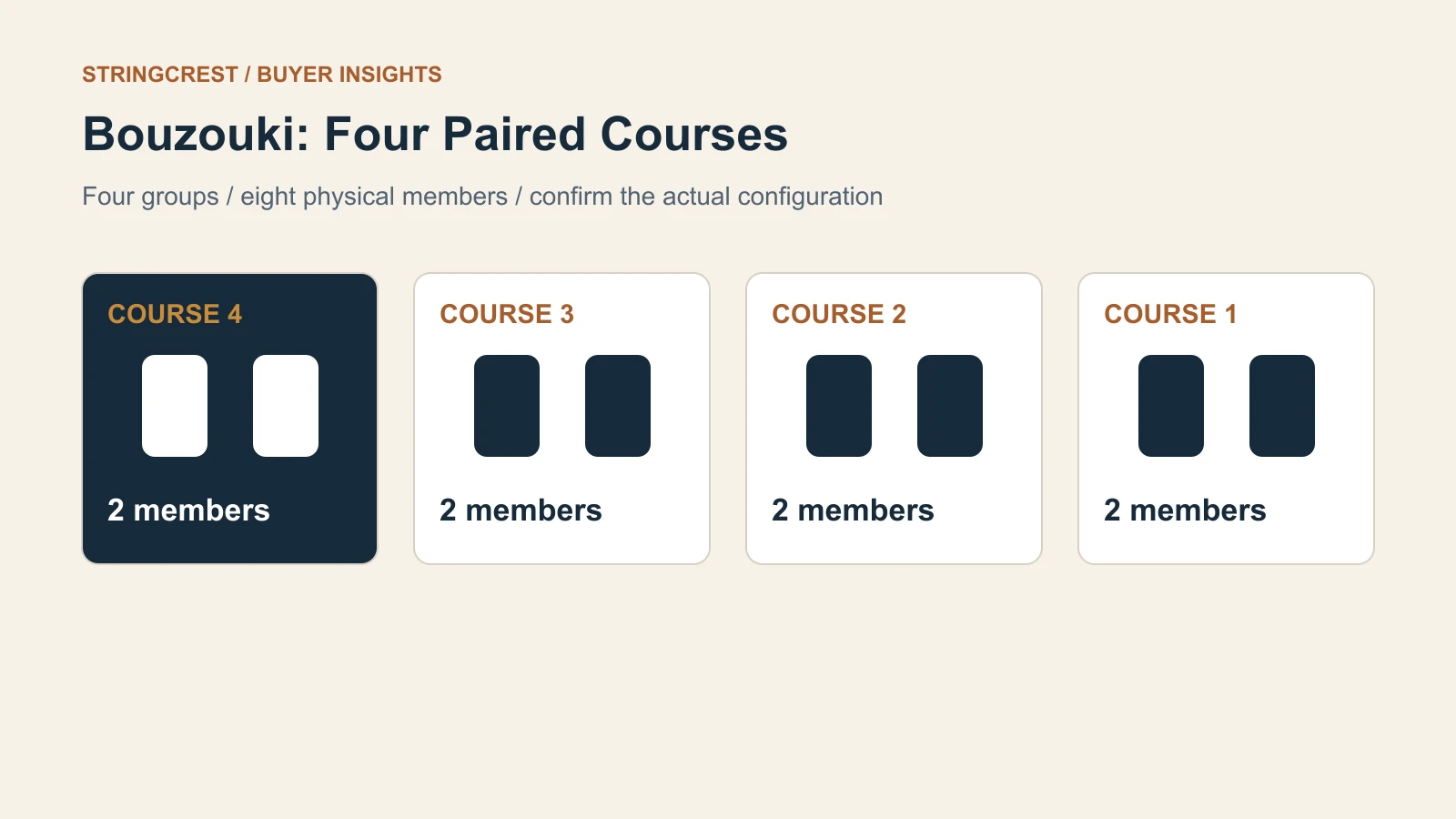
A course is a playing group. In the four double-course examples here, each course contains two physical strings, so the complete set has eight members. Count both: a request for four individual strings would supply only half of this configuration.
A pair can share a note name while sounding at different octaves. C3 and C4 are an octave pair; D4 and D4 are a unison pair. Writing only “C” or “D” loses that distinction. Record the octave number with every member, especially when a replacement single is being ordered from an otherwise complete set.
Count the actual instrument rather than assigning its layout from a regional name. If the customer's instrument has a different number of courses or members, it needs a separate specification. The four-course examples in this article do not establish a set for that instrument. A photograph can help establish the count, but string identity and intended tuning still need documentary support.
The octave-mandolin guide handles a related paired-course application. Its name, tuning and string specification should remain attached to that application; similar outlines and an eight-string count do not identify a bouzouki replacement.
Compare two named eight-string configurations
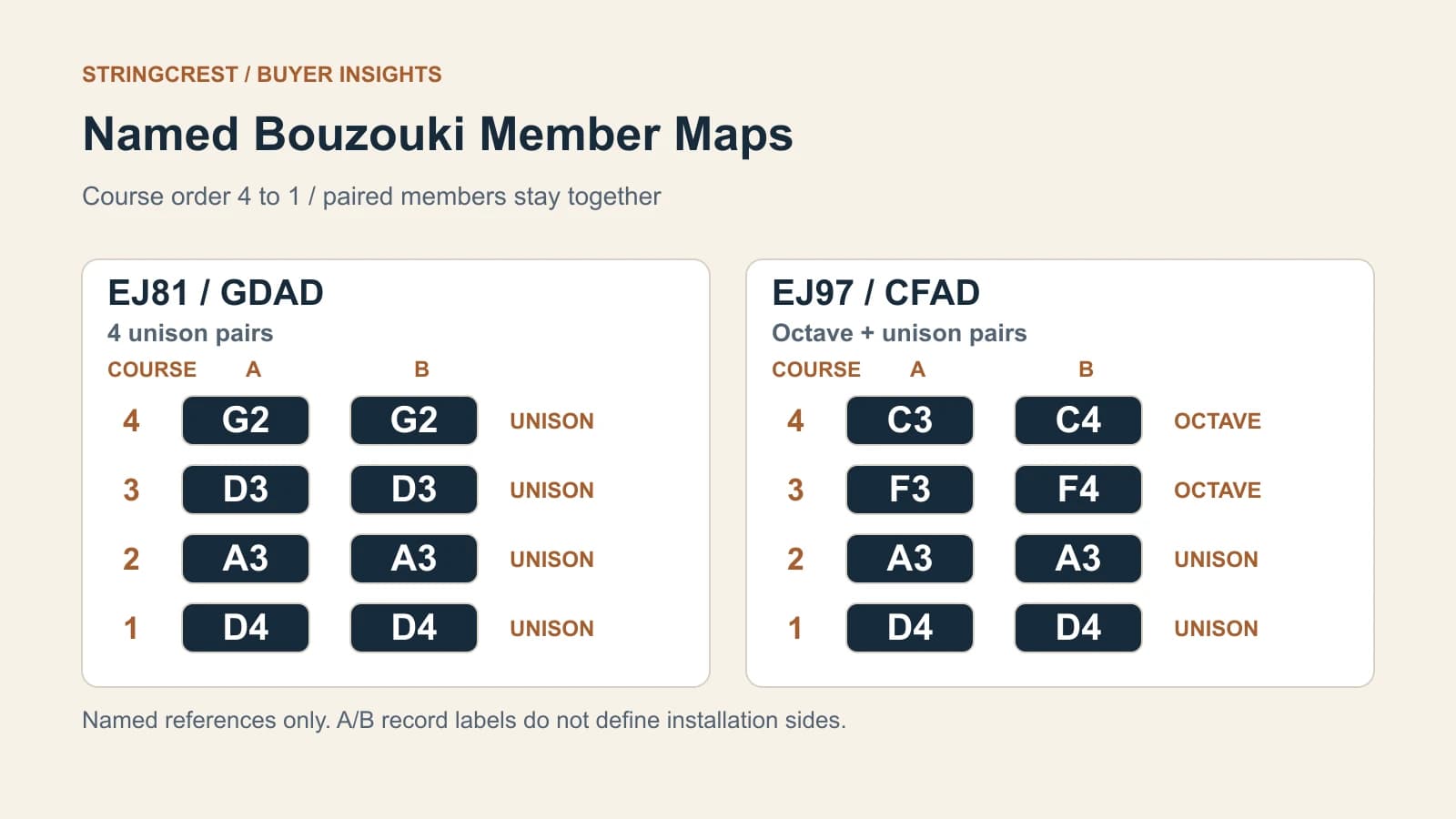
D’Addario lists EJ81 for Irish bouzouki in GDAD and EJ97 for Greek bouzouki in CFAD. Both are eight-string sets, but their published note charts give different member patterns.
The following transcription uses those named charts only. Courses run from 4 to 1, beginning with the course whose lower member has the lowest pitch. Member A and member B are record labels, not a left/right installation instruction. Do not read the entire row sequence as an ascending list of all eight individual pitches.
| Course, lower to upper | EJ81 Irish GDAD: A / B | Pair relationship | EJ97 Greek CFAD: A / B | Pair relationship |
|---|---|---|---|---|
| 4 | G2 / G2 | Unison | C3 / C4 | Octave |
| 3 | D3 / D3 | Unison | F3 / F4 | Octave |
| 2 | A3 / A3 | Unison | A3 / A3 | Unison |
| 1 | D4 / D4 | Unison | D4 / D4 | Unison |
This comparison establishes the pitch identities in those two published examples. It does not transfer their gauges, materials, dimensions, tensions or fit to another set, and it does not prescribe every Irish or Greek player's tuning.
Turn a tuning name into eight entries
A shorthand tuning is useful for identifying the player's intention. The complete record must then resolve its course order and both members. Check it against the actual proposed set and the instrument maker's guidance.
For instance, “GDAD” should not silently become GDAE when a stock system supplies an autocomplete suggestion. Likewise, a CFAD order cannot be completed by duplicating four string entries if its intended lower courses use octave members. Confirm the configuration before the order moves to component selection.
If the customer wants to change tuning, treat that as a new selection question. Obtain an appropriate set recommendation and an instrument assessment before bringing unidentified existing strings to the new pitches. Familiar note letters do not establish a safe or suitable retuning procedure.
Match replacement members, not just course labels
A broken string from an octave course presents a particular ordering risk. A message saying “replace the C string” leaves two candidates in the EJ97 example: C3 and C4. Their shared course does not make them the same component.
Ask for the set reference and the failed member's intended pitch, then preserve the identity of the remaining partner. If the component code is known, include it. If it is unknown, record the uncertainty and request clarification instead of deriving a gauge from the surviving member or from the package's light/heavy endpoints.
Keep construction fields at member level too. One member can be wound while its octave partner is plain in a specifically designed set. The word “bronze” or “nickel” on a family description is not enough to populate every plain string's material field. Distinguish the declared core, wrap and treatment where those details are necessary for the purchasing decision.
For a complete-set replacement, confirm that the proposed eight entries form the intended four pairs. A count of eight can still hide a duplicated member or a missing octave partner. This is an identity comparison; it is not a claim that the supplied strings have passed testing.
Check the instrument path after the pitch identity is clear
A correct pitch map is necessary for selection, but it does not establish physical fit. Record the actual instrument, its scale or speaking-length reference, and its bridge, tailpiece and tuner arrangement. Include any hardware changes that make the instrument differ from its published model description.
The speaking portion and the entire installed path have different endpoints. A string must reach its anchors and tuner using the appropriate sections of its construction. Obtain the supplier's applicable total or usable-length definition and check where its winding transitions lie relative to the actual contacts. Do not add an assumed universal extra length to the scale measurement.
The named examples above are described as loop-end products. That does not establish the required loop dimensions, seating or clearance for every tailpiece. Confirm those details from the actual hardware and approved string specification. The loop-end mandolin fit guide explains interface questions that can be useful vocabulary, but it is not installation approval for a bouzouki.
Follow the instrument and string maker's instructions for installation. Where a proposed set requires nut, bridge or other adjustment, ask an appropriate technician to assess the instrument. Do not alter an attachment or force an unidentified end into place to make a candidate appear compatible.
Use a compact course record for the inquiry
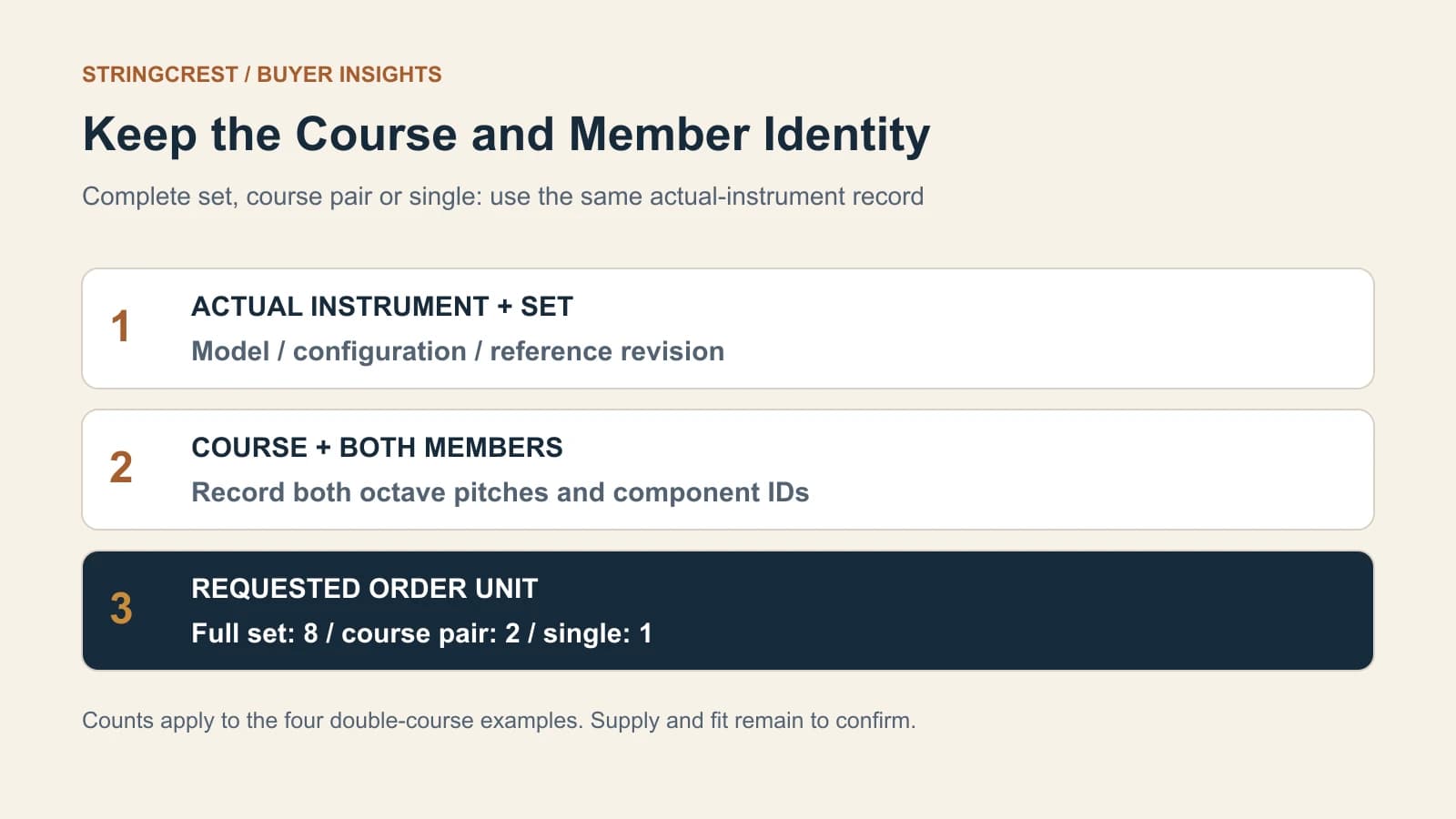
The record below keeps a complete set and replacement singles connected to the same configuration. Use the actual source references; it does not supply a ready-made StringCrest product specification.
| Field | What the buyer should establish |
|---|---|
| Instrument identity | Maker, model, instrument ID and relevant hardware changes |
| Requested unit | Complete set, complete course or individual replacement member |
| Course structure | Actual course count, members per course and written ordering direction |
| Pitch map | Course identifier plus member A and B pitches with octave numbers |
| Component identity | Proposed set/revision and individual component references, where available |
| Construction and fit | Member-specific gauge and unit, plain/wound status, ends and applicable length record |
| Supporting basis | Maker instructions, supplier specification and any unresolved question |
For an individual replacement, add the partner's identity and the course relationship. For a new complete set, resolve every intended member rather than approving the first and last positions and assuming the rest.
This record can also improve the retail description. State the instrument application and confirmed tuning beside the set reference. Keep a GDAD order line distinct from a CFAD one even if both sit under the same “bouzouki strings” heading. Add “eight strings / four double courses” when that is the confirmed pack unit; do not use the shorthand “four strings” for that pack.
Avoid a misleading substitute recommendation
A proposed substitute should answer the same instrument and configuration request. Matching a regional label, diameter endpoint or total string count does not resolve every member. Compare the full proposed component record and fit information, then obtain any required application guidance.
For a retailer, an unresolved replacement is a useful point to pause the recommendation. Tell the customer which information would settle it: a named set, the intended member pitch, the instrument's instructions or a supplier's component identification. A neat coil, a similar-looking loop or a familiar outer wrap cannot supply that missing identity.
The folk and orchestral string category is a starting point for an instrument-specific discussion. The named manufacturer examples in this article explain configuration differences; they do not announce a StringCrest bouzouki SKU, stock position or compatibility promise.
FAQ
Are all eight-string bouzouki sets interchangeable?
No. The GDAD and CFAD examples above already have different member patterns. Confirm the actual instrument, intended tuning, each member's specification and installed fit before selecting a replacement.
Should both members be changed when one breaks?
Follow the applicable maker's guidance and assess the actual set and instrument. First identify the failed member and its surviving partner; a course label alone cannot tell you which replacement is required. This article does not prescribe a universal single-member or whole-course replacement policy.
Conclusion
A useful bouzouki recommendation preserves the instrument identity and every intended course member from the first question through to the order line. Count the strings, write the octaves, identify the components and confirm the installed fit before treating two packets as substitutes.
FROM GUIDE TO PRODUCT
Connect this guide to StringCrest product ranges.
Review the relevant range, then bring the instrument, complete specification and open questions into one project brief.
YOUR PRODUCT · YOUR BRAND
Discuss your next string project with Frank.
Share your instrument category, target market, gauge or material direction and private-label packaging requirements.

ABOUT THE AUTHOR
Frank Zou
Frank works directly with musical-instrument brands, importers and distributors on string specifications, product selection and private-label project requirements.
Meet Frank