
Wholesale Planning
Wholesale Planning
Bajo Quinto vs Bajo Sexto Strings: A Course and Set Guide for Dealers
Distinguish ten-string bajo quinto and twelve-string bajo sexto sets by courses and paired-member pitches before choosing replacements or confirming fit.
Introduction
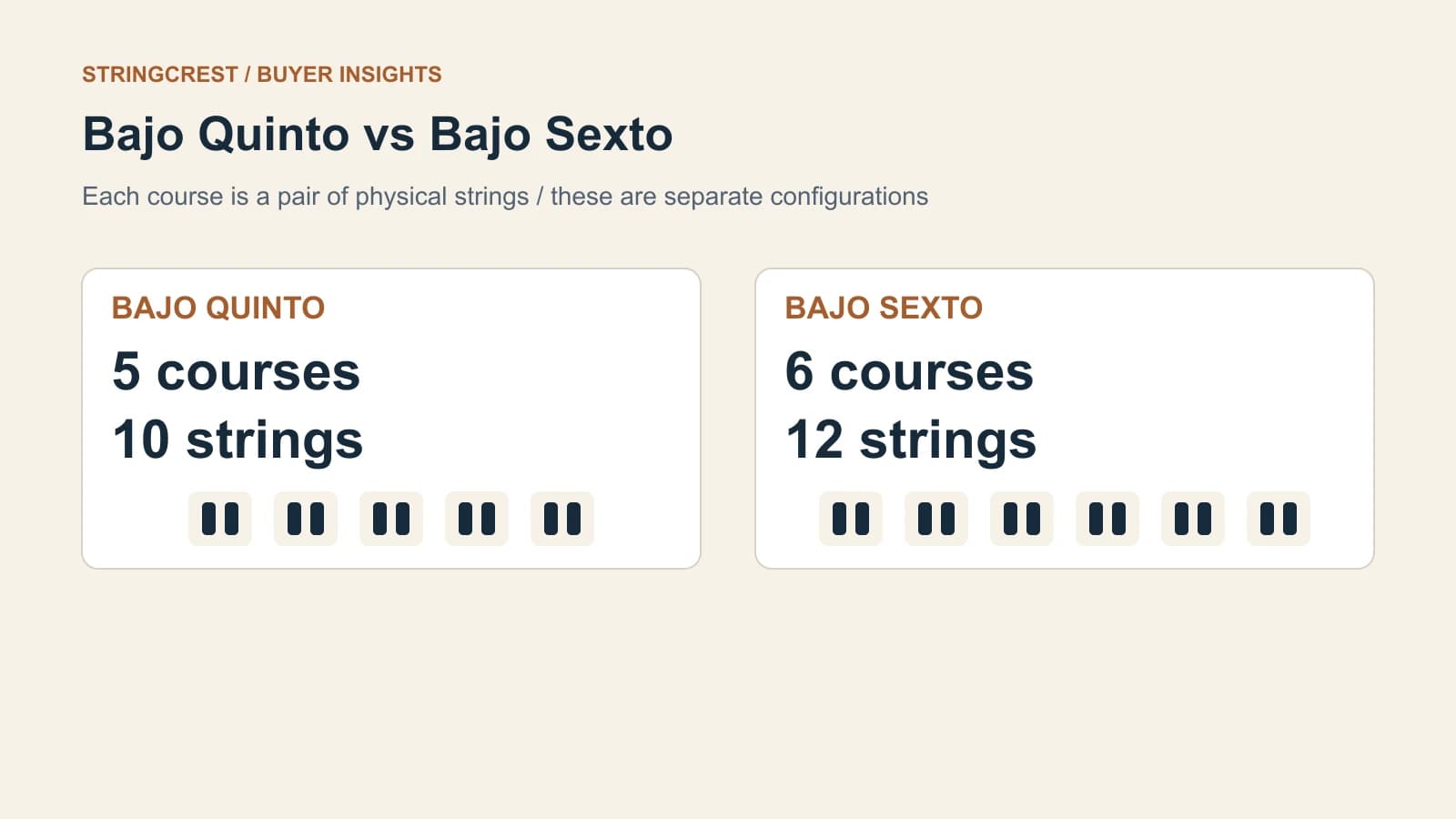
Bajo quinto strings form five paired courses containing ten physical strings; bajo sexto strings form six paired courses containing twelve. A course is the playing group, while each member is an individual string. An order therefore needs both counts, followed by the intended pitches of both members in every pair.
For a music store, importer or distributor, the first question is which instrument and complete configuration the customer needs. “Five,” “six” and “twelve-string” can describe different things. A bajo quinto is not a five-string guitar set, and a bajo sexto request does not call for an ordinary six-string guitar packet. Twelve physical strings also do not make a bajo sexto set interchangeable with a standard twelve-string guitar set.
Count the courses before reading the gauge range
Identify the maker and model, then distinguish the intended course layout from the strings currently installed. A missing member can make a complete six-course instrument appear to contain fewer strings. Ask whether the customer wants a replacement for the established setup or a change of configuration.
S.I.T.'s official bajo quinto and sexto guide distinguishes the five-course A–D–G–C–F layout from the six-course E–A–D–G–C–F layout, reading from low to high course. The letters identify the courses; they do not yet state both members' octaves.
| Instrument configuration | Playing groups | Physical strings in the complete configuration |
|---|---|---|
| Bajo quinto | 5 paired courses | 10 |
| Bajo sexto | 6 paired courses | 12 |
| Ordinary six-string guitar | 6 independent strings | 6 |
| Standard twelve-string guitar | 6 paired courses | 12 |
The last two rows explain a common ordering ambiguity. A count of six groups does not identify a bajo sexto, and a count of twelve strings does not identify their tuning or construction. D’Addario's twelve-string guitar tuning guide describes the guitar's own octave and unison layout. Use the separate twelve-string acoustic specification guide for that instrument's set brief.
An instrument name, photograph and maker reference are more useful than a request for “a heavy twelve-string set.” Keep an uncertain instrument identity open before selecting strings or recommending a tuning.
Read each pair as two pitches
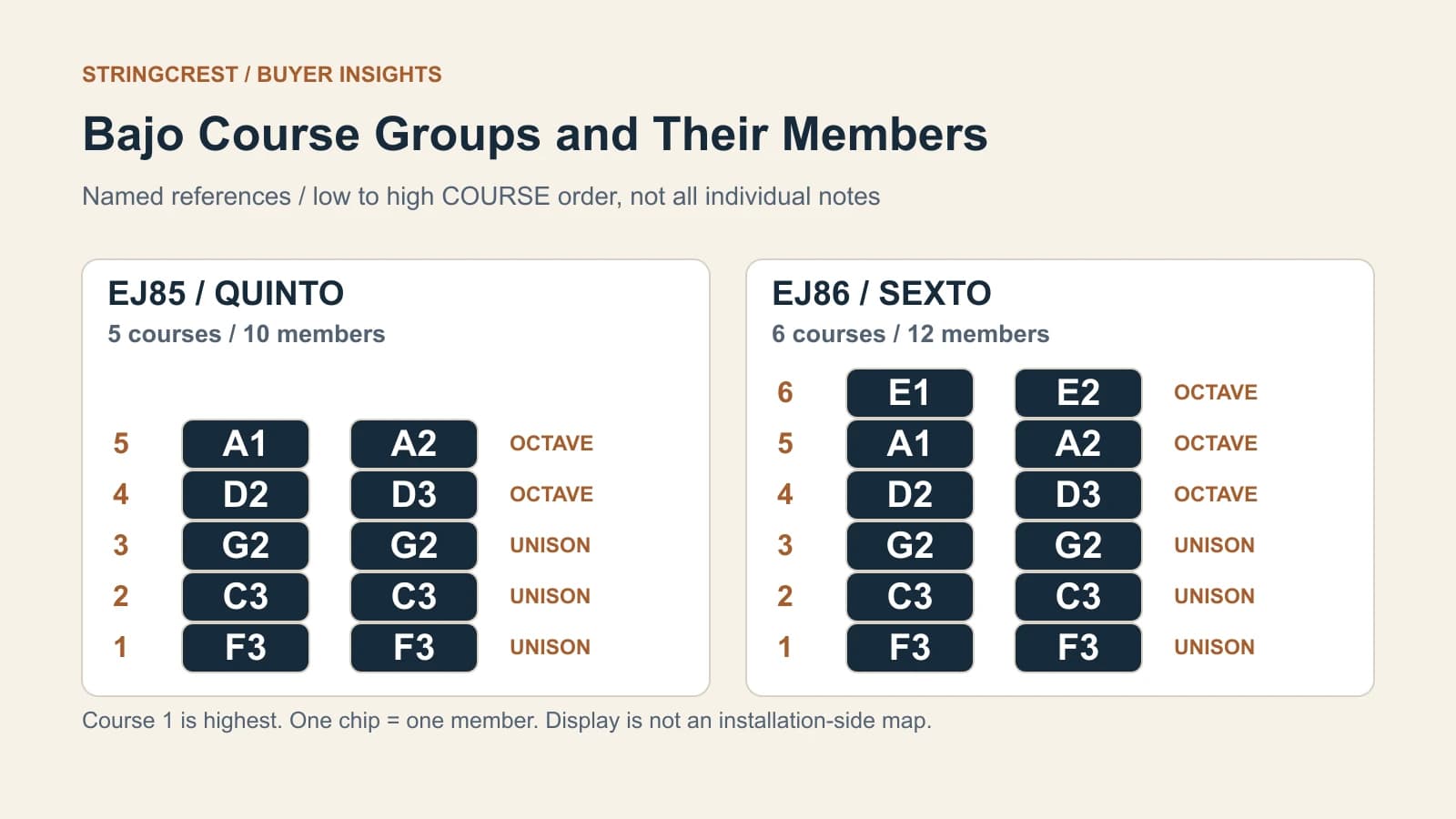
For the reference below, course 1 is the highest course, F; the table runs from the lowest course toward course 1. This is course numbering, not a numbering scheme for ten or twelve individual strings.
D’Addario's official EJ85 bajo quinto chart and EJ86 bajo sexto chart explicitly list the member pitches below. These are named set references, not a universal prescription for every bajo or a StringCrest product specification.
| Course, low to high | EJ85 bajo quinto members | EJ86 bajo sexto members | Relationship in these references |
|---|---|---|---|
| 6 — E | Not present | E1 + E2 | Octave pair |
| 5 — A | A1 + A2 | A1 + A2 | Octave pair |
| 4 — D | D2 + D3 | D2 + D3 | Octave pair |
| 3 — G | G2 + G2 | G2 + G2 | Unison pair |
| 2 — C | C3 + C3 | C3 + C3 | Unison pair |
| 1 — F | F3 + F3 | F3 + F3 | Unison pair |
An octave pair contains different pitches with the same letter name; a unison pair has two strings at the same pitch. In these charts, G is unison. Do not transfer the octave-G arrangement of a standard twelve-string guitar to this G course.
The table orders the courses, not all individual pitches in one ascending sequence. The higher member of a lower course can be above a member of the next course. Preserve the grouping when copying the map into a service record.
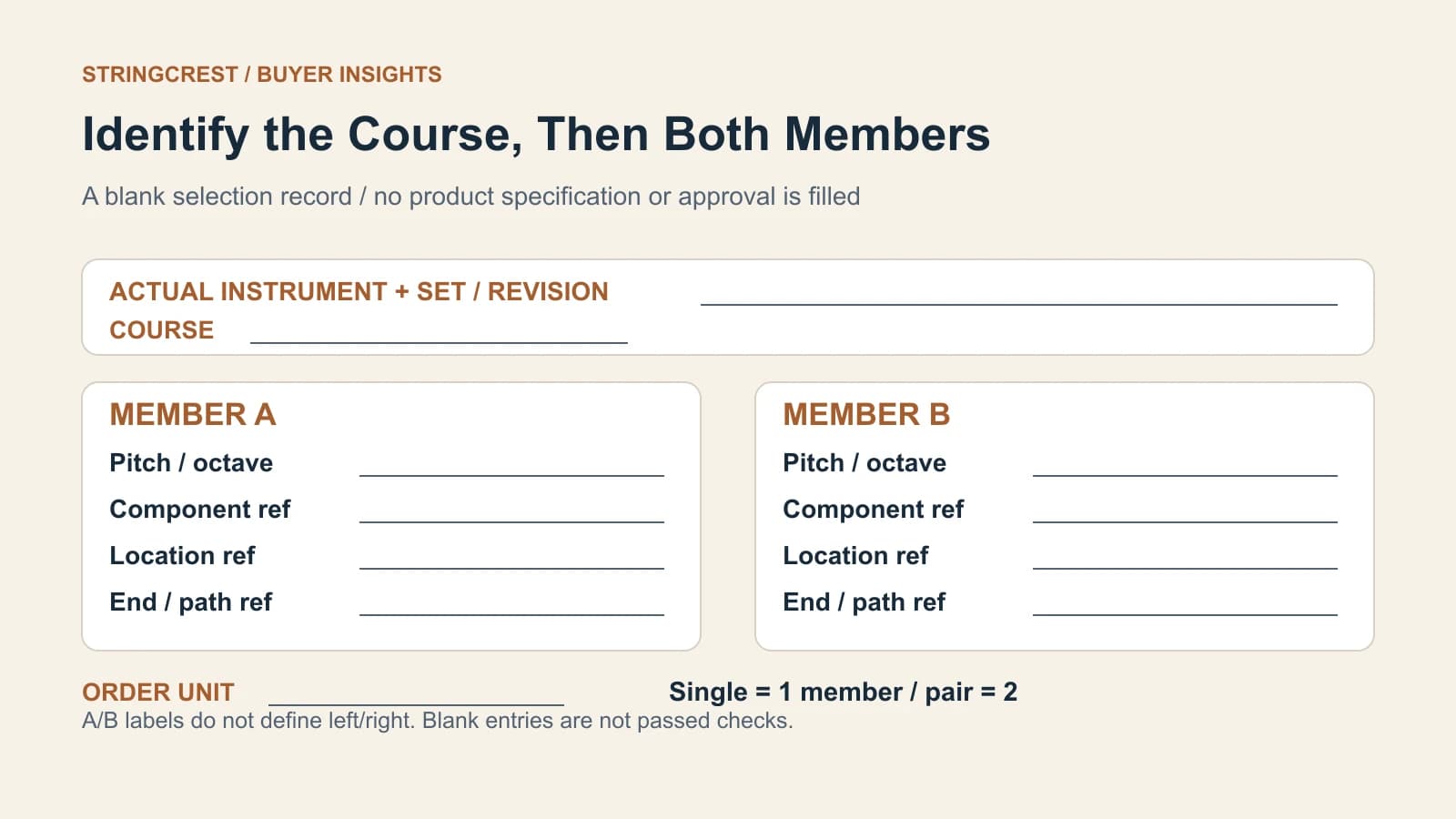
Within a pair, use temporary member labels A and B until the actual instrument diagram establishes their positions. Those labels must not silently mean player-left, treble-side, first envelope or lower pitch. Record both the pitch role and the physical location. A photograph viewed from the opposite direction can reverse an apparent left-to-right order.
Match a replacement to its member identity
A request for “the A string” needs clarification: the whole A course, its lower-pitched member or its octave partner? The order unit is two physical strings for a course pair and one for a single. A complete quinto or sexto set has its own ten- or twelve-member contents record.
Do not select a member by the largest or smallest printed gauge alone. Obtain the exact component reference, intended pitch, finished diameter and unit, plain or wound construction, declared wire/core and wrap materials, treatment, end and length specification. A shared diameter or wrap-family name does not complete that identity.
For a unison course, equal pitch does not by itself confirm identical components. For an octave course, a pair of identical-looking envelopes does not establish the two intended roles. The mandolin specification guide discusses the same distinction between a course and its physical members for a different instrument; its tuning and component choices should remain with that instrument.
Some supplier summaries show one gauge per course. Ask whether that value describes both members or only one. An octave pair needs both specifications, and an endpoint callout cannot supply the missing middle members. Resolve conflicting descriptions against the exact current set reference before treating a proposal as complete.
Keep a writable course-to-member record
Select quinto or sexto before completing this worksheet. Use courses 5–1 for the quinto configuration and 6–1 for sexto. Course 6 is absent from the quinto worksheet; it is not a missing component to be supplied later. Record a different intended tuning explicitly rather than borrowing the named reference map unchanged.
Instrument/model and current setup: ______
Requested configuration and tuning source: ______
Proposed set/reference revision: ______
Member A/B location diagram and viewing direction: ______
| Course | Member A: actual pitch and component/spec ID | Member B: actual pitch and component/spec ID | Pair relation confirmed | Length/end record IDs for A and B |
|---|---|---|---|---|
| 6 — sexto only | ______ | ______ | ______ | ______ |
| 5 | ______ | ______ | ______ | ______ |
| 4 | ______ | ______ | ______ | ______ |
| 3 | ______ | ______ | ______ | ______ |
| 2 | ______ | ______ | ______ | ______ |
| 1 | ______ | ______ | ______ | ______ |
Each component/spec ID should lead to the individual construction, gauge and treatment fields, not just another course name. Keep the source and revision with the record. The pitch table earlier supplies a reference for two identified products; it does not fill the blanks for another proposal.
Use “unknown” for an unresolved specification, “not checked” for a check not performed and “not applicable” only after confirming that a field does not apply. These states do not mean “passed,” and unknown dimensions must not be entered as zero. This is an empty planning tool, not a completed inspection or approved SKU.
Confirm attachment and usable length on the actual instrument
EJ85 and EJ86 are identified as loop-end sets, as are the products in S.I.T.'s bajo collection. That is a description of those offerings. Confirm the actual instrument's end requirement and the proposed string interface instead of treating the word loop as a complete fit specification.
For each member, identify the seated attachment reference, nut and saddle contacts, and route to the relevant tuner. Keep the speaking span between nut and saddle separate from the full installation path. Obtain the proposed overall or usable length, with endpoints defined, plus winding or transition locations where applicable.
A pair can contain members with different construction or diameter, so check both paths. The part that reaches a tuner must be appropriate for that tuner and the applicable installation instructions. Do not invent a common spare-length allowance, wrap count or trimming rule for all bajo strings.
If the proposed end will not seat as instructed, a component cannot be identified, or the change would require hardware or setup work, pause before cutting or tensioning it. Seek the string and instrument makers' guidance and an appropriate technician's assessment. A supplier's gauge chart cannot approve an altered instrument or explain every attachment geometry.
Keep the dealer description specific
A useful order line identifies bajo quinto, five paired courses and ten strings, followed by the confirmed tuning and set reference. For sexto, use six paired courses/twelve strings. Add the relevant pair/member identity when requesting a replacement. These descriptions establish scope; availability and supply format still need supplier confirmation.
For a service inquiry, keep the requested configuration, proposed product and observed problem separate. Suppose a customer asks for a replacement G member and the record says only “twelve-string.” That hypothetical record does not tell the dealer whether the request concerns a bajo's stated unison course or a guitar's different arrangement. Identify the instrument and exact member before recommending another string. This is a teaching example, not a reported shipment or StringCrest customer case.
The folk and orchestral strings category is an entry point for an instrument-specific discussion. It does not confirm a StringCrest bajo set, replacement pair, material recipe or available SKU. Keep the actual proposed specification separate from the educational reference tables.
FAQ
Do ten installed strings prove that the instrument is a bajo quinto?
The intended instrument layout must also be established. Ten strings might represent a complete five-course configuration, but a partly strung six-course instrument also contains ten. Check the maker/model and required course positions before deciding what a complete replacement needs. Do not add a course or change the tuning solely to match a packet's contents count.
Conclusion
Count five or six intended courses, then identify all ten or twelve members. Use the exact proposed set to confirm octave or unison roles, construction and fit. That gives a dealer enough information to distinguish a complete set from a pair or single, while keeping unresolved installation and supply questions visible.
FROM GUIDE TO PRODUCT
Connect this guide to Folk & Orchestral Strings.
Review the relevant range, then bring the instrument, complete specification and open questions into one project brief.
YOUR PRODUCT · YOUR BRAND
Discuss your next string project with Frank.
Share your instrument category, target market, gauge or material direction and private-label packaging requirements.

ABOUT THE AUTHOR
Frank Zou
Frank works directly with musical-instrument brands, importers and distributors on string specifications, product selection and private-label project requirements.
Meet Frank