
Wholesale Planning
Buying Guides
Five-String Violin Strings: Low-C Configuration and Replacement Guide
Record all five positions and the violin-appropriate low C before selecting a single replacement or a complete string configuration.
Introduction
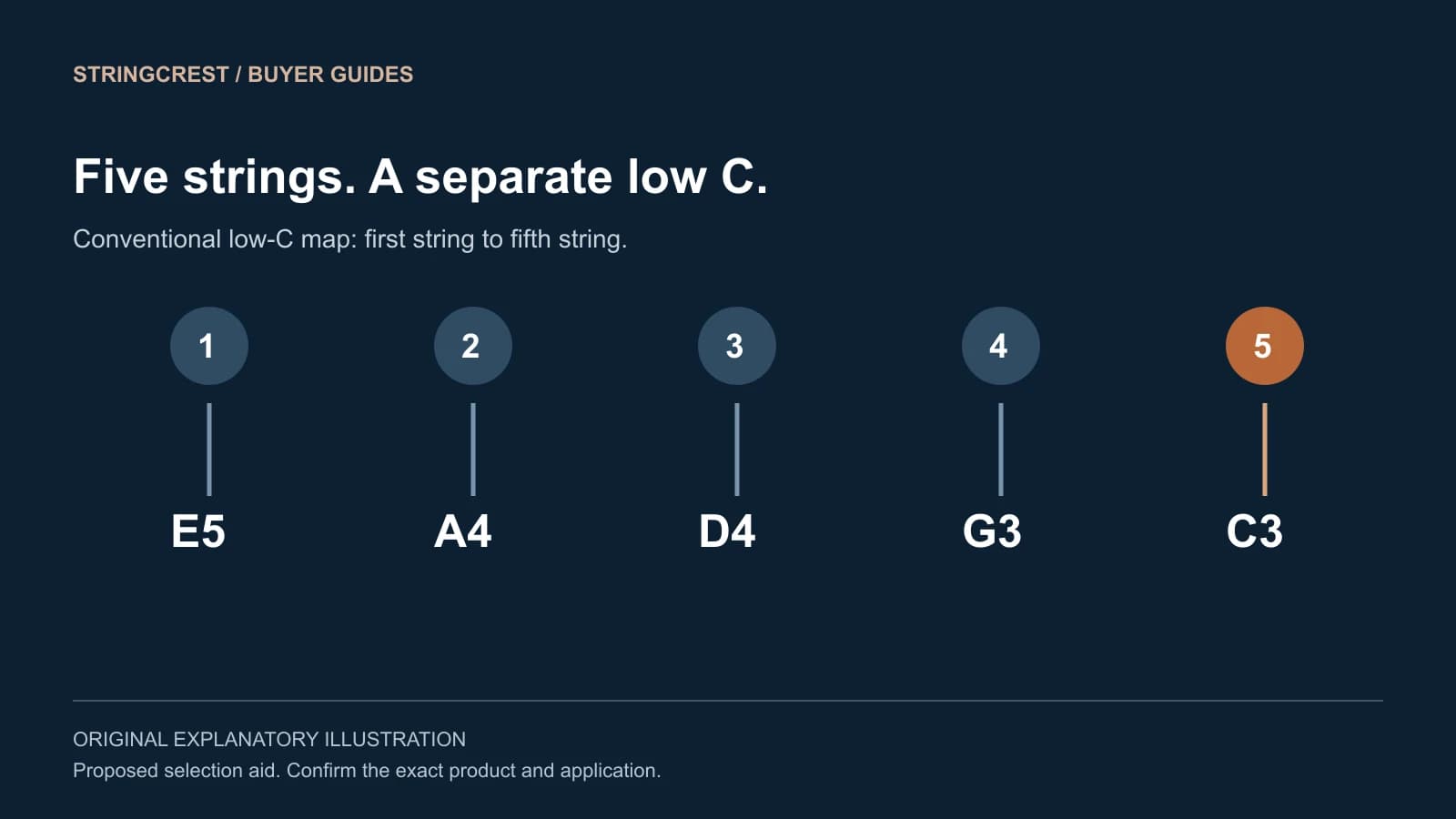
A conventional low-C five-string violin uses C3, G3, D4, A4 and E5 from lowest to highest. Selecting its strings requires a violin-appropriate low C and an identified five-position configuration. A four-string violin packet leaves that extra position unresolved; a viola C should not be treated as interchangeable simply because its note name matches.
For dealers, distinguish a complete five-string replacement from a request for one low C. Record the exact instrument, the existing strings and the maker's application requirements before suggesting a family. This guide addresses low-C five-string violins, not every extended-range bowed instrument or an instrument conversion.
Make string order explicit
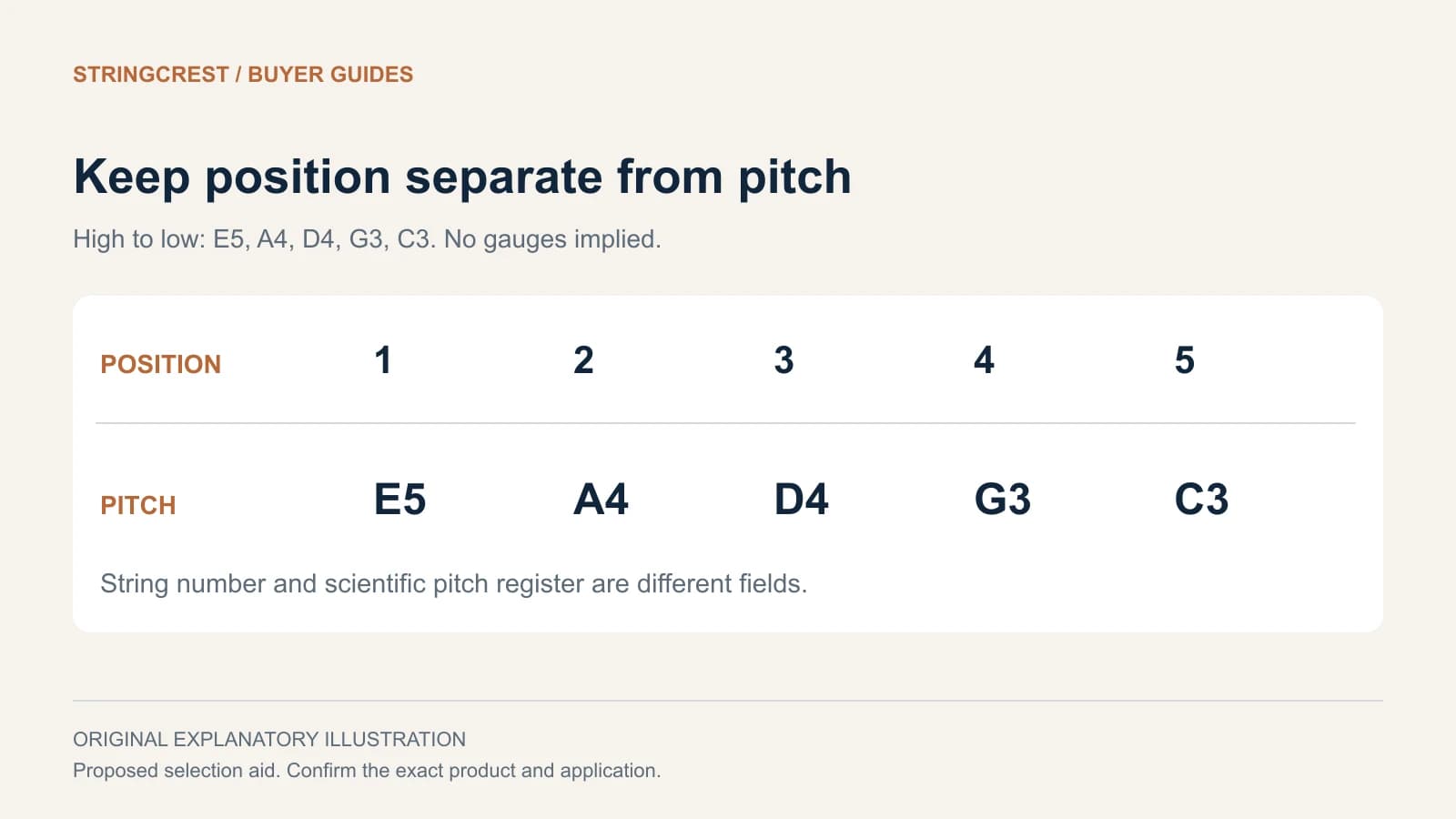
The Yamaha YEV104/YEV105 manual confirms the numbered E–A–D–G–C arrangement. Using scientific pitch notation:
| Physical position | Intended open pitch | Role in this configuration |
|---|---|---|
| 1 | E5 | Highest string |
| 2 | A4 | Violin upper register |
| 3 | D4 | Middle position |
| 4 | G3 | Lowest position of a conventional four-string violin |
| 5 | C3 | Added low position |
Read the table from the numbered highest string down to the lowest. It is a configuration reference, not a gauge schedule or an instruction to retune an unidentified string. If the instrument uses another arrangement, obtain its actual tuning rather than forcing it into this map.
This convention also prevents a receiving error: a label such as “C5” may be intended by a seller to mean fifth-position C, whereas C5 in scientific pitch notation is a different register. Put position and pitch in separate fields. Ask for clarification whenever the notation is ambiguous.
Identify what the customer is replacing
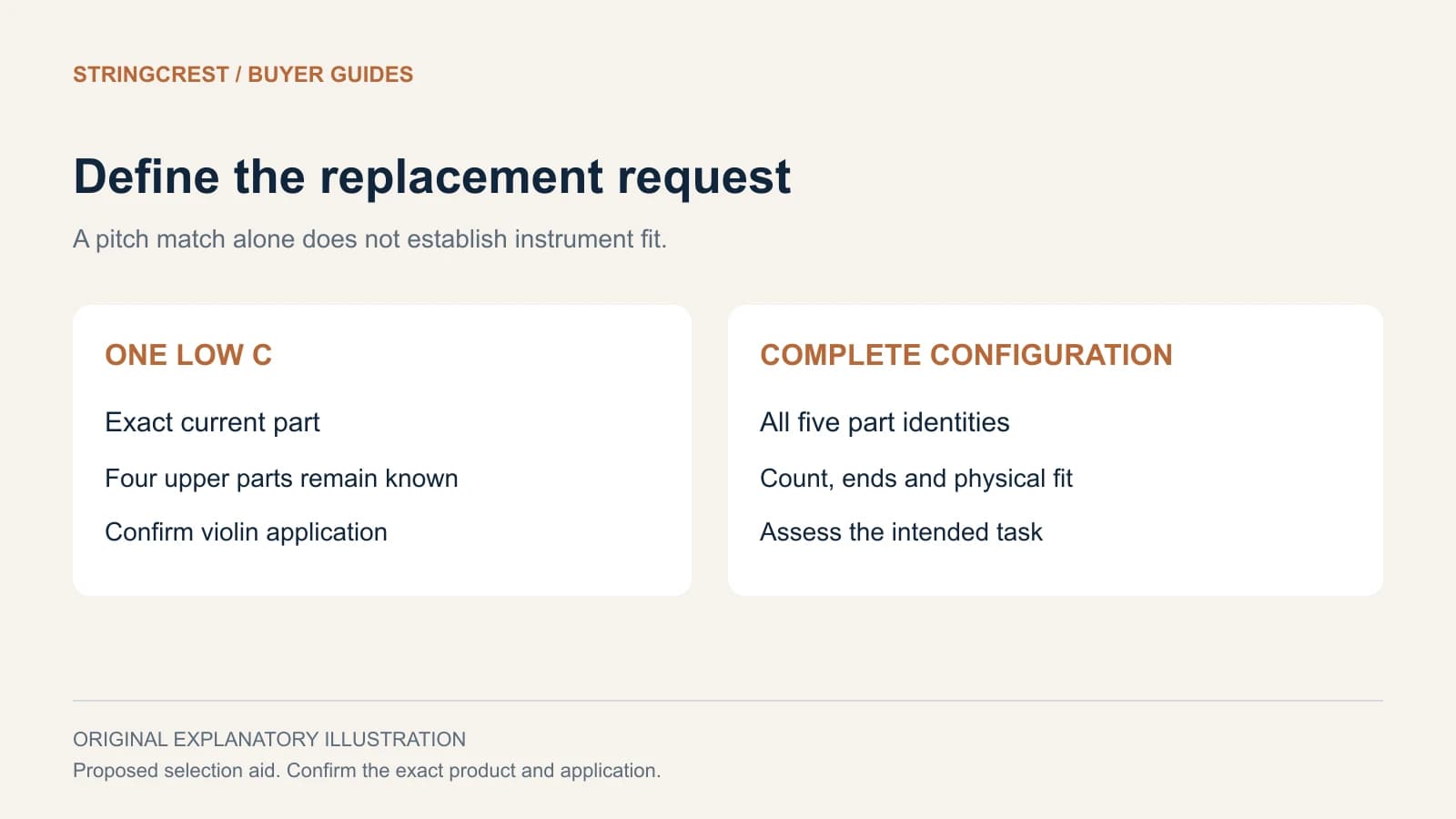
One low C
Ask which four upper strings will remain. Record the exact low-C part being replaced, its size or length designation and the instrument model. If that identity is missing, request the old packet, invoice or an installer record before calling a candidate an exact replacement.
A string specified for a viola's C position does not acquire violin fit through a shared C3 target. Size, speaking length, installed reach and construction still need to match the intended application. Use a maker-designated violin low C or obtain explicit application guidance for an alternative.
A complete set
List all five parts rather than writing “violin set plus C.” Confirm whether the proposed packet actually contains five strings, or whether the low C must be ordered separately. Record the E-string variant and end as well; a correct low C does not resolve an unsuitable E attachment.
A mixed configuration
Treat a mixed family as a defined configuration. Retain the part identity for every position and distinguish an instrument maker's specified combination from an unreviewed dealer substitution. A common brand name alone does not establish that two different families belong together.
Discuss your five-string violin requirement. Send the instrument model, the five-position map and whether the request concerns one C string or a complete configuration.
Use the actual instrument's requirements
The cited Yamaha manual is a useful model-specific example: it specifies ball-end violin strings and warns against using a loop-end E on that hardware. Its string-length specification is 328 mm. These facts describe the manual's YEV models and revision; they are not universal five-string violin dimensions or a current StringCrest product schedule.
Before ordering for another instrument, read its own instructions. Check the permitted string construction, end fittings and usable installation length. An electric instrument's tuning and retaining system can impose application limits that a generic “4/4 violin” label does not address.
Use the violin end-fit guide for the attachment distinction. Do not remove a ball, alter a retaining part or modify a tuner merely to make an unconfirmed candidate fit. Refer an unresolved installation question to the instrument maker or a qualified technician.
Judge the low C within the whole instrument
Once the application has been confirmed, choose a task that represents the player's use. A bowed low passage, a pizzicato part and an amplified performance need different observations. Ask what the current C fails to do before deciding what a candidate should improve.
For an electric violin, retain the actual amplification and settings in the comparison record. A quieter low position in one signal chain is not enough to establish a defective string. Instrument setup, installation, playing and electronics may require separate assessment. Avoid promising that a heavier designation will solve the issue.
For the transition between G3 and C3, listen to the intended phrase rather than judging an isolated open C alone. Record response, balance and any setup changes in the player's own specific terms. Do not invent scores or claim a comparison has been carried out when it remains a plan.
Preserve the fifth position in packaging and support
For a dealer range, the pack contents should make the added position unmistakable. Separate the part number, string position and note register. If one low C is sold individually, its description should identify the intended violin application rather than relying on a generic “C string” category.
Keep the complete set's component list linked to any separately supplied replacements. Check that the retail description, packing list and actual count agree. An ordinary four-string packet with an unclear loose fifth component creates an identification problem even if all five wires are physically present.
The violin wholesale specification guide covers the wider quotation and approval process. Extend its position record explicitly for a five-string enquiry; do not silently reuse a four-row worksheet.
FAQ
Does a five-string violin always add a low C?
This guide covers the conventional low-C arrangement. Other extended-range configurations exist. Confirm the actual instrument and tuning before using the map.
Can a viola C replace the added violin C automatically?
No. A shared pitch does not establish the correct scale, dimensions, construction or fit. Obtain application confirmation for the exact candidate.
Does the Yamaha end-fitting example apply to every five-string violin?
No. It is a requirement for the cited models and manual revision. Read the intended instrument's instructions and retain the exact part identities.
Conclusion
Resolve all five positions, the low-C part and the actual installation requirements before ordering. A reliable replacement record keeps position, pitch and product identity distinct. Browse the folk and orchestral string category for broader project context.
Send your low-C violin configuration for discussion, including the model, current parts and intended playing task. Construction and supply remain subject to the specific project review.
Sources and interpretation limits
Yamaha's YEV104/YEV105 manual, published in September 2021, was checked on 26 October 2026. Its model-specific tuning, end and length instructions are examples, not a universal fitting standard. Scientific pitch notation is used to clarify the conventional low-C map. Illustrations and selection records are original educational aids; no installation or product test is reported.
FROM GUIDE TO PRODUCT
Connect this guide to Folk & Orchestral Strings.
Review the relevant range, then bring the instrument, complete specification and open questions into one project brief.
YOUR PRODUCT · YOUR BRAND
Discuss your next string project with Frank.
Share your instrument category, target market, gauge or material direction and private-label packaging requirements.

ABOUT THE AUTHOR
Frank Zou
Frank works directly with musical-instrument brands, importers and distributors on string specifications, product selection and private-label project requirements.
Meet Frank