
Buying Guides
Buying Guides
Electric Mandolin Strings: Pickup, String Count and Set Selection
An electric mandolin enquiry needs its exact string count, pickup system and attachment; four singles and four pairs are different complete sets.
Introduction
Electric mandolin strings should be selected by the actual string arrangement, pickup system and attachment. An electric mandolin may use single strings or paired courses; an acoustic mandolin with a pickup is another application. “Electric” by itself does not establish a material, string count or end type.
For a dealer or importer, the first useful question is which instrument needs the replacement. Obtain the model and an overall photograph before choosing a packet. A four-string set, a five-string set and an eight-string paired set cannot share one unqualified “complete mandolin set” description.
Count physical strings and courses separately
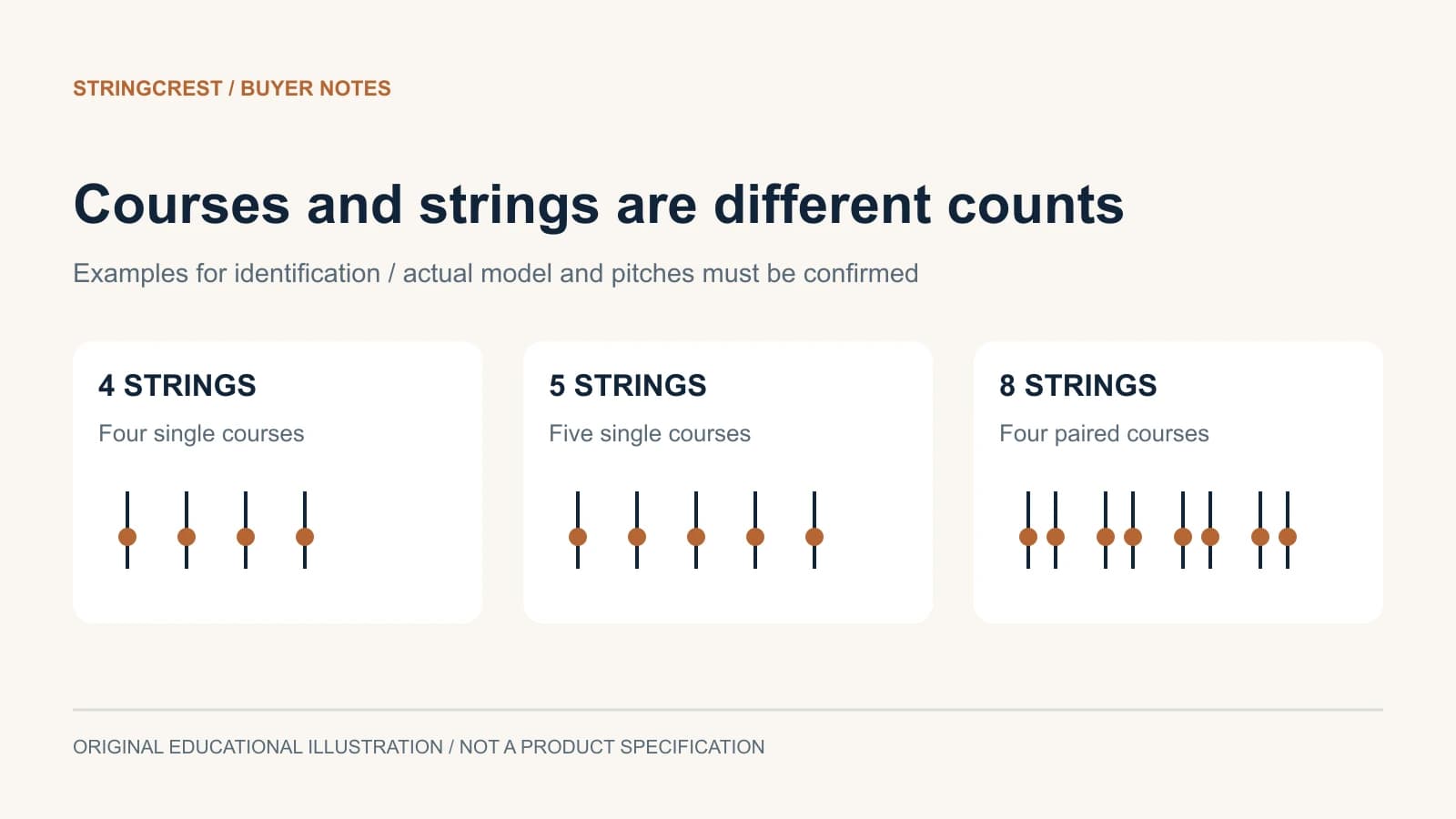
A course is a playing position that may contain one string or a pair. The common acoustic eight-string mandolin has four paired courses. Electric instruments also include single-string configurations, so counting four courses does not necessarily establish eight physical strings.
Gold Tone's EMS4 page lists four gauges: .011, .016, .026w and .040w. Its EMS5 page adds a fifth, .052w. Both describe nickel-plated steel and ball ends. These are named examples showing why the exact set identity matters; they do not define all electric mandolins or supply an approved StringCrest gauge matrix.
The “w” in those listed sequences identifies wound positions. Keep it attached to the gauge when transferring a reference. A number without the construction flag can leave a buyer comparing different strings without realizing it.
| Observed arrangement | Physical-string count | What the order must preserve |
|---|---|---|
| Four single-string courses | Four | One identified part for each position |
| Five single-string courses | Five | All five positions and their actual pitches |
| Four paired courses | Eight | Two identified strings per course and pair relationship |
For an eight-string order, retain both members of every pair instead of reducing it to four unspecified parts. This is an identification aid. It does not establish tuning or tell a player to install a different arrangement. Write the actual open pitches with octave numbers from the maker's documentation. Do not infer an added fifth string's pitch from a packet photograph.
Identify how the instrument produces its amplified signal
A magnetic pickup needs a magnetically responsive part of the string. Fishman's acoustic pickup FAQ explains this requirement for its magnetic soundhole pickups in terms of a ferrous or steel core. That principle helps identify the material question; its guitar product instructions are not mandolin installation instructions.
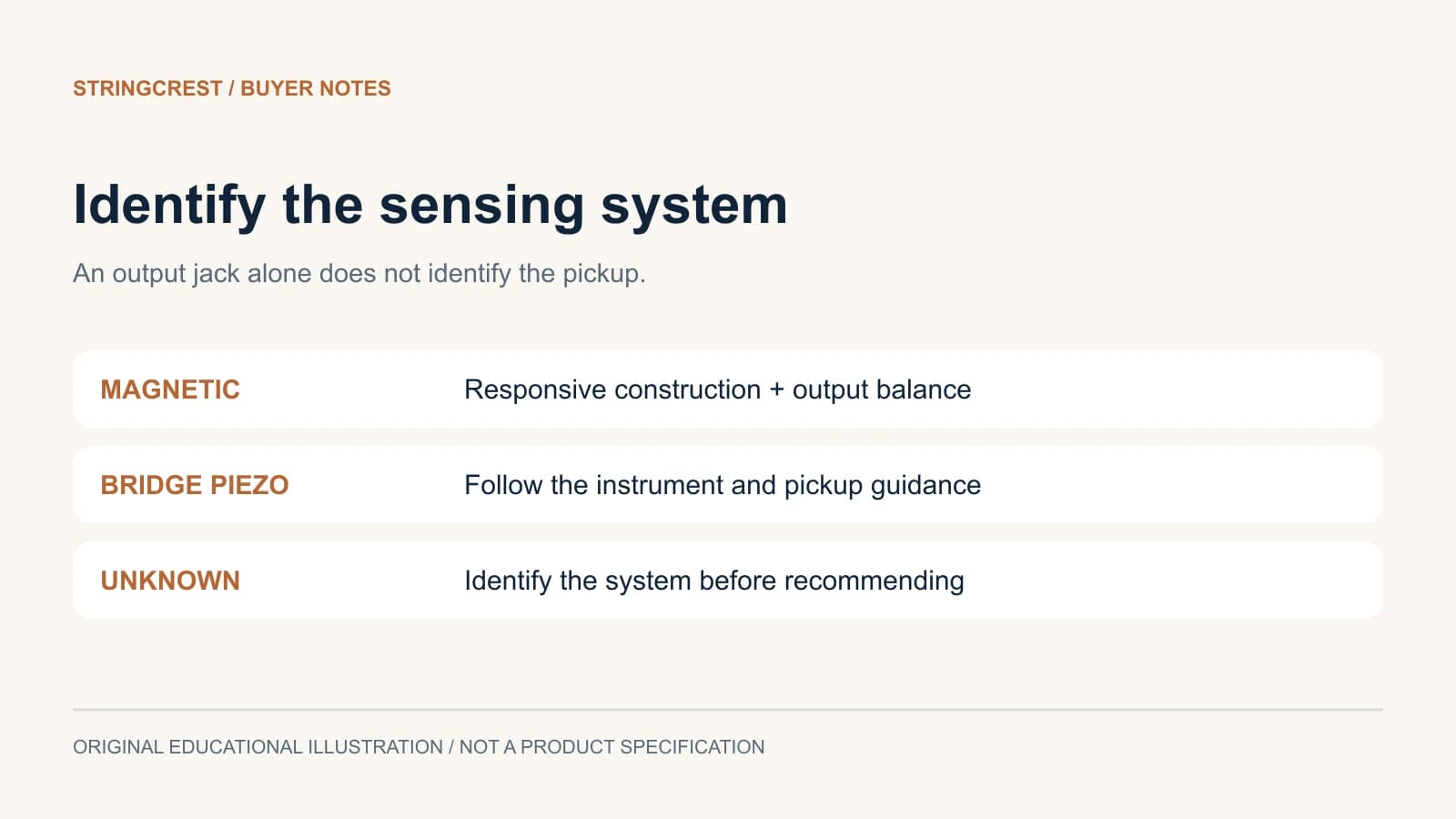
A bridge pickup can use a different sensing system. For example, Fishman's M-300 mandolin pickup uses a piezo-ceramic element embedded in the bridge. An output jack therefore does not prove that an instrument has a magnetic pickup or requires the same string choice as a solid-body electric model.
Obtain the pickup's actual identity. If there are separate magnetic and bridge outputs, record which route the customer uses and whether the complaint occurs in one or both. A material recommendation made without that distinction may answer the wrong question.
Do not reduce this to “bronze cannot work.” A bronze-wound string can still have a steel core. The complete construction and the particular pickup's design affect the relevant assessment. Nor does a steel core by itself prove balanced output across every position. Treat acceptable balance as something to check on the intended instrument.
Separate material suitability from the reported symptom
Ask the customer to identify the affected position and listening condition. Is the concern weak amplified level, a large jump between positions, finger noise or an acoustic preference? A full set may physically fit while failing the player's desired amplified response.
If the reference is known and approved for the instrument, compare a properly fitting candidate under the same signal chain and playing conditions. Record changes in amplifier settings or pickup adjustments rather than silently compensating until each candidate seems similar.
Do not promise that nickel-plated steel will cure every imbalance. A problematic pickup, electrical setting or installation needs its own diagnosis. A dealer can document the symptom and refer the instrument for evaluation without turning a string sale into an unsupported repair claim.
Discuss an electric mandolin string requirement. Send the model, physical-string count, pickup identity, current set and the position where the concern occurs.
Confirm attachment and length on the actual instrument
Do not carry the loop-end assumption from a conventional acoustic mandolin into every electric model. The cited four- and five-string examples have ball ends. Other instruments can require a different attachment, so verify the retaining hardware and the candidate's exact end before installation.
Likewise, ball and loop ends are not interchangeable because both can be photographed next to a tailpiece. Avoid removing an end or reshaping a loop to force an uncertain fit. Obtain model-specific instructions when the attachment is unclear.
Record effective scale between nut and saddle separately from the full anchor-to-post path. Confirm where winding transitions fall and whether the required section fits the post. A candidate's package count and material do not establish those dimensions.
For eight-string loop-end applications, the mandolin tailpiece-fit guide covers the relevant attachment questions. Keep that guide within its stated application; it is not an instruction to convert a single-course electric mandolin to paired courses.
Prepare a replacement or dealer-range decision
Use the proposed record below to connect the physical instrument with the complaint. It is a working aid, not a completed factory test or an assurance of interchangeability.
| Field | Record | Why it changes the decision |
|---|---|---|
| Instrument | Exact model and relevant revision | Similar appearance can hide a different configuration |
| Arrangement | Every course, its members and actual pitch | A complete set must contain the right parts |
| Signal route | Pickup identity and output in use | Magnetic response and bridge sensing ask different questions |
| Current reference | Full gauges, plain/wound flags and ends | Material alone does not identify the replacement |
| Fit | Anchor, scale, route and transition | A correct count can still install incorrectly |
| Complaint | Position, passage and listening setup | The candidate needs a defined task to address |
For a paired set, compare both members of each course in the intended playing task. For a single-course instrument, do not invent a paired-string requirement. This is also an order-unit issue: a single, a pair and a complete set need distinct quantities and identities.
The eight-string mandolin specification guide provides the paired-course reference. This article addresses the additional configuration and amplification questions raised by an electric enquiry. The folk and orchestral category is the related starting point for a broader instrument-string discussion, not proof that every specialist configuration is a stocked product.
FAQ
Can I use an electric guitar set as an electric mandolin set?
Do not assume so. Suitable magnetic response would answer only one question. Count, pitches, gauges, ends and the full usable route still need to match the mandolin. Use a documented application-specific set or obtain a confirmed custom specification.
Does plugging in an acoustic mandolin mean it needs different strings?
No automatic change follows from the output jack alone. Identify the pickup system, the instrument maker's guidance and the actual complaint. A bridge-piezo application may retain its acoustic string requirement, while a magnetic application needs a suitable responsive construction and balance assessment.
Conclusion
Count the strings, identify the pickup and verify the attachment before selecting an electric mandolin candidate. Keep the actual model and full set identity connected to any response assessment. This provides a repeatable replacement decision without treating every electric instrument as the same product.
Send your electric mandolin application brief with model photographs, the full configuration and pickup details. StringCrest can review the requirement; a specialist construction, dimensions and supply terms require confirmation.
FROM GUIDE TO PRODUCT
Connect this guide to Electric Guitar Strings.
Review the relevant range, then bring the instrument, complete specification and open questions into one project brief.
YOUR PRODUCT · YOUR BRAND
Discuss your next string project with Frank.
Share your instrument category, target market, gauge or material direction and private-label packaging requirements.

ABOUT THE AUTHOR
Frank Zou
Frank works directly with musical-instrument brands, importers and distributors on string specifications, product selection and private-label project requirements.
Meet Frank