
Specifications & Fit
Buying Guides
Flatwound Mandolin Strings: Construction and Selection Guide
A smooth exterior does not identify wrap shape. Compare actual construction, paired positions and the playing task before choosing a mandolin set.
Introduction
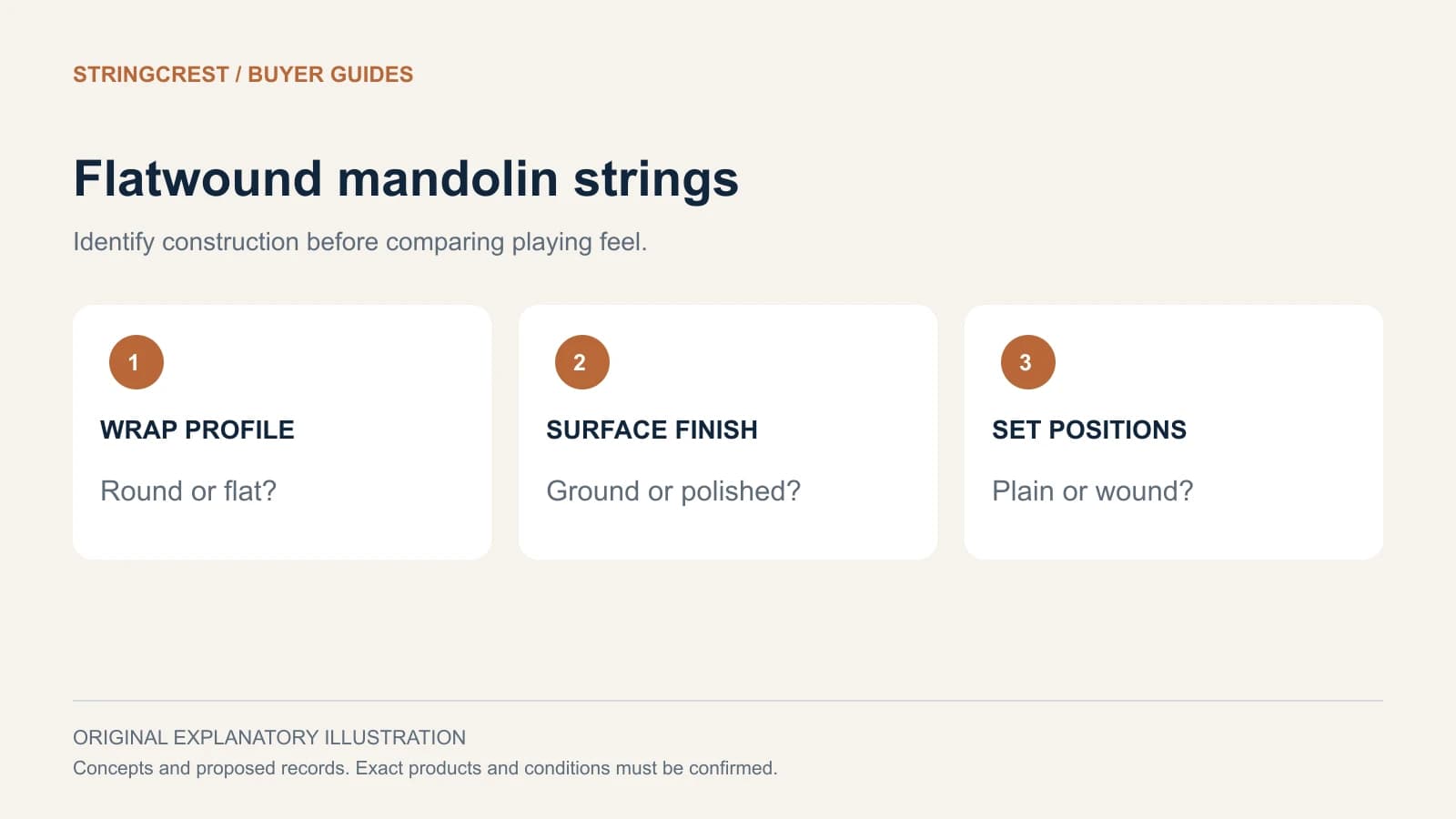
Flatwound mandolin strings and strings with a ground, semi-flat surface should not be treated as the same construction. A smooth exterior can result from different wrap profiles and finishing processes. Before selecting a replacement or specifying a dealer range, identify what the maker means by the surface description and which positions are wound.
That distinction matters when a customer asks for quieter finger movement or a smoother feel. A word such as “flat” does not establish the complete set, the gauge sequence, tension or compatibility with the mandolin. Start with the intended change, then compare identifiable products on the actual instrument.
Distinguish wrap shape from the finished surface
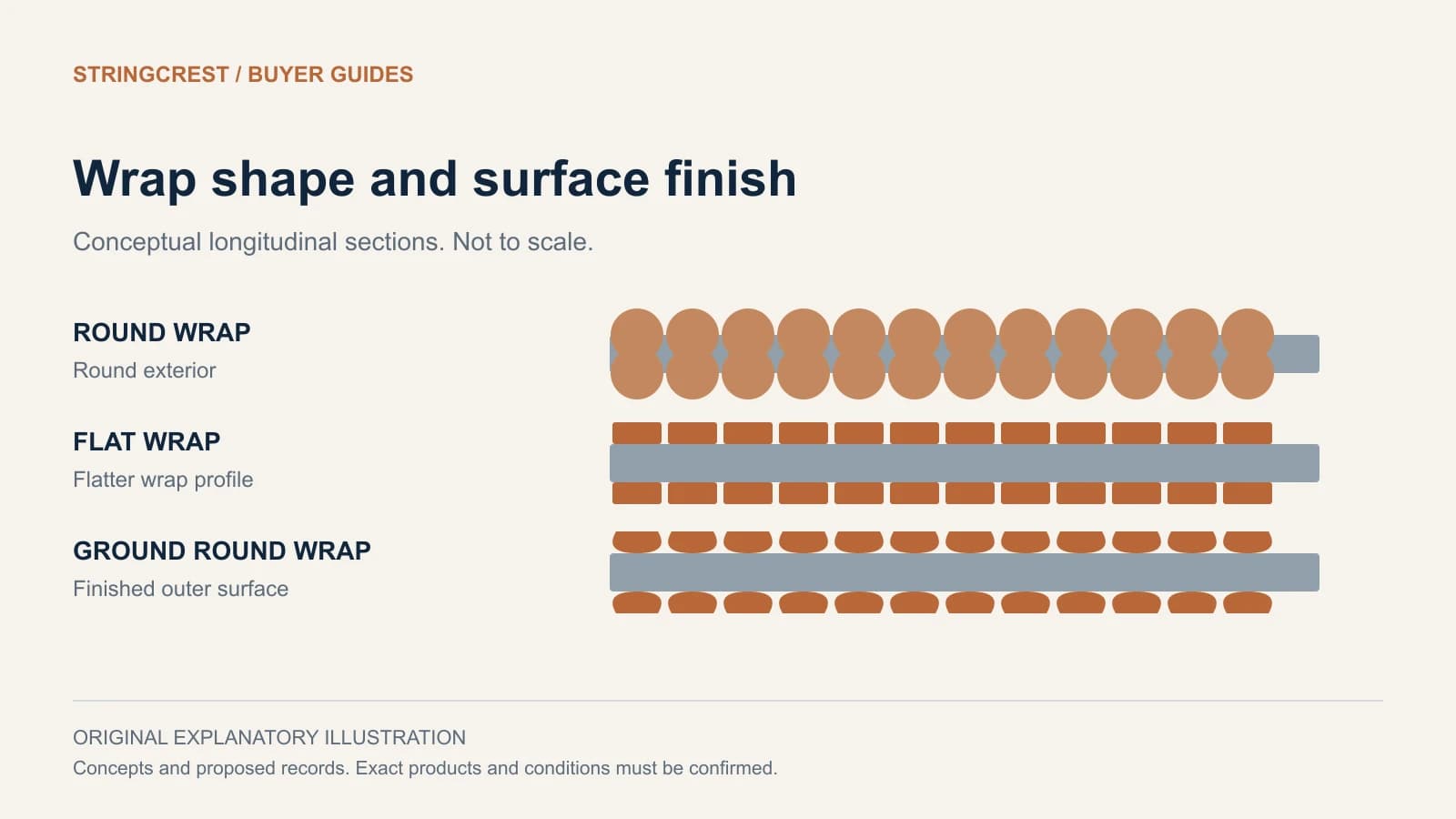
A conventional roundwound construction uses round wrap wire around a core. A flatwound construction uses a flatter wrap profile. A ground or polished roundwound construction changes the outside of an already wound string. The finished surfaces may all be described casually as smooth, but the descriptions refer to different constructions.
The Thomastik-Infeld mandolin page explicitly describes flatwound, highly polished chrome-steel winding, with a plain E made from tin-plated steel. This illustrates an important exception: a set described as flatwound can still contain plain strings.
For comparison, D'Addario's Flat Tops acoustic guitar page describes phosphor-bronze wrap over a steel core, followed by grinding and polishing to a semi-flat surface. That is an acoustic-guitar example explaining the process term. It does not supply a current mandolin specification, prove that an older mandolin listing is available, or make the two instrument sets interchangeable.
When a listing uses “Flat Tops,” “flatwound” and “polished” loosely, request the current maker description and per-position construction. Do not repair an ambiguous catalogue entry by guessing from a photograph.
Check which strings are actually wound
A standard eight-string mandolin has four pairs. A construction label for the set should therefore be connected to a position-by-position map, rather than expanded into “eight flatwound strings” without evidence.
Thomastik-Infeld's published example separates the plain E position from the wound A, D and G positions. Preserve that distinction when discussing the named family. Do not transfer it automatically to another maker's design or a mandola or octave-mandolin set.
Use the eight-string mandolin specification guide for the full course map. For this comparison, the minimum useful record is shorter:
| Record | What it must establish | What a smooth photograph cannot establish |
|---|---|---|
| Exact set and revision | The product being ordered or compared | Current availability or an unchanged design |
| Each paired position | Gauge, plain or wound identity, declared material | The complete sequence from the packet's endpoint gauges |
| Wound-string surface | Flat wrap, ground round wrap or another declared construction | Original wrap shape from apparent smoothness alone |
| Ends and usable length | Fit to the intended tailpiece and installation path | Compatibility from the word “mandolin” |
Enter the actual maker's terminology alongside a plain-language explanation. If the construction is not stated, mark it unknown and ask. “Polished” describes a finish; it does not by itself resolve the wrap shape beneath it.
Decide what the customer wants to change
Separate a surface complaint from a tonal preference. A player may want less audible movement between notes, reduced surface texture under the hand, or a different attack. Those are different evaluation tasks, even when the same candidate set is considered.
Ask the player to identify the problem using their normal repertoire. For a recorded passage, the relevant question may be whether movement noise is distracting in the intended microphone setup. For a live acoustic part, the player may care more about attack and balance across the paired courses. Do not assume that a smoother surface automatically meets both aims.
Record the current set, instrument and setup before changing anything. If the candidate also changes gauges or wrap material, call the result a complete-set comparison. It cannot isolate the effect of surface finishing alone. Dealer descriptions should reflect the comparison actually made.
Discuss a defined mandolin-string construction or range requirement. Send the current set, intended application and whether your priority is surface feel, movement noise or response.
Keep fit checks separate from surface preference
A customer can prefer a candidate's feel and still need a fit review. Confirm the end construction, usable installation length and the maker's instrument application. A smooth winding does not establish any of these.
For a loop-end application, use the mandolin tailpiece-fit guide. It covers seating and paired identity without turning a surface comparison into a full purchasing manual. Do not substitute ball-end guitar imagery for a loop-end mandolin reference.
Similarly, “light” and “medium” belong to the relevant product family. Do not assume two sets with the same label have identical gauges or load. If published tension is being compared, preserve the manufacturer's stated vibrating length, tuning and units. Where comparable information is missing, leave the conclusion open rather than estimating a load from feel.
Run a small comparison that answers the original question
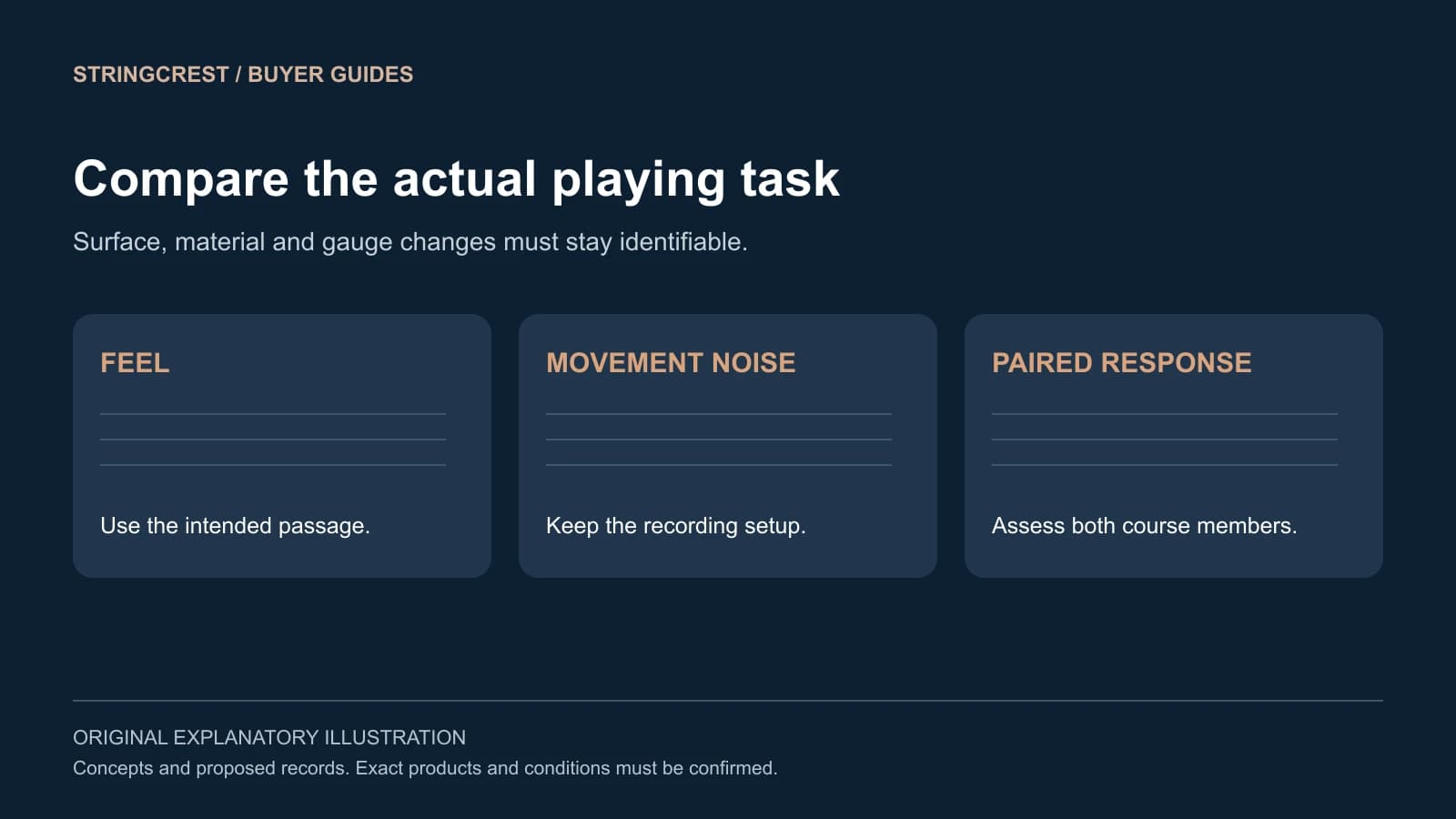
Choose a short passage for the specific task and retain the instrument and recording settings where practical. Note the set identity and installation date. If setup adjustments are necessary, record them because they affect the comparison.
Describe findings before choosing promotional language. “The player preferred movement feel in this passage” is a bounded observation. “Flatwounds eliminate finger noise” would overstate it, and a quieter recording would not prove that the string produces no mechanical noise.
Check the pairs as well as the overall sound. Ask whether both members of each course respond acceptably for the intended playing. Do not resolve an imbalance merely by assuming that the advertised construction guarantees uniform response.
For a shop with limited time, one clearly defined question is enough for an initial assessment. More samples are justified if the commercial decision requires them. An unperformed comparison should remain a plan, without scores, success percentages or customer endorsements.
FAQ
Are all strings in a flatwound mandolin set wound?
Not necessarily. The named Thomastik-Infeld example includes a plain E position. Check the complete set description instead of applying the family label to every wire.
Can Flat Tops be substituted automatically for a flatwound request?
No. Clarify whether the customer wants a particular construction or a particular playing result. A ground semi-flat surface is not sufficient proof of flat-wrap construction or equivalent behavior.
Does a smooth surface prove that the tension is lower?
No. Surface appearance does not establish tension. Compare applicable manufacturer information under matching conditions and review the instrument before treating a construction change as a direct replacement.
Conclusion
Resolve the construction term before ordering: identify the wrap profile, any finishing process and the plain or wound identity of each position. Then evaluate the actual playing question and verify physical fit. The folk and orchestral string category provides broader project context.
Send your mandolin string requirements, including the current set, instrument, intended surface construction and the application you want to assess. Construction and availability can then be confirmed for the project.
Sources and interpretation limits
The official Thomastik-Infeld mandolin page and D'Addario Flat Tops acoustic-guitar page were checked on 25 October 2026. The second example explains a process, not a mandolin SKU. Original illustrations are conceptual. The comparison tasks are proposed methods, without reported test results or a new StringCrest product specification.
FROM GUIDE TO PRODUCT
Connect this guide to Folk & Orchestral Strings.
Review the relevant range, then bring the instrument, complete specification and open questions into one project brief.
YOUR PRODUCT · YOUR BRAND
Discuss your next string project with Frank.
Share your instrument category, target market, gauge or material direction and private-label packaging requirements.

ABOUT THE AUTHOR
Frank Zou
Frank works directly with musical-instrument brands, importers and distributors on string specifications, product selection and private-label project requirements.
Meet Frank